Overview · §00
The thread at a glance
The aim of the conversation, the contents of all its parts, and the key exchanges in order, each with where it landed.
Read
80 KB
Hybrid thalamic circuits what does the surrogate know?
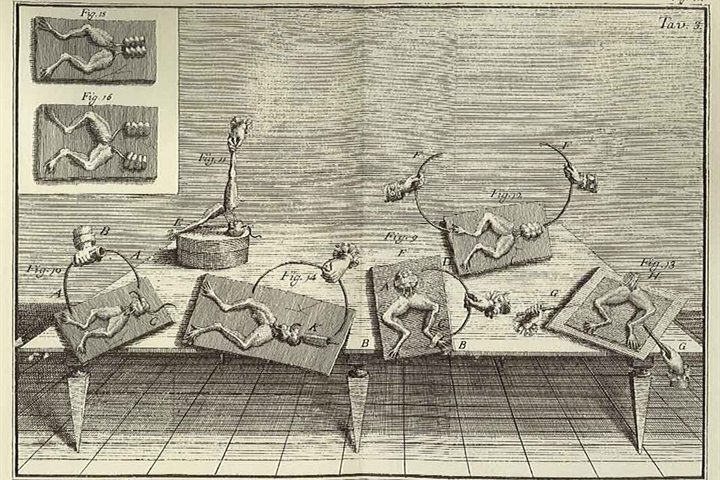
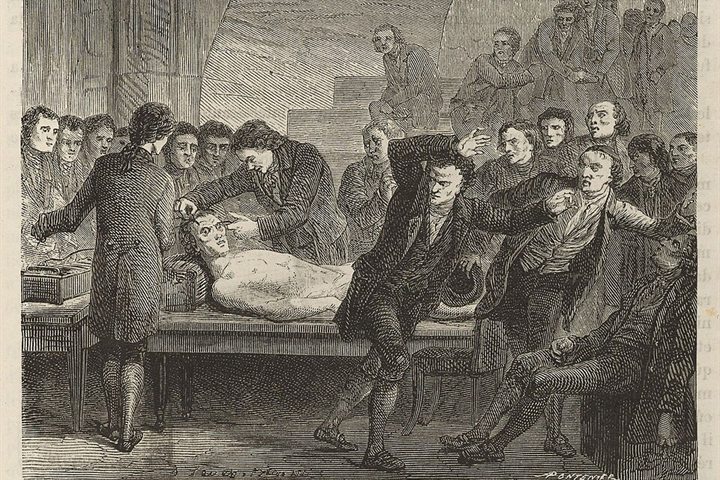
Antonio Muzzi, Galvani’s experiments with the electrostatic machine, 1862 (detail)
A surrogate can reproduce a circuit’s output without reproducing anything inside it.
The project’s test bed is the hybrid thalamic circuit of Le Masson and colleagues (Nature, 2002), in which living thalamic neurons were coupled to silicon ones and feedback inhibition decided which spikes got through. Simulated, the circuit exposes 160 of its biological variables, so a model trained only on its spikes can be checked for whether it has learned any of them.
These are conversations, not finished essays. Each page gives the questions as they were asked and the answers as they were given. A long conversation is published in its own parts, with an overview that holds its contents and the thread at a glance.
From a Failed Neural ODE to the Zombie Default and the Limits of Recovery
The aim of the conversation, the contents of all its parts, and the key exchanges in order, each with where it landed.
What the first transformation-replacement results mean: six scenarios from full correspondence to a functional zombie, what latent recovery is, and a three-way comparison in which the Neural ODE is dead on arrival.
Consciousness-relevant datasets, the whole project explained from zero, a second Neural ODE failure, and a detour through Collatz, DreamCoder and Hodgkin–Huxley that becomes the plan for a structured architecture search.
Wiring in the real Rung 3 data, how the search scores architectures against 160 biological variables, the C1/C2 mapping and gap compass, and putting an LLM in the loop in place of a meta-learner.
LTC learns spikes but not biology; a scorer bug is fixed; a latent-dimension sweep and a standalone GRU-ODE run show that high Pearson correlations can vanish under cross-validated ridge R²; the full run and the plan for an auxiliary biological loss.
Functional versus mechanistic substrate independence, gradual replacement, Charith's reading that output is mind, the Volterra kernel as a silicon neuron, and why an independent L5 pyramidal replication is the next test.
A research guide for the Beniaguev L5PC zombie test, what a report added to it, dendritic voltage traces and loss weights explained, and two visual guides.
A-R3b trains with increasing biological supervision. The results separate three explanations — zombie by choice, by information loss, by incapacity — and give a hierarchy: slow synaptic conductances become decodable, fast gates never do.
Prompts to dig deeper, three reports that expose baseline, drift and identifiability problems in the method, the information levels a surrogate would need, a cortical prosthesis design, and thirteen research prompts to settle before running more experiments.