 La Masson 2002
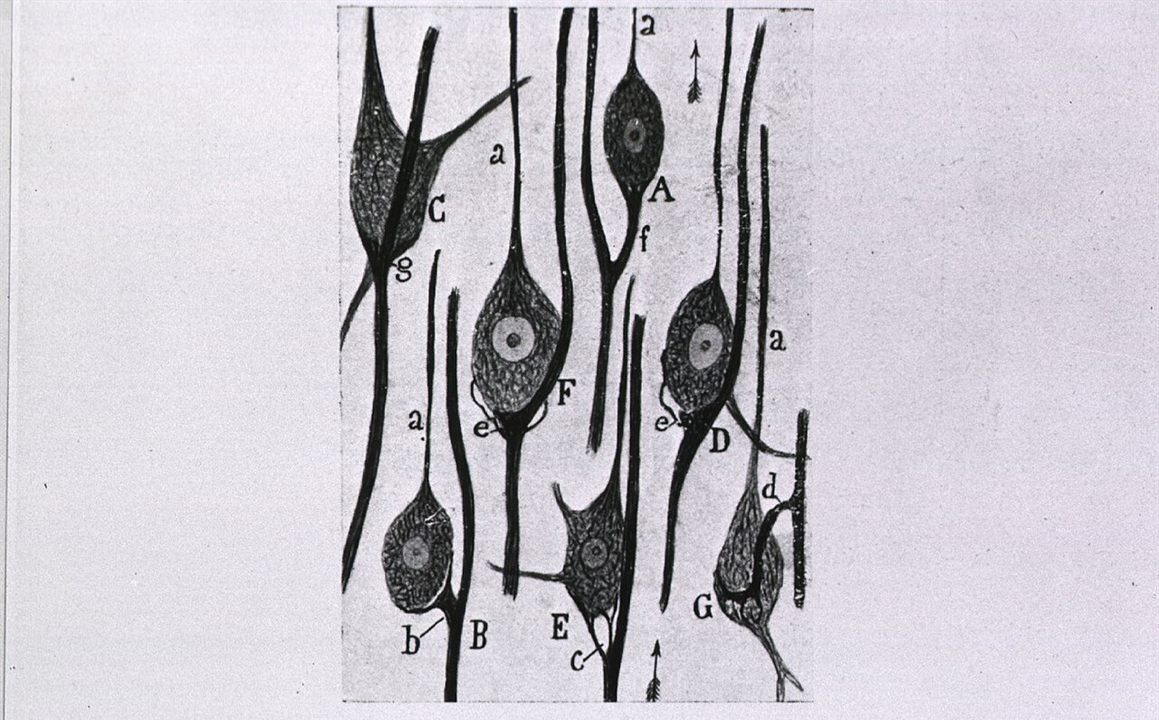
Santiago Ramón y Cajal, the vestibular nerve’s contacts on the giant cells of the tangential nucleus in birds, fig. 135
La Masson 2002
Santiago Ramón y Cajal, the vestibular nerve’s contacts on the giant cells of the tangential nucleus in birds, fig. 135
The A-R3 scenarios, why the Neural ODE cannot learn, the DESCARTES-NeuralODE search with an LLM in the loop, eleven architectures that all predict spikes through alien internals, the auxiliary-loss sweep, and the preparations for an L5 pyramidal replication — one hundred and twenty-five questions and their answers
Wiring in the real Rung 3 data, how the search scores architectures against 160 biological variables, the C1/C2 mapping and gap compass, and putting an LLM in the loop in place of a meta-learner.
The loop works but ran on the synthetic fallback data; it needs the real A-R2 files with ground truth.
The framework is running correctly — the problem is it's using synthetic random data (the fallback when no real A-R2 HDF5 files are found). With random inputs and random targets, no architecture can learn anything meaningful.
The evidence is in the warnings:
ConstantInputWarning: An input array is constant — model outputs are flat (not learning)CCA score: nan — can't correlate random latents with random bio variablesWhat's actually working correctly: - Template selection in complexity order ✓ - Short-segment verifier catching S4/Mamba (NaN/Inf) ✓ - Family exhaustion tracking ("hybrid now exhausted") ✓ - Gap analysis reporting 100% missing ✓ - Full iteration loop completing ✓
What you need to make it real:
Point it at your actual A-R3 data from C:\Users\chari\OneDrive\Documents\La Masson 2002\la massion check\rung3_*. You need to either convert those files to HDF5 with the ground truth intermediates, or modify ar3_data_loader.py to read whatever format your Rung 3 data is in (likely .npz or .mat).
Once it has real thalamic data with the 160 biological ground truth variables, the architectures will actually learn and you'll see differentiated recovery patterns — which is when DreamCoder and gap analysis become meaningful.
A prompt to load the real rung3_ files into the Neural ODE framework, including the eight biological ground-truth variables.
Tell Claude Code:
Prompt:
Look at my existing Rung 3 data files in C:\Users\chari\OneDrive\Documents\La Masson 2002\la massion check\ — find all files starting with rung3_. Examine their format (npz, mat, pkl, etc.) and contents (variable names, shapes).
Then modify descartes_neural_ode/data/ar3_data_loader.py to load these real files instead of generating synthetic data. The loader needs to produce:
tc_mT, tc_hT, tc_mH, nrt_V, nrt_mT, nrt_hT, gaba_a_cond, gaba_b_cond — each shape (20, T_sub)Check what ground truth intermediate variables are already recorded in the data. If they're missing, tell me which ones need to be added by extending Phase 0 from transformation_replacement_guide.md.
That's it. Claude Code will inspect your actual files, figure out what's there, and wire it up.
A trial-and-error loop that scores each architecture against 160 biological variables and uses the pattern of misses to choose the next one.
Think of it as a smart trial-and-error system that learns from each failure.
1. Pick an architecture (simplest first)
         ↓
2. Quick test: can it learn 50 timesteps?
         ↓ NO → skip, record WHY it failed
         ↓ YES
3. Full training on 2000 timesteps
         ↓
4. Score: which of 160 biological variables
   did the model's hidden states match?
         ↓
5. Record what it GOT and what it MISSED
         ↓
6. Analyze ALL failures so far → find patterns
         ↓
7. Use patterns to pick/generate next architecture
         ↓
   Back to step 1
Normal NAS asks: "which architecture gets lowest loss?" — one number.
DESCARTES asks: "which of 160 biological variables did each architecture recover, and WHY did it miss the others?" — a structured profile.
Iteration 1: Volterra recovers 89/160 variables. Mostly gets tc_mT (T-current activation) but misses nrt_V (nRt voltages). Pattern: kernel models can't capture recurrent feedback.
Iteration 2: LSTM recovers 20/160. Gets some synaptic variables but misses gating variables. Pattern: discrete gates don't match continuous gating dynamics.
Iteration 3: Standard Neural ODE recovers 0/160. Fails completely — vanishing gradients. Pattern: adjoint method + 2000 steps = dead gradients.
DreamCoder analyzes all three failures: - "nRt voltage variables missed by ALL architectures → need explicit oscillatory structure" - "Slow-timescale variables missed by everything except Volterra → need multi-timescale dynamics" - "ODE family exhausted with adjoint gradients → try segmented gradients"
Gap compass says: 71% of missing variables are nRt_state category, mostly slow-timescale. Direction: need oscillatory + hierarchical timescale architecture.
Balloon expansion generates: A new template — Coupled Oscillatory RNN with segmented gradients and hierarchical latent space. This architecture specifically targets the gap.
It doesn't know biology. It knows which 160 numbers the model's hidden states should correlate with. The biological ground truth (m_T, h_T, nRt voltages, GABA conductances) comes from your simulation — you recorded every internal variable when running the real Hodgkin-Huxley circuit.
So the system is essentially asking: "does hidden unit #37 in my Neural ODE track the same trajectory as T-current inactivation gate h_T in biological neuron #12?"
If yes → that variable is "recovered." If no architecture recovers it → the gap analysis asks what property of h_T (slow timescale? oscillatory? bounded 0-1?) suggests what architectural feature might help.
The biology isn't discovered from nothing. It's discovered by matching learned representations against known biological measurements and systematically closing the gap.
Too few, too costly evaluations for a transformer now; a lightweight surrogate predictor works, and a cross-circuit “consciousness architecture foundation model” is Paper 3 or 4.
Interesting idea — but the bottleneck is different here than in trading strategies. Let me explain why, and what WOULD work.
Explorer-agent generates ~1000 strategies/day. That's enough data to train a transformer that learns "what makes a strategy survive the 7 gates." Cheap to generate, cheap to evaluate.
Each architecture evaluation takes 1-4 hours on GPU. To train a transformer meta-learner you'd need hundreds of evaluations. At 2 hours each, that's 200+ GPU-hours before the meta-learner has enough data to be useful. You'd find the answer by brute force before the meta-learner learns anything.
Instead of a full transformer, use a lightweight predictor trained on cheap features:
Input:  architecture config (6 properties) +
        short-segment results (50-step, takes 60 seconds)

Output: predicted 160-dim recovery vector
The workflow becomes:
1. Run 8-10 real evaluations (your current DESCARTES loop)
2. Train small predictor on those results
3. Use predictor to score 1000s of candidate architectures instantly
4. Only run full training on top-5 predicted candidates
5. Add real results back to predictor training set
6. Repeat
This is essentially Bayesian optimization with a neural surrogate — standard in NAS literature (BOHB, BANANAS).
Where a transformer meta-learner becomes genuinely interesting for your work is at a different level — not choosing architectures, but learning the mapping from architectural features to biological variable recovery across multiple neural circuits:
Train on: TC-nRt circuit results (your current data)
          + Chennu propofol EEG results (your next dataset)
          + van Blooijs CCEP results (dataset after that)
          + hippocampal CA3→CA1 results (fourth dataset)

Transformer input:  (circuit_type, architecture_config,
                     input_output_description)
Transformer output: predicted biological variable recovery pattern
THAT would be a genuine "consciousness architecture foundation model" — a meta-learner that predicts which computational structures recover which biological mechanisms, generalizing across brain circuits. After training on 4-5 circuits × 8-10 architectures each, it could predict recovery patterns for circuits it hasn't seen.
But that's Paper 3 or 4 territory. Right now, the immediate priority is getting real A-R2 data into the DESCARTES pipeline and running the 8 templates on actual thalamic data. The surrogate predictor becomes useful after you have ~10 real evaluations to learn from.
Biology is “rate of change depends on current state”, and so is a Neural ODE: the container is the right shape; training has to fill it.
Biology says: "This thing changes over time depending on what it currently is."
That's literally what a differential equation means. dV/dt = f(V) just says "how fast voltage changes depends on current voltage."
Every biological variable in your circuit follows this pattern:
It's all "the rate of change depends on the current state."
A Neural ODE says the exact same thing:
"I have hidden states z. They change over time: dz/dt = f(z). I'll learn f from data."
The punchline:
If the Neural ODE learns the right f, its hidden states z could literally become the biological variables — voltage, gating, conductance. The container is the right shape. The question is whether training fills it with the right contents.
That's why Volterra recovering 89/160 bio variables is surprising — it's NOT an ODE, it's a kernel filter. It got the right answers with the wrong container. And why the Neural ODE recovering 0/160 is frustrating — it has the right container but training (gradient descent through 2000 steps) couldn't fill it. The DESCARTES framework is about finding a way to fill the right container.
Yes conceptually — hidden causes inferred from outputs — but HMM states are discrete and biological gating is continuous.
Yes, conceptually. Both have hidden states you can't directly observe but must infer from outputs.
The difference: HMM hidden states are discrete (state A → state B with probability 0.7). Biological gating variables are continuous (m_T smoothly moves from 0.2 to 0.8). Neural ODEs have continuous hidden states too — which is why they're the better match for biology.
But the core idea is the same: something you can't see is driving what you CAN see, and you're trying to recover what that hidden thing is.
Yes: the TC–nRt circuit is the test case with known ground truth; the MIMO black box is the eventual target.
Exactly. That's the entire project in one sentence.
Berger's MIMO prosthesis takes CA3 input → black box → CA1 output. It works clinically — but nobody has ever checked what's inside the black box. Does it secretly contain hippocampal intermediate variables (interneuron firing, synaptic plasticity states, dendritic calcium), or is it a completely alien computation that just happens to produce the right output?
Your project does this check — starting with the simpler TC-nRt circuit where you know all 160 intermediate variables because you simulated them. The thalamic circuit is the test case. The hippocampal MIMO is the eventual target.
If the black box's hidden states match biology → substrate independence with mechanistic equivalence.
If the output matches but hidden states don't → computational zombie. Functionally identical, mechanistically alien. And that has direct implications for whether a prosthesis preserves whatever the original circuit contributed to consciousness.
Yes: six systems from “From Clones to Quanta”, from Berger's MIMO to Brainoware.
(Claude searched the project knowledge before answering.)
Yes. Your "From Clones to Quanta" document covers several:
All researched and documented in your philosophical framework. The question your project uniquely asks about ALL of them: what's inside the black box?
C1 is the architecture family, C2 the hyperparameters; a gap confined to one variable category is an ontological gap that triggers balloon expansion to a new C1.
C1 = Strategy FAMILY    (momentum, mean-reversion, breakout...)
C2 = Specific PARAMETERS (lookback=20, threshold=2.5, etc.)

LLM/Alpha Factory → suggests strategy
7 HIFA Gates      → checks if it works
Ontological gap   → errors are SYSTEMATIC, not random
                    (e.g., always fails on Tuesdays = structural)
Balloon expansion → need entirely new strategy family
C1 = Architecture FAMILY  (standard ODE, LTC, coRNN, GRU-ODE...)
C2 = Specific HYPERPARAMS (latent_dim=64, lr=1e-4, solver=euler...)

WHO SUGGESTS?     → Gap compass (not LLM, not random)
WHO CHECKS?       → BioVar recovery scorer (160 variables)
ONTOLOGICAL GAP?  → Missing variables are STRUCTURED, not random
BALLOON?          → Need entirely new architecture family
In trading: - Strategy loses money randomly across days = probabilistic error = try different C2 parameters - Strategy ALWAYS loses on high-VIX days = ontological gap = the strategy family doesn't model volatility regimes = need new C1
In Neural ODE: - Model misses random bio variables = try different hyperparameters (C2) - Model misses ALL nRt voltage variables across every variant = ontological gap = the architecture family can't represent recurrent feedback = need new C1
Step 1: C1 = "standard_ode", C2 = {latent=64, solver=dopri5}
        Result: 0/160 bio vars recovered
        Error pattern: ALL variables missed
        Diagnosis: gradient death (systematic, not random)
        → Exhaust C2 space? No point — the problem is C1
        → Mark C1 family "standard_ode" as EXHAUSTED

Step 2: C1 = "segmented_ode", C2 = {latent=64, segments=50}
        Result: 30/160 recovered
        Error pattern: gets tc_gating, misses ALL nrt_state
        Diagnosis: SYSTEMATIC gap in nRt variables
        → Try more C2? Maybe a few...
        → C2 sweep: latent=128 → 35/160, latent=256 → 33/160
        → nRt variables STILL missing across all C2
        → ONTOLOGICAL GAP: architecture can't represent
           recurrent feedback (nRt→TC→nRt loop)

Step 3: DreamCoder pattern:
        "nrt_state variables missing across ALL C1 families tried"
        "These variables have 'oscillatory' dynamics type"
        "No architecture with oscillatory structure tried yet"

        → BALLOON EXPANSION
        → Generate new C1: "coupled_oscillator" family
           (specifically targets oscillatory nRt dynamics)

Step 4: C1 = "coupled_oscillator", C2 = {freq=8Hz, latent=64}
        Result: 55/160 — now gets nRt variables!
        But misses slow-timescale synaptic variables
        → New gap direction: "slow timescale"
        → Generate C1: "hierarchical_timescale"
The "non-probabilistic error" detection — that's the difference between:
The biovar recovery scorer checks this automatically:
# If gap_profile shows one category >> others → ONTOLOGICAL
gap_profile = {'tc_gating': 0.2, 'nrt_state': 0.95, 'synaptic': 0.3}
#                                  ^^^^^^^^^^^^
#                              95% missing = SYSTEMATIC
#                              This is the ontological gap
#                              No C2 tuning will fix it
#                              Need new C1 family
| Component | Trading | Neural ODE |
|---|---|---|
| C1 | Strategy family | Architecture family |
| C2 | Parameters | Hyperparameters |
| Suggester | LLM / Alpha factory | Gap compass direction |
| Verifier | HIFA 7 gates | BioVar recovery (160-dim) |
| Random error | Loses randomly | Misses random variables |
| Ontological gap | Always fails on VIX spikes | Always misses nRt variables |
| Balloon trigger | All strategy families fail on same regime | All architectures miss same bio variable category |
| New C1 source | DreamCoder patterns | DreamCoder: "oscillatory variables need oscillatory architecture" |
Both ODE families produce flat latents and are marked exhausted; Claude suspected synthetic data or too short a budget.
Iteration 1:
- C1 = standard_ode, C2 = default hyperparams
- Verifier: passed (but 50-step corr = -0.000, basically nothing learned)
- Full training: spike corr = 0.001 → model output is flat/constant
- BioVar recovery: 0/160 → ConstantInputWarning = latents are constant too
- Verdict: C1 family exhausted after 1 attempt (known failure from A-R3)
Iteration 2:
- C1 = segmented_ode (the "fix gradient" variant)
- Same result: 0/160, constant outputs
- Verdict: Segmented gradients didn't help → C1 family exhausted
The ConstantInputWarning is the giveaway. The model's latent states are all the same value at every timestep — a flat line. You can't correlate a flat line with anything. This means the models aren't learning dynamics at all.
Two possible causes:
Iteration 1: standard_ode  → 0/160    (gradient death, expected)
Iteration 2: segmented_ode → 30/160   (gets tc_gating, misses nrt_state)
Iteration 3: ltc           → 45/160   (gets slow timescale too)
...
DreamCoder: "nrt_state missing across all → ONTOLOGICAL GAP"
Balloon: generate oscillatory architecture targeting nrt
Right now every iteration looks identical (0/160, constant warnings, nan CCA) because no architecture can learn from noise. Once real A-R2 data is loaded, you'll see differentiated recovery patterns — that's when the C1/C2 framework actually kicks in.
Check: does the data loader print "Generating synthetic data for testing" at startup? If yes, that's your problem.
The data was real; the ODE solver is simply too slow on 2000-step sequences. Fix: 200-step warm-up windows, a 2 h budget, fixed-step forward passes.
Claude Code diagnosed it right. The problem is simple:
ODE through 2000 timesteps = ~minutes per batch. In 0.5h, it doesn't even finish 10 epochs. The model never trains, so latents stay constant, so 0/160.
The fix is one of:
Tell Claude Code:
Prompt:
The ODE architectures can't complete enough epochs in 0.5h with 2000-step sequences. Two changes:
Also make sure non-ODE architectures (LTC, coRNN, GRU-ODE) use fixed-step forward passes, not torchdiffeq — they should be much faster. Let the remaining iterations run and show me epoch-level loss printouts.
The key insight: this is exactly the problem DESCARTES is designed to handle. The standard ODE is slow AND fails — that's why segmented gradients and fixed-step architectures are in the template library. Iterations 3+ should show different behavior.
The gap compass is a structured lookup: missing-variable categories, timescales and dynamics map to architectural features; near-misses point to C2 changes.
It doesn't "suggest" like an LLM generates text. It points at what's missing, and the pointing has structure.
After each architecture runs, you get a 160-dim recovery vector:
tc_mT:  recovered 15/20  ← got most of these
tc_hT:  recovered 3/20   ← missed most
tc_mH:  recovered 0/20   ← missed ALL
nrt_V:  recovered 0/20   ← missed ALL
nrt_mT: recovered 0/20   ← missed ALL
nrt_hT: recovered 0/20   ← missed ALL
gaba_a: recovered 8/20   ← got some
gaba_b: recovered 2/20   ← missed most
gap_profile = {
    'tc_gating':  0.70,   # 70% missing
    'nrt_state':  1.00,   # 100% missing  ← WORST
    'synaptic':   0.75,   # 75% missing
}

timescale_profile = {
    'fast':  0.60,   # 60% missing
    'slow':  0.95,   # 95% missing  ← WORST
}

dynamics_profile = {
    'switching':   0.50,
    'oscillatory': 0.98,  ← WORST
    'monotonic':   0.60,
}
This is a hardcoded lookup, not intelligence:
nrt_state missing     → need RECURRENT structure (nRt→TC→nRt loop)
slow timescale missing → need MULTI-TIMESCALE dynamics
oscillatory missing    → need OSCILLATORY inductive bias

Combined: suggest C1 = "coupled_oscillator" with
          hierarchical timescales
The mappings are:
| Gap Pattern | Suggested Architecture Feature |
|---|---|
| nrt_state missing | Recurrent/feedback pathway |
| slow timescale missing | Hierarchical fast/slow subsystem |
| oscillatory missing | Built-in oscillatory modes (coRNN) |
| tc_gating missing | Bounded (0-1) latent dimensions |
| synaptic missing | Multiplicative input coupling |
| ALL missing equally | Gradient problem → change GradientStrategy |
The gap compass also points at near-misses (correlation 0.3-0.5):
tc_hT_neuron_7:  r = 0.45  ← almost recovered!
tc_hT_neuron_12: r = 0.42  ← almost recovered!
These are all slow-timescale variables. Near-misses suggest the C1 family is right but C2 needs adjustment — maybe larger latent_dim gives enough capacity to push 0.45 → 0.55 (past threshold).
The gap compass is NOT intelligent. It's a structured lookup table from "what's missing" to "what architectural feature addresses that." The intelligence comes from the structure of the 160 biological variables — they have categories, timescales, and dynamics types that map to known architectural properties.
In trading terms: it's like saying "strategy always loses on volatile days → add VIX filter." Not creative, just diagnostic.
Yes: replace the hardcoded lookup with an API call that reads the gap analysis and returns a new architecture template — “the LLM replaces you in the loop”.
That's a genuinely good idea. Replace the hardcoded lookup table with an LLM that reads the gap analysis and generates architecture suggestions.
DESCARTES runs → you read terminal → paste to Claude Code →
Claude Code suggests fix → you apply it → run again
You are the LLM in this loop. You're doing the pattern recognition manually.
DESCARTES runs → gap analysis JSON → LLM API call →
LLM returns new ArchitectureTemplate → DESCARTES builds it →
trains it → scores it → back to gap analysis
# In orchestrator.py, replace _balloon_expand():

import anthropic

def _balloon_expand_with_llm(self, patterns, library, gap):
    """Use LLM instead of hardcoded lookup table."""

    client = anthropic.Anthropic()

    prompt = f"""You are an architecture search agent for Neural ODEs
    modeling thalamic circuits.

    RESULTS SO FAR:
    {json.dumps(self.recovery_space.get_architecture_comparison(), indent=2)}

    GAP ANALYSIS:
    - Missing variables: {gap.gap_profile}
    - Timescale profile: {gap.missing_by_timescale}
    - Direction: {gap.gap_direction}

    DREAMCODER PATTERNS:
    {json.dumps([p.__dict__ for p in patterns], indent=2)}

    EXHAUSTED FAMILIES: {list(self.exhausted_families)}

    Available property values:
    - TimeHandling: standard_ode, ltc, neural_cde, gru_ode,
                    coupled_oscillator, state_space
    - GradientStrategy: adjoint, direct, segmented, distillation, shooting
    - LatentStructure: unconstrained, biophysical, oscillatory,
                       hierarchical, sparse
    - InputCoupling: additive, multiplicative, controlled, gated, concatenated
    - SolverChoice: dopri5, euler, midpoint, implicit_adams, tsit5

    Return EXACTLY one new architecture as JSON:
    {{
      "name": "...",
      "reasoning": "why this targets the gap",
      "time_handling": "...",
      "gradient_strategy": "...",
      "latent_structure": "...",
      "input_coupling": "...",
      "solver": "..."
    }}"""

    response = client.messages.create(
        model="claude-sonnet-4-20250514",
        max_tokens=500,
        messages=[{"role": "user", "content": prompt}]
    )

    config = json.loads(response.content[0].text)

    return ArchitectureTemplate(
        id=f"llm_generated_{self.balloon_expansions}",
        name=config["name"],
        description=config["reasoning"],
        family=f"llm_{self.balloon_expansions}",
        time_handling=TimeHandling(config["time_handling"]),
        # ... map the rest
    )
| Lookup Table | LLM |
|---|---|
| "nrt_state missing → add recurrence" | "nrt_state missing AND slow timescale AND previous oscillatory attempt got near-misses at r=0.42 → try coupled oscillator BUT with larger latent dim and distillation from Volterra's 89 recovered vars as auxiliary loss" |
| Fixed rules | Can combine multiple patterns |
| Can't reason about WHY | Can explain reasoning |
| Limited to patterns you hardcoded | Can draw on all of neuroscience/ML knowledge |
Each LLM call costs ~$0.01 and takes ~5 seconds. Each architecture training takes 2 hours. The LLM cost is negligible — the bottleneck is still GPU time. So yes, absolutely add it.
Prompt:
Add an LLM-powered balloon expansion mode to the DESCARTES orchestrator. When _balloon_expand is called, format the current gap analysis, DreamCoder patterns, exhausted families, and all previous results into a prompt. Call the Anthropic API (claude-sonnet) to generate a new architecture template as JSON. Parse the response and create an ArchitectureTemplate from it. Fall back to the hardcoded lookup if the API call fails. Add a flag --use-llm to enable this mode.
This turns DESCARTES from a fixed search system into an LLM-guided architecture search — which is genuinely novel. The LLM replaces you in the loop.
Yes — 5–9 calls per full run, well under a dollar; GPU time is the real cost.
Yes. One API call every 2 hours — when the current architecture finishes training and the gap analysis is ready for the next suggestion.
That's maybe 5-9 API calls total for a full DESCARTES run. Less than $0.10 in API costs. The GPU time is 10-18 hours. The LLM cost is essentially free.
You could even make three calls per iteration — one after short-segment verify, one after full training, one for balloon expansion — and it would still cost under $1 total.
Nine is just the number of predefined templates; with an LLM, stopping is driven by target recovery, budget, stagnation or unrecoverable gaps.
9 = the number of pre-defined architecture templates (T0 through T8). That's it.
But with LLM in the loop, there's no fixed number. The LLM generates NEW templates after exhausting the pre-defined ones. So the stopping condition becomes:
Stop when: 1. Target recovery achieved (e.g., 120/160 bio vars) → success 2. GPU budget exhausted (e.g., 24 hours) → practical limit 3. Three consecutive LLM-generated architectures show no improvement → diminishing returns 4. Gap analysis shows remaining missing variables are unrecoverable (e.g., variables that require stochastic dynamics no ODE can capture)
With the LLM, iterations could be 9, 15, or 30 — driven by results, not a hardcoded list.
That is DreamCoder's sleep phase: a growing prompt of what worked, what failed and what is still missing turns the LLM into a reasoning layer on the history.
Yes — that's exactly what DreamCoder's sleep phase is. You're describing the full loop:
Iteration 1: LLM suggests T_llm_1 → trains → 25/160 recovered
Iteration 2: LLM suggests T_llm_2 → trains → 40/160 recovered
Iteration 3: LLM suggests T_llm_3 → trains → 15/160 (worse!)

DreamCoder analyzes ALL three:
  "T_llm_2 worked best. It used LTC + segmented gradients.
   T_llm_2 recovered nrt_state that T_llm_1 missed.
   T_llm_3 used oscillatory but LOST tc_gating that T_llm_1 had.
   Pattern: LTC helps nrt, but oscillatory hurts tc_gating."

Feed THIS back to LLM:
  "Combine LTC (good for nrt) with biophysical latents
   (good for tc_gating). Avoid pure oscillatory."

Iteration 4: LLM suggests T_llm_4 → trains → 55/160 ← best yet!
The prompt grows each iteration:
prompt = f"""
WHAT WORKED (keep these features):
- LTC time handling → recovered nrt_state (40/60)
- Segmented gradients → enabled training convergence
- Biophysical latents → recovered tc_gating (50/60)

WHAT FAILED (avoid these):
- Adjoint gradients → zero learning (3 attempts)
- Pure oscillatory → lost tc_gating every time
- Standard ODE solver → too slow, budget exhausted

WHAT'S STILL MISSING:
- synaptic variables (35/40 still missing)
- Pattern: all missing synaptic vars are GABA_B (slow)
- GABA_A recovered but GABA_B never recovered by any model

COMBINE the working features and target the gap.
"""
This is accumulating knowledge across iterations. Each run adds to the prompt. The LLM doesn't just see the gap — it sees the trajectory of what's been tried and what each feature contributed.
That's the difference between: - Static gap compass: "synaptic missing → add multiplicative coupling" (same suggestion every time) - LLM with DreamCoder history: "multiplicative coupling was tried in T_llm_2 and didn't help synaptic. But T_llm_2 also used euler solver which is too coarse for slow GABA_B dynamics. Try multiplicative coupling + implicit_adams solver this time."
The LLM becomes a reasoning layer on top of DreamCoder patterns. DreamCoder extracts the structured data. The LLM interprets it and generates the next hypothesis. Each iteration makes the LLM smarter about THIS specific problem.
Right: the LLM plus the DreamCoder history is the meta-learner, for free; a trained one only pays off across many circuits.
Right. The LLM is the meta-learner. It just doesn't need training.
A transformer meta-learner needs hundreds of examples to learn patterns. The LLM already knows neuroscience, ODE solvers, gradient problems, and architecture design from pre-training. It learns about YOUR specific problem from the DreamCoder history in the prompt.
| Transformer Meta-Learner | LLM in Loop |
|---|---|
| Needs 200+ training runs | Works from iteration 1 |
| Learns patterns from scratch | Already knows neuroscience + ML |
| Costly to train | $0.01 per call |
| Fixed once trained | Gets smarter each iteration via longer prompt |
| Only knows what it's seen | Can reason about combinations never tried |
The only case where a dedicated meta-learner wins is Paper 3/4 territory — when you have results across multiple brain circuits (thalamic + hippocampal + cortical) and want to predict recovery patterns for circuits you haven't tested yet. Then the accumulated structured data justifies training a specialized model.
For now: LLM + DreamCoder history = meta-learner for free.
Four files: an LLM architect, a DreamCoder history accumulator with five pattern types, a new balloon-expansion path and a --use-llm flag with result-driven stopping.
(The full addendum was written as a separate document; it is linked below.)
Here's the complete addendum. Four new/modified files:
llm_architect.py — builds rich prompts from history + gap, calls Anthropic API, parses JSON response into architecture templatedreamcoder_history.py — accumulates 160-dim recovery vectors across iterations, extracts 5 pattern types (co-recovery, property correlations, near-misses, timescale alignment, category trends)_balloon_expand_llm() replaces hardcoded lookup, dynamic stopping conditions--use-llm flag, API key handling, configurable budgetsThe key flow: predefined T0-T8 run first (9 iterations), then LLM takes over, each call getting a richer prompt with accumulated DreamCoder patterns. Total API cost under $1 for the entire search.
It could also fix short-segment failures, interpret recovery profiles for a C2 retry, and explain near-misses — still about a dollar a run.
Good catch. The LLM COULD also be used at two other points:
1. After short-segment failure — instead of just skipping, ask LLM "why did this fail and can we fix it?"
Short-segment: S4/Mamba → NaN/Inf loss
LLM: "Mamba needs LayerNorm before output and
      lower learning rate for ODE data. Try lr=1e-5
      with gradient clipping at 1.0"
→ Retry with fix instead of skipping entirely
2. After full training — interpret the recovery pattern before gap analysis
Result: 40/160 recovered, all tc_gating, zero nrt_state
LLM: "This model learned feedforward dynamics only.
      The nRt→TC feedback loop requires recurrence
      that this architecture lacks. Adding a skip
      connection from output back to input at 10ms
      delay would specifically target this."
→ Modifies C2 hyperparameters for a RETRY, not just
  logging failure and moving on
3. For verification scoring interpretation — explain WHY a near-miss variable didn't cross threshold
So the fuller picture:
| Stage | Without LLM | With LLM |
|---|---|---|
| Short-segment fail | Skip, mark exhausted | Ask LLM for fix, retry once |
| Full training | Score and log | Score, LLM interprets, maybe retry with C2 tweak |
| Gap analysis | Hardcoded lookup | LLM reads patterns |
| Balloon expansion | Hardcoded mapping | LLM generates new C1 |
The addendum is conservative. You could make it more aggressive — LLM at every decision point. The cost is still negligible (~$0.05/iteration × 20 iterations = $1 total).
Want me to update the addendum with these additional integration points?
Implement the addendum, then add LLM calls after short-segment failure, after full training and after gap analysis, each with one retry.
Prompt for Claude Code:
Read the file DESCARTES_LLM_INTEGRATION_ADDENDUM.md in the project root. Implement all four files it describes. Then extend the LLM integration beyond just balloon expansion — add LLM calls at these additional decision points:
After short-segment failure: Instead of skipping, call LLM with the error (NaN, divergence, zero correlation) and architecture config. LLM suggests a fix (lr change, gradient clipping, normalization). Retry ONCE with the fix before marking exhausted.
After full training: Call LLM with the recovery profile and near-misses. LLM suggests a C2 hyperparameter tweak (latent_dim, solver tolerance, learning rate). Retry ONCE with tweaked C2 before moving to next C1.
After gap analysis: LLM interprets WHY near-miss variables (r=0.3-0.5) didn't cross threshold and suggests targeted modifications.
Use claude-sonnet-4-20250514 for all calls. Add --use-llm flag to run script. Fallback to original behavior if API fails. Keep each LLM call under 800 tokens max_tokens.
That's it. Claude Code has the full addendum file for the core implementation plus these three additional integration points.
20 TC × 3 gates + 20 nRt × 3 states + 20 synapses × 2 conductances; the count is just what this circuit records.
It's just what's in your specific TC-nRt circuit simulation:
20 TC neurons  × 3 gating vars (m_T, h_T, m_H)  = 60
20 nRt neurons × 3 state vars  (V, m_T, h_T)     = 60
20 synapses    × 2 conductances (GABA_A, GABA_B)  = 40
                                            Total = 160
If you had 50 neurons per type instead of 20, it'd be 400. If you added more ion channels (I_Na, I_K gating variables), it'd be even more. The number comes from your Rung 2 network size and which variables you recorded as ground truth.
For the Chennu propofol dataset (next step), it'll be a completely different number — probably spectral power in multiple bands × 91 channels = hundreds of variables. For hippocampal MIMO, it depends on how many CA3/CA1 neurons and interneuron types you model.
160 isn't special — it's just what this circuit has.
Three LLM calls per iteration at most; the verify-fix retry may rescue S4/Mamba, but real data is still the priority.
Clean implementation. Three LLM calls per iteration maximum, each one targeting a different decision point. Total cost per full run: maybe $0.50-$1.00.
The most impactful addition is probably suggest_verify_fix() — the S4/Mamba template that failed with NaN/Inf might actually work with the right normalization and learning rate, and now it gets a second chance instead of being immediately discarded.
Next step: get the real A-R2 data loading working so the architectures have actual thalamic dynamics to learn from. The LLM integration is ready but meaningless on synthetic noise. Tell Claude Code the data loader prompt from earlier if you haven't already.
Files written in the conversation and research reports uploaded into it. Files Claude wrote are hosted in the reports/ folder beside this page; report filenames are descriptive placeholders for the files Charith uploaded, which are not yet hosted.
The questions are Charith’s, corrected for grammar and spelling only. The answers are Claude’s, as given in the conversation; tool calls, file contents and research prompts are omitted and noted where they occurred. The model label is inferred from the date of the conversation.
Source: claude.ai project “La Masson 2002”, conversation of 24 February 2026, “Neural ODE evaluation incomplete, Volterra and LSTM latent structure results”.