 τί ἐστι;
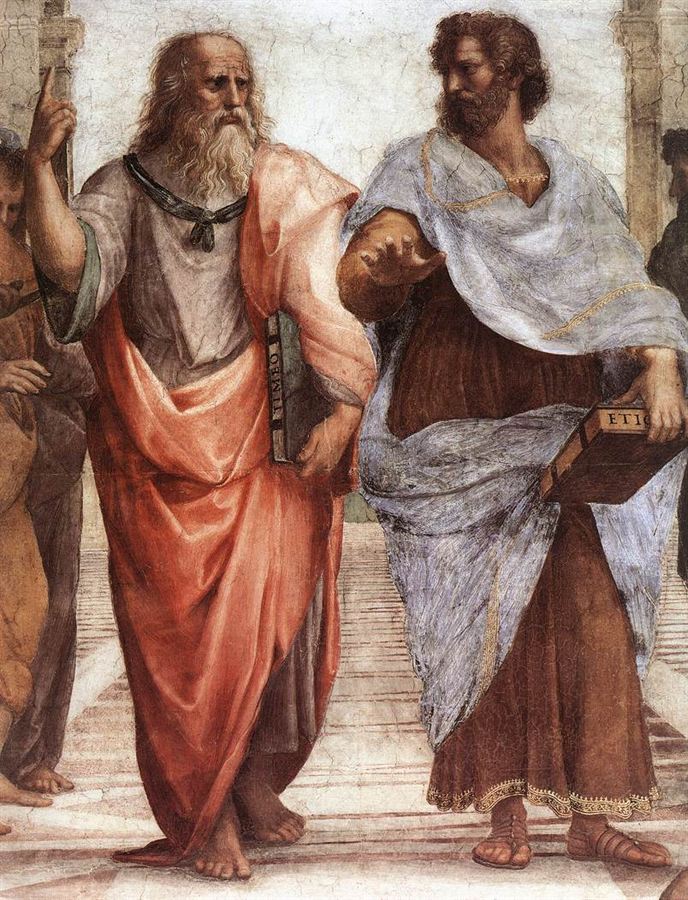
Raphael, Plato and Aristotle, detail of The School of Athens
You know Kant, Frege, Quine, Kripke. You know the words Forms, ideal world, allegory of the cave — and not what they mean. This is the shortest honest route from there to reading the scholarship in your folder.
Plato has no word for "metaphysics" and no word for "epistemology." Both fall out of a single inherited question.
Heraclitus said the sensible world is in flux. Parmenides said that only what is, unchangingly, can be thought or spoken of at all — becoming is literally unsayable. Plato takes both seriously and draws the conclusion: if knowledge is possible, there must exist a class of objects that do not change. Otherwise knowledge has nothing stable to be knowledge of. The Forms are the conclusion of that argument. They are a posit, not a vision.
This is the reframe that makes Plato legible to you. Don't read him as a mystic making a claim about a second geographical location. Read him doing what Frege does with numbers, or what a modern realist does with universals, laws, or natural kinds: arguing that certain explanatory jobs — predication, definition, mathematics, learning, value — cannot be done by anything spatiotemporal, and therefore something non-spatiotemporal exists.
That heuristic will get you moving, and you should know that it's contested. Grabowski's book in this folder opens with an introduction titled Platonism as Realism, sets out exactly this mapping — Forms as a solution to the problem of attribute agreement, particulars instantiating universals — calls it "the standard interpretation," and spends the rest of the book arguing that Plato isn't doing that. Use the analogy to get in. Expect to be argued out of it.
The second thing to fix: Plato is his own harshest critic. The Parmenides is Plato assembling the best objections to the Forms — including the Third Man regress — and not answering them. Whatever you decide the Forms are, you have to explain why Plato published a demolition of them and kept going.
What is there? (Forms, sensibles, soul, the Good) → How do we get at it? (recollection, dialectic, the Line) → How do the two connect? (participation, and the fact that Plato never gives a theory of it). Nearly every chapter in your folder is answering one of these three.
Left column: something you already have. Right column: what Plato does with it, and where he does it. The last column is where your modern training will actively mislead you.
| You know | Plato's version | Where | Don't assume |
|---|---|---|---|
| Universals, abstract objects | Form — eidos / idea, lit. "look, shape." Mind-independent, non-spatiotemporal, one over many, the real referent of a general term. | Phaedo 65d–66a, 74a–75d Rep. X 596a | That "Idea" is psychological. It never is. Plato explicitly refutes the reading that Forms are thoughts. |
| Instantiation | Participation — methexis. Sensibles "have a share in" Forms; that's why they're F. | Phaedo 100c–102b Parm. 130e–131e | That there's a theory here. There isn't — it's a placeholder, and Plato says so. Its failure drives the late dialogues. |
| Impredicativity, comprehension paradoxes | Self-predication (the Form of F is itself F) → the Third Man regress. | Parm. 132a–b, 132c–133a | That Plato missed it. He wrote it. Vlastos's 1954 reconstruction (in the Allen volume) is where modern work starts. |
| Innate content; the learning paradox (Meno's, Fodor's) | Recollection — anamnēsis. You can't inquire into what you don't already in some sense have. | Meno 80d–86c Phaedo 72e–77a | That reincarnation is the point. The point is that a priori content can't be abstracted from experience — the metempsychosis is the delivery mechanism, not the thesis. |
| Knowledge vs. justified true belief | epistēmē vs. doxa, distinguished by their objects: knowledge is set over what is, belief over what is-and-is-not. | Rep. V 476e–480a | That it's an analysis of one propositional content into components. It isn't. This is the single biggest misreading, and one whole book here is about these four pages. |
| Levels of representation; foundations | The Divided Line — eikasia (images) / pistis (visible things) / dianoia (mathematics, reasoning from unexamined hypotheses) / noēsis (dialectic, reasoning up to an unhypothetical first principle). | Rep. VI 509d–511e | That mathematics is the top. It isn't — that's the interesting move. Rigour isn't enough if your axioms are unexamined. |
| Grounding; the explanatory ultimate | The Form of the Good — cause of both the being and the knowability of everything else; "beyond being in dignity and power." | Rep. VI 504e–509c, esp. 509b | That the refusal to define it is an oversight. It is a considered refusal, and it's why Neoplatonism happened. |
| Ideology critique; transcendental illusion | The Cave — an image of paideia. Education is not filling a soul with data but turning the whole soul around toward what is. | Rep. VII 514a–521b, esp. 518b–d, 519d–520a | That it's a skeptical scenario. It's a political and pedagogical one — and the escapee is compelled to go back down. That return is the part everyone drops. |
| Negation; identity vs. predication; the copula | Not-being as difference. "X is not F" = X is other than F, not X is the contrary of F. Solves Parmenides' ban on speaking of what is not — and so makes falsehood possible. | Sophist 237a–239c 254b–259d, esp. 256d–e, 257b–c | That this is a footnote. It is the first theory of negative predication in the West, and Ackrill's 1957 paper on it (in Allen) is still the reference point. |
| Definition; carving nature at the joints | Dialectic as collection and division — sunagōgē / diairesis. Plus the due measure (to metrion) that keeps division from being arbitrary. | Phaedrus 265d–266b Sophist 253d–e Statesman 283c–285c | That "dialectic" means what it means in Hegel. In Plato it is a method of definition and of tracking which Forms combine with which. |
| Truth-bearers; compositionality | Logos as name + verb. "Theaetetus flies" is false because it says, about Theaetetus, things that are, but are other than the things that are about him. | Sophist 261c–263d, esp. 262e–263d | Nothing — this one really is the ancestor of what you think it is. |
| Structure, hylomorphism, powers ontology | Limit and the unlimited; the fourfold (limit, unlimited, mixture, cause); the receptacle (chōra) as that "in which" becoming happens. | Philebus 16c–17a, 23c–27c Timaeus 48e–52d | That late Plato is a decline. It's Plato going structural and quasi-Pythagorean — the material three books in your folder are entirely about. |
Eight stops. Stop 0 is not optional — the secondary literature in this folder is unreadable without the primary text, and the primary text is short.
Use Plato: Complete Works (Cooper & Hutchinson, Hackett) — it's the one-volume standard, and it's sitting in the parent plato folder. Read in this order:
Meno → Phaedo → Republic V–VII → Theaetetus → Parmenides → Sophist. Later, if you want: Timaeus, Philebus, Statesman.
That's roughly 150 pages and it is 80% of Plato's metaphysics and epistemology. Everything in the new folder is commentary on it.
Silverman ch. 1 is fifteen pages titled "An Overview of Platonic Metaphysics," with sections on the philosophical background, Forms, particulars, and — literally — "Metaphysics and Epistemology." It is the fastest orientation in the folder. Read it, ignore the other 390 pages for now, come back at stop 8.
Raven is the book to actually read first. He wrote it explicitly for readers with "small Latin and less Greek," and it is largely an anthology of Plato with connecting commentary — the passages that matter, quoted, with explanation around them. Part II covers Phaedo, Symposium, Republic I–VI, then chapter 10: "Sun, Divided Line and Cave," 57 pages on precisely the three things you named. Then Part III does Parmenides, Sophist and Timaeus.
Caveats: it's from 1965, it's a developmentalist reading, and it's a scan with no text layer. None of that matters for a first pass. It solves your actual problem — no Greek, no context — better than anything else here.
The only book in the folder that states the theory of Forms as a numbered list of theses and then tests each one. Chapter 1 runs through the seven claims — Forms exist; Forms are causes; Forms are paradigms; self-predication; Forms as objects of knowledge and the being/becoming distinction; separation; participation. Chapter 2 then walks the Parmenides objections one at a time (the population problem, the immanence arguments, the Third Man, the Two-Worlds argument).
Read chapters 1–2 (~80 pp) and stop. That is the spine of everything else in the folder. Chapters 3–4 (Timaeus, Sophist) can wait until stops 7–8.
Read §2.3 (the Recollection Argument) and §§4.1–4.3 (Knowledge vs. Belief · The Form of the Good · The Divided Line and the Allegory of the Cave). Roughly 60 pages, in clean analytic prose, and it answers by name the three things you said you'd heard of and didn't understand.
Gerson's larger thesis — that the Platonic "person" just is the ideal knower — is contestable, but the exegesis is careful and you can take it or leave it.
Two hundred pages on four pages of Greek. Deliberately narrow, and worth it: Rep. 476e–480a is the one place where Plato's metaphysics and his epistemology are explicitly welded together, and it is the passage that generates the whole "two worlds vs. two powers" fight. If the crude two-worlds picture bothers you — it should — this is where to have it out.
It's a dissertation, so it also gives you a literature map: who holds what, and why.
If you read one piece of secondary literature after Prior, make it this. Eighteen essays, every one of them post-1970, chosen and introduced by the leading analytic scholar of exactly your two topics — and the contributor list is people you may already know from modern philosophy. McDowell on "Identity Mistakes: Plato and the Logical Atomists." Burnyeat and Cooper on the Theaetetus. Owen on not-being. Frede on perception. Nehamas, Irwin, Ackrill, Lesley Brown on being in the Sophist.
Two things to do with it. First, read Fine's own Introduction (pp. 1–35) early — earlier than this stop, right after Prior. It's a compressed survey of the whole territory, and it's the best single orientation in the folder after Silverman ch. 1. Second, use the essays as companions: ch. VIII is Fine's "Knowledge and Belief in Republic 5–7," which is the paper the whole two-worlds/two-powers fight turns on — read it directly against stop 4.
Note this is not the same book as Fine's Plato on Knowledge and Forms: Selected Essays (2003), also in the folder — that one is her own collected papers, 460 pp, and it's a scan with no text layer. This one is her editing eighteen other people, it's searchable, and it's the better place to start.
The Theaetetus asks "what is knowledge?" and — remarkably — never invokes the Forms. Three definitions, three refutations, and an explicit failure at the end. Perception 151d–186e; true judgement 187a–200d; true judgement plus an account 201c–210b. The passage at 201a–c is the ancestor of the Gettier problem, and the wax tablet 191c–195b and aviary 197a–200d are the first serious models of misrepresentation.
Read Rowe's translation with Giannopoulou as the running companion (her chapters are just the three definitions, in order — the "second apology" thesis is a frame you can ignore). Use Cooper when you want the argument reconstructed rigorously.
Part I: the young Socrates states the theory of Forms and old Parmenides takes it apart — the population problem (are there Forms of hair, mud, dirt?), the whole/part dilemma about participation, the Third Man, and the "greatest difficulty," which is that separation makes the Forms unknowable to us. Then 135b–c: without Forms, thought and dialectic are destroyed anyway. Part II: eight deductions from "if one is / if one is not," which look like formal nonsense and are the deepest pages Plato wrote.
Hermann gives you the essay, the Greek, and a facing translation with each deduction sub-headed — the right format for a dialogue this dense. Pair with Prior ch. 2 (stop 2), Silverman ch. 4, and Vlastos's Third Man papers in the Allen volume.
Where the late metaphysics lands. The "battle of gods and giants" over what being is 246a–249d; the attack on the "friends of the Forms" 248a–249d; the five greatest kinds — being, motion, rest, same, different 254b–259d; and the solution that not-being is difference, which rescues falsehood and therefore rescues the possibility of philosophy itself.
Seligman first. It is a 127-page section-by-section commentary keyed to Stephanus numbers — read it with the dialogue open in Rowe's translation, one section at a time. Then Notomi for what the dialogue is doing as a whole, Silverman chs. 5–6 for the technical core, and Ackrill's two papers in the Allen volume for the copula.
Silverman ch. 1 (15 pp) → Meno and Phaedo from the Complete Works (~70 pp) → Raven ch. 10, "Sun, Divided Line and Cave" (~57 pp), with Republic VI–VII open beside it. That's about a day and a half, and you come out knowing what the Forms are, what explanatory job they were hired to do, and what the cave is an image of. Add Prior chs. 1–2 when you want to know why Plato thought the theory was in trouble.
The remaining eleven files. All good; none of them is a starting point.
This is the Tübingen School position: that the dialogues deliberately withhold Plato's real teaching, that his actual doctrine was an unwritten theory of principles (the One and the Indefinite Dyad) delivered orally, and that we reconstruct it from Aristotle's reports and the criticism of writing in the Phaedrus and Seventh Letter. Krämer's Part One is largely an attack on Schleiermacher's assumption that the written dialogues are self-sufficient.
It is a serious thesis with serious defenders, and it is a minority one. Almost every other book in this folder assumes the opposite. Reading it early would hand you a picture of Plato you'd then have to unlearn. Come back to it once you have your own view — and read it alongside Sayre's Late Ontology, which reaches partly sympathetic conclusions by ordinary textual means.
Stephanus numbers are the universal citation system — Rep. 509d means the same page in every edition and translation, and they're printed in the margins of the Complete Works.
| Dialogue | Driving question | Passages you can't skip | Companion here |
|---|---|---|---|
| Meno | Can virtue be taught? → the learning paradox | 80d–e paradox · 81a–86c recollection, slave boy · 97e–98a knowledge vs. true belief | Gerson §2.3 |
| Phaedo | Is the soul immortal? → Forms as what it knows, and as causes | 65d–66a · 72e–77a recollection · 78c–80b affinity · 100b–102a the "safe" cause | Gerson ch. 2 · Prior ch. 1 |
| Republic V–VII | What does the philosopher know that others don't? | 476e–480a two powers · 504e–509c Sun & the Good · 509d–511e Line · 514a–521b Cave · 531d–534e dialectic | Hartenburg · Gerson ch. 4 · Cornford in Allen |
| Parmenides | Can the theory of Forms survive its own objections? | 128e–130a · 130b–e population · 131a–e participation · 132a–133a Third Man · 133a–134e greatest difficulty · 135b–c · then 137c–166c | Hermann · Prior ch. 2 · Vlastos, Ryle, Runciman in Allen |
| Theaetetus | What is knowledge? (without using the Forms) | 151d–e D1 · 152a man-measure · 170a–171c self-refutation · 187a–200d D2, wax & aviary · 201c–210b D3 · 210b aporia | Rowe (trans.) · Giannopoulou · Cooper · Balaban |
| Sophist | How can we speak or think of what is not? | 236d–239c · 241d "parricide" · 246a–249d gods & giants · 251a–253e · 254b–259d five kinds · 259d–264b logos & falsehood | Seligman · Notomi · Ackrill in Allen · Prior ch. 4 |
| Timaeus | What is the sensible world, and what is it made of? | 27d–28a being/becoming · 29b–d likely story · 48e–52d the receptacle · 51b–52a proof that Forms exist | Prior ch. 3 · Owen & Cherniss in Allen · (Timaeus books sit in the parent folder) |
| Philebus | Is the good life pleasure or knowledge? → a fourfold ontology | 14c–20a one & many · 16c–17a "gift of the gods" · 23c–27c limit / unlimited / mixture / cause · 55c–59d kinds of knowledge | Hampton · Sayre Late Ontology ch. 3 |
| Statesman | What is the expertise of ruling? → division and measure | 258b–267c divisions · 268d–274e the myth · 283c–285c the two kinds of measure | Sayre Statesman · White |
| Cratylus | Do names track natures? → flux and the possibility of knowledge | 439b–440d | (commentary is in the parent folder) |
24 PDFs now in plato / platos metaphysics and epistemology — 21 I moved, plus the Vlastos anthology, the Fine anthology, and Pursuing the Good. The other 72 files stayed in the parent folder.
Deliberately left behind, but you'll want them: Plato: Complete Works (Cooper & Hutchinson) and The Complete Plato — the primary texts, needed at every stop above. Meno and Phaedo and the standalone Meno volume — those two dialogues are core epistemology, but the books are single-dialogue studies with heavy ethical content. The Timaeus and cosmology books (One Book, the Whole Universe; The Platonic Cosmology; Plato's Universe), The Cratylus of Plato, and the soul/psychology volumes — all adjacent to the metaphysics, but not centrally about it. Say the word and I'll pull any of these in.
One file I skipped on purpose: the parent folder still has a second Plato-s-Parmenides.pdf (129 KB). It's a Portuguese translation of the dialogue, digitised by a Brazilian discussion group — not scholarship, and probably not useful to you. Hermann's edition in the new folder is the one to use.
Also left behind and worth knowing about: Crombie's Plato: The Midwife's Apprentice — a short, opinionated summary of his two-volume Examination of Plato's Doctrines (both are in the parent folder). It covers all of Plato rather than just M&E, which is why it didn't move, but it's one of the better short interpretive books and the midwife/recollection connection is directly relevant to stop 2.
Definition, Form, Receptacle — the three steps in one map: Plato needs definitions; definitions with an ontological dimension become Forms; Forms need a receptacle to give rise to sensibles. Each branch gives the short answer first, then the books behind it.