 τί ἐστι;
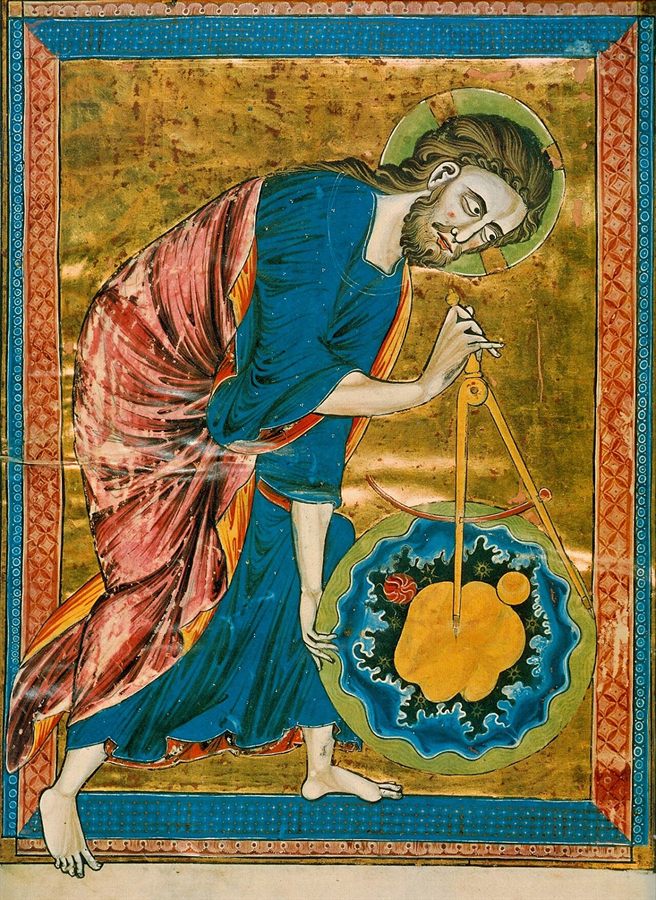
God as Architect of the World, frontispiece of the Bible moralisée, Codex Vindobonensis 2554, c. 1220–30
τί ἐστι;
God as Architect of the World, frontispiece of the Bible moralisée, Codex Vindobonensis 2554, c. 1220–30
Socratic metaphysics · wrap-up
Three steps: Plato needs definitions; definitions with an ontological dimension become Forms; Forms need a receptacle to give rise to sensibles. Each branch gives the short answer first, then the books behind it.
From the Socratic “What is F?” to a world of sensible images: definition, then Form, then receptacle.
Why Plato, not Socrates?
Socrates sought definitions only in ethics, to judge cases and act well. For Plato a definition is the account (logos) that turns true belief into knowledge, so anything that can be known needs one: equality and fire as much as virtue.
Socrates was “busying himself with moral excellence”; the founders of the theory were “concerned with questions of knowledge and its ontological requirements.”
“to know a form requires knowing what it is; and that, in turn, is to know its definition”
“the ethical philosopher is forced to face the problems of epistemology”
Plato “took the questions Socrates was raising about definitions to pertain to a realm of objects different from the ones we perceive.”
How does Plato get from knowledge to what exists?
He argues from the existence of knowledge to the existence of its objects. Knowledge differs from true belief, each cognitive power has its own objects, and sensibles are in flux or both F and not-F, so if there is knowledge there must be stable, non-sensible things for it to be about: the Forms.
“An epistemological premiss, ‘there is knowledge’ gives rise to an ontological conclusion, ‘there are Forms’.”
“Since knowledge requires definitions and definitions require ousia, if there is knowledge there must be things that have or are ousia.”
“the proof that knowledge and opinion are different faculties is conclusive evidence for the fact that the objects with which they are concerned must be different”
Knowledge “is unerring, and takes only what exists as its proper object”; its stability is “an unargued assumption at Meno 98a.”
Plato’s order of explanation runs the other way: “he takes the explanatory order to be metaphysics-first.” White: “Certainly in Plato there is no such divide.”
The Timaeus argument “does not pretend to be conclusive” (Crombie); it is “as pure an example of ‘deductive metaphysics’ as one could hope to find” (Vlastos); “different faculties could have the same object” (Cross & Woozley).
The Timaeus “assumes, and does not argue, that the latter are Forms” (Annas); Plato “invalidly jumps” to separate substances (Irwin); Republic V shows only that “to have any knowledge at all, one must know forms” (Fine).
Why can’t Forms give rise to sensibles on their own?
Sensibles are images, and an image has nothing of its own, so it must come to be in something else. Elemental change needs the same stable “in which”, so Plato posits a third kind that receives becoming, not Forms.
“it stands to reason that the image should therefore come to be in something else, somehow clinging to being, or else be nothing at all”
Asked what a reshaped piece of gold is, “your safest answer by far, with respect to truth, would be to say, ‘gold’.”
“The third Kind is said equally to be that which receives coming-to-be and that in which coming-to-be occurs.” The image is “in” the receptacle and “of” the Form; Form and receptacle “neither are ‘of’ nor ‘in’ each other.”
“If what comes to be explains what comes to be, there will be an infinite regress”
Grasped by “a kind of bastard reasoning”: “Not only must its existence be inferred, but its role can be illustrated only by cumbersome analogies.”
If a logos turns true belief into knowledge, what certifies the logos?
True belief can be right by luck or by persuasion; knowledge is tied down by an explanation. But if each account must itself be known, the accounts regress, and each way out Plato offers has a cost.
A jury persuaded of the truth still lacks the eyewitness’s knowledge. True beliefs run away like Daedalus’ statues until tied down. Knowledge comes by instruction, has an account and resists persuasion; only it is infallible.
In the Meno, yes: a true belief is tied down by working out the explanation, which Socrates calls recollection. In the Republic, belief “excludes” knowledge, so one turns to a different object instead of upgrading the belief.
Partly. The method of hypothesis checks consequences for consistency and backs each hypothesis with a higher one, “verifying or confirming the truth of the hypotheses.” The check stays internal: understanding and verification “cannot be strictly separated.”
Knowledge needs a logos that must itself be known: “the famous regress of reasons.” Plato meets it in the Theaetetus (a “circulus in definiendo”), and recollection meets it too: “Is there to be another process of recollection…? If so, we have an infinite regress.”
A foundation: the unhypothetical first principle, “a sort of foundation for all scientific knowledge,” grasped by infallible, self-reflexive knowing. A circle that is “virtuous, not vicious” if large and explanatory enough. Or left open: Plato “has no answer to this at his finger tips.”
Partly. Knowledge’s objects must be “intelligible Forms and truths about them.” But self-standing Forms bring the Third Man regress, and “if the Forms are entirely separate from things of sense, then we cannot know them as they are in themselves.” Natorp: treat Forms as explanations, not things.
The same move recurs at every level of the discussion: a chain that would run forever ends in something that does not need the next link.
Dialectic climbs to the unhypothetical first principle. Contested: Fine reads Plato as holist instead.
What comes to be cannot explain what comes to be; it needs a principle that is not itself a step.
Whatever comes to be has a cause; the chain ends in the craftsman looking to the eternal model.
Page numbers are the printed pages of the editions in the library; quotations were checked against the PDFs. Annas, Irwin and Burnyeat are cited as quoted by the authors named.