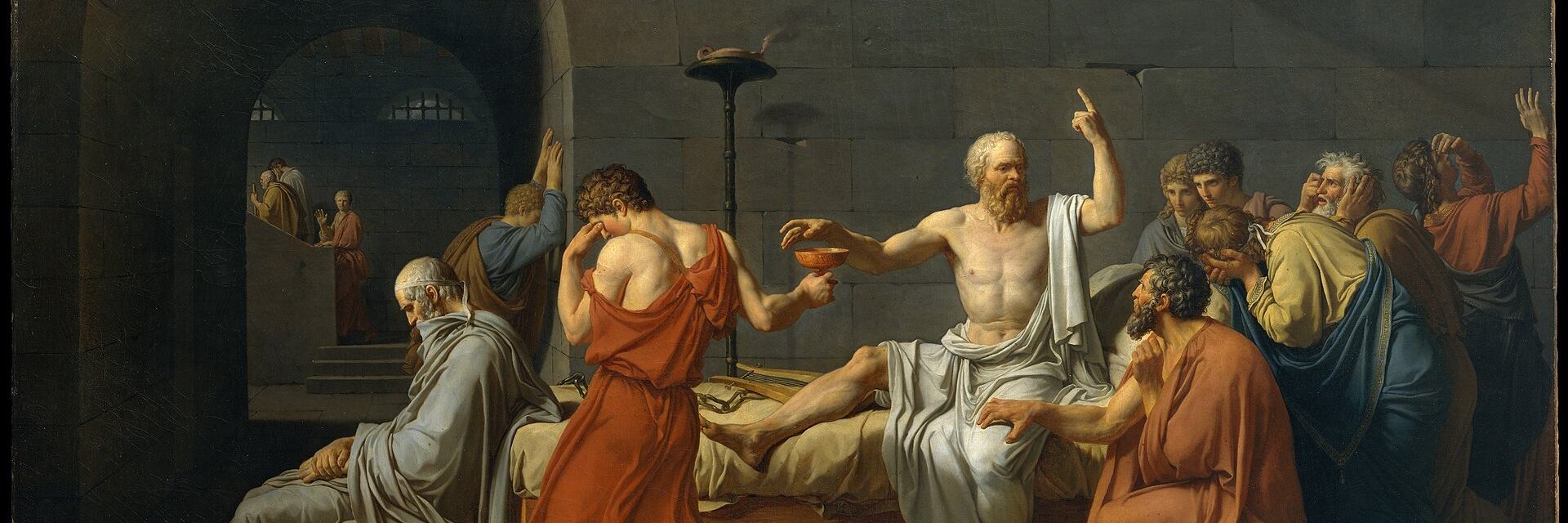
 τί ἐστι;
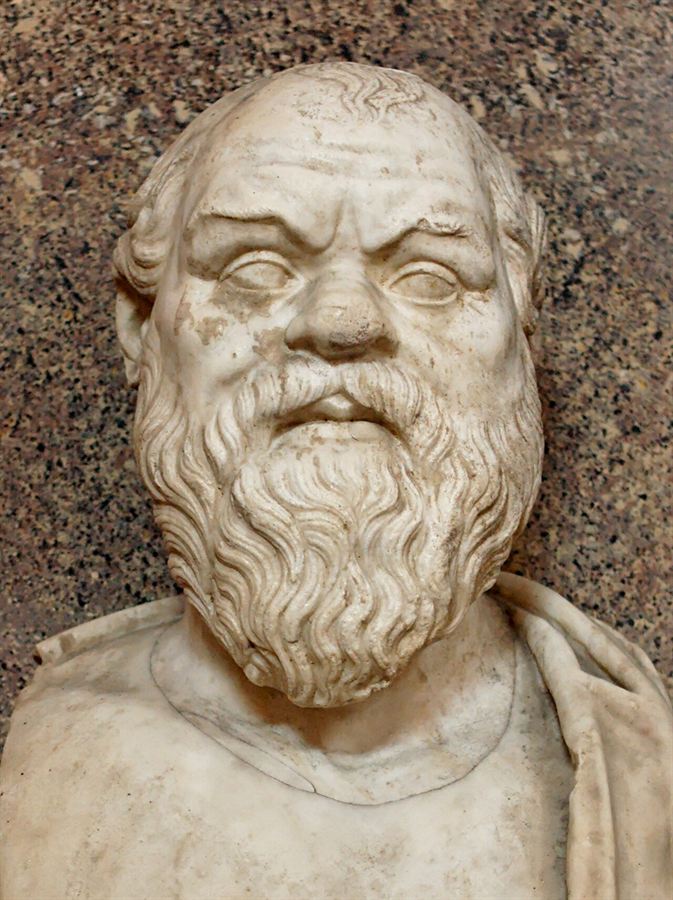
Portrait of Socrates, Roman copy of a Greek original
Prior’s chapter, its five opponents — and what the Euthyphro is actually committed to
This review takes William Prior’s “Socratic Metaphysics” as the field’s best statement of a question that has been asked for a century — whether the Euthyphro’s talk of an eidos amounts to a theory of Forms — and follows it through its five confrontations to a result Prior half-concedes in his conclusion: nobody in the dispute has said what makes a theory metaphysical. Part Two argues that this is not an oversight but a symptom of two different investigations running under one name, and offers an apparatus from the logic of questions to separate them.
One structural finding organises the rest. Five of the seven positions surveyed share a single method: fix a criterion for when a set of claims counts as metaphysical, then test whether the early dialogues satisfy it. Prior fixes Quine’s criterion of ontological commitment; Gail Fine fixes separation, modally defined, with Armstrong’s realist/semantic distinction behind the account of universals; Dancy fixes the Argument from Relativity; Fronterotta fixes the content of the adequacy conditions on a definition; Vlastos fixes reflective investigation. The criteria differ in source and in severity, and the verdicts differ accordingly — but the shape of the argument is the same in all five: criterion first, text second.
Allen is the exception, and the exception is the interesting case. His argument runs: Socrates refutes his interlocutors’ answers without ever establishing what the thing is; he can do this because what he demands is a real definition, governed by conditions on admissible answers; and a real definition is a definition of something that exists. So the forms are not a conclusion the dialogues reach but a presupposition the dialogues need — “not a superstructure gracelessly added on to dialectic: it is the foundation of dialectic” Allen 1970: 68. No criterion is imported and no satisfaction test is run. That is why Allen and the other four never touch, and why no instrument built to detect what a text asserts can either confirm or refute him.
And there is a gap in Allen, which this review does not paper over. He never shows that demanding a real definition is demanding something metaphysical. He identifies the two and proceeds. The identification is defensible — but its defence was published twenty-four years after his book. Kit Fine’s “Essence and Modality” (1994) argues that essence cannot be reduced to modality, and that essence must therefore be understood through real definition — definition of the thing, not of the word. That is Allen’s premise, argued at length against a serious rival. The programme it opened — Lowe on essence as prior to modality, Rosen on grounding, Correia and Schnieder, Koslicki, Oderberg — is among the more active areas of current metaphysics. Allen’s book is of 1970 and his article of 1971. He could not have had any of it. So his premise is vindicated in retrospect and undefended in place, and those are two different things: modern philosophy shows that the step is available, not that he took it. The rival camp is also alive — the deflationists of §16.1, and anyone who holds that definitions are conceptual all the way down.
Two cautions on names and sources. Kit Fine and Gail Fine are different philosophers, and the collision is easy to make in a bibliography: Gail Fine is the author of On Ideas and “Separation,” used throughout Parts One and Two; Kit Fine enters only here and at §30, as modern background. And the modern metaphysics named in this paragraph is reported from knowledge, not held for this project and not quoted from the files — unlike every page reference elsewhere in this review, which was checked against the document it names.
What the review adds. The two-projects distinction at §19, which separates asking what the claims yield when regimented from asking what they conveyed in their own idiom; the three-level erotetic test at §27, which separates the existential presupposition of the ti esti question from the category condition on admissible answers and from a theory of that category; and a comparative table of the seven thresholds at §04. Dancy, the one opponent whose denial rests on a device rather than a thesis, is treated at length in a companion document linked from §04.
Let Plato’s statements x, y, z in the early dialogues carry meanings xm, ym, zm, so that they become premises of arguments built upon them. There are two ways to examine this, and the whole dispute over Socratic metaphysics has been conducted without distinguishing them.
The first takes xm, ym, zm on their own, stripped of Plato’s context and set out as a modern philosopher would set them out, and asks whether they propose a metaphysical theory — whether from those premises one can validly conclude that forms exist and are separate from their instances, or immanent in them, or whatever other feature is at issue.
The second asks a different question: did those statements carry an ontological meaning for Plato and Socrates? Even if xm, ym, zm do not yield an ontology for us, did the words of the Euthyphro convey one in their own idiom, doing the work they were made to do in that text?
The review has two halves. Part One takes William Prior’s chapter as the field’s best statement of the question and follows it through its five confrontations — Dancy, Vlastos, Allen, Fine, Fronterotta — to the result that nobody in the debate has said what makes a theory metaphysical. Part Two argues that this is not an oversight but a symptom: two different investigations have been running under one name. Prior runs the first project and Allen the second, which is why their arguments never touch. An apparatus from the logic of questions then separates three things the debate has run together — the existential presupposition of the ti esti question, the category condition on admissible answers, and a theory of that category. The Euthyphro establishes the second, firmly and textually. It never reaches the third. That is where Prior’s criterion needs it to be.
Prior’s chapter is the spine of Part One and the target of Part Two; Allen’s book is the argument examined most closely. All works below are held and were read directly. Every page reference has been checked against the file it names, except where marked as OCR.
| Work | What it contributes here | Enters at |
|---|---|---|
| William J. Prior, “Socratic Metaphysics,” ch. 4 of J. Bussanich & N. D. Smith (eds.), The Bloomsbury Companion to Socrates (London, 2012), pp. 68–93, with nn. at p. 337 | The chapter under review. Sets the question, states the five positions, and answers each in turn. Also — in a footnote — disowns the chronological framework the whole question is built on. | throughout; §17 |
| R. M. Dancy, Plato’s Introduction of Forms (Cambridge, 2004); “Platonic Definitions and Forms,” in H. Benson (ed.), A Companion to Plato (Oxford, 2006), pp. 70–84 | Obstacle one. A theory of definition with three requirements, and the claim that where Socrates is concerned with definitions “he is not concerned with metaphysics at all.” | §§05–06 |
| Gregory Vlastos, Socrates: Ironist and Moral Philosopher (Cambridge, 1991), ch. 2 | Obstacle two, and the strangest. Thesis II makes SocratesE “exclusively a moral philosopher” — and then pp. 57–58 concede him an ontology in so many words. | §§07–08 |
| R. E. Allen, Plato’s ‘Euthyphro’ and the Earlier Theory of Forms (London, 1970); “Plato’s Earlier Theory of Forms,” in G. Vlastos (ed.), The Philosophy of Socrates (1971), pp. 319–34 | The ally, and the source of the position Prior adopts. Real definition; forms as the foundation of dialectic, not a superstructure on it. Distrusts Aristotle. | §§09–10 |
| Gail Fine, On Ideas: Aristotle’s Criticism of Plato’s Theory of Forms (Oxford, 1993), ch. 5, pp. 44–65 | The second ally. Aristotle read as reliable; Socratic and Platonic forms both universals and properties, so the gap narrows to three predicates. | §§11–12 |
| Francesco Fronterotta, “The Development of Plato’s Theory of Ideas and the ‘Socratic Question’,” OSAP 32 (2007), pp. 37–62 | The obstacle from above. Written in reply to Prior 2004: yes there is a theory, and the forms of the early dialogues are already separate. Development disappears. | §§13–14 |
| Prior, W. J., “Socrates Metaphysician,” OSAP 27 (2004), pp. 1–14 | The earlier article the chapter reuses and Fronterotta answers. Quoted throughout the chapter by page. | §08 |
| John Burnet, Plato’s Euthyphro, Apology of Socrates, and Crito (Oxford, 1924), notes at pp. 116–17 | Ontology delivered three times in philological notes: the instrumental dative, the Phaedo cross-reference, and — against himself — the concession at 7a2. | §24 |
| Gail Fine, “Separation,” OSAP 2 (1984), repr. in Plato on Knowledge and Forms (Oxford, 2003), pp. 252–300 | The three senses of separation at p. 257, and the verdict at p. 294 that the middle dialogues do not clearly argue for it. | §28 |
| P. T. Geach, “Plato’s Euthyphro: An Analysis and Commentary,” The Monist 50 (1966) · S. Marc Cohen, “Socrates on the Definition of Piety: Euthyphro 10A–11B,” JHP 9 (1971), 1–13 | The two canonical technical reconstructions of the passage — and the evidence that neither touches the ousia moment at all. | §22 |
| David Wolfsdorf, Trials of Reason (Oxford, 2008), pp. 129, 193 · Michael Ferejohn, Formal Causes (Oxford, 2013), pp. 50, 59 · Hugh Benson, Socratic Wisdom (Oxford, 2000), p. 121 n. 36 | The three readings that do the most careful work on 11a–b, including the direct attack on the premise Allen needs. | §22 |
Read this once; everything after it is elaboration.
One conclusion, five obstacles, and the obstacles do not stand in a line. Two of them say the passages claim too little to be a theory; two are allies who claim the same thing for different reasons and disagree with Prior about the details; one says the passages claim too much for there to be any development at all. Clearing any one leaves the others exactly where they were.
| Obstacle | What is denied | On what ground | Prior’s reply, in a line |
|---|---|---|---|
| Dancyfrom below | That the Euthyphro passages are metaphysical at all | They state conditions on definitions. Metaphysics begins with the Argument from Relativity, in the Phaedo. | Your own Transmission Theory is metaphysics by your own admission — and you never check whether the whole package already adds up. |
| Vlastosfrom below | That the ontology is a theory, or Socrates a metaphysician | Everyone assents to it as a matter of course; and Socrates never asks “What is form?” | By Quine’s criterion he is committed. And the “everyone agrees” claim is false — Meno does not. |
| Allenfrom beside | Nothing — but denies Aristotle’s reliability | On Aristotle’s own account of separation, the early forms are just as separate. | Side with Fine: take Aristotle at his word, and keep the two senses of separation apart. |
| Finefrom beside | Nothing — but makes the gap smaller | Socratic and Platonic forms are both universals and properties; only three predicates differ. | Agreed about Socrates. But separation changes what kind of entity a form is — property to substance. |
| Fronterottafrom above | That there is any development to describe | The early forms are already separate; “two worlds” is only a metaphor for what was there. | Two Worlds separation answers an epistemological question the early dialogues never raise. His second objection — immanence vs. universality — goes unanswered (§14.1). |
The dispute is not about the Greek. All five read Euthyphro 5c–d and 6d–e the same way. What divides them is a question none of them answers: how much does a set of claims have to contain before it counts as a metaphysical theory? Prior gets this into the open by quoting a reviewer against Dancy — “I worry about the lack of attention given to the question as to what counts as a metaphysical theory” — and then, in his own conclusion, concedes that he cannot fix the threshold either: “Exactly where the threshold of metaphysical significance lies is uncertain.”
Once that is visible, the five obstacles stop looking like five readings of a text and start looking like five placements of a line. Dancy and Vlastos put it at separate existence. Fronterotta puts it so low that the early dialogues are already across. Prior puts it at the One over Many, and then declines to insist, arguing instead that his seven features cross it “as a body, wherever it lies.”
1 · The first premise is Prior’s imputation, not his opponents’ claim. What is on the page is Prior’s report: “Dancy (like Vlastos) identifies ‘having a metaphysical view’ with having … ‘a grandiose theory of separately existing Forms’” p. 75. Dancy states no criterion at all — that is Zeyl’s complaint and Prior’s. And Vlastos’s stated criterion is something else entirely: reflective investigation. “One qualifies as a linguist when one makes language an object of reflective investigation … And this is what SE never does” 1991: 58. Separation is how Vlastos characterises Platonism; it is not how he defines metaphysics. §08 answers the criterion Vlastos actually gave; the box above answers the one Prior attributes to him.
2 · The second premise conjoins two sources that nobody conjoins. “Says what there is, with identity conditions” is Quine, and Prior uses it explicitly p. 80; 2004: 7–8. “And a causal role” is Allen and Fine. The conjunction is a reconstruction, and §16.1 shows that the Quinean half and the framework Prior cites as his foundation are not compatible.
Nobody invented the first premise. It descends from Aristotle, Metaphysics M.4 1078b30–31: “Socrates did not make universals or definitions separate, but they separated them.”
But notice what Aristotle is doing there. He is distinguishing Plato from Socrates — separation is his mark of what makes a theory Platonic. It is not his mark of what makes a set of claims metaphysical, and it cannot be: at M.9 1086b2–7 he says Socrates “was right not to separate them,” which would be an odd thing to say of a man who on that account had no view.
The criterion is inherited and put to a different job. A mark of Platonism becomes a mark of ontology as such. That slide is the root of the dispute, it is made by no one on purpose, and once it is named, Prior’s “I do not think this is a reasonable place to put the threshold” stops being a preference and becomes a diagnosis.
Before any of the five is heard, three things have to be fixed: what is being asked, what text is being asked about, and how much of the answer is already common ground.
Almost everything is common ground. What is contested is a single word — “theory” — and nobody has defined it.
It is easy to read this literature as five rival interpretations of two short passages. It is not that. All five interpreters agree on what the passages say, on which words matter, and on which dialogue they belong to. Four of the five agree that the Phaedo contains a theory of Forms and that the Euthyphro lacks something the Phaedo has.
What they disagree about is whether what the Euthyphro has, without the thing it lacks, is enough to be called a theory — and that is a question about where to put a line, not about what the Greek says. §04 makes the line explicit, because the rest of the chapter is unreadable without it.
Prior opens by refusing to let the question stay vague. “Did Socrates have a metaphysics?” splits into two prior questions — what a metaphysics is, and who Socrates is — and he answers both before starting.
Metaphysics is concerned with what lies at the foundation of things, the principles underlying reality. In this essay, that will mean primarily an ontology, a theory of ‘what there is’. Prior, “Socratic Metaphysics” p. 68
That is a deliberately modest stipulation, and it does a great deal of work later: it is the reason Vlastos’s concession at §07 turns out to be fatal to Vlastos’s own thesis. On the second question Prior is equally brisk. Of the five, “only Gregory Vlastos insists that he is seeking the historical Socrates. The rest are content to deal with the Socrates of the Platonic dialogues” p. 68 — and that, Prior says, is “the only Socrates about whom we have information adequate to provide an answer to the ontological question.”
Prior notes that this formulation is forced on him by the developmentalist framework, which confines the question to the early group. He then lists the three answers the framework allows:
The stakes are not scholastic, and Prior says why at some length. The answer “decisively shapes our understanding of the nature of Socrates’ philosophical inquiry, which is central to everything we know about him” p. 71. If the Socrates of the early dialogues has a theory of forms, then he stands much closer to the Socrates of the middle dialogues than Dancy or Vlastos can allow — and Vlastos’s whole solution to the Socratic problem, which depends on the two being irreconcilable, loses its foundation.
Two passages, quoted in full, because the entire chapter is a quarrel about them.
Prior labels them E1 and E2, and every one of the five scholars anchors his or her reading in one or both.
(E1) SOCRATES: … So tell me now, by Zeus, what you just now maintained you clearly knew: what kind of thing do you say that godliness and ungodliness are, both as regards murder and other things; or is the pious not the same and alike in every action, and the impious the opposite of all that is pious and like itself, and everything that is to be impious presents us with one form (idean, d4) or appearance in so far as it is impious?
EUTHYPHRO: Most certainly, Socrates.
SOCRATES: Tell me then, what is the pious, and what the impious, do you say? Euthyphro 5c–d, trans. Grube — Prior p. 69
(E2) SOCRATES: Bear in mind then that I did not bid you tell me one or two of the many pious actions but that form (eidos, d11) itself that makes all pious actions pious, for you agreed that all impious actions are impious and all pious actions pious through one form (idea, e1), or don’t you remember?
EUTHYPHRO: I do.
SOCRATES: Tell me then what this form (idean, e4) itself is, so that I may look upon it, and using it as a model (paradeigmati, e6), say that any action of yours that is of that kind is pious, and if it is not that it is not. Euthyphro 6d–e — Prior p. 69
Prior reads four commitments straight off the surface, and it is worth noticing that none of the five disputes any of them:
It is worth setting out the common ground in one place, because the size of it is the reason the chapter has the shape it has. If the five disagreed about the text, Prior could argue about the text. They do not, so he cannot.
1. Plato has a metaphysics — in Vlastos’s phrase, which Prior adopts as the chapter’s point of departure, “a grandiose theory of ‘separately existing’ Forms” Vlastos 1991: 48, found in the Phaedo, Symposium and Republic.
2. Those Forms are universals, causes, paradigms or standards, and in some sense self-predicational.
3. The Euthyphro is an early dialogue. “All of the authors considered in this essay regard the Euthyphro as an early dialogue” p. 69.
4. E1 and E2 are the proof texts, and they use eidos, idea and paradeigma.
That the difference between the early passages and the middle-period theory is separation — that the forms of the early dialogues do not exist apart from their participants, and the Forms of the middle dialogues do. Fronterotta is the exception, and denies precisely this.
What divides the four who agree about separation is not whether it is the difference, but how much difference it makes. Prior sets that out with unusual precision:
For some interpreters (Allen and me, in particular), separation is a serious issue, marking a large-scale difference between the theories and requiring a difference in the kind of entities forms can be said to be (unseparated forms being properties, but separate Forms being substances). For Fine, in contrast, the difference between the unseparated forms of the early dialogues and the separated Forms of the middle dialogues is much more modest, with forms of both kinds being treated as properties. For Francesco Fronterotta, the germ (at least) of separation, and thus of the middle period theory of Forms, is already present in the early theory. Prior p. 70
The question the whole literature is really about, and which nobody in it has answered.
Prior does not use the word “threshold” until his conclusion, but the concept is doing all the work from the first page. The five positions are not five readings of a text; they are five placements of a line, and the line is: how much must a set of claims contain before it is a metaphysical theory?
The most damaging thing in the chapter is not any of Prior’s five replies. It is a quotation he takes from a review of Dancy by Donald Zeyl, which he deploys against Dancy and which turns out to indict the whole discussion:
I worry about the lack of attention given to the question as to what counts as a metaphysical theory, and what distinguishes such a theory from one that isn’t metaphysical. That distinction is crucial to Dancy’s overall argument, yet it seems assumed without much support. Donald Zeyl, review of Dancy 2004 — quoted at Prior p. 75
Prior presses the point in his own voice, and the sentence is the hinge of the chapter:
And then, seventeen pages later, Prior concedes the same about himself. That symmetry — the objection turning on its author — is treated at §16.
The arrangement above puts the five positions on a single axis, from a high threshold to a low one. That is how the chapter presents them, and it is incomplete. Set each criterion out in the words its author gives it and a second division appears, deeper than the first: they are not all measuring the same thing. Three ask what a text commits its user to. One asks what the question presupposes. Two ask what the text takes as its topic. A commitment test and an aboutness test can both be correctly applied to Euthyphro 6d–e and return opposite verdicts without either being misapplied.
Zeyl says Dancy assumes the distinction “without much support,” and Prior adds that he “does not offer an account of what makes a theory metaphysically innocent.” That is true of any definition. It is not true of Dancy’s practice. He has an operational criterion, stated forty-seven pages before he uses it: the Argument from Relativity. “The concession by itself is not a piece of metaphysics, but simply a matter of fixing the topic for discussion” Dancy 2004: 19; metaphysics is the affirmation plus “the subsequent apparatus that turns the affirmation into metaphysics” pp. 67–8.
So the threshold problem is not that nobody states a criterion. It is worse than that. The one criterion in the literature that is operable is the middle-period argument itself — the thing whose presence in the early dialogues is the question — used as the measure of whether the early dialogues have reached it. And on Dancy’s own p. 19, all three of its premises are already granted to the Socratic dialogues; what is missing is the assembly.
| Scholar | The threshold, as stated | What it tests | Verdict on the Euthyphro | Where |
|---|---|---|---|---|
| Prior | Quine’s criterion of ontological commitment. “Socrates is committed to the existence of justice, piety and the like: he treats them as values of bound variables.” | Commitment — what the sentences quantify over | Yes — “whether or not it counts as a theory” | p. 81; 2004: 7–8 |
| Fine | Separation, modally: forms are separate iff “they can exist whether or not any corresponding sensible particulars exist.” | Commitment — a modal fact about the entities | Forms yes, separation no — and “Plato never argues, or even says, that forms are separate” | On Ideas 51, 60–1 |
| Allen | Real definition, biconditionally. “To say that Forms exist is to say that real definition should be pursued; to say that real definition should be pursued is to say that Forms exist.” Forms are “antecedents of ‘it’ in the question ‘What is it?’” | Presupposition — what the question must range over | Yes — “the foundation of dialectic,” not a superstructure on it | 1970: 68 |
| Fronterotta | The content of the requirement on the definiendum: if what is defined must be universal, unchangeable and stable, “it obviously cannot belong to the physical world.” | Commitment — entailment from the adequacy conditions | Yes, and already separate | 2007: 50–1, 57 |
| Burnet | The construction itself — the instrumental dative read productively: “the universal makes the particulars.” | Grammar — the shape of the sentence | Yes — delivered in a philological note, without argument | 1924: 116–17 |
| Vlastos | Reflective investigation. “One qualifies as a linguist when one makes language an object of reflective investigation. One would qualify as an ontologist if one made ontology an object of reflective investigation. And this is what SE never does. … What is form? he never asks.” | Aboutness — second-order thematisation | Has an ontology; is not an ontologist | 1991: 58 |
| Dancy | Possession of the Argument from Relativity. Existence alone is “fixing the topic”; metaphysics is the affirmation plus “the subsequent apparatus.” | Aboutness — and, against Allen, validity | Not yet — the conclusion is not stated, though p. 19 grants the premises are present | 2004: 18–19, 67–8, 80 n. 3 |
1 · The two “no” verdicts share an instrument. Vlastos’s reflective-investigation test and Dancy’s thematisation test are the same test in different words: both ask whether the text turns and looks at its own furniture. Neither asks what the furniture is doing while nobody looks.
2 · Prior has already refuted that instrument once, and has not noticed it generalises. Against Vlastos: “it is too restrictive. True, Socrates does not ask ‘What is Form?’ in the early or Socratic dialogues, but neither does he ask it in later dialogues, such as the Phaedo and Republic, which Vlastos admits are metaphysical” p. 81. Applied evenly, an aboutness test either promotes the Euthyphro or demotes the Phaedo. The same objection reaches Dancy, and nobody has put it to him.
Followed up at length elsewhere. Dancy is the only one of the five whose denial rests on a device rather than a thesis, and the device — the swimming-pool analogy at pp. 65–6 — is given once and never defended. The criterion recovered above, the analogy, the footnote that answers Allen, and five objections to the whole construction are set out in a companion document: Dancy and the Threshold — the criterion he does set, and the three tests that cannot see what Allen claims. Its §13 reads Allen p. 68 in full, which this section cites at second hand.
Two scholars who say the passages claim too little. They agree with each other about the conclusion and disagree about almost everything else.
Dancy denies there is metaphysics in the early dialogues. Vlastos concedes there is an ontology and denies it is a theory. The second concession is the more useful of the two, and Prior builds on it.
Both of these are developmentalists, and both draw the line at separate existence. But the shape of the denial is different in each case, and so the reply has to be different. Dancy says the Euthyphro gives you a theory of definition — three requirements on what a good answer to “What is F?” must do — and that a theory of definition is not a theory of anything that exists. Vlastos does not say that. Vlastos says Socrates has an ontology, in so many words, and then denies him the title of ontologist on the ground that he never reflects on it.
The two denials fail for different reasons, and Prior treats them separately. Against Dancy the reply is that his own theory already contains metaphysics on his own admission. Against Vlastos the reply is that the premise about universal assent is simply false of the text.
The purest version of the anti-metaphysical position, and the one Prior treats with the most respect.
Dancy is a developmentalist who divides the corpus into a Socratic group (Charmides, Euthyphro, Hippias Major, Laches, Lysis, Protagoras, Republic I), a doctrinal group (Phaedo, Symposium, Republic), and the Meno as transitional. What the early dialogues contain is not metaphysics but a theory of definition, which Dancy constructs from their refutations rather than finding stated in them.
The last two “are clearly stated in (E2)” p. 73 — which is the whole difficulty, since E2 is also the metaphysician’s proof text.
The load-bearing claim is the one Prior quotes twice, because everything turns on it:
That Theory of Definition will contain one fairly straightforward condition of adequacy for a definition, below called the “Substitutivity Requirement,” another more difficult one, the “Explanatory Requirement,” and a third quite puzzling one, the “Paradigm Requirement.” The latter two especially will feed into the Theory of Forms. They do not, however, entail that theory; where Socrates is concerned with definitions, he is not concerned with metaphysics at all (against this see, e.g., Allen 1970). We shall see the turn toward metaphysics when we get to the Phaedo. Dancy, “Platonic Definitions and Forms,” in Benson (ed.), A Companion to Plato p. 71
Prior quotes the middle of that sentence and drops what follows the semicolon’s end. The parenthesis matters: Dancy names Allen 1970 as the position he is denying, on the page where he states the denial. The line of §§05–10 is therefore not a coincidence of the chapter’s arrangement — Dancy and Allen were already opposed, in print, and Prior is standing behind Allen.
What marks the transition, for Dancy, is the Argument from Relativity — and it is not in the Socratic dialogues:
“This argument does not appear in the Socratic dialogues, though it is anticipated in the Hippias Major. It does, however, appear in the middle dialogues” p. 72. Dancy identifies it with the Argument from Flux that Aristotle uses to separate Socrates from Plato — and he accepts Aristotle’s testimony that “Socrates did not make the universals or the definitions exist apart” (Metaphysics M.4, 1078b30–31).
Dancy connects the Paradigm and Explanatory Requirements by what he calls a Transmission Theory of Causality: the cause transmits to the effect a quality it possesses itself, so the cause of something’s being F is the perfect paradigm of F-ness. And of that theory he says:
Dancy calls the Transmission Theory ‘a piece of metaphysics although not yet the Theory of Forms’. Dancy 2006: 77 — at Prior p. 73
Prior immediately inserts his objection in parentheses, and it is the most efficient sentence in the chapter:
Two passages show the placement precisely. The first is on the Hippias Major, where Hippias concedes that justice exists and that by justice things are just:
Almost but not quite, and here close doesn’t count. So far we have only conceded the existence of the beautiful, and no one can suppose that this concession lets in the super-beautiful described in the Symposium. All that Socrates needs is that there is something to be defined, as subject for his ‘what is it?’ question. Dancy, Plato’s Introduction of Forms p. 78 — quoted at Prior p. 74
And the second, on why the Hippias Major’s argument does not establish a theory of Forms: “Socrates says nothing whatever to indicate that he has an overarching interest in the transcendental existence of the Form of the Beautiful” (2006: 79). Prior’s gloss is flat and correct: “This remark indicates clearly that Dancy regards only a theory of transcendental Forms as a metaphysical view” p. 73.
It matters, for §06, that Dancy’s denial is not a claim about Plato’s mind. He says so explicitly, in a passage Prior does not quote:
when I deny (as I shall) that the Euthyphro has a “Theory of Forms,” I do not suppose that I am commenting on what was or was not in Plato’s mind at the time he wrote the Euthyphro. I am talking only about what is required by the argument of the Euthyphro. Dancy, Plato’s Introduction of Forms p. 11
So the disagreement between Dancy and Prior is not about history and not about Greek. It is about what a given body of argument requires — which is exactly the kind of question a threshold governs.
Prior concedes almost the whole of Dancy’s positive account, and attacks one gap in it.
The concession is generous and specific:
Dancy provides an excellent account of the theory of definition in the Socratic dialogues, and of the development or unfolding of the theory of Forms in the Phaedo and Symposium. A proponent of the Allen/Fine/Prior account … can accept much of what he says. Prior p. 75
Then the objection, in two parts.
The one substantive textual difference concerns the Hippias Major’s beautiful girl. For Dancy the step from “any beautiful girl is also ugly” to the general Argument from Relativity is a large one, requiring a generalisation Socrates does not make. For Prior:
For me the step is a small one, and is almost inevitable when one realizes that there is nothing special about the example of a maiden, that she simply typifies the entities in the phenomenal world. In general, I think the Socratic dialogues anticipate the Platonic theory of Forms in many ways such as this. Prior p. 76
Strong on the threshold. The complaint that Dancy never defines metaphysical innocence is well-founded, and Zeyl’s review makes the same complaint independently. Dancy’s working criterion — as Zeyl reconstructs it, that a claim intelligible to naive interlocutors and accepted as obviously true is not metaphysical — is one Dancy never states and could not easily defend. Zeyl’s reply is unanswerable as it stands: “Why, one might wonder, should a philosophically naïve interlocutor be incapable of understanding a metaphysical proposition?”
Weaker on the package. The parenthesis at p. 74 is an invitation, not an argument. Prior asks whether the four items amount to the Phaedo’s theory; he does not carry out the comparison, and he does not say which of the Phaedo’s commitments the package would still be missing. Since the answer — on Prior’s own account — is separation, the parenthesis assumes exactly what is in dispute. It shows that Dancy owes an argument. It does not supply one.
And note the asymmetry of burden. Prior repeatedly says Dancy “does not show” that the early material is non-metaphysical. But Dancy could reply, with equal justice, that Prior does not show that it is — both are appealing to a threshold neither has drawn. §16 is where this comes home.
The most influential position in the field, and the one that concedes most of what it means to deny.
Vlastos divided the corpus, distinguished SocratesE from SocratesM, identified the first with the historical Socrates and the second with Plato, and listed ten differences. Thesis II is the one that matters here, and he says so himself:
IIB. SocratesM had a grandiose metaphysical theory of ‘separately existing’ Forms […]
IIA. SocratesE has no such theory. Vlastos, Socrates: Ironist and Moral Philosopher p. 47
I move directly to Thesis II, the most powerful of the ten: as I shall try to show in the balance of the present chapter, the irreconcilable difference between SocratesE and SocratesM could have been established by this criterion even if it had stood alone. Vlastos p. 53
From the absence of SocratesM’s theory Vlastos infers that SocratesE is “exclusively a moral philosopher” p. 47. And then, having set out the two conditions on definition that E1 and E2 impose, he writes the passage Prior labels V1 — and which, read on its own, reads like an argument for the opposite conclusion:
(V1) In assuming that these two conditions can be met SE is making a substantial ontological commitment. He is implying that what there is contains not only spatio-temporal items, like individuals and events, but also entities of another sort whose identity conditions are strikingly different since they are “the same” in persons and in actions which are not the same: justice here and justice there and again elsewhere, the same in different individuals and occurrences, real in each of them, but real in a way that is different from that in which they are real, its own reality evidenced just in the fact that it can be instantiated self-identically in happenings scattered widely over space and time, so that if justice has been correctly defined for even a single instance, the definiens will be true of every instance of justice that ever was or ever will be anywhere — in Greece or Persia, on earth or on Olympus or in Hades.
That there are things which meet this strong condition is a piece of ontology firmly fixed in SocratesE’s speech and thought. He has this ontology. Vlastos pp. 57–58 — quoted at Prior pp. 76–7 as (V1)
Vlastos sees the problem coming and meets it in the next sentence: “Can he have an ontology without being an ontologist? Why not?” The answer is an analogy:
The belief in the existence of a physical world independent of our own mind … is a solid piece of ontology, as entrenched in the mind of the average Athenian then as in that of the average New Yorker now. Does this make an ontologist of either of them? Why should it? Can’t one have a language without being a linguist? One qualifies as a linguist when one makes language an object of reflective investigation. One would qualify as an ontologist if one made ontology an object of reflective investigation. And this is what SE never does. Vlastos p. 58
The test is then applied. Socrates asks what piety is, what beauty is — but never what form is:
The search for those general properties of forms which distinguish them systematically from non-forms is never on his elenctic agenda. He asks: What is the form piety? What is the form beauty? And so forth. What is form? he never asks. He is perplexed about many things, but never about the fact that what there is contains forms … He banks on their reality with the same unreflective, unexamined, unargued, undefended assurance with which the man in the street banks on the reality of trees and stones. Vlastos pp. 58–59
Vlastos’s case is comparative, and the comparison is precise. In the Protagoras, faced with the leading relativist of the age, Socrates declines the ontological argument altogether:
Plato could hardly have made it clearer that the interests of Socrates in this dialogue are exclusively ethical. Brought up face to face with the premier relativist of the day, the chance to debate ontology virtually thrust upon him, SocratesE turns it down. Vlastos p. 63
In the middle dialogues the same existence claim becomes contestable. It is a “posit” at Republic 596a and a “hypothesis” at Phaedo 100b — “To the existence of the F, which had been regularly conceded to SocratesE by all of his interlocutors without contest, SocratesM refers as a highly contestable thesis” p. 63. Prior reports the four categorical features Vlastos then attributes to the Forms — inaccessible to the senses, absolutely changeless, incorporeal, existing “themselves by themselves” — and the conclusion:
This is the heart of Plato’s metaphysics: the postulation of an eternal self-existent world, transcending everything in ours, exempt from the vagaries and vicissitudes which afflict all creatures in the world of time, containing the Form of everything valuable or knowable, purged of all sensory content. Vlastos p. 76 — at Prior p. 78
Vlastos knew Allen’s position and did not dismiss it. Attached to the sentence “it is gratuitous to credit him … with a theory of forms” is this note:
For an attractive version of this view, which allows SE to have a piece of SM’s ontology — though only a modest one, still a far cry from SM’s two-world theory of reality — see Allen, 1970: 67ff. et passim. Vlastos p. 59 n. 52
So the disagreement between Vlastos and Allen is, on Vlastos’s own showing, about how much of SocratesM’s ontology SocratesE gets — not about whether he gets any.
Prior’s own contribution, first published as “Socrates Metaphysician” (2004) and reused here.
Prior begins by pocketing the concession, and he is explicit about what it does to the map:
Now Vlastos’s response to the claim that there is an ontology in the Socratic dialogues is remarkable: as we saw above, he admits that SocratesE has this ontology (V1). He goes on to argue that though he has an ontology, SocratesE is nonetheless still exclusively a moral philosopher. Before I go further, let me note that from my perspective this concession puts Vlastos in the camp of those who, like Allen, Fine and myself, attribute to the Socrates of the early dialogues a metaphysical view. Prior p. 80
What is left of Vlastos’s denial is then two theses, and Prior answers each.
Reply (ii) is the sharpest thing in the chapter. Vlastos’s criterion for being an ontologist is reflective investigation of ontology as such; the Phaedo and Republic do not contain it either; and Vlastos calls them metaphysical. So the criterion, applied evenly, either promotes the Euthyphro or demotes the Phaedo.
Prior calls this “perhaps the most serious objection Vlastos made,” and answers it in three moves — the third of which is a straightforward textual refutation.
Prior adds two supporting observations from the same page: that Socrates is careful to secure explicit assent to his existence claims — from Protagoras, Hippias and Euthyphro alike — and that his interlocutors “often show that they do not really understand such claims even when they have assented to them.” Hippias and Euthyphro find the idea of a common character “intellectually daunting,” and “it takes much subsequent discussion to sort matters out.”
Objection: the Meno is transitional, not early — on Vlastos’s own scheme it belongs to the group he thinks post-dates the elenctic dialogues. So a refutation drawn from Meno’s resistance is not a refutation about SocratesE.
Reply: “It is, however, in its first third, an elenctic dialogue, as Vlastos notes (Vlastos 1988: 144). The discussion of the ontology of definition in the Meno is germane to the ontology of the elenctic dialogues” p. 82. And a second pre-emption: if it is objected that the Meno’s doctrine of Recollection is linked in the Phaedo to separate Forms, so that the Meno’s common characters must be separate too — “the common characters of the Meno are not separately existing Forms, but ‘forms’; there is no trace of separation in the Meno” p. 82.
1. The Socrates of the elenctic dialogues is a moral philosopher. The form his moral philosophy took was that of enquiry into the nature of the moral virtues. The assumption underlying this enquiry is that the virtues are characteristics, properties, common to many individual persons and actions. Without this assumption it is hard to see how moral enquiry could go forward. The assumption is ontological, metaphysical in character. The fact that it is held not casually, but in the face of philosophical objections, marks it as a philosophical view. Prior 2004: 13–14 — at Prior p. 82
2. Vlastos was incorrect in his claim that the Socrates of the early dialogues was exclusively a moral philosopher … The ontology of the elenctic dialogues differs from that of the middle dialogues only in a single respect: separation. This is a huge difference and it is, strictly, an incompatibility. Thus, the ontology of the elenctic dialogues is in this one respect incompatible with that of the middle dialogues. In other respects, however, it is compatible with that ontology and should be seen as the precursor or first stage of that theory. Prior 2004: 14 — at Prior p. 82
Two allies. Neither is an obstacle to the conclusion; both are obstacles to the version of it Prior wants.
Allen supplies the theory Prior adopts and distrusts the witness Prior relies on. Fine trusts the witness and narrows the gap so far that Prior’s “huge difference” starts to look small.
These two sections are the reason the chapter cannot be a single argument even among friends. Allen, Fine and Prior all hold that there is a theory of forms in the early dialogues; they hold it on the same textual basis, E1 and E2; and they still disagree about two things that matter. One is whether Aristotle’s report can be trusted. The other is what separation does — whether it changes a form’s properties or changes what kind of thing a form is.
Prior sides with Fine against Allen on the first and with Allen against Fine on the second. The result is a position that is nobody else’s, and he says so.
The source of the position Prior adopts. “His works remain, after four decades, the classic statement of that view.”
Allen finds his evidence where everyone does — in E1 and E2 — and reads the forms there as universals, causes, self-predicating paradigms and essences. What he adds is an account of why that set of claims has to be metaphysical rather than merely regulative: because the two roles the forms play are inseparable.
That theory is both logical and metaphysical. Logically, Forms play a regulative role in dialectic: as antecedents of ‘it’ in the question ‘What is it?’ they determine the kinds of answer which are acceptable, and more importantly, unacceptable, in Socrates’ search for definition. They define the conditions for deciding when dialectic has succeeded, and when it has failed. Metaphysically, Forms affect the career of the world: they are the real natures of things, and the world is what it is because they are what they are. Allen, Plato’s ‘Euthyphro’ and the Earlier Theory of Forms pp. 67–8
The join is real definition, and Allen states the equivalence as tightly as it can be stated:
These two sides of Plato’s theory meet in the notion of real definition. Dialectic is governed by rule, and directed toward the nature of things. Its rules are determined by its aim. To say that Forms exist is to say that real definition should be pursued; to say that real definition should be pursued is to say that Forms exist. The theory of Forms in the Euthyphro is not a superstructure gracelessly added on to dialectic: it is the foundation of dialectic. Without it, dialectic would not proceed by the rules it uses, or work toward the goal at which it aims. Socratic moral inquiry is inquiry about reality. Allen p. 68
That last clause is the answer to Vlastos in a single line, thirty years before Prior gave it in Quine’s vocabulary: if Socratic inquiry is inquiry about reality, the question whether Socrates is “also” a metaphysician does not arise.
Prior reports Allen’s account carefully, because it does the work Dancy’s theory of definition does not:
Hence the conclusion Prior takes over wholesale: “The fact that the forms Socrates seeks in the Euthyphro are universals, standards and essences implies that the kind of definition he seeks is real definition; this in turn entails that the search is a metaphysical one” Prior p. 83.
Allen’s own version of the anti-nominalist point is more vivid than any paraphrase, and it turns on a criterion of existence he takes from Plato himself:
This echoes Plato’s own criterion of ontological commitment in the Sophist (247e), which he supposed was shared by Gods and Giants alike: it is that the mark of being is power, power to act or to be acted upon. A difference, to be a difference, should make a difference. If Forms are to exist, we might expect them, not as it were to just sit there, but to do honest work, to affect the career of the world. This they do; for we shall find that, in the early dialogues, Forms are causes. Allen 1970, ch. on Essence and Reference
Prior quotes the 1971 version of the same passage — “They do honest work … Beauty is not a word, not a thought, not a concept. It is an existing thing” Allen 1971: 329 — and adds Allen’s explanation of why Euthyphro can accept all this without a struggle. The theory is metaphysical, but it is “continuous with common sense” 1971: 330:
His question is hardly one which common sense, left to its own devices, will ask. But it is a question to which common sense may certainly be led… The progress of dialectic involves passage from the naive existence claim that ‘there is such a thing as holiness’ to the highly sophisticated existence claim that there is an essence of holiness, and that it can be defined… the commitment to essence is then latent in the common sense use of words. Allen 1971: 331
Allen is emphatic that what he has found is not the middle-period doctrine, and his statement of the difference is the one Prior adopts and Fronterotta attacks:
[T]hat theory of the choir of heaven and the furniture of earth found in the Phaedo, Republic, and other middle dialogues… The philosophy of the middle dialogues is a nest of contrasts: Being and Becoming, Appearance and Reality, Permanence and Flux, Reason and Sense, Body and Soul, Flesh and the Spirit. Those contrasts are rooted in an ontology of two Worlds, separated by a gulf of deficiency. Allen 1971: 332 — at Prior p. 84
And he explains the change by an epistemological pressure that arises about Socratic dialectic rather than within it — the passage that becomes Prior’s weapon against Fronterotta at §14:
Plato’s account in the middle dialogues is conditioned by problems in epistemology which the early dialogues had not faced. Those problems arose over scepticism and a priori knowledge. They arose not in Socratic dialectic, but about it; specifically, they arose when Plato turned to deal with the question of how Socratic dialectic, as a search for Forms or essences, is possible. Allen 1970: 157 — at Prior p. 85
The pressure enters at the Meno — which Allen calls an “early middle” or “boundary” dialogue — in Meno’s paradox; the answer is Recollection; and in the Phaedo Recollection is tied to the Forms. Hence his final formula, which Prior quotes as the summary of the whole metaphysical interpretation:
The middle dialogues do not abandon the ‘What is it?’ question. They pursue it in the light of a new ontology. The theory of Forms in the middle dialogues, then, is neither the same theory as that of the early dialogues, nor a different one. Not different because it contains the earlier theory as a part. Not the same because it is directed towards issues which the early dialogues do not raise. Allen 1971: 334; cf. 1970: 163–4 — at Prior p. 85
“My agreement with Allen is nearly complete” — and the residue is two items, both consequential.
If Gregory Vlastos holds the majority opinion about Socratic metaphysics, Allen is the leader of the minority view. My agreement with Allen is nearly complete; we hold the same view of Socratic metaphysics, but we have slightly different views on separation. We also disagree about the testimony of Aristotle; like Fine, I take Aristotle’s view of Socrates’ ontology to be reliable, whereas Allen is critical of it. Prior p. 70
Splitting “separation” into independent existence and Two Worlds deficiency is a real advance, and it is what lets Prior hold his own position while calling Allen an ally. But it has a cost he does not register.
If the early forms are already separate in Allen’s first sense — numerically distinct, existing independently, ontologically prior — then the early theory is already an ontology of independently existing universals, and it is much harder to say what Dancy and Vlastos are denying. On this reading their target has already conceded everything they care about.
And if it is not, then Prior owes an account of the first sense too, and he does not give one. He says only that the second sense is the one he focused on. The chapter therefore leaves the strongest version of its own thesis unstated: either the early forms exist independently, in which case say so, or they do not, in which case Allen is wrong and should be answered rather than accommodated.
The ally who makes the gap smallest — and, by doing so, makes Prior’s “huge difference” hardest to maintain.
Fine’s chapter differs from the rest in method: it is primarily about Aristotle, not about the dialogues. She works from three Metaphysics passages, which Prior reproduces in her translations as F1–F3, and which are the external evidence the whole debate turns on.
(F1) But Socrates was concerned with moral questions, and not at all with the whole of nature; he was seeking the universal (katholou) and was the first to turn his thought to definitions. Plato agreed with him; but because of this (Heraclitean view) he supposed that this (defining) applied to different things (heterōn) and not to sensibles — for, he thought, it is impossible for the common definition to be any of the sensibles, since they are always changing. Metaphysics A.6, 987b1–b7, trans. Fine Fine 1993: 44–6
(F2) Now Socrates was concerned with the moral virtues, and he was the first to seek universal definitions in connection with them… For there are just two things one might fairly ascribe to Socrates — inductive arguments and universal definitions, both of which are concerned with the starting point of knowledge. But Socrates did not make universals or definitions (horismous) separate (chorista), but they (the Platonists) separated them. Metaphysics M.4, 1078b17–19, 23–5, 27–31
(F3) Socrates motivated this (view) … through definitions; but he did not separate (universals) from particulars. And he was right not to separate them. This is clear from the results. For it is not possible to acquire knowledge without the universal; but separating it is the cause of the difficulties arising about the ideas. Metaphysics M.9, 1086b2–7
F3 is easy to pass over and should not be. Aristotle is not merely reporting that Socrates did not separate; he is endorsing the non-separation and blaming the difficulties of the theory of Ideas on the separating. The witness Prior chooses to trust has a view of his own about which side was right.
Socrates believes that correct answers to ‘What is F?’ questions specify forms; forms are the objects of definition where, as we have seen, definitions are real definitions. The ontological correlates of real definitions are real essences, non-linguistic universals that explain why things are as they are. Fine, On Ideas p. 49; quoted at Prior p. 86
Prior attaches a one-line note of his own to that quotation — “The relation to Allen’s view is clear” (n. 14) — and the point is not decorative: Fine arrives at Allen’s conclusion by a completely different route, from Aristotle rather than from the Euthyphro, and that convergence is the strongest thing the metaphysical interpretation has going for it.
Aristotle takes Socratic forms to be universals not just in the sense that they are or can be in more than one thing at a time but also in the sense that they are real essences, explanatory properties. Fine 1993: 50 — at Prior p. 86
Prior’s summary of what she attributes to Socrates: “Socratic forms are thus real essences, universals, explanatory properties rather than meanings, self-predicative paradigms. They are not separate from their participants” p. 86. Note the divergence from Allen already visible here: Fine has forms as properties, and explicitly not as meanings — where Allen’s account is a referential theory of meaning, on which “the meaning of a term is the characteristic to which it refers, which is a Form” Allen 1970: 125.
The passage Prior quotes here is the most striking concession in the chapter after Vlastos’s V1, and it comes from the scholar most committed to trusting Aristotle:
Nothing said in the middle dialogues seems to me to involve clear commitment to separation. None the less, separation fits well with the tenor of the middle dialogues, and the casual way in which separation emerges in the Timaeus perhaps suggests that Plato takes it for granted. So I shall assume that Aristotle is right to say that Plato separated forms, though it is important to be clear that Plato never argues, or even says, that forms are separate. Fine 1993: 61 — at Prior p. 87
And earlier, on what the middle-dialogue arguments do establish: “The argument from compresence shows that forms are different from both sensible particulars and sensible properties. But it does not show that forms are separate: that is, that they can exist whether or not the corresponding sensible particulars exist” Fine 1993: 60.
She is explicit that Plato is not innovating against Socrates but defending him: “he is offering what he takes to be the most plausible defence of Socrates, or developing Socrates’ views in what he takes to be the most plausible way” 1993: 64.
One disagreement, stated in three sentences at the very end of the chapter, and it is the load-bearing one.
I am in complete agreement with Fine’s postulation of an early theory of forms, and especially with her treatment of early Platonic forms as properties. I think that this is what Aristotle meant when he said that Socrates ‘did not make the universals or definitions exist apart’: that he accepted universals, but not separately existing ones. I do not think, however, that Fine is right to claim that the separated Forms of the middle dialogues continue to be properties. I think that separation transforms forms into Forms, properties into substances. Prior p. 93
The consequence he draws is a chain, and it is the closest the chapter comes to an argument for the importance of separation:
Prior then closes the door on the obvious follow-up: “Aristotle’s interpretation of the Platonic version of Forms, with all its complexities, is, however, beyond the scope of this chapter” p. 93.
This disagreement is doing an enormous amount of work and receives about a hundred and fifty words. It is what makes separation “a huge difference” rather than a modest addition; it is therefore what distinguishes Prior’s position from Fine’s and from Fronterotta’s; and it is the premise that lets him call the early theory a precursor rather than the same theory.
It is also asserted rather than argued. Fine has an account of why forms stay properties: their self-predication is broad (BSP), so being perfectly F does not require being an instance. Prior’s step 2 presupposes narrow self-predication for the middle dialogues — and Fine has already argued that Plato, like Socrates, holds the broad version. The disagreement therefore reduces to a prior dispute about self-predication in the Phaedo, and that dispute is not conducted here.
Which places the burden exactly where §06 placed Dancy’s. Prior objects that Dancy assumes his threshold; on properties-versus-substances Prior assumes his. The chapter is more even-handed than it means to be.
The obstacle from the other side: a scholar who grants the conclusion and then takes it too far for Prior to accept.
Fronterotta wrote in reply to Prior 2004. He agrees there is a theory of Ideas in the definitional dialogues, and holds that the Ideas are already separate — so there is nothing left to develop.
Every obstacle so far has been an attempt to keep metaphysics out of the early dialogues, or a friendly dispute about its shape. This one is the reverse. Fronterotta accepts Prior’s textual case, extends it, and then uses it against the developmental framework that Prior, Allen and Fine all share. If the early forms are separate, then the middle dialogues add nothing ontological, and the two-worlds imagery is — his word — a metaphor.
So Prior, who has spent eighteen pages arguing that the passages claim more than his opponents allow, has to spend the last four arguing that they claim less than his ally does.
“Fronterotta is a unitarian, or, to use his term, an ‘anti-developmentalist’.”
The aim is stated in his own words, as Prior reports it: to show that “an anti-developmentalist thesis (like Allen’s or more radical) is wholly plausible” Fronterotta 2007: 40. And the route runs through four definitional dialogues, with a progression inside them.
The positive statement is unambiguous:
An answer to the Socratic question ‘what is X?’ can now be given solely by indicating a unique and universal object — qualified by Plato as an ‘Idea’ or ‘Form’ itself — that is always unchangeable and identical to itself and yet ‘present’ in a multiplicity of particular things, to which, by virtue of its ‘presence’, it confers that same property whose true nature it embodies. Fronterotta, OSAP 32 (2007) p. 44; quoted at Prior p. 88
The question raised in the definitional dialogues, emphasizing the need for a definition, leads to positing Ideas as the real beings one has to know beforehand … in order to put forward an appropriate definition: on these terms, it seems to me beyond doubt that one can legitimately speak of a ‘theory of Ideas’ in Plato’s early dialogues. Fronterotta 2007: 49 — at Prior p. 89
Up to here Fronterotta is compatible with Allen, Fine and Prior. What follows is not. Against Allen — whom he calls “one of the rare scholars who has … recognized a true philosophical meaning in the theory of Ideas in the definitional dialogues” 2007: 57 — he argues:
that the difference between Ideas and sensible things, in the early dialogues, already consists in a real and concrete separation between two kinds of beings. Fronterotta 2007: 57 — at Prior p. 90
He concedes that this separation “never takes on the ‘mythical’ form of the juxtaposition between two separated worlds” — and then downgrades that concession to nothing: it “represents a narrative change at most,” an “enlargement” of the hierarchy “from a ‘geographical’ point of view.” The argument for it is a single inference:
I tend to believe that this onto-epistemological principle, which plausibly explains the introduction of Ideas, forcing their status to be separated from the physical world and justifying their set of functions, is on no account subject to development in Plato’s thought. Fronterotta 2007: 57
The last move is aimed at the Socratic question itself, and Prior reports it without softening. The attempt to find the historical Socrates in the early dialogues “falls apart” once there is a theory of separate forms there, and it was resting on
an implicit exegetical prejudice … consisting in the dogmatic assumption that Plato’s early dialogues represent a faithful portrayal of Socrates’ philosophical activity. Fronterotta 2007: 58 — at Prior p. 90
The prejudice, on his account, is what requires the elimination of the theory of forms from the early dialogues and the drawing of a sharp early/middle line. Remove it, and “Plato already inaugurates an original philosophical trend from the early dialogues, especially regarding the onto-epistemological framework of the theory of Ideas” 2007: 59.
The remarkable thing is that Prior, who is about to reject Fronterotta’s conclusion, keeps his diagnosis and turns it on Dancy and Vlastos:
“I suspect that the real reason for rejecting the metaphysical interpretation of the Socratic dialogues is antecedent commitment to the radical developmentalist framework of interpretation, what Fronterotta calls an ‘exegetical prejudice’. The evidence in favour of an early theory of forms cannot be decisive because we ‘know’, prior to inquiring, that the Socrates of the early dialogues was ‘exclusively a moral philosopher’” p. 92.
So the unitarian’s weapon is borrowed by a developmentalist to use on other developmentalists. That is a fair indication of how little the labels are doing in this debate.
The reply is Allen’s, and it is the only place in the chapter where Prior argues from the function of a doctrine rather than its content.
Prior grants the whole of Fronterotta’s positive case: “Naturally, I have no criticism of Fronterotta’s introduction of forms in the early dialogues, but are these forms ‘Forms’?” p. 90. And he immediately locates the dispute where §10 located it — in the ambiguity of the word:
Fronterotta, on Prior’s reading, downplays Two Worlds separation by calling it mythological, geographical, a metaphor. The reply is that the metaphor is doing philosophical work, and that the work is epistemological:
As Allen argued, the separation of the Forms in the ‘middle’ dialogues is a response to questions about Socratic dialectic that the Socratic dialogues do not raise. These questions are epistemological in nature. They are raised for the first time in the Meno, in Meno’s paradox. The Meno offers a solution to the problem of Socratic dialectic in the doctrine of Recollection; the Phaedo connects this doctrine with the theory of Forms. It is in the Phaedo that Socratic ‘forms’ become ‘Forms’, and the change is due to Plato’s consideration of these new questions about the possibility of inquiry. Prior p. 90
A second cause is added, and it is Dancy’s:
It is also due to Platonic meditation on the imperfection of sensible objects, the fact that for every example of F-ness one finds, there is some respect in which it is not-F. The paradigm requirement of Socratic definition, enunciated by Dancy and accepted by Allen, among others, requires as a definition an object that is F in all respects. Believing that such objects could not be found in the phenomenal world, Plato posited a separate world in which they existed. This was a consequence of Dancy’s ‘Argument from Relativity’, introduced for the first time in the Phaedo, but adumbrated in the Hippias Major. Prior p. 90
Prior concedes half of Fronterotta’s ground and holds the other half: “Fronterotta could argue that this hint indicates that Platonic separation is present already in the Socratic dialogues, but the same cannot be said for the epistemological considerations mentioned above” p. 90.
That is: the Hippias Major may anticipate the Argument from Relativity, so one of the two causes of separation may be early. But Meno’s paradox is demonstrably not in the definitional dialogues, and Recollection is its answer. A doctrine whose job is to answer a question cannot be present before the question is.
In brief, it seems to me that Two Worlds separation is not found in the Socratic dialogues, but marks a new development in the so-called middle dialogues. With this development comes another, a change in ontological status of the Forms. Socratic forms are properties of phenomenal objects, however independent of those objects they may be; Platonic Forms are self-subsistent substances, though they generate properties of objects through participation. One may argue that Platonic Forms are properties, as does Fine, but I think one cannot eliminate the change in ontological status between forms and Forms. Prior p. 91
Fronterotta plants it in a parenthesis on his second page, and Prior never comes back to it.
Fronterotta opens by summarising Prior 2004 in three numbered claims. The third carries an aside:
Prior argues that: (1) a theory of Ideas had been present since Plato’s early dialogues; (2) this theory implies the existence of certain ideal entities that are not separated from sensible things, but immanent to them; (3) their function is exactly the one Aristotle included among the purposes of Socratic enquiry, i.e. to serve as universal terms, thereby fulfilling the need for a definition — an issue Socrates’ character often raises in the early dialogues (although it is not clear how an Idea that is immanent in something may at the same time work as a universal term that is predicated of that very thing and provides a definition of it). Fronterotta, “The Development of Plato’s Theory of Ideas and the ‘Socratic Question’,” OSAP 32 (2007) pp. 37–8
The aside is not idle. It is the seed of the whole article, because the tension is what Fronterotta will use to argue that the early Ideas cannot be immanent and must therefore already be separate — his §5 conclusion at §13 above. When he reaches the problem in his own voice, at the end of his fourth section, he states it in full:
Yet a problem arises here: if in the early dialogues Ideas are kept distinct from the multiplicity of particular things, is it not paradoxical that they represent at the same time the proper being of that multiplicity and that, furthermore, the relationship between the Ideas and the particular things is conceived as the presence or the addition of Ideas in/to those things? Fronterotta 2007 pp. 50–1
This is the decisive fact about the objection, and it is easy to miss because it comes in the same breath:
The matter is extremely difficult and we shall leave it at that: it is, however, noteworthy that Plato does not seem troubled by such a question, as in the middle and late dialogues he continues to describe participation of the sensible things in Ideas as the presence of separated Ideas in things that participate in them. Fronterotta 2007 p. 51
The footnote to that sentence closes the door explicitly:
My conclusion is that this fluctuation between different conceptions of the relationship Ideas–sensible things remains an unresolved dilemma in Plato’s thought. Fronterotta 2007 p. 51 n. 19
And he says it a third time, in his own survey of developmentalist arguments, where the same point is used against the developmentalists:
the relationship between things and Ideas is described in all dialogues either as ‘presence’ (παρουσία) of Ideas in the participating things or as likeness of participating things to the ideal ‘models’ … What is more, at least up to the Parmenides, Plato does not take a clear stand on the modalities of participation, and one is forced to admit that the problem is left unsolved even in middle and late dialogues. Fronterotta 2007 p. 56, argument (II)
It converts it into a tu quoque that cannot discriminate. If “the Idea is present in the thing and is also what the thing is defined by” is unclear, it is unclear in the Phaedo too — where participation is still described as presence, and where, on Fronterotta’s own account, the Ideas are separate and present in what participates in them. An objection that lands equally on both readings is not a reason to prefer either. It is a problem about methexis, not about the early theory.
Neither paper takes it up. Prior 2004 could not have — Fronterotta was written in reply to it. But the 2012 chapter, which reports Fronterotta at length across three pages, never mentions the parenthesis. The word “immanent” occurs once in the whole chapter, and it is a different point: Fronterotta’s complaint that immanence and transcendence vocabulary appear in both groups of dialogues Prior p. 89, citing Fronterotta 2007: 54. The reply Prior does give — that Two Worlds separation answers a question raised first in the Meno — is an answer to a different objection.
The most direct dissolution is in the book Prior calls himself in “complete agreement” with, on the pages he cites for other purposes. Fine derives universality from immanence rather than setting the two against each other:
he says that the form of piety is some one thing, the same in (en; Eu. 5d1–2; cf. Ch. 159a1–2, 158e7) everything that is pious; it is that feature of things by which they are pious. … We saw before that Aristotle takes Socratic forms to be universals, and we can now see why he does so. For since the form of piety is in everything that is pious, it is simultaneously in more than one thing at a time, and so it fits one of Aristotle’s descriptions of universals. Fine, On Ideas pp. 49–50
On this account there is no double role to reconcile. To be a universal is to be capable of being in more than one thing at a time; the immanence is not a second, competing fact about the form but the very thing that makes it general. And Fine diagnoses precisely why the tension seems to arise — by distinguishing two kinds of one-over-many argument, after Armstrong:
Realist one over many arguments posit universals to explain sameness of nature; if a group of objects are all F, they are F in virtue of sharing a genuine property, the property of F. … Semantic one over many arguments posit universals to explain the meanings of general terms and, indeed, universals just are the meanings of those terms. On the account of Socrates that I have provided, he offers not a semantic but a realist one over many argument. For, as we have seen, he wants to know not the meanings of general terms, but the properties in virtue of which things are as they are. Fine p. 50
Allen 1970 devotes a section to the question, under the heading “The Immanence of Forms,” answering W. D. Ross. His move is more radical than Fine’s: he denies that the “in” locution carries any ontological weight at all.
All of the expressions Professor Ross cites are used quite ordinarily in Greek with abstract nouns; to say, for example, that there is justice in an action is merely another way, and an ordinary way, of saying that an action is just. Since Forms are the meanings of abstract nouns, the use of such expressions is metaphysically neutral: if the claim that Forms are immanent in their instances merely summarizes facts of linguistic usage, the claim is true but, so far as the issue of ontological status is concerned, vacuous. Allen, Earlier Theory pp. 145–6
And if “immanent” is meant in some stronger, technical sense, Allen’s complaint is that nobody has ever given it one: “because no independent meaning has been assigned to ‘immanence’, neither truth nor falsity attach to Professor Ross’s claim that Forms are immanent in their instances in the early dialogues, if that claim is meant as an account of their ontological status” p. 147. Which leads to the sentence that makes this answer unusable for Prior:
The truth of the matter is that in a strong sense of term Forms are as ‘separate’ from their instances in the early dialogues as they are later on. For they are not identical with their instances, and ontologically prior to their instances. That is, they exist ‘apart’. Allen p. 147
Prior 2004 has the pieces. He calls the early forms “common characters” and “immanent characters” throughout, and identifies the resulting position by name:
What remains when the idea of ‘separation’ has been removed? As Aristotle saw, a theory of universals. Aristotle describes Socrates as ‘seeking the universal’ in the ethical matters he investigated … but Socrates ‘did not make the universals or the definitions exist apart’ (1078b30), as the Platonists did. Thus, Allen and Aristotle seem to agree that a theory of universal forms can be attributed to Socrates. Prior, “Socrates Metaphysician,” OSAP 27 (2004) p. 4
An immanent universal is not an unstable hybrid; it is the standard Aristotelian category, and Prior says in the 2012 chapter that the unseparated theory “seems to me to be the forerunner of Aristotle’s ontology” p. 75. He also quotes Vlastos describing the early forms in exactly Fronterotta’s terms without registering any difficulty: “What he is talking about are forms existing only ‘in’ their instances, never ‘separately’ from them” Vlastos 1988: 140, at Prior 2004: 7. Neither Vlastos nor Prior treats that as paradoxical, and on the Aristotelian reading it is not.
Allen’s answer is closed to him. It dissolves the tension by making the early forms separate in the strong sense — numerically distinct, ontologically prior, existing “apart.” Prior’s whole position is that the early forms are properties of phenomenal objects and that separation is what converts a property into a substance (§12). He cannot take Allen’s dissolution without conceding Fronterotta’s conclusion by another route. This is the unstated cost of §10: having split “separation” into two senses and declined to say where the early forms stand on the first, he has also forfeited the answer that turns on it.
Fine’s answer is open to him, and he half-takes it. He endorses “her treatment of early Platonic forms as properties” p. 93, which is all the answer needs. But he then denies that the middle-period Forms remain properties — and once Forms become substances, the Phaedo’s continued talk of presence in participants becomes exactly the puzzle Fronterotta describes, now in Prior’s own middle dialogues. He solves it for Socrates by a move that recreates it for Plato.
The tu quoque is open to him and costs nothing. Fronterotta concedes three times over that the presence relation is unexplained everywhere in the corpus. That alone disarms the objection as a reason to prefer separation. It is the reply the chapter should have made, and did not.
The objection of §14.1 has a sharper form, and a mirror image. Neither favours separation, and the pair of them turn out to be the engine of the corpus.
Take three people — a, b, c — and three pious actions, pa, pb, pc. On the Allen–Prior reading the one form P is present in all three. Two questions can be pressed, and they pull opposite ways.
The downward version is not a modern complaint. It is Parmenides’ first objection to young Socrates at Parmenides 131a–e, and its structure is a dilemma:
Socrates offers the sail — one sail covers many people — and Parmenides answers that then each person is under a part of the sail, which is horn 5a again. He then runs the reductio: the part of Largeness in a large thing would have to be smaller than Largeness itself.
Whole-or-part exhaustion is a truth about bodies. Half a loaf in each of two rooms; there is no third option. Whether it holds of anything else is precisely what is at issue — and the realist answer is that “universal” names the category of entities for which it fails. Aristotle’s own mark of a universal, which Fine cites, is that it can be in more than one thing at a time. On that account premise 4 is not refuted so much as inapplicable.
This is the point that decides §13–§14, and it is worth stating flatly. Suppose you take Fronterotta’s route and make P separate. You still owe an account of why pa, pb and pc are pious — and Plato’s account, in the dialogue where the Forms are least in doubt, is presence:
nothing else makes it beautiful other than the presence or communion or however and in whatever way it comes on of that beautiful; for I don’t make any further claims about that, but [I do claim] that [it is] by the beautiful that all beautiful [things are] beautiful. Phaedo 100c–d, trans. Dancy, “Platonic Definitions and Forms” p. 83
Separation relocates the Form; it does not remove the “in.” Parmenides’ dilemma is aimed at the middle-period theory, not the Euthyphro — which is exactly what Fronterotta concedes when he says the problem “is left unsolved even in middle and late dialogues” 2007: 56. The downward objection is an objection to methexis. It cannot be used to choose between an immanent and a separated reading, because both must answer it.
Suppose one avoids the downward dilemma by demoting P — not a real one-in-many but a generalisation we form from the instances. That is the conceptualist or abstractionist reading, and three considerations close it.
Downward rules out treating the form as a body divided among its instances. Upward rules out treating it as a generalisation drawn from them. What is left is the position Prior names but never defends — “As Aristotle saw, a theory of universals” 2004: 4 — provided one distinction is observed.
And she notes the consequence for method: definitions “are generally tested against examples of Fs and against various beliefs about Fs” 1993: 49. Ordinary usage supplies a candidate list; the inquiry is the attempt to find what would vindicate or correct it; and the dialogues end in aporia because the list keeps turning out to have been assembled wrongly.
The upward answer has a price, and the price is the interesting part. What it commits Socrates to is the Priority of Definition principle — Dancy’s Intellectualist Assumption, others’ Socratic Fallacy. Meno 71b states it flatly: if I do not know what a thing is, how could I know what qualities it has?
And Plato gives it up. Dancy’s account of the Meno, in his own words:
The Doctrine of Recollection, the retraction of the Intellectualist Assumption, and the Method of Hypothesis are hardly Socratic, if we take the dialogues discussed above as our touchstone of Socraticism. So it looks very much as if, in the Meno, we have Plato striking out on his own. He is, it appears, now prepared to allow that we can use terms in the absence of an explicit definition, and that, when definitions are required, our way of getting at them is due to our prenatal grasp of what is to be defined. Dancy, “Platonic Definitions and Forms” p. 81
That is a defect and a repair too closely fitted to each other to be independent — the same form of argument the companion review runs on the elenchus (Gorgias → Meno), appearing here on a different axis, in a different dialogue pair, discovered from a different starting point.
And it is orderable without a date. You can state the Euthyphro’s demand without any of the Meno’s apparatus; you cannot state the Meno’s repair without a difficulty for it to repair. That is one ordered pair, paid for by the texts — which is the whole price the logical-first position asks.
So the one-over-many worry is not a problem for the early theory. It is what drives the corpus forward, and it is a second instance of the only kind of development that survives the collapse of the chronology.
1 · Immanent realism is a position, not a proof. Saying that “universal” names the category for which whole/part exhaustion fails answers Parmenides only if one is entitled to the category. A nominalist will say the category was invented to make the objection go away. Nothing above closes that off; it shows only that the objection does not discriminate between Prior and Fronterotta.
2 · Self-predication has to be read broadly, or the regress returns. If P is itself pious (Prior’s feature 7) in the same way pa is, then P joins the collection and a Third Man begins. Prior says his unseparated theory “does not appear to be a version that gives rise… to an infinite regress” p. 92, and that is right — but only because he is tacitly taking Fine’s broad self-predication, on which the form is F “in a sui generis way, simply in virtue of its explanatory role” Fine 1993: 52–3. He does not say so.
The functional argument is the strongest thing in the chapter, and it is the one move that could not be replaced by a threshold stipulation. It has a testable form: identify a question, show it is absent from a body of texts, show a doctrine that answers it, and conclude that the doctrine is later. Nothing in it depends on how much a set of claims must contain to be metaphysical.
But two things weaken it. First, it is Allen’s argument, and Prior applies rather than extends it. Second, Prior has just conceded that the other cause of separation — the Argument from Relativity — is adumbrated in the Hippias Major. If separation has two motives and one of them is present early, Fronterotta can say the germ is there, which is all he claimed (“the germ (at least) of separation”). The reply defeats the strong version of Fronterotta’s thesis and leaves the weak one standing.
And there is a dating dependency. The argument needs the Meno to be later than the definitional dialogues and the Phaedo later than the Meno. Prior’s note 2 says he is “suspicious of the chronological basis” for exactly this division — see §17.
Prior’s own position, stated systematically at the end rather than defended at the start.
Seven features, offered as crossing the threshold “as a body”; a candidate for where the threshold lies; and a footnote in which the chapter disowns its own framework.
Prior is explicit about the order: “In the course of doing so I have presented my own view in the form of a critique of Vlastos’s position. In this concluding section I would like to present my view in a more systematic way than I have done so far” p. 91. The five confrontations were the argument; the summary comes afterwards.
He is also unusually frank about how much it establishes: “I am well aware that those holding other views may find my position unpersuasive. I hope, however, that some readers may be convinced” p. 91.
“It is true that all of these claims are not found in a single text, but E1 and E2 come close to a complete statement of the theory.”
| # | The feature | Where Prior locates it | Who grants it |
|---|---|---|---|
| 1 | Use of the language of the middle-period theory: eidos, idea, paradeigma | E1, E2 | All five |
| 2 | That things corresponding to abstract terms such as “justice” exist | Protagoras 330c–d; Hippias Major 287b–d | All five — but Dancy reads the concessions as securing only “something to be defined” |
| 3 | That these things are the objects of real definition — things in the world, not linguistic terms | Allen’s argument, adopted | Allen, Fine, Fronterotta; not Dancy (§06) |
| 4 | That they are ones over many, universals | E1, E2; Prior’s n. 4 notes that a fully general statement of the principle does not appear before Republic X 596a | All five — and Prior’s own candidate for the threshold |
| 5 | That they are causes of some sort | “through one form” (E2); Hippias Major’s “by justice things are just” | All five; Dancy classes the mechanism as “a piece of metaphysics” |
| 6 | That they are standards | paradeigmati (E2, e6) | All five; it is Dancy’s own Paradigm Requirement |
| 7 | That they are self-predicational | Protagoras 330c–e; derived from 6 | All five, with Fine distinguishing narrow from broad |
Prior adds a second argument, which is about the dialogues as a group rather than the passages as a set:
I have a further argument in favour of the ‘metaphysical’ interpretation… It ties together at least some of these dialogues into a neat whole. The dialogues I have in mind are the dialogues of definition: the Euthyphro, Charmides, Laches, Hippias Major, Republic I, Lysis, Meno and (perhaps) Protagoras… According to the account I adopt, it is a search for real beings… If one rejects this account, it seems to me that one must say either that the search is purely linguistic in character, or refuse to provide an answer at all. The attempt to ‘read out’ the ontological theory from the dialogues one by one runs afoul of E1 and E2; why not assume, therefore, that when Socrates is seeking definitions he is seeking forms? Prior p. 92
And a note on internal coherence: the theory “posits the existence of the objects it seeks to define, assigns a causal role to them and assigns a role as standards as well. The latter claim gives rise to a version of self-predication, but it does not appear to be a version that gives rise (if any in fact does) to an infinite regress” p. 92. That is a pointed remark: the Third Man is a problem for the separated Forms, and the unseparated theory escapes it.
Prior offers three options and dismisses two. Is the trichotomy exhaustive?
Option A — purely linguistic. Ruled out by E2’s paradeigmati and by Allen’s point that a nominal definition would not need a standard to look upon. Fairly ruled out.
Option B — refuse an answer. Not really a position, and Prior treats it as a concession.
But there is an Option C he does not list, and it is Dancy’s: the search is for conditions of adequacy on answers — neither linguistic nor ontological, but normative. Dancy’s three requirements are exactly that, and his p. 11 statement (§05) makes the point explicitly: he is describing “what is required by the argument,” not what exists. The dilemma therefore does not close, and the coherence argument inherits the threshold problem rather than escaping it.
The chapter’s real result, and it is not the one advertised.
Prior asks, at the end, why Dancy and Vlastos refuse a conclusion he thinks the text supports, and he answers it in the vocabulary of a threshold — using the word for the first and only time:
Perhaps because they hold the view I rejected above, that only the inclusion of separate existence among the premises of the theory of forms renders it metaphysically significant. What Vlastos called Plato’s ‘grandiose theory of “separately existing” Forms’ would be a metaphysical theory; anything less ‘grandiose’ would not be. Perhaps the question is seen as a ‘threshold problem’: what does it take to make a theory cross the threshold from metaphysical innocence to metaphysical significance; their answer being, ‘the doctrine of separate existence’. As noted above, I find this implausible. I do not think this is a reasonable place to put the threshold. Prior p. 92
And then, in the next breath, the admission:
Exactly where the threshold of metaphysical significance lies is uncertain; if I had to select a single principle that gave this theory metaphysical significance, it would be the ‘one over many’ principle (4 above), which introduces the idea of forms as universals. In fact, however, I think the seven principles I outlined above constitute a single theory that crosses the threshold of metaphysical significance, wherever it lies, as a body. Prior p. 92
There is a principled answer available, it is published, it predates the debate by half a century, and Prior names it in a footnote.
Prior 2004 carries a note attached to his use of Quine’s criterion of ontological commitment. It is four sentences long, and it points at the one paper in the analytic tradition whose entire subject is the question the chapter cannot settle:
My own views about ontological commitment are shaped by my understanding of Rudolf Carnap’s classic essay ‘Empiricism, Semantics and Ontology’, Revue internationale de philosophie, 4 (1950), 20–40. I believe that what I say here is in line with Carnap’s view, but I am aware that a specialist in ontology might disagree. Prior, “Socrates Metaphysician” 2004: 8 n. 13
That hedge is carrying more weight than Prior knew. Carnap’s paper does three things to this debate, and only the first is good news for him.
Carnap’s question is when a body of talk counts as having introduced a framework of entities. His answer is explicit, and it is two steps:
The two essential steps are rather the following. First, the introduction of a general term, a predicate of higher level, for the new kind of entities, permitting us to say of any particular entity that it belongs to this kind (e.g., “Red is a property”, “Five is a number”). Second, the introduction of variables of the new type. The new entities are values of these variables; the constants … are substitutable for the variables. With the help of the variables, general sentences concerning the new entities can be formulated. Carnap, “Empiricism, Semantics, and Ontology” §III
Carnap attaches a footnote to the second step crediting the man Prior actually quotes: “W. V. Quine was the first to recognize the importance of the introduction of variables as indicating the acceptance of entities” — and then quotes the bound-variable formula itself §III n. 3. So Prior’s Quinean argument at 2004: 7–8 and Carnap’s second step are the same test.
Now apply both steps to the proof texts. They are not a close call.
It is the argument §15 needed and did not have. Prior’s seven features are offered as crossing a line he admits he cannot locate; Carnap’s two steps are a location, given in advance, by someone with no interest in Socrates. And the test is textual and decidable: you check whether a higher-level general term appears and whether the talk quantifies. No chronology, no threshold, no intuition about what is “grandiose” enough.
Vlastos’s central argument was that assent comes too easily for a theory to be present. Set his sentence beside Carnap’s on internal existence questions:
And this sharpens Prior’s best evidence rather than merely supporting it. His answer to Vlastos is that Meno does not assent — he rejects the bee comparison, and the rejection produces the paradox p. 82. On the Carnapian reading that is exactly what one would expect at the point where an internal question is pushed toward an external one. The Meno is where the framework stops being taken for granted, and Meno’s paradox is what asking the external question costs.
Carnap’s whole purpose is to separate having a framework from asserting a metaphysics, and he is unsparing about it:
Thus it is clear that the acceptance of a framework must not be regarded as implying a metaphysical doctrine concerning the reality of the entities in question. … An alleged statement of the reality of the framework of entities is a pseudo-statement without cognitive content. Carnap §III
And when he reaches the framework that matters here — properties of things, the exact case of piety — he names the resulting thesis, and names it as his example of a pseudo-question:
New rules are laid down which admit sentences like “Red is a property”, “Red is a color”, “These two pieces of paper have at least one color in common” … The last sentence is an internal assertion. It is of an empirical, factual nature. However, the external statement, the philosophical statement of the reality of properties — a special case of the thesis of the reality of universals — is devoid of cognitive content. Carnap §II, “The framework of thing properties”
“Socratic forms are real universals” is, verbatim, the thesis Carnap picks out as his specimen of a statement devoid of cognitive content. Prior cites, as the source of his views on ontological commitment, a paper whose headline example of a meaningless question is his own conclusion.
He is not careless about this — the note admits “a specialist in ontology might disagree.” But the disagreement is not marginal. It is total, and it is about the one question the chapter exists to answer.
Prior grounds the positive argument in Quine’s criterion and grounds his understanding of ontological commitment in Carnap. Carnap flags the incompatibility himself, in the same paper:
Quine does not acknowledge the distinction which I emphasize above, because according to his general conception there are no sharp boundary lines between logical and factual truth, between questions of meaning and questions of fact, between the acceptance of a language structure and the acceptance of an assertion formulated in the language. Carnap §III n. 5, on Quine’s “On What There Is”
For Quine there is no internal/external line, so “is Socrates committed to forms?” is a real question with a real answer — and Prior’s bound-variable argument goes through. For Carnap the line holds, so the same question splits into a trivial internal one and a meaningless external one — and Prior’s conclusion evaporates. You may have the Quinean argument or the Carnapian foundation. Not both.
1 · Carnap is not a neutral referee. The internal/external distinction is itself contested — Quine’s attack on it in “Two Dogmas” and “On Carnap’s Views on Ontology” is one of the most consequential arguments in twentieth-century philosophy, and it is not settled. Using Carnap to adjudicate is taking a side, not standing above the dispute. The honest claim is narrower: Carnap offers the only stated criterion in the vicinity, and the Euthyphro meets it.
2 · Framework-introduction is not the theory of Forms. Meeting Carnap’s two steps shows that Socrates is talking about forms as entities of a kind. It does not show they are causes, standards, self-predicative or separate — features 5 to 7 of §15 are untouched by it. What Carnap settles is the part of the dispute that was about whether there is an ontology here at all. The part about what kind remains exactly where §§09–14 left it.
Two sentences at p. 337 that change how the whole chapter should be read.
The question of the chapter — does the Socrates of the early dialogues have an ontology? — presupposes that there is an early group, identified independently, whose contents can be treated as a stage. Prior states the presupposition, and disowns it, in an endnote:
I am suspicious of the chronological basis for the division of the first two groups of dialogues, but it is necessary to generate the problem of this essay and it is the basis for several of the essays I shall discuss. I therefore follow the convention of referring to ‘early’ or ‘Socratic’ and ‘middle’ dialogues in this essay. Prior, “Socratic Metaphysics” n. 2, p. 337
Nothing, to most of it. The seven features are read off E1 and E2, and their being a theory does not depend on when the Euthyphro was written. The reply to Vlastos runs on Quine’s criterion and on Meno’s resistance, neither of which is a dating claim. The reply to Dancy is about a threshold. Fine’s reading of Aristotle is about Aristotle.
Everything, to one part. The reply to Fronterotta at §14 needs the Meno’s paradox to be later than the definitional dialogues and the Phaedo to be later than the Meno. Take away the chronological division Prior distrusts and the functional argument becomes an argument about the order of dependence among the arguments rather than about dates — which is a stronger position, not a weaker one, but it is not the one the chapter states.
The same note carries a second admission of the same kind, in Prior’s note 1: the “Forms”/“forms” capitalisation convention that the entire chapter runs on is Dancy’s — “In this essay I follow the convention of Russell Dancy in referring to the separately existing Forms of the Phd., Smp. and R. as ‘Forms’ and the unseparated forms of the Euthphr. and other Socratic dialogues as ‘forms’.” So the notation presupposes the answer: it builds separation into the orthography and then asks whether separation makes the difference.
Several claims in this review amount to charges against Prior’s argument. They are scattered across §§06–17, and a charge stated in passing is easy to make and hard to check. They are collected here, each with the two passages that conflict and a verdict on how serious it is.
Contradiction — two claims that cannot both be true. Unmarked switch — a term used in one sense here and another there, both load-bearing, with no notice given. Non sequitur — the conclusion does not follow from the stated criterion. Misattribution — alignment claimed with a position that rejects the conclusion. Overstatement — agreement or disagreement described inaccurately. Disowned premise — a premise used that the author says elsewhere he distrusts.
Only one item below is a strict contradiction. That is not a concession made reluctantly: over-charging here would repeat the fault the chapter itself commits against Dancy.
| # | The conflict | Where | Verdict |
|---|---|---|---|
| 1 | Self-predication read broadly to escape the regress, and narrowly to make Forms substances | pp. 92 and 93 — facing pages | Unmarked switch, and the closest thing to a contradiction in the chapter |
| 2 | Separation is a “strict incompatibility” and a change of ontological category — and also not enough to matter | 2004: 14 vs pp. 92–93 | Contradiction, or else an unstated distinction he owes |
| 3 | Quine’s criterion yields commitment; the conclusion asserted is having a theory | p. 80; 2004: 7–8 | Non sequitur — the gap is real and unbridged |
| 4 | Ontological commitment grounded in Carnap, whose paper voids the conclusion | 2004: 8 n. 13 | Misattribution, not contradiction |
| 5 | “Complete agreement” with Fine, alongside rejection of her central claim about the middle dialogues | p. 93, one sentence apart | Overstatement |
| 6 | Dancy is faulted for having no account of the threshold; Prior says its location is “uncertain” | p. 75 vs p. 92 | Asymmetry of burden, defensible but unacknowledged |
| 7 | The reply to Fronterotta needs an ordering the author says he is suspicious of | p. 90 vs n. 2, p. 337 | Disowned premise |
This is the sharpest one, and it is contained entirely within the Conclusion. On p. 92, arguing that the unseparated theory is internally sound:
This metaphysical theory is, moreover, highly coherent. It posits the existence of the objects it seeks to define, assigns a causal role to them and assigns a role as standards as well. The latter claim gives rise to a version of self-predication, but it does not appear to be a version that gives rise (if any in fact does) to an infinite regress. Prior p. 92
On p. 93, distinguishing himself from Fine:
I think that separation transforms forms into Forms, properties into substances. This leads to a new concept of self-predication, according to which Forms become perfect instances of their relevant properties, and participation becomes resemblance to that instance. Prior p. 93
The p. 92 claim is true only on broad self-predication — Fine’s BSP, on which the form is F “in a sui generis way, simply in virtue of its explanatory role” Fine 1993: 52–3. On the broad reading the form is not one more F thing, so no Third Man starts.
The p. 93 claim is narrow self-predication by definition: a “perfect instance” is an instance, and participation as “resemblance to that instance” is precisely the structure the Third Man exploits.
Both are load-bearing. Item (7) of the seven features is “that they are self-predicational” — and which reading it takes decides whether the theory is regress-free (p. 92) and whether separation changes the category of entity (p. 93). Prior needs one reading on each page and marks neither.
Is it a contradiction? Not quite, because p. 92 concerns the early theory and p. 93 the middle one, so he could consistently hold BSP early and NSP late. But then that is the argument for the property/substance thesis and it is never given — and Fine, whom he says he agrees with completely, argues that Plato holds BSP as well 1993: 62–3. So the reading is available and undefended against the one opponent who has already closed it.
Verdict. This is the one place the charge of contradiction can be pressed. There is an escape: he could say separation makes a huge difference within metaphysics without being what makes something metaphysics at all — the difference between two ontologies rather than between ontology and non-ontology. That is coherent and is probably what he means. But he never says it, and it is exactly the distinction the chapter most needs, because it is what would let him hold the anti-Dancy and anti-Fine positions together.
Prior’s reply to Vlastos’s “not a theory” charge is the bound-variable argument:
whether or not it counts as a theory, Socrates is ontologically committed to forms. According to Quine’s criterion of ontological commitment, Socrates is committed to the existence of justice, piety and the like: he treats them as values of bound variables. Prior p. 80, citing 2004: 7–8
Quine’s criterion, in the formulation Carnap quotes, is a claim about a language: “The ontology to which one’s use of language commits him comprises simply the objects that he treats as falling … within the range of values of his variables.” It says what a body of talk is committed to. It says nothing about whether the speaker holds a theory, and by design — the whole point of the criterion is to settle commitment without consulting the speaker’s intentions.
§16.1 sets this out. One correction to how it is easy to state it: this is not Prior contradicting himself. He nowhere asserts both a proposition and its negation. He asserts a Quinean conclusion while believing it to be Carnapian, and Carnap’s paper says in terms that the conclusion does not follow from the criterion — and names “the thesis of the reality of universals” as its specimen of a statement without cognitive content.
The right description is misattribution of one’s own position. The damage is not logical but evidential: note 13 is the chapter’s only stated ground for the criterion doing the heaviest work in the argument, and the ground does not support what is built on it.
I am in complete agreement with Fine’s postulation of an early theory of forms, and especially with her treatment of early Platonic forms as properties. … I do not think, however, that Fine is right to claim that the separated Forms of the middle dialogues continue to be properties. Prior p. 93
Fine’s thesis is that “Platonic forms are not different entities from Socratic forms” 1993: 64. Rejecting that is rejecting her conclusion, not a detail. Verdict: overstatement, and a consequential one, since a reader takes “complete agreement” as licence not to check where the two accounts come apart — which is the very place item 1 above is hiding.
The chapter’s reporting is sound. Nothing above touches the accuracy of its account of the five positions, which is careful and fair, or the two arguments that carry it: the parity argument against Vlastos’s criterion (§08) and the functional argument against Fronterotta (§14). Those survive intact.
What the audit reaches is the positive thesis. Items 1, 2 and 3 are all failures at the same joint — the move from “there is an ontology in the early dialogues” (which Prior establishes) to “it is a metaphysical theory of real universals, and separation is a large difference that nevertheless does not decide metaphysical status” (which he asserts). Item 4 shows the only stated foundation for that move going the other way; item 5 shows the one opponent who blocks it described as an ally.
And the fix is available, which is why this is worth setting out rather than scoring. On the Carnapian route of §16.1 the joint is not crossed at all: the Euthyphro introduces a framework, that is demonstrable, and the further question about the reality of the universals is one Prior does not need to win. Items 1 to 5 are the cost of trying to win it.
1. All five scholars read E1 and E2 the same way, and the dispute is not textual.
2. Dancy nowhere gives an account of metaphysical innocence, although his argument requires one. Zeyl’s review reaches this independently.
3. Dancy concedes that the Transmission Theory is “a piece of metaphysics,” and never asks what his whole package sums to.
4. Vlastos concedes the ontology in so many words (V1, pp. 57–58), which places him, on the question of whether there is a metaphysical view, with Allen, Fine and Prior rather than with Dancy.
5. Vlastos’s stated criterion — reflective investigation, tested by whether Socrates asks “What is form?” — does not divide the corpus where he needs it to, because the Phaedo and Republic do not ask it either.
6. Vlastos’s premise that assent is universal is false: Meno rejects the common-character comparison, and the rejection produces the paradox.
7. Two Worlds separation answers an epistemological question — how inquiry is possible — that the definitional dialogues do not raise.
8. The word “separation” carries two senses in this literature, and Allen’s apparent disagreement with Prior turns on the equivocation.
9. Carnap’s two-step test for framework introduction — a higher-level general term, and variables of the new type — is met by E1 and E2 on the page. The Euthyphro introduces a framework of forms by a stated, published, independent criterion (§16.1).
10. Prior grounds the positive argument in Quine and his understanding of ontological commitment in Carnap, and the two are incompatible on precisely this question — as Carnap says in the paper Prior cites (§III n. 5).
11. The separation criterion is Aristotle’s mark of Platonism, inherited and repurposed as a mark of metaphysics. At M.9 Aristotle says Socrates was right not to separate (§00).
12. The one-over-many objection does not discriminate between the readings. Run downward it is Parmenides 131a–e, which targets the separated Forms; run upward it refutes abstractionism and so tells for the realist reading Prior, Allen and Fine share (§14.2).
1. That the seven features constitute a theory. Prior does not claim to have shown this; he claims they cross the threshold “wherever it lies,” and concedes the location is uncertain.
2. That separation converts properties into substances. Asserted at p. 93 against Fine, who has an account of self-predication that blocks the inference.
3. That the early forms are or are not separate in Allen’s first sense — numerical distinctness, independent existence, ontological priority. The chapter simply does not say.
4. That Fronterotta is wrong about the germ. The functional argument defeats the strong claim and leaves “the germ (at least) of separation” standing, since the Argument from Relativity is conceded to be adumbrated in the Hippias Major.
5. That any of this is independent of the chronology. Section 14 is not, and note 2 says the author distrusts the chronology.
6. That Socratic forms are real universals in the sense Prior intends. On Carnap that is the external statement about the framework, and “the philosophical statement of the reality of properties — a special case of the thesis of the reality of universals — is devoid of cognitive content.” On Quine it is establishable, but then the Carnapian foundation goes (§16.1).
7. That Fronterotta’s immanence/universality objection has been met. It is never addressed (§14.1). Three answers are available from sources Prior endorses; one of them — Allen’s — he cannot use without conceding separation, and the one he can use he half-takes and then undoes at §12.
Part One ended on a negative result: no party to the dispute has said what makes a theory metaphysical. That is usually treated as a gap to be filled by a better definition. It is not.
Prior asks what follows from the sentences once regimented. Allen asks what the words carried in their own idiom. Neither answers the other, and the threshold problem is what that mismatch looks like from inside.
What follows is not a further obstacle of the kind Part One catalogued. It is an argument about the shape of the question: that two different investigations have been running under one name, and that the threshold problem is the symptom.
The evidence is textual and mostly negative — a concession of Burnet’s that undoes his own reading, two canonical treatments that never engage the passage’s key vocabulary, and a translation that hides the terms from every English reader.
The debate has been conducted as though everyone were answering one question. They are not. Two different investigations have been running under one name, and their results have been reported as rival answers.
The natural way to put the second question is: did Plato believe it? That formulation has to be refused, and the person who refuses it hardest is the one whose reading most needs it. Allen is explicit that the historian’s claims “are of the form, ‘S means p’” — not claims about what Socrates had in mind. The reason is not squeamishness. There is no evidence base for Plato’s mental states distinct from the text, so “did he believe it” collapses into “does the text mean it,” and the psychological framing merely disguises the collapse.
Stated semantically, the project has an evidence base and a method: lexical-distributional. Whether οὐσία at Euthyphro 11a carried technical charge is settled by where else the word appears and what it does there. Both sides of the dispute already work this way, which is the strongest sign that the project is real:
Dancy and Allen are not disagreeing about an inference. They are disagreeing about a philological question inside Project B′, and it is decidable by evidence of a kind both of them already supply. Prior is not in that argument at all. Recognising this is the first result, and it reorganises everything that follows.
Who holds that the Euthyphro contains a metaphysical theory, who denies it, and — the category the literature does not name — who declines to run the test at all.
| Scholar | Verdict | Method | Where |
|---|---|---|---|
| Allen 1970 | Yes | Transcendental. The elenchus could not function as it does unless the ontology were already in place. Argues from the working of the method back to its preconditions; refuses psychologism. | 45, 61, 76, 107–9, 121 |
| Prior 2004, 2012 | Yes | Satisfaction. Fixes an independent criterion of ontological commitment, then shows the sentences meet it. Runs text → criterion. Never uses the 11a–b passage. | ch. 4 |
| Gail Fine 1993 | Yes, split | Aristotelian-exegetical. Socratic forms are universals = explanatory properties, introduced for epistemological and metaphysical but not semantic reasons. Separation is a separate thesis, and not clearly argued before the Timaeus. | 53–4; 257, 294 |
| Wolfsdorf 2008 | Yes, earned | Corpus-comparative. Refuses the easy essence/accident equation, establishes the trichotomy first, then draws the Form-conclusion. | 129, 193 |
| Vlastos 1991 | No — changes the question | Method-internal, epistemic. Never engages any definition of “metaphysical theory.” Asks what the elenchus requires and answers with moral objectivity. Uses 10a; the word πάθος does not occur in the book. | 165 |
| Dancy 2004 | Not yet | Developmentalist, plus a burden-of-proof reversal. The early dialogues give requirements on definition; the ontology that satisfies them arrives in the Phaedo. And the default reading is logical. | 1–2, 15, 146 |
| Ferejohn 2013 | No — deflates it | Explanatory, not ontological. The causal idiom marks explanatory priority; the πάθος is extrinsic, not inexplicable. | 50, 59 n. 26 |
| Beversluis 2000 | No | Deflationary paraphrase. No Greek, no weight: “merely mentioned one of its properties.” | 175 |
| Geach 1966 | Declines the test | Logical analysis only. Rephrases 11a after McTaggart and breaks off: “the remainder of the dialogue is of less interest.” Never reaches οὐσία. | 376, 379–80 |
| Cohen 1971 | Declines the test | Reasons vs sufficient conditions. Verdict is conditional; the words ousia, pathos and “essence” do not occur in the article. | 10–11, 13 |
| Sayre 2022 | Doubts the premise | Meta-level. Questions whether Plato’s thoughts about forms “constituted an actual theory” anywhere. | 240 |
The “No” column is not one position. Vlastos changes the question; Dancy defers the date; Ferejohn deflates the vocabulary; Geach and Cohen never engage. Nobody in this literature has argued, as a thesis, that the Euthyphro contains no metaphysical theory. The negative has been assumed, inherited, or reached as a by-product — never defended.
Three passages carry the argument. Set the Greek beside the translations and something becomes visible that is invisible in English alone.
Bear in mind then that I did not bid you tell me one or two of the many pious actions but that form itself that makes all pious actions pious, for you agreed that all impious actions are impious and all pious actions pious through one form, or don’t you remember? … Tell me then what this form itself is, so that I may look upon it and, using it as a model, say that any action of yours or another’s that is of that kind is pious, and if it is not that it is not.
Grube, in Cooper & Hutchinson (eds.), Plato: Complete Works
Allen renders the same: “Then teach me what this very character is, so that I may look to it and use it as a standard by which, should those things which you or someone else may do be of that sort, I may affirm them to be holy, but should they not be of that sort, deny it.” Burnet at p. 117 also glosses παραδείγματι as “using it as a standard.”
Grube’s “model” and Allen’s “standard” are not stylistic variants. Παράδειγμα carries two senses that pull in opposite directions, and the choice of English quietly settles which is in play.
| Rendering | Sense | What it points to |
|---|---|---|
| “model” (Grube) | a pattern one copies or produces from | Timaeus 28a–29b — the craftsman looking to the παράδειγμα in order to make |
| “standard” (Burnet, Allen) | a criterion one judges against | the Euthyphro’s own next clause — “affirm… or deny” |
Socrates’ stated purpose is to affirm or deny, not to make anything. “Standard” fits what the text says the thing is for; “model” imports the Timaeus picture. The irony is that Burnet, who translates the noun thinly, loads the ontology into the grammar instead (§24), while Allen, who also translates thinly, argues for it openly (§23).
EUTHYPHRO: Well then, what is dear to the gods is pious, what is not is impious. — SOCRATES: Splendid, Euthyphro! You have now answered in the way I wanted.
Grube; παγκάλως at 7a2
Burnet, p. 117, ad loc.: “The definition is at any rate formally correct; for it is in appearance a universal. We must see, however, whether it really is one.”
This is the hinge of the paper, and it comes from the most heavyweight of the commentators. Socrates’ παγκάλως endorses the shape of the answer. “What is dear to the gods” — a candidate nobody claims carries an ontology of Forms — satisfies the demand of 6d–e. It is admitted, praised, and then destroyed four Stephanus pages later by a different argument. If the demand at 6d were already metaphysical, such a candidate could not have been formally admissible at all.
| Greek | Grube | Allen | Dancy |
|---|---|---|---|
| τὴν μὲν οὐσίαν μοι αὐτοῦ οὐ βούλεσθαι δηλῶσαι 11a7–8 | “you did not wish to make its nature clear to me” | “the nature and reality of the holy, its οὐσία” | “its substance” |
| πάθος δέ τι περὶ αὐτοῦ λέγειν 11a8 | “you told me an affect or quality of it” | “only an affection of it… πάθος τι” | “an affect” |
| ὅτι δὲ ὄν, οὐπω εἶπες 11b1 | “you have not yet told me what the pious is” | “what it is, you have not yet said” | “that is not what it is” |
Grube renders οὐσία as “nature” and πάθος as “affect or quality.” Neither technical term survives into the English. A reader working from Cooper sees an ordinary complaint — you gave me a property instead of the thing itself — and has no way of knowing that these are the two words on which Allen builds an ontology and which Dancy refuses to let carry one.
The pattern in §22 follows from this. The commentators who pass over the contrast entirely (Geach, Cohen) are writing analytic philosophy in English. The commentators who make it load-bearing (Allen, Dancy, Wolfsdorf) all quote the Greek.
Every page below was located by searching the text of the work itself. The negative results matter as much as the positive ones.
| Source | Page | Position | Verbatim |
|---|---|---|---|
| Allen 1970 | 45 | The contrast separates the reality of holiness from a fact about it | “being loved by all the gods is not the nature and reality of the holy, its οὐσία, but only an affection of it, a fact about it, something which happens to be true of it, πάθος τι” |
| Allen 1970 | 61 | Euthyphro’s collapse diagnosed as failure to hold the distinction | “none too clear on the difference between definition and mere connection, between the ὁὐσία of holiness and a πάθος of it” |
| Allen 1970 | 76 | The load-bearing page. The ἐστί of the ti esti question is the “is” of definition | “Euthyphro, 10e–11a, is a palmary example of this… this states only a πάθος of holiness, not its οὐσία… the ‘is’ involved is the ‘is’ of definition, not of characterization, answering to οὐσία rather than to πάθος. It is of the essence of dialectic to search for essence.” |
| Wolfsdorf 2008 | 129 | Rejects the standard equation; substitutes a trichotomy | “Some scholars have thought that the ousia/pathos distinction is equivalent to the essence/accident distinction. But this is not quite right… Plato conceives of ousia and pathos as two elements of a trichotomy, the third member of which is poiêma (action).” |
| Wolfsdorf 2008 | 193 | and still draws the Form-conclusion, by argument | “Being a being (ousia), in contrast to an affection or, for that matter, an action, is also closely connected to the Platonic conception of Form since Forms are preeminently real things.” |
| Ferejohn 2013 | 50 | Explanatory priority, not causal production | “the ‘essential form’ of piety (what he calls its ‘essence’ (ousia) at 11 B)” — but “Charity therefore requires that we interpret these passages as concerned not with causal responsibility, but with explanatory priority.” |
| Ferejohn 2013 | 59 n. 26 | The πάθος is extrinsic, not inexplicable | “The contrast with ‘what it is’ (ho ti on) instead suggests that he regards this feature as extrinsic, in the sense of being extraneous to the definition… no reason to take him here to be denying that there is some law-like connection.” |
| Benson 2000 | 121 n. 36 | Attacks the bridge Allen needs | “According to Allen, the ti/poion distinction in (T3b) is identical to the ousia/pathos distinction from the Euthyphro… A preliminary study of Socrates’/Plato’s use of poion, however, suggests that it is used for any feature or property, disputable or indisputable, essential or nonessential.” (citing Tht. 182a–b, Chrm. 160d–e) |
| Continuum Companion to Plato 2012 | 56 | Socrates never endorses the πάθος Euthyphro gave | Against Friedländer 1964: 87 and McPherran 1985: 289 — “all Socrates says in fact is that Euthyphro has spoken in pathos- (as opposed to ousia-) terms — not that the pathos he has provided is a correct one.” |
| Bloomsbury Companion to Socrates 2012 | 263 | Theological upshot, not metaphysical | “‘god-loved’ appears to designate only a non-essential property of piety (a pathos) rather than specifying piety’s essential nature (its ousia)” → “Socrates makes it evident that he is no Divine Command Theorist.” |
| Beversluis 2000 | 175 | Deflationary paraphrase, no Greek | “instead of explaining what piety is… Euthyphro has merely mentioned one of its properties” |
| Dancy 2004 | 146 | The direct denial | “This terminology will eventually have ontological significance. Here there is no reason to ascribe to it any but logical significance: the substance of something is what it is; affects of it are not what it is.” |
| Geach 1966 | 379–80 | Does not discuss it. Analyses only the logic of ‘because’ | “The remainder of the dialogue is of less interest.” |
| Cohen 1971 | 13 | Does not discuss it. Verdict is conditional | “It does not prove that ‘pious’ cannot be defined as ‘god-loved’. It only proves that ‘pious’ cannot be defined as ‘god-loved’ if the gods’ reason for loving what is pious is that it is pious.” |
| Vlastos 1991 | 165 | Never uses πάθος. Takes the neighbouring fork at 10a instead | “pressing Euthyphro to agree that the essence of piety — its rationally discoverable nature — has no dependence on the fact that the gods happen to love it” |
| Prior, ch. 4 | — | Nothing. No πάθος, no 11a | — |
First. The two canonical technical reconstructions of Euthyphro 10a–11b — Geach 1966 and Cohen 1971, the pieces everyone cites — both go past the οὐσία moment without touching it. The metaphysical reading of 11a–b therefore does not live in the same literature as the close logical work on the passage; it lives in a separate one. The passage supposed to carry the ontology is precisely the one the analytically rigorous commentators decline to read ontologically.
Second. Benson’s note at p. 121 is a direct hit on Allen’s premise, and it is the objection Allen’s argument has to survive. It is not, so far as I can find, discussed by anyone who defends the metaphysical reading.
Set out as a sequence, with the step he never defends marked at the end.
Allen states the objection at full strength (pp. 108–9): Euthyphro, an ordinary man, assents to the demand; ordinary language is not committed to abstract entities; so the assent shows nothing. His answer has three parts, and the third is the interesting one.
To this Allen adds the Hippias Major inference at p. 121 — if beauty is that by which beautiful things are beautiful, and beautiful things exist, then beauty exists; “they are not made beautiful by our words or thoughts or concepts” — and the biconditional at p. 68 linking the theory’s logical and metaphysical faces.
The oldest commentary in the tradition delivers its metaphysics three times in philological notes — and concedes, on the same page, the point that undoes them.
Greek nouns change their ending according to the job they do in the sentence. That is case. The dative covers the jobs English handles with to, for, by, with; one of them is instrument or means — “he struck him with a stone,” λίθῳ, no preposition needed. At 6d11 the relative pronoun stands in the dative: ᾓ πάντα τὰ ὅσια ὅσιά ἐστιν, “by which / in virtue of which all pious things are pious.”
The standard reference grammars — Smyth, Kühner–Gerth, Goodwin — set out several distinct functions of the bare dative that are not distinguished by any formal marker: means, cause, manner, respect. Which is in play is settled by sense and context, not by morphology.
The inference from that to “therefore ᾓ at 6d11 does not by itself decide between makes and marks” is mine, not a quotation from any grammarian. It is a straightforward application, but it should be argued rather than cited. Where the philosophical version of this dispute has actually been conducted is the αἰτία literature, since Phaedo 100d runs the same construction and Socrates there refuses to specify the relation: Vlastos, “Reasons and Causes in the Phaedo” (1969), and Gail Fine, “Forms as Causes: Plato and Aristotle,” in Plato on Knowledge and Forms, pp. 350–96.
The chapter’s sequence — Introduction, Interpretation, Critique of Dancy, Critique of Vlastos, The Metaphysical Interpretation, Separation, Conclusion — is the sequence of a satisfaction argument, and inherits that form’s liabilities.
Prior attributes to Vlastos a thesis about the separate existence of forms. Vlastos’s stated criterion is reflective investigation — whether Socrates ever turns to examine the forms themselves — which is an epistemic test, not an ontological one. The separation thesis is Prior’s imputation. It is easy to make, because a scholar who declines to answer your question can be read as having answered it badly.
If Prior’s method is to define a metaphysical theory and then show the Euthyphro has one, an opponent must either dismantle the definition or show the text fails it. Only one of the three opponents does either.
This terminology will eventually have ontological significance. Here there is no reason to ascribe to it any but logical significance: the substance of something is what it is; affects of it are not what it is.Dancy 2004: 146 — the sharpest denial in the literature, and it sits inside §6.3, ten pages devoted to Euthyphro 9d–11b
Set that beside Allen p. 76 — “it is of the essence of dialectic to search for essence” — and you have the cleanest head-to-head in the dossier. Two scholars read the same three lines of Greek and reach opposite verdicts, and neither is making an inference the other can show invalid. They are disagreeing about what the words carried. That is Project B′, and it is decidable by philology.
An apparatus from the logic of questions, applied to the ti esti question, and what it settles about separation, the Forms literature and the modern revival of real definition.
A question carries an existential presupposition, a category condition on admissible answers, and — separately — a theory of that category. The Euthyphro establishes the second and never reaches the third.
The proposal of this review, offered as a proposal and not as received apparatus: replace “does the Euthyphro contain a metaphysical theory?” with “which of three levels does the text carry?” The first question has no agreed threshold. The second is decidable.
What follows from it is a narrower result than either side of the standing dispute wants, and a more defensible one. It also reopens separation, because Fine’s three senses turn out to do the work that chōris alone cannot.
The proposal of this paper. A question, on Belnap’s analysis, carries several separable things; the debate has run three of them together, and they come apart in the Euthyphro at exactly the point that matters.
The Euthyphro establishes a category condition on admissible answers. It does not supply a theory of the category. Prior’s Quinean criterion requires bound variables ranging over οὐσίαι — that is level three. What the text demonstrably supplies is level two.
This is a cleaner objection to Prior than any available from the chronology, because it does not depend on dating the dialogues, on Aristotle’s testimony, or on a threshold nobody has defined. It locates the gap inside the logic of the question Socrates asks.
Belnap’s erotetic logic was not built for this material, and no one in the literature surveyed here applies it to the Euthyphro. Benson uses it on the Meno, which is the bridge. The three-level split is therefore offered as a proposal to be defended on its own merits, not as received apparatus to be cited. Readers should weigh it as such.
Prior’s penultimate section, rebuilt. The standing question is whether the Euthyphro’s παράδειγμα already carries what the Phaedo asserts.
A is separate from B just in case A can exist without B… So Socratic forms are separate just in case they can exist whether or not there are any corresponding sensible particulars. If forms are universals, then to say that they are separate is to say that they can exist uninstantiated by the corresponding sensible particulars.Fine, On Ideas, pp. 51–2; developed in “Separation,” p. 257 into local, definitional and ontological (IE) separation, which are mutually independent. “When he says that Plato separated forms… he typically has IE in mind.”
| Sense | Required by the standard-role at 6d–e? |
|---|---|
| Distinctness — not identical with any instance | Yes. “Not one or two of the many pious actions, but that form itself.” You cannot measure a by a. |
| Local separation — in a different place | No |
| Definitional separation | Not established — an immanent universal is also definable without reference to any particular instance |
| Ontological separation (IE) — capable of existing whether or not instances do | No — and this is the one Allen and Prior need |
The strongest evidence on the other side is not παράδειγμα but the verb: ἀποβλέπειν, to look away to, whose directional prefix sits in the Greek rather than in a translator’s choice. But a directional metaphor about attention is not a claim about existence. “Look away from these particular acts to what they have in common” is something an immanent realist says without embarrassment. The standard metre bar was distinct from every other metre-length object and was what you judged them against, yet it did not exist apart from the physical world; Armstrong’s immanent universals are distinct from their instances, ground genuine similarity, and exist only in instances. Distinctness plus explanatory role plus no IE is a coherent package.
| In the Phaedo | In Euthyphro 6d–e? |
|---|---|
| Forms exist before we are born and after we die (76d–77a) | No |
| αὐτὸ καθ᾽ αὑτό in the existence-asserting sense (78d, 100b) | No — and Allen himself glosses the Euthyphro’s “itself by itself” at 5d as “holiness as such, and the same in every action” (p. 28): sameness across cases, not existence apart |
| Forms invisible, ἀειδές, grasped by the soul apart from the body | No |
| Deficiency — equal sticks fall short of the Equal (74d–75b) | No. The Euthyphro’s standard sorts (“of that sort” / “not of that sort”). It never grades. |
The last row is the decisive one. Separation in the Phaedo is argued from deficiency: instances fall short, therefore the standard is not among them. Remove the shortfall and the argument has no premise. Burnet has to import it (§24); the Euthyphro does not supply it.
Continuity of cognitive access. Rather than claiming the Euthyphro has separation, claim that it already treats the ἐιδος as a distinct object of cognitive access — something one turns toward, consults, and judges by — and that the Phaedo adds existence claims to an item already so treated. This damages the developmental break just as effectively, because the break required is a break in kind.
Attack from the other end. Fine, “Separation,” p. 294: “Can we use the Timaeus’ account of separation to show that (nonartefact) forms are separate in the middle dialogues after all? I do not think so… Though the middle dialogues may well accept separation, they do not clearly do so for the Timaeus’ reasons.” If she is right, the contrast fails not because the Euthyphro has separation but because the Phaedo does not have it in the form the contrast needs.
A survey of the handbooks, companions and monographs held for this project. The agreed core is thinner than it looks, and one item usually listed in it turns out to be contested.
| # | The point | Sources |
|---|---|---|
| 1 | Objective and mind-independent. Not concepts — which is why “Idea” is a bad translation | G. Fine, Oxford Handbook 15 n. 43: “forms are objectively existing, mind-independent entities” · Silverman 2 |
| 2 | Non-sensible, accessible only to thought | G. Fine 16: “forms are, at any rate, unobservable entities” · Sayre, Bloomsbury Handbook 241 |
| 3 | Stable and unchanging, against sensibles that are not | Sayre 241 · Moss 71: Forms are “clean… stable, clear, and precise; perceptibles… messy” · Ebrey & Kraut 26 |
| 4 | The basic objects of knowledge and definition — and this is why they are posited | G. Fine 15–16 (Met. 1.6, 13.4, 13.9) · Sayre 240–1 (Met. 1078b12–15) · Silverman 3 |
| 5 | One over many — each the same in all its instances | G. Fine 16 · Meinwald 246: “what F things have in common” · Sayre 242 |
| 6 | Explanatory — things are F because of the Form | G. Fine 17 (the safe aitia) · Sayre 241 · White 1976 |
| 7 | Paradeigmata — standards one looks to | Ebrey & Kraut 26 · Sayre 241 |
| 8 | Compresence of opposites is at least a reason for positing them | G. Fine 16, crediting Harte with making compresence in types the primary motivation |
| 9 | There is no fully articulated theory in the texts | Sayre 240: “that theory is never fully articulated in his extant writings. It has even been questioned whether Plato’s thoughts about forms constituted an actual theory.” |
Points 1–8 are all functional descriptions — what Forms do. Not one of them says what a Form is. And point 9 is the one that bears hardest on the Euthyphro question: if the standard reference handbook’s own entry on Forms opens by doubting whether there is a theory anywhere in Plato, then “the Euthyphro contains a metaphysical theory” is a stronger claim than the field’s baseline, not a weaker one.
| Scholar | Page | The distinctive claim |
|---|---|---|
| Gail Fine | 51–2; 257, 294 | Separation is modal, hence compatible with immanence. Three senses, mutually independent. The middle dialogues do not clearly argue for it. |
| Verity Harte | 471–2 | No two worlds, no Platonic heaven. Forms “are located where everything else is, around here, sometimes in (at least some of) the things we see.” The spatial imagery is “designed to accentuate the intelligibility… of Forms.” |
| Verity Harte | 472–3 | Universal in character, but the theory of Forms is not a theory of Universals; the universal/particular distinction “is not, in fact, central to the contours of Plato’s ontology… if, that is, he would recognize the distinction at all.” |
| Allan Silverman | 2–3, 7 | The core is essence: “Forms are the primary bearers of essence… They may be the only bearers of ousia.” |
| Anna Marmodoro | 65–6 | Forms are transcendent causal powers whose efficacy is normativity governing how objects are qualified — Plato’s “Anaxagoreanism.” |
| Jessica Moss | 71–2 | Objects-based epistemology via like-by-like: the qualitative Form/perceptible split is what grounds the epistêmê/doxa split. |
| Constance Meinwald | 246 | Self-predication is not self-instantiation; if it were, “Plato’s theory builds in a flaw in its very foundation.” |
| Richard Patterson | 26, 51 (OCR) | Paradigmatism, and the claim that kills the regress: “On Plato’s view of imaging, model F and image F are two different types of F such that they do not share the property of being F.” Hence “the regress of similarities of the Parmenides has no force against Plato’s paradigmatism.” |
| Francis Grabowski | 10 (OCR) | Forms are perfect particulars, not universals — driven by the acquaintance model of knowledge: “not as abstract universals, but rather as concrete exemplars or perfect particulars.” With an unusually honest hedge: “‘should have’ does not imply ‘did’.” |
| Kenneth Sayre | 240, 243 | Doubts there is a theory; stresses the late reversals — in the Sophist forms “admit opposing characters” and “are no longer changeless.” |
| Ebrey & Kraut | 26–7 | Open verdict on the late dialogues, and compresence applied to the Forms themselves (Phlb. 14d–15c). |
| Gareth Matthews | 397–8 | Socratic forms already universals, quoting Fine: introduced “for epistemological and metaphysical, but not for semantic reasons… self-predicative paradigms because they are explanatory properties.” |
| Krämer · Cherniss | — | The Tübingen claim that the real doctrine is unwritten; and Cherniss against it, that Aristotle’s report distorts. |
Allen’s premise — that a real definition is of something that exists — is a live and currently well-defended position in contemporary metaphysics. Whether that helps him is the question this section leaves open.
Kit Fine, “Essence and Modality” (1994), argues that essence cannot be reduced to modality — Socrates is necessarily a member of {Socrates}, but set-membership is no part of what Socrates is — and concludes that essence must be understood through real definition, a definition of the thing rather than the word. That is Allen’s premise, defended at length. The programme it opened includes E. J. Lowe, The Four-Category Ontology (2006); Gideon Rosen on grounding and real definition; Correia & Schnieder (eds.), Metaphysical Grounding (2012); Koslicki, Form, Matter, Substance (2018); Oderberg, Real Essentialism (2007).
A warning for the bibliography: Kit Fine is not Gail Fine. Both are central to this material and the collision is easy to make.
Whether the modern revival of real definition recovers the idiom of the ti esti question or merely re-imports a criterion is a question this paper states and does not settle. It is the natural next piece of work, and it would decide whether Allen’s unargued step can be supplied from outside.
What this paper has established, what it has assumed, and what a reader is entitled to refuse.
| Claim | Status | Grounds, or what is missing |
|---|---|---|
| The two-projects distinction, and the mapping of Prior to A and Allen to B′ | Mine | Not drawn in the literature. The evidence is each scholar’s own procedure, which is visible; but the framing is a proposal. |
| Geach and Cohen never engage the οὐσία/πάθος contrast | Verified | Full-text search of both. Cohen has no occurrence of ousia, pathos or “essence”; Geach reaches 11a and breaks off. |
| Prior never uses 11a–b | Verified | Full-text search of the chapter. |
| Vlastos never uses πάθος | Verified | Zero occurrences in Socrates: Ironist and Moral Philosopher. |
| The bare dative does not distinguish means from criterion | Mine | The categories (means, cause, manner, respect, undifferentiated by form) are standard in Smyth, Kühner–Gerth and Goodwin. No grammar was opened for this paper, and no section numbers are cited. The application to 6d11 is my own and should be argued, not cited. |
| The three-level erotetic split | Proposal | Belnap’s apparatus was not built for this; nobody applies it to the Euthyphro. Benson on the Meno is the bridge. |
| Patterson and Grabowski quotations | OCR | Both are image-only scans. Patterson was scanned as two-page spreads and had to be split before OCR. The text reads cleanly but should be checked against the PDF before publication. |
| Sharvy 1972, “Euthyphro 9d–11b” | Absent | Cited by Warne’s further reading; not held. It is devoted to exactly this passage and should be obtained. |
| Kit Fine, “Essence and Modality” | Not held | §30 reports the position from knowledge, not from the text. The section is written as an open question partly for that reason. |
| Whether Allen anywhere defends the predicate–being step | Unresolved | Not found in Parts I–II. A full reading of the remaining chapters could overturn this and would be the first place a critic should look. |
The result is narrower than either side of the standing dispute wants, and it is more defensible than either.
The Euthyphro enforces a category condition on admissible answers, front-loaded at 6d–e, satisfiable by a candidate with no ontology, and named in the vocabulary of οὐσία and πάθος only after the argument that destroys the definition has already run.
What follows from that is not that Socrates has no metaphysics. It is that the question “does the Euthyphro contain a metaphysical theory?” has been asked at the wrong grain. Replace it with “which of the three levels does the text carry?” and the dispute becomes decidable — by philology for level two, and by a search for a missing passage for level three.
Three findings in this paper are negative in the same way, and together they suggest something about how the question has been handled. Nobody has argued the negative thesis; the two canonical treatments of the key passage never engage its key vocabulary; and the leading reference handbook opens its own entry on the Forms by doubting that there is a theory. The debate over Socratic metaphysics has been conducted as though the burden lay entirely on the deflationary side. On the evidence assembled here it does not.
Both parts as one collapsible tree. Click a node to collapse or expand its branch. Drag to pan; hold Ctrl or ⌘ and scroll to zoom, or open it full screen.
The interactive argument map is available only in the web version of this review; it reproduces, as a collapsible tree, the structure set out in §§00, 15–18 and 19–32.
Part One and Part Two were researched separately and cite different pages of several of the same works; both lists are given in full rather than conflated.
Part One — claims marked as mine rather than Prior’s: the reading of the chapter as five non-reducible obstacles rather than one argument (§00); the placement of all five positions on a single threshold axis (§04, §16); the observation that Vlastos’s criterion, applied evenly, either promotes the Euthyphro or demotes the Phaedo (§08 — Prior makes the point, but not this consequence); the objection at §10 that Prior never says whether the early forms are separate in Allen’s first sense; the objection at §12 that the property/substance claim presupposes narrow self-predication against Fine’s argued broad version; the missing Option C in the coherence dilemma (§15); the two premises reconstructed at §00 and the Aristotelian slide beneath the first of them; the application of Carnap’s two-step test to E1 and E2, and the Quine–Carnap incompatibility in Prior’s n. 13 (§16.1); and the reading of note 2 as making §14 a claim about dependence rather than dates (§17).
Part Two — claims marked as mine rather than any scholar’s: the two-projects distinction and the mapping of Prior to regimentation and Allen to idiom (§19); the reading of the παγκάλως at 7a2, via Burnet’s own note, as showing that the 6d–e demand is satisfiable without ontology (§§21, 27); the observation that the two canonical reconstructions of 10a–11b never engage the οὐσία vocabulary, and the explanation of that pattern from Grube’s translation (§§21–22); the identification of the unargued step in Allen (§23); the reading of Burnet as delivering ontology three times in notes (§24); the claim that the bare dative does not decide between makes and marks (§24 — flagged in the audit as unsourced); the three-level erotetic split and its application (§27); the observation that the Euthyphro’s standard sorts but never grades, and the consequence for the deficiency premise (§§24, 28); the two routes left open to a unitarian (§28); the placement of “Forms are universals” in the divergence table rather than the consensus (§29); and the symmetry trap in §30.