 τί ἐστι;
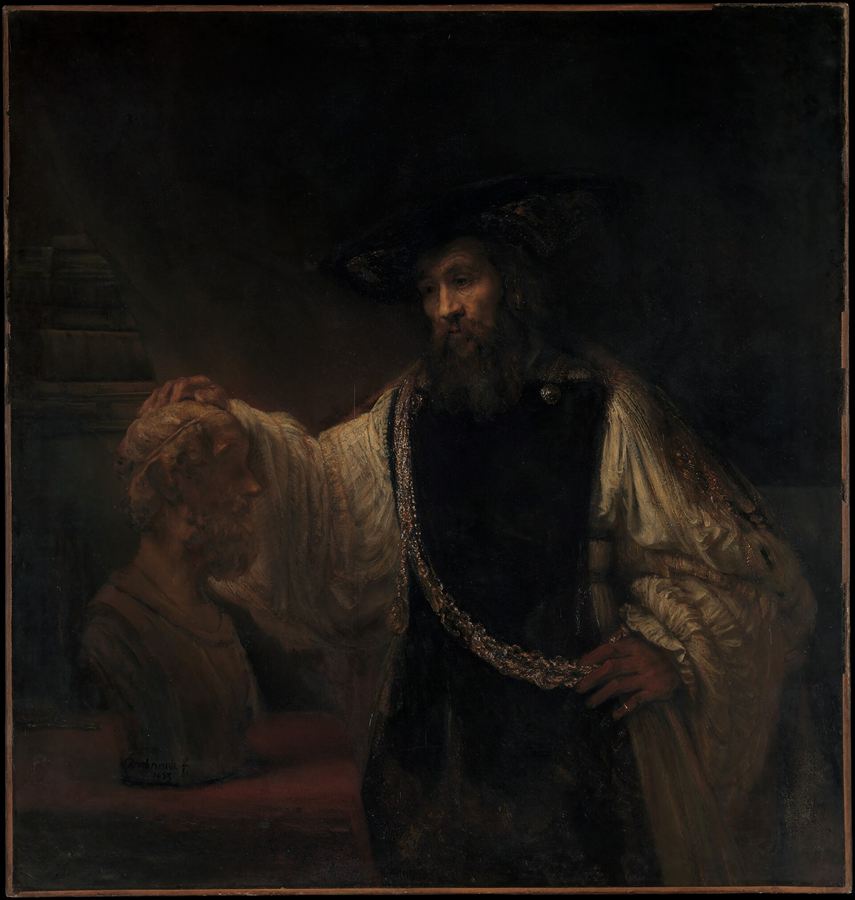
Rembrandt, Aristotle with a Bust of Homer, 1653
From step zero to the synthesis — what to read, in what order, and which pages
"I've suggested that they are objective, mind-independent properties; that they are separate, that is, that they can exist uninstantiated by the corresponding sensible particulars; for all that, they are, and non-problematically can be, the properties of particulars; and though they are not themselves causes, they are causally relevant."
Plato on Knowledge and Forms (2003), Introduction §XI, p. 39
Fine tells you herself, in the Preface, that the fifteen essays were not substantially revised — they are period pieces written across twenty-five years. The mature position exists whole in exactly one place: the Introduction she wrote in 2003 to hold them together.
"To compensate for the lack of large-scale revision, in the Introduction I outline the main themes of the essays and some connections between them. (In doing so, especially in the sections on metaphysics, I borrow freely from my Introduction to Plato 1: Metaphysics and Epistemology … and from On Ideas, chapter 4.) In the Introduction I also attempt to clarify some of my views, to indicate some ways in which they have changed, and to respond to criticisms." Plato on Knowledge and Forms, Preface, p. vii
Three consequences, and they set the whole strategy below. One: the Introduction is the spine; the chapters are the evidence. Read the spine first. Two: she has just named her own three sources — 2003 Intro, 1999 Intro, On Ideas ch. 4 — so those three texts are one argument in three drafts. Three: where they diverge is where she changed her mind, and she says so on purpose. Those are the passages worth slowing down for.
Before you read Fine arguing, read Fine explaining. Same author, no thesis to defend, written for exactly your position.
This is a survey of Plato's metaphysics and epistemology written to introduce a newcomer to everyone's positions, not to win. It moves dialogue by dialogue: the elenchus and Socrates' disavowal of knowledge, then the Cratylus, then the middle-dialogue theory of Forms, then the Theaetetus and Sophist. You get the vocabulary and the map of the disputes in one sitting, in her voice, before you have to take sides.
Read this before Stage 5, not as opposition. Irwin spends twenty-eight pages establishing, argument by argument from the Euthyphro to the Phaedo, the thesis Fine states in two sentences at Introduction §VII: that the engine of the theory is the compresence of opposites, not Heraclitean flux, and that compresence attaches to types rather than particulars. Fine cites him for it and says "I concur" (On Ideas ch. 4, nn. 46–9, 53); he cites her back (his n. 24, to On Ideas 54–7). If the hinge passage feels too fast, this is the remedy. Note what it does not cover: separation, self-predication and the Two Worlds Theory are absent from it.
Devereux is the standing objection on separation that her chapter 11 answers; Nehamas is the ally who unpicks the "imperfection" cliché from a different direction. For the position Fine is really attacking, though, go to Cornford's Plato's Theory of Knowledge (1935), 99–101 and Cherniss — both in your folder, and both cited by Fine and Irwin as the view to reject.
Fine builds from epistemology to metaphysics, never the reverse. That order is the argument. Follow it.
She opens where Plato does: the Meno is "the first Platonic dialogue to reflect systematically on some still fundamental issues in epistemology." Knowledge is true belief bound by an aitias logismos. Two principles arrive here that carry the whole rest of the book — PKW (to know anything about F, you must know what F is) and PKD (knowing what F is means knowing its definition). Note that at this stage Forms have not been mentioned. That is deliberate.
The central negative thesis. She states the Two Worlds Theory in its several versions, then dismantles it — the dialectical requirement at the end of Republic V (the argument must use premisses the sightlovers already accept), the contents-versus-objects reading of esti, and finally Rep. 520c, where the returning philosopher knows the things in the cave.
"In Republic VI–VII, in the famous images of the Sun, Line, and Cave, Plato goes further, and says that there is (or can be) knowledge of sensibles, and that there is mere belief about forms. The Republic, then, so far from endorsing the Two Worlds Theory, is incompatible with it."2003, Introduction §II, p. 13
Shortcut worth knowing: chapter 4 is the same essay reprinted as ch. VIII of Plato 1 (1999) at p. 215. If you have that volume open, you need not switch books.
Epistemological atomism (you can know one thing on its own) and semantic atomism (names are mere tags) travel together, and Fine denies both on Plato's behalf. The Cratylus is her test case. This is the least load-bearing stage for the Forms specifically — but it is where her positive epistemology gets its shape, and Stage 5 will lean on it.
The longest and heaviest stretch — five chapters, roughly 120 pages if you read them all. Protagorean relativism, conflicting appearances, false belief, and finally knowledge as true belief plus a logos. Section V matters disproportionately for the Forms: this is where she refutes the Extreme Heracleitean flux reading of the sensible world — the reading Cornford and Cherniss used to argue that sensibles are unknowable, and therefore that there must be a second world of Forms to know instead. Knock out flux and the two-worlds motive collapses.
If you are reading for the Forms and not for epistemology as such, read §§IV–VI of the Introduction and skip chapters 6–9 on the first pass. Come back for chapter 10.
Three pages. If you read nothing else in the book, read these.
Everything before this was epistemology. Everything after is metaphysics. This is the weld, and it is the single most compressed statement of her whole position:
"We have seen that Plato thinks knowledge is possible. In his view, this has metaphysical implications. For as we saw in looking at the Meno, he thinks that to know anything about F, one must know what F is; this is his Principle of the Priority of Knowledge What (PKW). He also thinks that in some cases … to know what F is is to know the answer to the question 'What is F?', that is, to know the real definition of the nature of F-ness, the one, nondisjunctive property because of which (di' ho) all F things are F (72 c 8). This is his Principle of the Priority of Knowledge of a Definition (PKD). In the middle dialogues, virtue and so on — the referents of 'F' in 'What is F?' questions — are forms (eidē)."2003, Introduction §VII, pp. 28–29
"Hence, in at least some phases of his career, Plato takes the possibility of knowledge, or at least of some knowledge, to require the existence of forms. This is an epistemological argument for the existence of forms; and it posits forms as objective, mind-independent explanatory properties or universals."2003, Introduction §VII, p. 29
Read that last sentence twice. It answers the question the whole dispute table turns on — what explanatory demand do the Forms answer? — and it explains why Fine never needs the Cave. Forms are not posited because this world is a shadow. They are posited because knowledge requires definitions, definitions pick out properties, and those properties have to be real.
Now the four clauses of the synthesis get earned, one section and one essay at a time.
Her method in miniature: nobody agrees what the word means, so fix a definition first and only then ask the questions. She takes Aristotle's sense, since Aristotle started the debate.
"Separation is a relational notion: to be separate is to be separate from something. Aristotle claims that Plato takes forms to be separate from sensible particulars. Separation is also a modal notion: to say that forms are separate is to say that they can exist whether or not [sensible particulars instantiate them]."2003, Introduction §VIII, p. 31
This dissolves the apparent contradiction that trips most readers: Plato never argues for separation, yet is committed to it. Both are true, because separation on this reading is a weak modal claim — could exist uninstantiated — not the two-worlds claim that Forms live somewhere else. Chapter 11 is a 1984 paper; §VIII is the 2003 refinement of it. Read them in that order and the refinement is visible.
Short. If Forms are separate, are they also in things? Fine's answer keeps clause 3 of the synthesis alive: separate and immanent are not rivals, because separation is modal and immanence is about property-possession here and now.
The Phaedo's aitia. Fine's move is to deny that aitia means efficient cause, which lets her say Forms are causally relevant without being pushers and pullers. This is clause 4, and it is what makes the theory look less strange to a modern reader than the textbook version does.
One paragraph, four clauses — printed at the top of this guide. Read it now and every clause should have a receipt behind it: clause 1 from Stage 5, clause 2 from Stage 6, clause 3 from Stages 6–7, clause 4 from Stage 8. If any clause still feels unearned, that tells you exactly which stage to reread.
Her methodological self-defence. Aristotle is the earliest and most philosophically serious reader of Plato, so his objections are the sharpest test available — which is also the argument for the detour below.
Do not read this book front to back. Chapters 1, 3, and 10–14 are technical philology on Alexander of Aphrodisias, and they will stop you dead.
Fine named the entry point herself in the passage quoted at the top: when writing the 2003 metaphysics sections she borrowed from On Ideas, chapter 4. That chapter is the self-contained statement of her Plato, written for readers who came for Aristotle and need Plato explained first. It is the best forty pages she has written for a newcomer, and almost nobody finds it, because it is buried inside a monograph about a lost treatise.
Section by section, and the section titles are the syllabus:
| § | Section | Page | What it settles |
|---|---|---|---|
| §2 | Aristotle on the origins of the theory of forms | 44 | The doxography everyone inherited — flux, Cratylus, Socrates |
| §3 | The 'What is F?' question | 46 | The notation you already met; why it is a real question, not lexicography |
| §4 | Socratic forms | 49 | Forms before the middle dialogues — universals, not separate entities |
| §5 | Plato's Heracleiteanism | 54 | How much flux Plato actually accepts. The Cornford–Cherniss demolition |
| §6 | Compresence, knowledge, and separation | 57 | The engine. Compresence of opposites, not flux, drives the theory |
| §7 | Self-predication and paradigmatism | 61 | Broad self-predication — the Form is F in virtue of its explanatory role |
| Location | Page | Why |
|---|---|---|
| Ch. 2 §3 — Realist and semantic conceptions of universals | 21 | The Armstrong distinction. Two pages that fix what kind of question "What is F?" is: a demand for the property things share, not for what a word means |
| Ch. 2 §5 — "Plato's view" | 24 | Her thesis in one breath: forms are not meanings or particulars, but explanatory properties |
| Ch. 7 §4–5 — Imperfection Argument; broad compresence | 97–101 | Why sensibles fall short without being defective — compresence, not imperfection |
| Ch. 8 §7 — Separation | 116 | The 1993 version of Stage 6. Compare with 2003 §VIII to watch her position tighten |
| Chs. 15–16 — Third Man Arguments; Is Plato vulnerable? | 203, 225 | The famous objection, and her answer. Ch. 16 §2 "A partial escape-route" (p. 226) is the payoff |
The 2003 Introduction is a table of contents in prose. This is that mapping made explicit, with page numbers verified against the book.
| Intro § | Pages | Subject | Essay it introduces | Essay p. |
|---|---|---|---|---|
| §I | 1–8 | What is knowledge? The Meno; PKW | 2. Inquiry in the Meno | 44 |
| §II | 8–15 | Two Worlds Theory rejected; Republic V–VII | 3. Knowledge and Belief in Rep. V 4. …in Rep. V–VII | 66 85 |
| §III | 15–17 | Atomism vs. holism | 5. Plato on Naming | 117 |
| §IV | 17–21 | Theaetetus; Protagorean relativism | 6. Protagorean Relativisms 7. Conflicting Appearances 8. Refutation of Protagoras 9. False Belief | 132 160 184 213 |
| §V | 21–23 | Heraclitean flux refuted; knowledge ≠ perception | — (within chs. 6–10) | — |
| §VI | 23–28 | Knowledge = true belief + logos; holism | 10. Knowledge and Logos | 225 |
| §VII | 28–31 | THE HINGE — the epistemological argument for forms | — (bridges the two halves) | — |
| §VIII | 31–35 | Separation defined and defended | 11. Separation | 252 |
| §IX | 35–36 | Immanence | 12. Immanence | 301 |
| §X | 36–39 | Forms as aitiai | 14. Forms as Causes | 350 |
| §XI | 39–40 | THE SYNTHESIS; relational property-possession | 13. Relational Entities | 326 |
| §XII | 40–43 | Method: why Aristotle is the test | 15. Plato and Aristotle on Form and Substance | 397 |
Tables of contents were rendered as images from the PDFs in your folder and read directly, not recalled. Section boundaries in the 2003 Introduction were located by matching running page headers to the roman-numeral section markers in the text, so each §-to-page mapping is derived from the printed page numbers rather than estimated. The quotations from §§VII, VIII and XI and the Preface were extracted verbatim from the same scans.
One caveat worth stating: the 2003 volume is a scanned digital reprint, so the text layer comes through optical recognition. Where OCR mangled a character inside a quotation — Greek transliteration, and the roman numerals — I have restored it silently against the page image. If you plan to quote any of these passages in writing, check them against your own copy first.