 τί ἐστι;
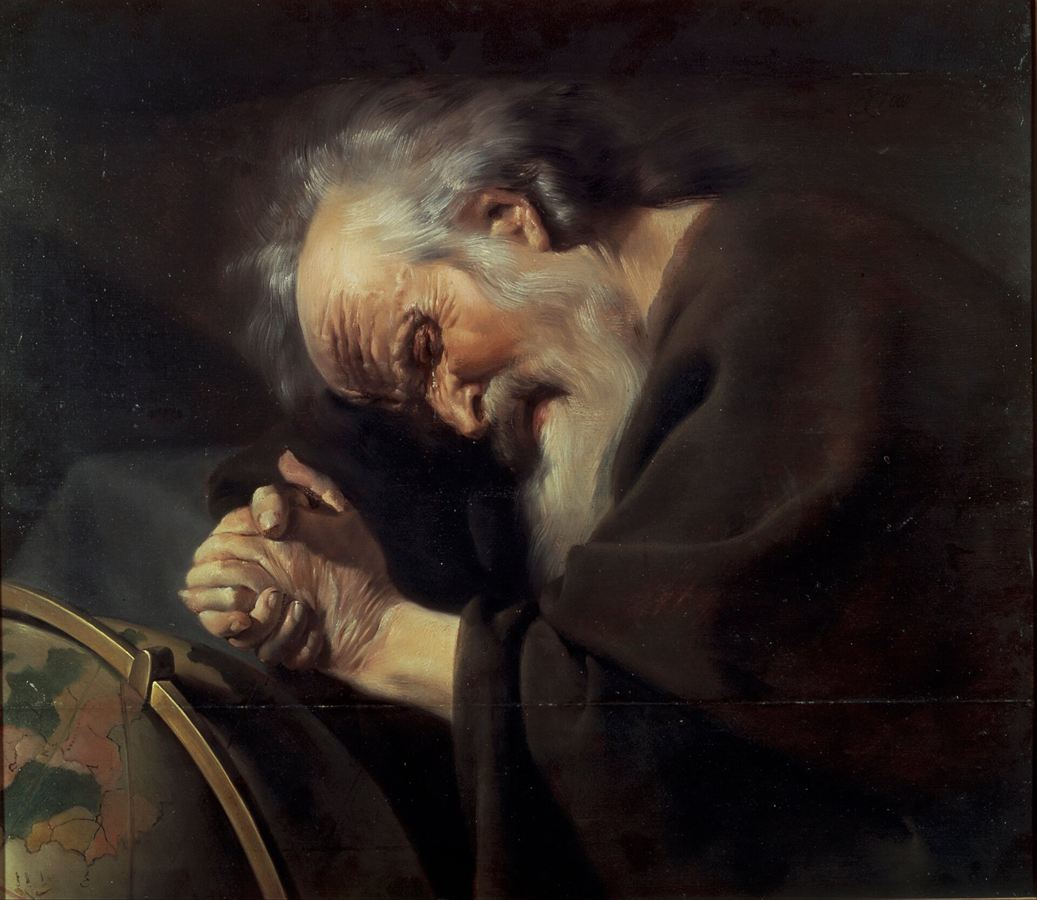
Johannes Moreelse, Heraclitus, c. 1630
Six formulations of the paradox of analysis, set side by side — and the objection reformulated so that it stands in the same family and can be argued with.
The six formulations are not variants of one thing. They differ in what sameness is at issue and in what the first horn accuses the analysis of. Husserl’s first horn is circularity; Langford’s is triviality. That difference decides everything, because the two horns require opposite escapes, and each escape aggravates the other.
The objection is then not a rival to the paradox. It is what you get when you take the standard escape from the circularity horn and apply (PD) to the escape. Stated that way it becomes a dilemma of the same shape as the others, with a first horn that does real work — and it catches Clark, who walks into that horn explicitly.
Each is given in the same schema: the pair being related, the relatum in which sameness is asserted, the two horns, and the escape the author takes or refuses.
pair: definiendum / definiens · relatum: sense — what I “think with” the expression
pair: two definitions of a term · relatum: changed — extension, not sense
pair: analysandum / analysans · relatum: meaning of the verbal expressions
pair: “to be a brother is to be a male sibling” / “to be a brother is to be a brother” · relatum: concept
pair: (A) concept of vixen = concept of female fox / (B) concept of vixen = concept of vixen
pair: ‘F’ / its ousia · relatum: primary intension; “sameness in cognitive significance”
| Relatum | Horn 1 accuses the analysis of | Escape | What the escape gives up | |
|---|---|---|---|---|
| Husserl 1891 | sense | circularity | none | — (analysis declared impossible) |
| Frege 1894 | extension | — | drop to extension | explanation, and conceptual priority |
| Langford 1942 | meaning | triviality | none | — |
| Moore 1942 | concept | triviality | partly metalinguistic | admitted: cannot say in what sense |
| Lewy 1976 | proposition | triviality | deny (1) or (2) | either sense-transparency or concept-individuation |
| Clark 2022 | primary intension | circularity | articulation into other concepts | unexamined |
The finding. The column that splits the table is the third. Two authors — the first and the last, 131 years apart — take the first horn to be circularity. The four in between take it to be triviality. These are different accusations and they call for opposite remedies.
To beat circularity you require that the definiens be articulated into concepts other than the definiendum. That is Forster’s criterion, Clark’s criterion, and Husserl’s own “more richly articulated sense.”
To beat triviality you require a difference in cognitive significance between the two sides. That is what makes the analysis informative.
But the remedy for circularity is the disease for correctness. Husserl saw this and stated it as his own second horn: the more richly articulated the definiens, the less I think the same with it, and so the more incorrect the definition. The articulation that saves you from the circle is the very thing that opens the gap in sense. Clark helps himself to the first half of Husserl’s sentence and does not read the second.
The objection was three things, stated informally. Each now has a place in the family above, and each can be given the same two-horned shape.
As it stood: “what is F-ness? → z. and then what is z-ness? → y. and then what is y-ness… what is n-ness? this is an infinite regression.”
The regress was never a consequence of (PD) alone. It is a consequence of (PD) together with the condition imposed to escape Husserl’s first horn — and that condition is not a private addition, it is what Forster and Clark themselves require of a Socratic answer.
Stated as a dilemma, to match the family:
This is the improvement. The old version had only the second horn, and “that’s an infinite regress” invites the reply “so stop somewhere.” The first horn makes stopping the problem rather than the solution: every place you stop is a concession that the principle has exceptions, and the principle contains nothing that says where they fall.
Clark walks into horn 1, in his own words. He needs stage one — the conceptual investigation — to be startable, so he grants that “it is plausible that competent speakers will have some initial grasp, at least, of the primary intension.” That is an exemption from (PD), granted to the definiens’s concepts, on the ground of linguistic competence. It is the same move as the cultural-inheritance defence, and the paper already has the answer to it in §4.4: a genuine cultural given cannot be denied by a competent member of the culture, and Gorgias denied one. Competence supplies familiarity, not warrant.
As it stood: “let say we say F is e1, F is e2… but then we are defining a category, let say e, that F belongs to. but then again without definition of F we can not do that.”
This is the objection with the strongest position in the family, because it is the one that defeats Frege’s escape — the only escape in the six that actually dissolves the paradox rather than relocating it. Frege escapes by saying coincidence of extension is necessary and sufficient. The objection says: you cannot fix the extension without already having the concept. To collect e1, e2, e3 as the F things rather than as an arbitrary list is already to have exercised the very competence the definition was supposed to supply.
Dummett makes horn 2 against Frege in exactly this form: the two definitions of a conic “are not merely coextensive: they are provably coextensive,” and a predicate merely materially equivalent to ‘conic’ “obviously would not be accepted by mathematicians as an admissible definition.” That is Socrates rejecting the god-beloved as a definition of the pious, in a mathematical example. Same objection, and it is already in print — against Frege, by Frege’s best reader, with no idea that it is Socratic.
As it stood: “these questions assume what x is something separate different from idea about x… how would Socrates know F-ness without knowing x is F? or F-ness is G? if he can then knowing F-ness mean nothing more than x is F and F-ness is G.”
Lewy’s version of the paradox needs propositions individuated by the concepts they contain. This objection asks the corresponding question one level down, about the object: what individuates F-ness apart from the true propositions about it? (PD) asserts a priority — knowledge of the essence before knowledge of the instances and properties. The priority is intelligible only if the essence is something over and above the instances and properties.
Fine concedes the same ground when she declines to generalise from the Meno’s ousia of bees and flags the cost: if something lacks an essence, it cannot be known. Horn 2 is that cost collected.
Primary sources for the six. Husserl, Philosophie der Arithmetik (1891), quoted in Frege’s review, Zeitschrift für Philosophie und philosophische Kritik 103 (1894), 319, translated in Dummett, Frege and Other Philosophers (Clarendon, 1991), 24. Frege’s reply, ibid. 319–20, in Dummett 25; Dummett’s objection at 29; the Grundlagen §64 priority requirement at 42. Langford, “The Notion of Analysis in Moore’s Philosophy,” in Schilpp (ed.), The Philosophy of G. E. Moore (1942), 319–42; “Analysis,” Phil. Phen. Res. 25.1 (1964), 117–21. Moore, “A Reply to My Critics,” §11, in Schilpp (ed.), 3rd edn. (Open Court, 1968), 666. Lewy, Meaning and Modality (CUP, 1976), chs. 6–7, as set out in O’Connor, Philosophy 57 (1982), 211. Clark, Plato’s Dialogues of Definition (Palgrave, 2022), ch. 2 and nn. 28, 30, 31; AGPh (2021).
Still unverified. Langford’s own page, quoted at second hand from Schick; and Sharvy 1972, unopened.