 τί ἐστι;
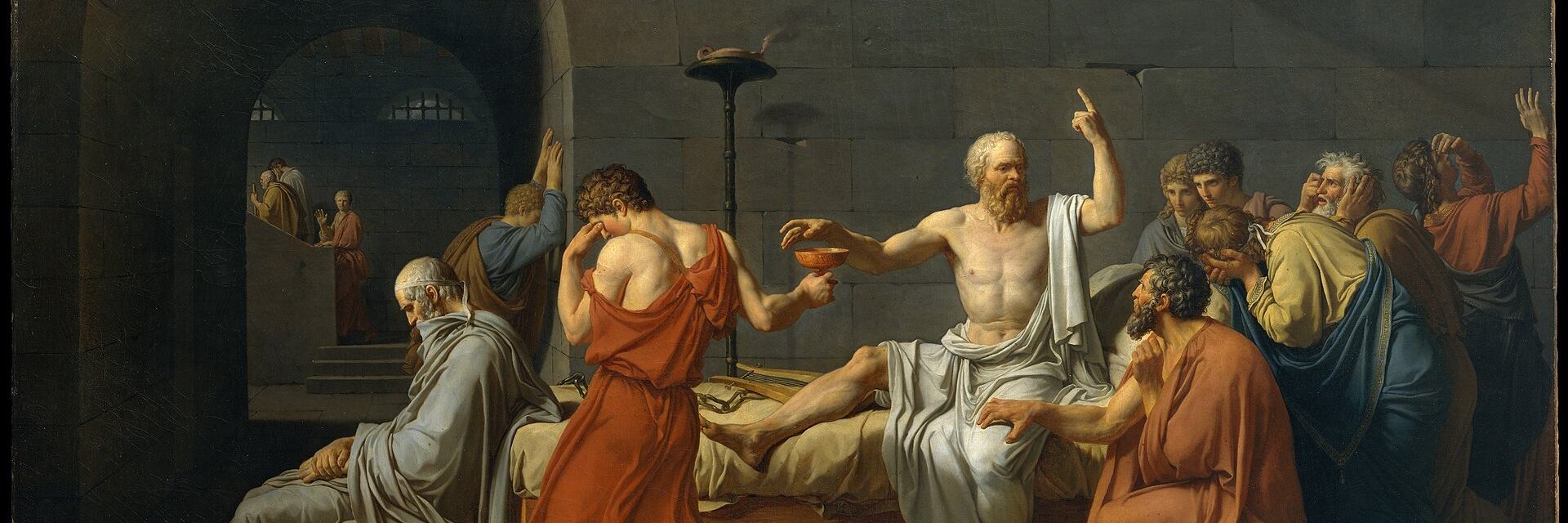
Jusepe de Ribera, A Philosopher, c. 1630
Meno 78d–79e in Plato's own words, Benson's use of Belnap and Steel, and what a Belnap matrix is not.
The paper quotes 79b4–c9. Here is the whole movement, from the point where Meno adds ‘justly’ to his definition down to Socrates' demand that he start again — because the argument only shows its shape when the three re-posings are seen together.
78dSocratesVery well. According to Meno, the hereditary guest friend of the Great King, virtue is the acquisition of gold and silver. Do you add to this acquiring, Meno, the words justly and piously, or does it make no difference to you but even if one secures these things unjustly, you call it virtue none the less?
MenoCertainly not, Socrates.
SocratesYou would then call it wickedness?—Indeed I would.
78eSocratesIt seems then that the acquisition must be accompanied by justice or moderation or piety or some other part of virtue; if it is not, it will not be virtue, even though it provides good things.
MenoHow could there be virtue without these?
79aSocratesThen to provide these goods would not be virtue any more than not to provide them, but apparently whatever is done with justice will be virtue, and what is done without anything of the kind is wickedness. … We said a little while ago that each of these things was a part of virtue, namely, justice and moderation and all such things?—Yes.
SocratesThen you are playing with me, Meno.—How so, Socrates?
SocratesBecause I begged you just now not to break up or fragment virtue, and I gave examples of how you should answer. You paid no attention, but you tell me 79b that virtue is to be able to secure good things with justice, and justice, you say, is a part of virtue.
MenoI do.
SocratesIt follows then from what you agree to, that to act in whatever you do with a part of virtue is virtue, for you say that justice is a part of virtue, as are all such qualities. Why do I say this? Because when I begged you to tell me about virtue as a whole, you are far from telling me what it is. Rather, you say that every action is virtue if it is performed with a part of virtue, 79c as if you had said what virtue is as a whole, so I would already know that, even if you fragment it into parts. I think you must face the same question from the beginning, my dear Meno, namely, what is virtue, if every action performed with a part of virtue is virtue? For that is what one is saying when he says that every action performed with justice is virtue. Do you not think you should face the same question again, or do you think one knows what a part of virtue is if one does not know virtue itself?—I do not think so.
79dSocratesIf you remember, when I was answering you about shape, we rejected the kind of answer that tried to answer in terms still being the subject of inquiry and not yet agreed upon.—And we were right to reject them.
SocratesThen surely, my good sir, you must not think, while the nature of virtue as a whole is still under inquiry, that by answering in terms of the parts of virtue you can make its nature clear to anyone or make anything else clear by speaking in this way, but only that the same question must be put to you again79e—what do you take the nature of virtue to be when you say what you say? Or do you think there is no point in what I am saying?—I think what you say is right.
SocratesAnswer me again then from the beginning (ἐξ ἀρχῆς): What do you and your friend say that virtue is?
Plato, Meno 78d1–79e6, trans. G. M. A. Grube, in Cooper & Hutchinson (eds.), Plato: Complete Works (Indianapolis, 1997), 878–9.Four things are worth marking in that text, because the paper leans on all four.
First, the injunction is issued three times in a page — 79c (twice) and 79e — and each time in the same words: the same question, again, from the beginning. Socrates is not making a local complaint about justice. He is stating a rule for what happens when an answer is given in the wrong terms: the question does not get settled, it gets re-posed.
Second, 79d gives the rule in general form, and it is stronger than any modern descendant of it. Socrates does not say that the definiens may not mention the definiendum, nor that it may not be unintelligible without it. He says it may not be given ‘in terms still being the subject of inquiry and not yet agreed upon’. That is a condition on the status of the terms, not on their content — and it therefore presupposes a stock of terms that are already agreed. Nothing in the passage says which terms those are, or how they came to be agreed while virtue did not.
Third, the reason given at the end of 79c is the priority principle itself: ‘do you think one knows what a part of virtue is if one does not know virtue itself?’ It is that clause, and not the fragmentation complaint, which carries the priority principle into the definiens.
Fourth, Socrates' own back-reference at 79d is to the shape example, not to a general principle he has argued for. The rule arrives as a recollection of an earlier agreement, which is exactly the kind of thing the rule itself forbids.
This is the whole of the passage the paper's first section rests on, from the paragraph that introduces the apparatus to the point where Benson applies it to Meno. The two displayed formulas (m) and (c1) are reproduced as they stand on p. 104; most text extractions of this book drop them, because they are set as display lines in a different face.
In order to explain why Socrates objects to Euthyphro's, Laches', and Meno's initial answers in the way that he does, we need to carefully distinguish between formally and materially correct answers to Socrates' ‘What is F-ness?’ questions. We can do this by borrowing from the work of Belnap and Steel (1976) on the logic of questions.
According to Belnap and Steel (1976), a which-question, which for present purposes can be identified with Socrates' ‘What is F-ness?’ question, can be usefully divided into two parts: its subject and its request. The subject of a which-question presents the alternatives from which a respondent is to choose in giving his response by means of a matrix and one or more category conditions. Thus, to use one of their examples, the alternatives presented by the subject of the question ‘Which primes lie between 10 and 20?’ are determined by the matrix
x is a prime between 10 and 20
and the category condition
x is an integer.
That is, the respondent must choose his answer from propositions of the form ‘x is a prime between 10 and 20’, where what is substituted for x is an integer.
The request of a which-question specifies the number of the alternatives to be selected and whether or not that selection is to be complete (1976, 35–52). Thus, for example, the question ‘What are two examples of primes between 10 and 20?’ requests that exactly two alternatives be selected without the commitment that these are the only primes between 10 and 20.
According to Belnap and Steel, an answer that fails to satisfy the category condition makes a category mistake (1976, 33). Thus, for example, to answer the question ‘What are two examples of primes between 10 and 20?’ with the proposition ‘A triangle and a square are primes between 10 and 20 and there are others’ would be to make a category mistake. It would not simply be to give an incorrect answer. It would be to give an incorrect kind of answer. Analogously, to give as an answer the proposition ‘13 is a prime between 10 and 20 and there are others’ or ‘13 and 17 are primes between 10 and 20 and there are no others’ would be to violate the request of the question. The first violates the number of alternatives constraint and the second violates the completeness constraint. … Both of these sorts of mistakes might reasonably be called formal mistakes, while an answer that satisfied the category condition and the request of the question but failed to satisfy the matrix would be materially incorrect.
Armed with this distinction between formally and materially incorrect answers, a traditional way of explaining Socrates' response to the initial answers of Laches, Euthyphro, and Meno becomes available. The subject of the ‘What is F-ness?’ question presents its alternatives by means of the matrix
(m) x is F-ness
and the category condition
(c1) x is a universal.
According to the tradition, Laches, Euthyphro, and Meno give answers of the form ‘x is F-ness’, whose substitution instances are concrete particulars, not universals, and thereby violate the category condition. They make a category mistake. Thus, Socrates concludes that they have misunderstood his question. They have given an answer that is not even among the alternatives presented by the question. More recently, however, this tradition has been successfully challenged. The initial answers of Laches, Euthyphro, and Meno are not concrete particulars; they are universals. Consequently, they do not violate the category condition. But Belnap and Steel (1976, 34–36) provide another way in which an answer can be formally incorrect short of violating the category condition. The answer can violate the request of the question.
Consider Socrates' response to Meno's initial answer (72a6–d1). Meno has answered by providing a number of universals. Socrates objects that only one universal was sought. … Adopting Belnap and Steel's terminology, Socrates understands his ‘What is virtue?’ question to consist of a request that specifies that only one of the alternatives be selected. Meno, however, has misunderstood the question and takes its request to permit that a number of alternatives be selected. It is as if Socrates had asked Meno ‘What is one example of a prime between 10 and 20?’ and Meno had answered ‘13 and 17’. Meno has not merely failed to give a correct answer: he has failed to give the correct kind of answer. Meno's answer is formally, not merely materially, incorrect.
H. H. Benson, Socratic Wisdom (New York and Oxford, 2000), §5.3, pp. 102–4. Ellipses mark two omitted sentences and a footnote reference; nothing else is cut.And the admission in the footnote, which is where the paper's argument starts:
Accuracy demands that I point out that Socrates' ‘What is F-ness?’ question should really be identified with Belnap and Steel's equivalence version of what-questions (1976, 82–84). Discussing the ‘What is F-ness?’ question in these terms, however, would only serve to complicate the otherwise simple points to be made here. As a result throughout this chapter I will be understanding the ‘What is F-ness?’ question as a which-question. The resulting inaccuracy is more than made up for, I believe, by the relative ease and clarity of the explanation.
Benson 2000: 103 n. 16.Two further notes from the same pages are worth having, because they mark the two places where Benson narrows the apparatus. At n. 17 he writes that he ‘here leave[s] out the distinctness condition for the sake of brevity’ — so of the three components of the request, only two are in play. And at n. 18 he refers the reader to §5.4 for the content of the matrix, which is where the three matrix conditions — coextensive, explanatory, semantic — are set out. The matrix (m) is therefore a placeholder: ‘x is F-ness’ is not itself the Socratic demand but the slot into which the demand's three conditions are loaded.
The apparatus is easier to see than to read. Figure 1 is Belnap and Steel's own example, the one Benson uses; Figure 2 is Socrates' question set into the same frame, with the part Benson does not use marked in red.
Short answer: no. They are different kinds of object that share a word, and the word is shared for a reason that is etymological rather than mathematical. A Belnap matrix is an open sentence — a formula with a free variable. An embedding matrix is a rectangular array of real numbers. One is a mould that generates statements by substitution; the other is a lookup table that maps token indices to vectors.
But three structural analogies are real, and one disanalogy is decisive — and the decisive one happens to be exactly where this paper's argument lies.
On the word itself: Latin matrix is a womb, then a mould. Logic took it in Whitehead and Russell's sense — the quantifier-free open formula left when you strip the prefix of quantifiers, the frame into which values are poured. Sylvester coined the linear-algebra sense in 1850, calling an array a matrix because it is the ‘womb’ out of which determinants are born. Two independent specialisations of the same metaphor. Nothing mathematical passes between them.
A slot with admissible fillers. The matrix has one free variable; the question's alternatives just are the results of filling it.
A slot with admissible fillers. The array is indexed by a vocabulary position; what the model can be given at that place is exactly what has a row.
A stipulated, hard type restriction: only integers may fill x. You can check compliance before the answer is evaluated for truth, and non-compliance is a different kind of failure from falsehood.
A soft, learned analogue. On the distributional hypothesis, vectors that sit near one another are the ones that are interchangeable in similar contexts. Same job — constraining what may go in the slot — but discovered rather than laid down, and gradient rather than binary.
Selection-size and completeness-claim: how many alternatives are wanted, and whether the reply asserts they are all of them.
Greedy, top-k, temperature, beam width: how many candidates are drawn from the distribution and on what terms. Again a genuine parallel of role — and again, one is a semantic specification of what would count as a complete answer, the other a sampling procedure with no semantic content.
Belnap and Steel's second half assigns truth values to questions. A question is true iff it has some true answer; its presuppositions are the statements whose truth is required for that; and where a presupposition fails, the question does not merely get a wrong answer — it fails to arise. That is a piece of structure. It is enforced by the semantics, not learned from examples.
There is no counterpart to it in an embedding matrix, or anywhere else in the architecture. A transformer computes a distribution over next tokens for any input whatever. There is no place in the forward pass where a question can be refused. Ask ‘What is the F-ness of a round square?’ and you get a fluent definiens, drawn from the same machinery and with the same confidence as an answer to ‘What is virtue?’. Presupposition failure has to be represented as content — something the model has learned to say — rather than enforced as form.
That prediction is testable and has been tested. On the benchmarks built for exactly this — questions carrying false or questionable assumptions — models accommodate rather than reject at high rates. In one recent study the best-performing model rejected 84% of false presuppositions and the worst rejected 2.4%, against an ideal of 100%.1 The failures are not random: they cluster where accepting the presupposition produces the more fluent continuation.
Why this is worth a paragraph in the paper. The fourth horn of the quadrilemma — the question that fails to arise — is the horn with no doxastic analogue, and it now turns out to have no computational analogue either. A large language model is a very good model of the interlocutor who answers anyway.
Euthyphro, Laches and Meno all do this. Not one of them ever says your question has no answer, or you have not shown that there is one thing all pious acts share. They produce a filler for the slot, every time, and when it is refuted they produce another. The dialogues have been read as records of interlocutors who cannot find the answer. They can equally be read as records of respondents with no machinery for declining the question — which is what Socrates' own machinery, on Belnap and Steel's analysis, would have given them.
| Belnap matrix | Embedding matrix | |
|---|---|---|
| Kind of object | An open sentence; a syntactic-semantic type | An array in ℝ|V|×d; a numerical lookup |
| Where productivity lives | In the matrix itself — one schema, unboundedly many substitution instances | Not in the array — it has a fixed finite number of rows. Productivity lives in the layers above it |
| How you know what it says | By reading it. You wrote it; its content is stipulated | By probing it. Its content is discovered after training, and imperfectly |
| Failure modes | Three, and they are distinguished: category mistake, request violation, false | One, undifferentiated: low probability. Nothing marks the difference between wrong-kind and wrong |
| Truth | Answers have truth values; so do questions | Neither has one. Truth is a property some outputs happen to have |
The third row is the one that rewards a second look, because it recapitulates a distinction from the paper. A stipulated matrix with a stipulated category condition is a nominal specification of the answer-space: it says what shall count. A learned embedding is closer to a real one: it is a claim about how the things actually distribute, discovered a posteriori, correctable by more evidence, and not fully surveyable by the person who built it. The nominal/real fork of §16 turns up again, in miniature, in the difference between writing a matrix and training one.
1 J. Sieker, C. Lachenmaier and S. Zarrieß, ‘LLMs Struggle to Reject False Presuppositions when Misinformation Stakes are High’ (arXiv:2505.22354): rejection rates of 84.08% (GPT-4o), 50.05% (LLaMA-3-8B) and 2.44% (Mistral-7B), against ‘an ideal system that would reject 100% of false presuppositions’. See also N. Kim et al., ‘(QA)²: Question Answering with Questionable Assumptions’, ACL 2023, and X. Yu et al., ‘CREPE: Open-Domain Question Answering with False Presuppositions’.
Sources for the two quoted passages. Plato, Meno 78d1–79e6, Grube's translation, from Cooper & Hutchinson (eds.), Plato: Complete Works (Indianapolis, 1997), 878–9 — read from the volume in the folder. Benson, Socratic Wisdom (2000), §5.3, pp. 102–4 and n. 16 — the displayed formulas (m) and (c1) read from a page image of p. 104, since they do not survive text extraction.