 τί ἐστι;
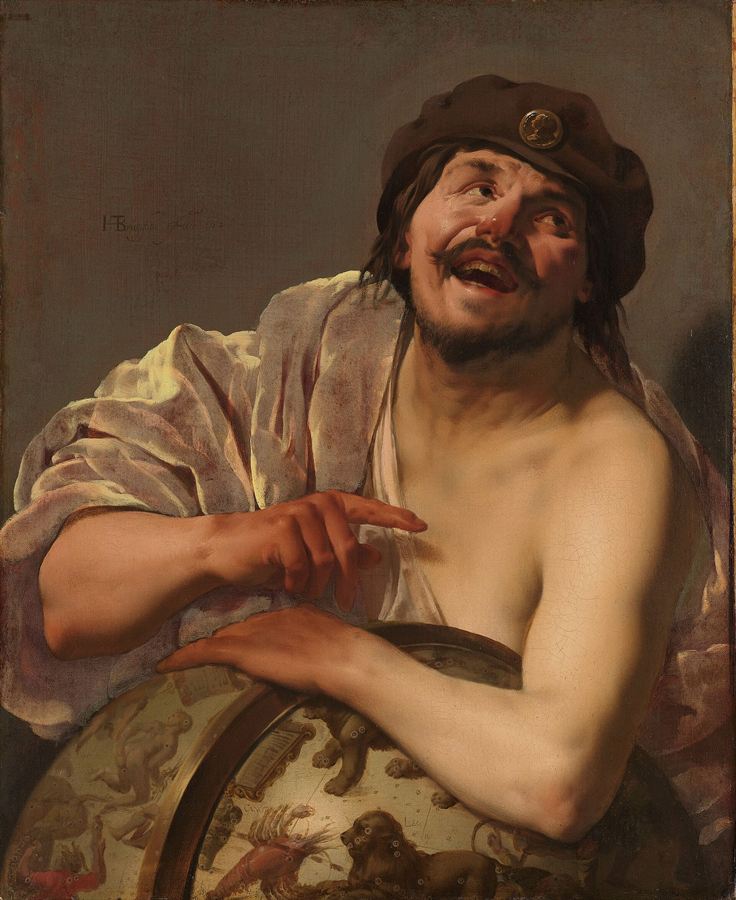
Hendrick ter Brugghen, Democritus, 1628
Your proposal is Belnap and Steel's own equivalence-question — the form Benson calls the accurate one and then sets aside. It is right, and it makes the problem worse.
What you have just described is not an analogy or a proposal. It is, almost word for word, the apparatus Belnap and Steel define on p. 83 — a question whose subject is a determinable Hx together with the descriptors associated with it, written Equiv(Hx // Ax). It is also the form Benson names in the footnote quoted in §1 of the paper as the one Socrates' question should really be identified with, and declines to use.
So the answer to ‘can we represent it like this?’ is: yes, and it has been representable like this since 1976, and the one person who brought that machinery into Socratic studies said so in a footnote and walked away from it. What follows sets out what the form gains, and the three things it does not fix.
Given a matrix Ax as posit and a descriptor (as we shall say) Bx as desideratum, there are four natural sentence-forming modes of combination. The most natural is perhaps equivalence, ∀x(Ax ≡ Bx), but necessary condition of Ax, ∀x(Ax ⊃ Bx), sufficient condition of Ax, ∀x(Bx ⊃ Ax), and nonempty intersection of Ax and Bx, ∃x(Ax & Bx), are almost on a par in point of naturalness. …
The first new sort of subject is Equiv(Hx // Ax), where Ax is a matrix and Hx a determinable. Where the descriptors associated with Hx are H₁x, …, Hᵢx, …, the presented alternatives are defined as ∀x(Ax ≡ H₁x), …, ∀x(Ax ≡ Hᵢx), … .
We will call the genus of the four sorts of question what-questions, and award the species titles respectively equivalence-questions, necessity-questions, sufficiency-questions, and intersection-questions.
N. D. Belnap and T. B. Steel, The Logic of Questions and Answers (New Haven, 1976), 82–3.That is your structure exactly. The determinable fixes the dimension; the descriptors are the admissible values along it; the question asks which descriptor is equivalent to the posit. ‘What is red?’ becomes
Equiv(x is a colour // x is red)
and the reason ‘red is a fugue in D minor’ is not a wrong answer but a non-answer is that it is not among the descriptors associated with the determinable, and so is not one of the alternatives the question presented at all.
And here is the sentence in the same paragraph that you should read before doing anything else with the idea:
Examples: ‘What is a prime?’ is probably intended as an equivalence-question, though the appropriate determinable is hard to isolate. Perhaps the following will do: ?! Equiv(x is a number // x is a prime), where the determinable ‘x is a number’ has associated with it a fixed list of number-theoretic descriptors.
Belnap & Steel 1976: 83.‘Perhaps the following will do’ is not a solution, and the case is the friendliest one available. A prime is a term with a textbook definition, a settled extension, and a discipline built around it. If the determinable is hard to isolate there, the prospects for ἀρετή should be estimated accordingly. The difficulty you have to face is not one I am raising against your proposal; it is the one its authors raised against it, in their own paradigm example, and did not answer.
Three things, and the third is a result the paper does not currently have.
(i) A category condition with content. Benson's (c1) is ‘x is a universal’. That excludes concrete particulars and nothing else: it lets through number, weight, music, virtue and colour alike. A determinable excludes almost everything. It is the difference between a gate that turns away one kind of traveller and a gate that admits one kind.
(ii) It explains Socrates' own model answers, which (c1) does not. When Socrates shows Meno what a good answer looks like, he does it twice, and the second time he does exactly what you describe. The first attempt fails:
75bLet us say that shape is that which alone of existing things always follows colour.
MenoThat shape, you say, always follows colour. Well then, if someone were to say that he did not know what colour is, but that he had the same difficulty as he had about shape, what do you think your answer would be?
Meno 75b9–c5Meno's objection is that the determinable has not been secured. Socrates concedes it, and states the requirement:
75d…the answers must not only be true, but in terms admittedly known to the questioner. I too will try to speak in these terms. Do you call something ‘the end’? I mean such a thing as a limit or boundary… Further, you call something a plane, and something else a solid, as in geometry?—I do.
76aFrom this you may understand what I mean by shape, for I say this of every shape, that a shape is that which limits a solid; in a word, a shape is the limit of a solid.
Meno 75d5–76a7Read that as a procedure and it is your proposal, performed. Socrates does not offer a descriptor and hope. He first establishes the determinable — limit, plane, solid, each secured by explicit agreement — and only then supplies the value along it. The same at 76d for colour, where the Empedoclean apparatus of effluvia, channels and sight is put in place before ‘colour is an effluvium from shapes which fits the sight and is perceived’ is offered.
And 75d is 79d again, stated positively. ‘In terms admittedly known to the questioner’ is the same requirement as ‘not in terms still being the subject of inquiry and not yet agreed upon’. What the determinable reading adds is a reason why the requirement is imposed: without an agreed determinable there is no set of presented alternatives, and so nothing for a proposed answer to be an answer among.
(iii) A fourth failure mode, which Benson's taxonomy cannot express. Benson gives three: category mistake, request violation, material falsehood. Now consider Socrates on gold saying ‘gold is a metal’.
| Answer | (c1)? | Request? | True? | Benson's verdict |
|---|---|---|---|---|
| ‘gold is a triangle’ | ✗ | — | — | category mistake |
| ‘gold is yellow and heavy and soft’ | ✓ | ✗ | — | request violation |
| ‘gold is a kind of iron’ | ✓ | ✓ | ✗ | merely false |
| ‘gold is a metal’ | ✓ | ✓ | ✓ | no verdict available |
‘Gold is a metal’ is a universal, it selects one alternative, it claims to be the only one, and it is true. Benson's machinery has nothing to say against it. But it is not an answer to ‘What is gold?’, and every one of us knows this immediately. On the determinable reading we can say why: the determinable is wrong. Equiv(x is a metal // x is gold) has no true instance, because no descriptor under metal is equivalent to gold; the equivalence only appears under element. The failure is at the dimension, not at the value.
That is a genuine gain, and it is worth a paragraph in §14 of the paper, because it sharpens the gold argument. Socrates' error about gold would not have been a false answer. It would have been a true answer in the wrong dimension — a failure invisible to every condition the commentators impose.
‘What is red?’ is answerable because colour is not in dispute. Ask ‘what is colour?’ and you need a determinable for colour; ask what that is and you need one above it. Determinables form a hierarchy, and the hierarchy either terminates or it does not. Aristotle's answer is that it terminates: the categories are the topmost determinables, and above them there is nothing — being is not a genus, because a genus must be differentiated by something outside itself and there is nothing outside being. That is a foundationalist terminus declared, in exactly the sense of §12 of the paper, and it is why the determinable proposal is not an escape from the argument but a restatement of it in the other direction. The definitional regress descends through definientia; the determinable regress climbs through types. Same series, same four exits.
This is your own gold case, and it does new work here. The determinable for gold is not metal. It is element — a determinable that did not exist in the fifth century BC, that no amount of reflection on Greek usage could have yielded, and that was itself the product of the inquiry it was needed to start.
So a strong reading of the requirement is self-defeating. If the determinable must be agreed before the question may be put — Socrates' condition at 75d and 79d — then the inquiries that actually succeed are exactly the ones the condition forbids, because they are the ones that revise the dimension rather than supply a value along an agreed one. Chemistry did not find out which metal gold is. It found out that metal was the wrong question.
Notice what the aporetic dialogues actually argue about. Is virtue a kind of knowledge (Protagoras, and the hypothesis at Meno 87c)? A kind of psychic order (Republic IV)? A craft? A divine dispensation (Meno 99e–100b)? These are not four candidate descriptors. They are four candidate determinables, and the dialogue is a fight over which dimension the answer lies along.
Which gives a sharper account of aporia than the one in §17.9. There, aporia was the condition of a question whose exemption class had not been fixed. Here it is something more specific and more mechanical: where the determinable is open, the question presents no set of alternatives at all. Every proposal can therefore be refuted — there is always another dimension along which it fails — and no proposal can be confirmed, because confirmation would require being the right one among a set that has not been determined. The interlocutors are not failing to find the value. They are being asked for a value before the axis has been chosen.
And the Meno's last sentence says so. ‘We shall have clear knowledge of this when, before we investigate how it comes to be present in men, we first try to find out what virtue in itself is’ (100b4–6): the dimension question, deferred to the end and left open.
It has been tried, seriously, at least five times, and the failures are the useful part.
| Attempt | What it is | Where it broke |
|---|---|---|
| Aristotle, Categories; Porphyry's tree | Ten topmost determinables, each subdivided by differentiae down to infimae species | Nothing above the ten, and no argument that there are ten. Cross-cutting cases have no place |
| Wilkins, An Essay towards a Real Character and a Philosophical Language (1668) | Literally this proposal, executed: forty genera, each with differences and species, so that a word's position in the matrix encodes what it is | The tables had to be built by hand and reflect their author's world; a small revision to the taxonomy invalidates every word |
| Leibniz, characteristica universalis | The same, with the ambition that reasoning become calculation over the encoding | Never built. The encoding presupposes the analysis it was meant to deliver |
| WordNet, Cyc, formal ontologies (OWL, BFO) | Machine-readable hypernym hierarchies with typed relations | No agreed upper level; polysemy multiplies nodes; useful categories turn out to be task-relative |
Three obstacles recur, and it is worth knowing which of them is fatal and which is not.
Cross-classification is a nuisance, not a refutation. A tomato is a fruit, a vegetable, a commodity and a botanical ovary; a whale is a mammal and, for a nineteenth-century customs inspector, a fish. But nothing stops a thing from falling under several determinables at once — the question fixes one, and which one is fixed by what is being asked. ‘What is a tomato?’ asked in a kitchen and in a laboratory are two questions, and on this apparatus they are visibly two, because they have different subjects. That is a point in the proposal's favour.
The absence of an agreed top level is the regress of §3.1, in applied form. Every large ontology project has had this argument and none has settled it. That is not a coincidence and not an engineering failure.
The structural limit is the one to take seriously: determinable and descriptor are monadic. ‘Peter is taller than Paul’ has no determinable/descriptor form, because there is no single thing it is predicating. Relations were what broke the term logic that determinables belong to, and repairing that is what Frege's Begriffsschrift did. Belnap and Steel are not caught by this — their matrix is an open sentence, so it can be Hxy as easily as Hx, and their subjects can carry several category conditions. But a picture of all knowledge as a two-dimensional array of determinables and values is a picture of the monadic fragment only, and most of what we know is not in it.
The point I made about language models was that nothing in the architecture can refuse a question — that presupposition failure has to be learned as content rather than enforced as form. Your proposal is the specification of the thing whose absence I was describing. A hard determinable check is exactly a gate that can return ‘no’.
‘What is the F-ness of a round square?’ fails at Hx: there is no determinable under which the posit falls, so no alternatives are presented, so there is nothing to generate. That is a refusal produced by the form of the question, before any content is consulted — which is what the benchmarks show is missing.
And the reason the machines do not have it is worth stating precisely, because it is not that nobody thought of it. Embedding geometry does carry determinable-like structure: hypernym and hyponym relations show up in the arrangement of the space, which is why hierarchy-aware embedding methods work at all. What it carries is a soft, learned, graded version of the relation — near enough to a determinable to be useful, and different from one in the single respect that matters here.
A soft gate never returns ‘no’. It returns a lower number. Every input has a nearest neighbourhood, every neighbourhood yields a continuation, and a question with no admissible determinable is not distinguishable, at the level of the mechanism, from one whose determinable is merely unusual. Belnap and Steel's gate is binary and prior; the geometric one is continuous and posterior. That single difference is the whole of the disanalogy, and you have put your finger on it.
Three changes to the paper, in order of how much they gain.
First, §1 becomes a stronger accusation. At present it says Benson takes the answer-side half of Belnap and Steel and leaves the semantic half. That is true but understated. What he leaves is the equivalence-question form itself — the one he names in his own footnote as the accurate identification of Socrates' question — and the determinable slot in that form is where the Socratic problem actually sits. The footnote is not a modest disclaimer about expository convenience. It is a signpost to the argument, planted by the person who then walked past it.
Second, a new subsection giving the fourth failure mode and the gold table of §2 above. It costs a page and it upgrades §14, because it lets the gold argument say something Benson's apparatus cannot express: that ‘gold is a metal’ fails as an answer while satisfying every condition the commentators impose.
Third, §17.9 on aporia gets replaced. The mechanical account — where the determinable is open the question presents no alternatives, so nothing can be confirmed and everything can be refuted — is better than the one currently there, and it has textual support at 75b–c, 75d and 79d that the present version does not use.
Say the word and I will write the three in and re-render.
Sources. Belnap and Steel, The Logic of Questions and Answers, 82–3, read from page images of the scan (the volume has no text layer). Plato, Meno 75b–76a and 76c–d, Grube's translation, Cooper & Hutchinson (eds.), 874–6. Benson, Socratic Wisdom, 103 n. 16 and 104. Aristotle on being and genus: Metaphysics B.3, 998b22–7.