 τί ἐστι;
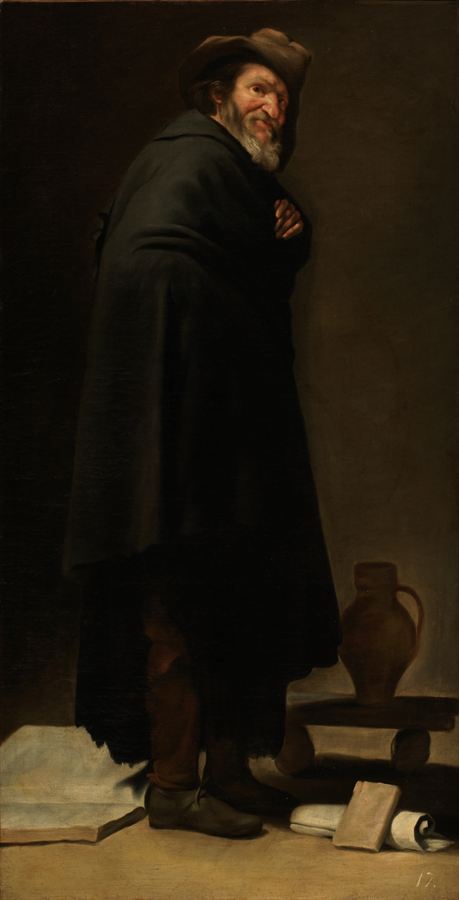
Diego Velázquez, Menippus, c. 1638
You asked whether she says the same thing in both introductions. She answers that herself, in print — and the answer is yes, deliberately, with three additions. What follows is the machinery: where she starts, how she reconstructs an argument, how she cites Plato, and how she handles people who disagree.
You spotted it correctly, and she declares it in the Preface to the 2003 volume.
To compensate for the lack of large-scale revision, in the Introduction I outline the main themes of the essays and some connections between them. (In doing so, especially in the sections on metaphysics, I borrow freely from my Introduction to Plato 1: Metaphysics and Epistemology, in the Oxford Readings in Philosophy series (Oxford: Oxford University Press, 1999), and from On Ideas, chapter 4.) In the Introduction I also attempt to clarify some of my views, to indicate some ways in which they have changed, and to respond to criticisms, though in doing so I am extremely selective. Plato on Knowledge and Forms (2003), Preface, p. vii
So: the metaphysics sections are substantially the same text, by her own account. What the 2003 Introduction adds is three things the 1999 one does not do — clarify her views, say how they have changed, and answer critics.
The difference in function follows from that. The 1999 volume is an anthology of eighteen essays by other people; her Introduction is a survey of the field, in which her own position appears as one option among several, flagged as hers. The 2003 volume is fourteen of her own papers written over twenty-five years; its Introduction is an author defending a body of work. Same content, different job.
When she writes "in my view" or "I am inclined to think" in the 1999 Introduction, she is stepping out of the survey voice to mark a commitment. Those moments are where the two texts converge — and they are the ones to underline. Everywhere else in 1999 she is reporting, not arguing.
Three starting moves, made before any argument begins.
She does not begin "Plato held that…". She begins with a text and the problems it raises.
The Meno is the first Platonic dialogue to reflect systematically on some still fundamental issues in epistemology: What is knowledge? How does it differ from true belief? What if anything can we know, and how can we know it?2003, Introduction §I, opening sentence
In the early dialogues Socrates often asks the 'What is F?' question: for example, 'What is piety?' in the Euthyphro; 'What is courage?' in the Laches; 'What is friendship?' in the Lysis; 'What is temperance?' in the Charmides.1999, Introduction §I.1, opening sentence
Both start from a practice in the text — a question being asked — not from a thesis to be expounded. That is the analytic ancient-philosophy default, and it is why her books read as investigations rather than expositions.
Any claim about "early" or "late" Plato presupposes a dating. She fixes hers immediately, marks the disputed cases, and cites the alternatives — then gets out of the way.
I follow a common practice of dividing Plato's dialogues into four groups: (1) early or Socratic dialogues… (2) transitional dialogues — Gorgias, Meno, Hippias Major, Euthydemus (?), Cratylus (?); (3) middle dialogues — Phaedo, Symposium, Republic, Phaedrus; and (4) late dialogues… The dating of the dialogues whose names are followed by question marks is especially controversial.2003, Introduction, n. 1
Notice the question marks inside the list. She is not hiding the soft joints; she is marking them so you can see where her framework could give way. She then records John Cooper's dissent, and Brandwood on stylometry, in the same note.
The Socratic problem you asked about earlier is a premise of her whole method, and she says so rather than smuggling it.
In some chapters, I contrast Socrates and Plato; in doing so, I generally have in mind the early as opposed to middle dialogues. Here I follow those who think that the early dialogues represent the thought of the historical Socrates. For a defence of this controversial assumption, see Vlastos.2003, Introduction, n. 1 (continued)
"This controversial assumption" — four words that tell you exactly how much weight the rest can bear.
Six moves she uses over and over. Once you can see them, her prose becomes transparent.
She converts a vague interpretive claim into a named object that can be affirmed, denied, or restricted.
This is Plato's Principle of the Priority of Knowledge What (PKW): to know anything about F, one must know what F is. In some cases, such as virtue, to know what F is is to know the answer to the question 'What is F?', that is, to know the real definition of the nature of F-ness, the one, nondisjunctive property because of which (di' ho) all F things are F (72 c 8). This gives us an instance of PKW: the Principle of the Priority of Knowledge of a Definition (PKD). Though PKD governs knowledge of such things as virtue, it doesn't clearly govern all cases.2003, Introduction, pp. 2
Watch what the naming buys her: having distinguished PKW from PKD, she can now say that Plato holds the general one everywhere and the specific one only sometimes — a distinction that is unstateable without the labels. She does the same later with KL, EE and KBK in the Theaetetus, and with MH and EH (Moderate and Extreme Heracleiteanism) in 1999.
This passage is also, incidentally, the cleanest definition of "F-ness" anywhere in your folder: the one, nondisjunctive property because of which all F things are F.
Before evaluating anything, she puts it in a form where a premise can be pointed at.
Socrates converts Meno's questions into the form of a constructive dilemma:
(1) For any x, one either knows, or does not know, x.
(2) If one knows x, one cannot inquire into it.
(3) If one does not know x, one cannot inquire into it.
(4) Therefore, whether or not one knows x, one cannot inquire into it. 2003, Introduction, p. 3 — the paradox of inquiry, Meno 80d
Compare the same move applied to a passage rather than to a stated argument, in 1999 — the three-step reconstruction of Phaedo 74b–c:
(1) Equal 'sticks and stones, sometimes, being the same, appear equal to one, unequal to another' (74b8–9). (2) On no occasion 'did the equals themselves ever appear unequal to you [i.e. Simmias], or equality inequality' (74c1–2). (3) 'Therefore those equals [i.e. the equal sticks and stones], and the equal itself, are not the same' (74c4–5).1999, Introduction, p. 14
She has turned six lines of Greek into a three-premise argument with the Stephanus line for each step. Everything she then says is about those three numbered items.
This is the single most characteristic move. The question is never "is Plato right?" but "which premise does he deny, and why?"
This paradox of inquiry, as we may call it, challenges Socrates' procedure both earlier in the Meno and in the early dialogues… And yet, the paradox is valid if 'know' is used univocally… Plato, however, doesn't think the paradox is sound. He rejects premiss (3): even if one has no knowledge whatsoever about a thing, one can inquire into it.2003, Introduction, p. 3
And then, in a footnote, the honest qualification: "I think he also rejects premiss (2); but that is not the focus of his discussion." She distinguishes what Plato is committed to from what he is currently arguing.
Her most disciplined habit, and the one that generates her most controversial conclusions.
Notice that the conclusion of the argument is only that forms are not the same as sensibles. Are forms not only different from sensibles, but also — as Aristotle and many others believe — separate from them? That is, does Plato believe that the form of F could exist whether or not any F sensible things exist? Phaedo 74b–c certainly doesn't imply that forms are separate from sensibles. And in fact, although separation is usually thought to be one of the distinguishing features of Platonic, as opposed to Socratic, forms, Plato never (in my view) explicitly argues, or even says, that forms [are separate].1999, Introduction, p. 14
That is her 1984 paper 'Separation' compressed into four sentences — and it is a direct challenge to Aristotle's whole reading of Plato, arrived at purely by noting the gap between what the argument proves and what everyone assumes it proves.
When Plato raises a dilemma she does not pick a side; she works each branch and looks for a resource that defuses it.
This defuses the second horn of the dilemma: it shows that the proposed account of knowledge isn't ultimately circular. But aren't we now impaled on the first horn of the dilemma? For didn't Plato say that being able to provide a distinguishing mark is necessary for belief?… Here, however, the interrelation model of knowledge is again helpful.2003, Introduction, p. 26, on Theaetetus 209e–210a
Where the acronyms pay off. An aporia becomes a set of jointly inconsistent claims, and the interpretive question becomes: which one goes?
The dream theory accepts KL. It also assumes that an account of something consists in enumerating its elements (EE). The dream theorist uses KL and EE to argue that simples can't be known; for, being simple, they have no elements. Hence, by EE, they lack accounts; and so, by KL, they are unknowable. Yet if unknowables are the basis of all knowledge, KBK is violated. Plato replies by retaining both KBK and KL, and by replacing EE with the help of the interrelation model of knowledge.2003, Introduction, p. 25
Four sentences, three named theses, one identified casualty. This is what philosophical prose looks like when the labels are doing work.
Five habits, all of them worth copying.
She writes (71 a–b) for a stretch of argument, but (72 c 8) when a single Greek phrase is doing the work, and (85 b 8–d 1) or (209 e 6–210 a 9) when precision matters for what she is claiming. The granularity of the citation tells you how much weight the passage bears.
Not decoration. She gives di' ho ("because of which") at exactly the moment she is defining F-ness; elenchein when introducing the elenchus; aitias logismos and logos when comparing the Meno's and the Theaetetus' conditions on knowledge; epistēmē when the dispute is about whether it means "knowledge" or "understanding." The Preface records the editorial decision:
All Greek has now been transliterated; and I have consistently used (for example) 'form of large' rather than 'Form of large' or 'Form of Large'.2003, Preface, p. vii
That second half is a philosophical choice disguised as a style note. Capitalising "Form" makes it look like a proper name for an object. Lower-case keeps the question open.
The most honest thing she does. Where her reading depends on rendering a word one way, she says so and grades her own confidence.
I assume (controversially) that 'appears' means 'evidently is' (assuming a suppressed participle); I also assume (somewhat less controversially) that 'the equals themselves', 'equality', and 'the equal itself' all refer to the form of equality.1999, Introduction, n. 40
Two assumptions, each with a confidence level attached. Her entire compresence reading of Phaedo 74b–c rests on the first one, and she tells you.
When she claims Plato holds something generally, she lists the other places: "Plato also discusses compresence in Hp.Ma. 289a2–c6, 293b5–e5; Phd. 100ff.; Smp. 210e5–211a5; and Rep. 479a5–b10, 523–5." The main text stays readable; the evidence is checkable.
The hardest problem in reading dialogues: how do you attribute a view Plato never states? She has an answer, and it's a reason rather than a shrug.
In the Theaetetus, though he doesn't explicitly endorse the interrelation model of knowledge, he adverts to it. If he endorses it elsewhere, both before and after the Theaetetus, and mentions it here as well, it is reasonable to think he endorses it here as well: especially when, as we shall see, it solves various problems he raises. It's just that the dialectical strategy of the dialogue makes it more appropriate for him to hint, rather than to say outright, that this is so: he is a midwife, and wants us to give birth to the truth ourselves.2003, Introduction, p. 25
Three grounds — cross-dialogue endorsement, local allusion, explanatory power — plus a reason drawn from the dialogue's own dramatic self-description. That is how you attribute an unstated view without inventing one.
Named, quoted, and answered — in the footnotes, so the argument stays readable.
Her signature refutation. Rather than simply denying a rival reading, she shows it errs in both directions at once — which locates her own position precisely between them.
A. Nehamas argues that Plato makes only 'the modest claim that there are some features of virtue… about which he can have no knowledge, or any other cognitive attitude, without first knowing what virtue itself is'. I think this is both too strong and too weak. It is too strong, in that it requires knowledge of what virtue is for having any cognitive attitude towards its disputable features… It is too weak, in that it says that knowledge of what virtue is is necessary only for knowledge of some of its features; whereas, in my view, Plato takes it to be necessary for knowing each of its features.2003, Introduction, n. 3
She rarely denies an opponent's observation. She grants it and shows it does not reach the conclusion drawn.
Myles Burnyeat says that at the end of the inquiry the slave has a justified true belief about the answer; since Plato says that the slave still lacks knowledge, Burnyeat infers that Plato doesn't think knowledge is justified true belief. However, Plato might think that, though the slave has some justification for his belief, he doesn't have enough justification for satisfying the justification condition on knowledge. To say that knowledge is justified true belief isn't to say that any old justification will do.2003, Introduction, n. 8
Footnote 58: "For this objection to my account, see Bostock, Plato's Theaetetus, 250." Footnote 56 names Lesley Brown, Nehamas and Bostock as challengers to her interrelation model. She builds the reader a route to the case against her.
"as I am inclined to think" · "So far as I can see" · "it doesn't seem to me to take a stand on whether" · "I'm not sure whether this is what Nehamas means" · "though I haven't defended that belief here". These are not hedges. They are a map of which parts of her position are load-bearing and which are provisional.
| 1999Plato 1 Introduction | 2003Selected Essays Introduction | |
|---|---|---|
| What the book is | Anthology of 18 essays by other scholars | 14 of her own papers, 1977–1998 |
| Voice | Survey. Her view appears flagged as hers among the alternatives | Advocate. Her view is the subject |
| Organised around | The dialogues, early → late | The essays, epistemology → metaphysics |
| Metaphysics sections | The original | "I borrow freely" from 1999 and from On Ideas ch. 4 |
| Unique to it | Situates 18 other essays; broader coverage of positions she rejects | Clarifies her views · says how they have changed · answers critics |
| On Aristotle | Reports his testimony, footnotes her On Ideas on reliability | Notes she omitted the essays absorbed into On Ideas |
| Read it for | The map of the field | The argument, and where she has moved |
The 2003 Preface records where the method came from: her dissertation was written at Harvard under G. E. L. Owen — the Owen of "A Proof in the Peri Ideōn" and "Plato on Not-Being," both of which sit in your Allen and Fine volumes. She spent a graduate year at Oxford with Gosling and Ackrill, and names Burnyeat on the Theaetetus as a major influence. Her husband is Terry Irwin, whose "The Theory of Forms" is chapter V of the 1999 anthology.
The numbered-premise, named-thesis, locate-the-bad-premise style you are reading is the Owen school. Recognising it will make Ackrill, Owen, Burnyeat and Irwin all read the same way.
Read one section of each in parallel. Take the metaphysics part of the 1999 Introduction and the corresponding part of 2003 and put them side by side. Because she borrowed rather than rewrote, the places where the wording diverges are exactly the places where she changed her mind or answered a critic between 1999 and 2003. That is a free view into how a philosopher's position moves.
Then do the exercise on a passage. Take Phaedo 74b–c in the Complete Works. Write the argument as numbered premises. Ask which premise the conclusion actually needs. Ask what the conclusion does not establish. Then read her page 14 and see how much of it you got. That single passage runs moves 5, 6, 7 and 12 all at once, and it is where her whole compresence reading is built.
And note the one thing she never does: she never says what Plato "really meant" without saying which sentence shows it. Every interpretive claim in either Introduction is anchored to a Stephanus reference or to a named scholar's argument. When you write about Plato yourself, that is the standard to hold — and it is the reason her conclusions survive disagreement.