 τί ἐστι;
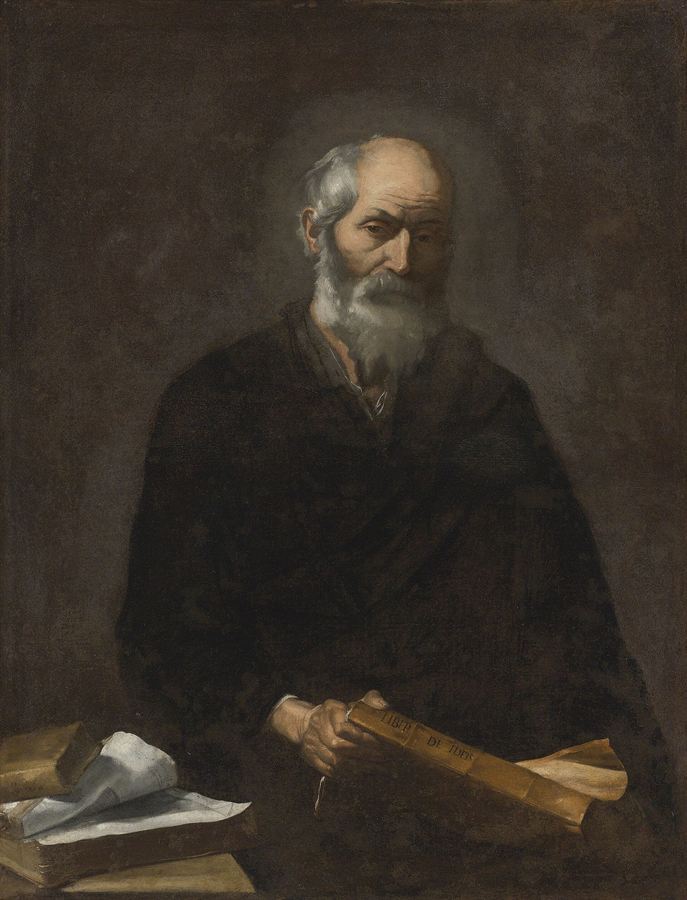
Jusepe de Ribera, Plato, 1637
What changes across the dialogues — and what the change is evidence of
The question was never whether Plato changed his mind in fifty years. It is what a difference between two dialogues is evidence of: a mind at a date, or an artefact designed for a reader.
That question cannot be settled in the abstract. It has to be tested somewhere — and the one place it can be tested cleanly is the elenchus: the Gorgias contains arguments that demonstrably fail to establish what Socrates says they establish, and the Meno and Republic contain machinery shaped to repair exactly that failure. If that repair is real, development wins on this axis. If it is staged, design wins.
The result: Kahn — the leading unitarian — poses the failure himself, states that Plato saw it, and names the Meno's method of hypothesis as the repair. He is a unitarian about doctrine and a developmentalist about argumentative equipment. Once those two axes are separated, most of the apparent disagreement dissolves, and the remaining dispute is narrower and sharper than the labels suggest.
Read this once; everything after it is elaboration.
Three axes get confused with one another whenever this debate is conducted under the labels “developmentalist” and “unitarian.” Keeping them apart is most of the work.
| Axis | The question | What settles it | State of play |
|---|---|---|---|
| A · Chronology | In what order were the dialogues written? | Stylometry; a very little external testimony | Late group secure. Middle soft. Early group unorderable — Brandwood’s own verdict. |
| B · Socrates | Whose philosophy is in the early dialogues? | Aristotle’s testimony; Xenophon; the Sokratikoi logoi | Contested between heavyweights — Kahn sceptical, Irwin and Smith for independence. And it silently props the order (§12). |
| C · Doctrine | Did Plato’s views change, or were they withheld? | Presence and absence of doctrine across texts | Genuinely contested. Kahn, Gerson: withheld. This is the classic fight. |
| D · Equipment | Did Plato’s argumentative resources improve? | Whether arguments fail, and whether later machinery repairs the failure | Not contested. Kahn concedes it in his own words. §21. |
And one internal fact discriminates. Convergence of style and doctrine does not — prolepsis predicts it too, and Kahn claims the same pattern as his own evidence (§24). What design does not predict is a method abandoned and then reinstated. That is the discarded patch, and it is the sharpest thing in the file.
Axis D has been invisible because it was never separated from Axis C. Once separated, the structural-fit argument — a defect appears, then machinery shaped to repair it — runs on D, where the leading unitarian agrees with it, rather than on C, where he does not. That is what converts an argument the field has been having for forty years into one with a determinate answer.
The debate is not about whether Plato changed. It is about what a difference between two texts is evidence of.
Three positions get bundled under one label, and they carry very different burdens.
The debate is regularly misdescribed — by its participants as well as its readers — as a disagreement about whether Plato changed. It is not. No unitarian holds that a man wrote for fifty years without learning anything, and Kahn says so more forcefully than his opponents do.
What is actually in dispute is an inferential licence: whether the difference between two texts entitles you to infer a difference in their author. Three positions get bundled under one label, and they have very different burdens.
The question as posed: are unitarians saying Plato did not change his view in fifty years — which would be absurd — or are they saying the developmentalists’ evidence is insufficient?
The second, with a qualification that matters. Nobody defends the first. What separates the camps is not a claim about Plato’s biography but a premise about what a dialogue is, and therefore about what its silences mean.
Stylometry delivers a sequence of texts. To get from that to a sequence of beliefs you need an extra premise — that a dialogue’s contents index its author’s mind at the date of writing. That premise is what unitarians deny. They do not deny the sequence, and they do not deny that the texts differ.
So the absence of the Forms from the Laches admits of several explanations: the interlocutor’s capacity, the question at issue, the dramatic date, deliberate reserve — and “Plato had not yet thought of them” is one candidate among these, not the default.
a fuller, subtler, and more satisfying account of the differences is available using the resources internal to each dialogue Ebrey & Kraut, Introduction, Cambridge Companion to Plato, 2nd edn (2022) — on the “growing reluctance” to read the dialogues developmentally
Note what that sentence does and does not say. It does not say nothing changed. It says the changes have a better explanation than a changing mind. The target is the inference, not the phenomenon.
Ranked from weakest and most widely held to strongest and most exposed.
Order of composition is not order of doctrine; textual absence has many available explanations; therefore the developmental reading is not licensed by the evidence usually offered for it. This leaves the developmental conclusion possible. It attacks the route.
This is the Ebrey & Kraut position, and it is where most working scholars now sit. It is also why the labels have fallen out of use: on this claim you are not committed to any thesis about Plato’s mind at all.
The aporetic dialogues are not records of a Socratic phase but literary preparation: they raise, in the reader, the questions the middle dialogues answer. Ch. 2 §5 sketches the ingressive interpretation; §6 is titled for Plato’s motive for holding back.
He accepts a chronology. The seven threshold dialogues belong to “the middle or late 380s, when Plato was about forty-five”; the Republic to “the decade 380–370” p. 59. His assumption is narrow and stated plainly: “I assume that Plato did not change his mind in any fundamental way between the Laches and Protagoras, on the one hand, and the Phaedo and Republic on the other” p. 59. Ten to fifteen years and one authorial project — not a frozen half-century. See §04.
Scope note, easily missed: Kahn’s book runs from the Socratic dialogues through the Republic. He is perfectly content that the late dialogues move to new problems and revise old apparatus. His target is narrow — the claim that there was an early period in which Plato held, as his own, a philosophy inherited from his teacher.
Plato “was probably in some sense a proponent of Pythagoreanism and a ‘two-world metaphysics’ well before he wrote anything” (AGPh 96/4, 2014). This is not a claim about texts at all; it is a claim about a man who had a philosophy before he had a pen.
Strongest and most exposed: it is unfalsifiable by the corpus, since on it the corpus was never a record of the position in the first place.
Stable core, revised under challenge. A settled set of commitments, repeatedly reformulated as objections land — the Parmenides being the obvious case of Plato pressing his own view. This is neither claim 1 nor claim 2, it fits the corpus, and it is roughly where most current scholarship actually operates while still using the old vocabulary.
| Position | Buys you | Costs you | Vulnerable to |
|---|---|---|---|
| Developmentalism (classic) | A narrative: the philosopher’s growth, with the Meno as hinge | Requires a secure early chronology and a licence to read silence as absence | Brandwood’s own verdict on the early group (§05); the argument from silence |
| Evidential unitarianism | Immunity — it asserts almost nothing | Explains no positive fact; cannot say what the differences are | Cases where the later machinery is visibly shaped to a specific earlier failure (§21) |
| Prolepsis (Kahn) | A unified corpus with a designed pedagogy | Posits a decades-long plan plus motives for concealment — an extra entity | Parsimony; and Kahn’s own concessions about the Gorgias arguments |
| Gerson | Maximum unity | Detaches the thesis from the texts entirely | Nothing — which is the problem |
Development requires only that a man’s views changed — something that happens to everyone. Prolepsis requires an additional posit: a sustained authorial plan with a motive for withholding. That asymmetry is real and it favours development. But it is not decisive on its own, because Kahn does not rest on the plan alone — he offers textual anticipations (Lysis 219c–220b on the prōton philon; Charmides 167a ff. on knowledge-of-knowledge) that he says are too precisely aimed to be accidents. Parsimony sets the burden; it does not discharge it.
Suppose we obtained solid proof that Plato wrote the whole corpus inside one year at the end of his life. Which developmental claims could still be derived from textual evidence alone?
The hypothesis is absurd. It is useful for exactly that reason: forcing the chronology to zero shows which claims were leaning on it without saying so.
Internal evidence yields a dependency order, not a composition order. And a dependency order is exactly what both readings predict: the developmentalist reads it as a mind working forward, the proleptic reader as an author organising an exposition. Under the one-year hypothesis the second reading simply wins by default, because there is nothing left for the first to describe.
So: no. Developmentalism is not derivable from internal evidence alone. It needs two further things — a composition order, and the premise that composition order tracks doctrinal order. The first comes from stylometry (§05); the second is exactly what unitarians deny (§01).
One class of internal evidence does discriminate, and it is not dependency. It is a method being dropped and then reinstated. See §24.
It is tempting to treat unitarianism as “fifty years without a change of mind.” Kahn does not hold that. He accepts a chronology: the seven threshold dialogues in “the middle or late 380s, when Plato was about forty-five,” and the Republic “in the decade 380–370, when Plato was in his fifties” p. 59.
His actual assumption is narrow and he states it plainly: “I assume that Plato did not change his mind in any fundamental way between the Laches and Protagoras, on the one hand, and the Phaedo and Republic on the other” p. 59. That is a span of perhaps ten to fifteen years and one authorial project — not a frozen half-century. Prolepsis is a live position, and the absurdity objection does not touch it.
Stylometry is doctrine-blind, which is why it is not circular — and why it cannot settle doctrine either.
The order is secure exactly where no thesis needs it, and unavailable exactly where every thesis needs it.
The developmental reading has historically leaned on stylometry: establish the order, then trace the growth. Part One shows that the order is secure precisely where nobody’s thesis needs it, and unavailable precisely where every thesis needs it.
The source is Leonard Brandwood, “Stylometry and Chronology,” ch. 3 of the Cambridge Companion to Plato, 2nd edn (2022), pp. 82–112 — a chapter carried over essentially unchanged from the 1992 first edition, which produces a visible seam (§06).
Three groups on a confidence gradient, descending sharply.
the differences that distinguish the final group … those which separate the dialogues of Plato’s middle period from all preceding it are not as sharp Brandwood, CCP² ch. 3 pp. 82–112
On the sequence of dialogues in the early group little can be said. Division into subgroups also seems out of the question. Brandwood — the verdict that matters most for the developmental thesis
The most he will grant is a terminal cluster: Phaedo, Cratylus, Symposium, Republic I, Lysis, Menexenus, Euthydemus, Hippias Major are “among the last of this group” — but “their relative order cannot be determined.”
Republic I was very likely a separate, earlier work — a conclusion Siebeck, Ritter, and Arnim reached independently. That matters: the dialogue most often used to characterise “early Socratic method” may be a detached piece later annexed.
External evidence is nearly nil. Brandwood: “the only information likely to be reliable is Aristotle’s statement that the Laws was written after the Republic.” One datum, at the far end of the corpus, about two works whose relative position nobody disputes.
You cannot trace a development through a group you cannot order. Every interesting developmental claim — that the Laches precedes the Meno, that the Gorgias follows the aporetic dialogues, that the elenctic method has a career — lives inside or at the edge of the group Brandwood declares unorderable. Chronology delivers coarse bands: early < middle < late. Within the band that carries the argumentative weight, it delivers nothing.
Worth noticing because it shows how the field moved while the chapter stood still.
Brandwood’s chapter opens with a flat developmentalist premise, stated as motivation:
his philosophical activity spanned some fifty years, during which time certain doctrines underwent considerable changes. To trace this development … it is essential to know in what order the dialogues were written. Brandwood, opening of ch. 3
That sits roughly three pages after an Introduction, written thirty years later by Ebrey and Kraut, reporting a “growing reluctance” to read the dialogues that way and recommending resources internal to each dialogue instead. The volume contains both, unreconciled.
Not incoherence on the editors’ part — they are reprinting a standard technical survey. It is evidence that the developmental premise was once so unremarkable that it served as a chapter’s opening motivation, and that this is no longer true. The chapter is a fossil of the consensus that Kahn 1996 and its successors displaced, preserved intact inside the volume that reports the displacement.
The methodological point that keeps Axis A from settling Axis C.
Fine’s position — stated in the Introduction to the Oxford Handbook of Plato, and present verbatim in the 2008 first edition as well as the 2019 second — is that chronology as such is neutral between developmentalism and unitarianism. Both parties can accept the same order of composition; they disagree about what the order licenses.
This is why the argument has to move somewhere else — and why Part Three goes to a case where the two readings make different predictions.
The historical Socrates is the main external prop for the developmental inference. Part Two removes it.
§12 is the document’s standalone treatment of historicity: four gates, four failures.
The historical Socrates has functioned as the main external prop for the developmental inference. If the early dialogues report a real man’s philosophy, you have a non-textual reason to think that material is not Plato’s own, and therefore a reason to read the later divergence as Plato coming into his own.
Part Two does two things: it shows that the prop is weaker than it looks, and then shows that the developmental argument does not need it — which is the more important result.
The most quoted sentence in the anti-developmental case, and the least load-bearing.
it is highly implausible to assume that a philosopher as creative as Plato should remain fixed in the position of his master for a dozen years or more Kahn, first objection to Vlastos
Read the emphasised phrase. The objection is to remaining fixed in someone else’s position — which is Vlastos’s ventriloquist version, where SocratesE is the historical man’s philosophy that Plato held and expounded before finding his own.
Substitute the neutral formulation — the early dialogues present position P₁, whoever first held it; the Meno marks a transition; the middle dialogues present P₂ — and the objection has no purchase. A creative philosopher holding his own view at forty and a better one at fifty is the default case, not an implausible one.
If Plato was too creative to stand still for a dozen years, why is he creative enough to possess the whole system by thirty and then spend twenty years withholding it? The proleptic Plato is the more static of the two. “Too restless to stand still” cannot be run as an argument for “he stood still and staged the reveal.”
It is also, as an argument, a biographical premise about a man whose biography we do not have — not textual evidence.
The creativity line is a crowbar to loosen Vlastos, not the foundation. What Kahn rests on is (i) the literary premise — a dialogue is fiction, and we do not infer a novelist’s beliefs from what chapter 3 omits; and (ii) proleptic textual data — anticipations in the early dialogues aimed at later material. Point (ii) is genuine textual argument and has to be met on its merits.
Before asking how much weight the testimony bears, it is worth being exact about what it consists of. It is not what the developmental tradition’s shorthand suggests.
Aristotle nowhere names a dialogue as a record of Socrates. There is no sentence in the corpus of the form “the Laches gives us Socrates.” What he does is two quite different things, and the tension between them is the whole problem.
He mentions the Phaedo (Met. 991b3–4) and “Socrates in the Phaedo” (GC 335b9–17); alludes under Plato’s name to the Phaedrus, Theaetetus, Sophist and Philebus; and contrasts the Timaeus with the unwritten doctrines (Phys. 209b11–16).
“Aristotle’s criticism of the Republic and the Laws in Politics II provides a striking example of his identification of Plato with the Platonic Socrates. After speaking of the Socrates in the Republic, Aristotle goes on to speak of the Laws as another ‘Socratic discourse’ (1265a10–13), even though Socrates is not a speaker in the Laws.” He then treats both dialogues as evidence of Plato’s views (1266b5, 1271b1, 1274b9–10).
The argument from silence around this is strong. Aristotle does all of it while attacking Plato, before an audience that included Plato’s own school, during or just after Plato’s lifetime. If the character Socrates were not understood as Plato’s mouthpiece, “a defender of Plato would only have had to remind Aristotle that the Platonic Socrates was not meant to represent Plato’s views.” Nobody appears to have done so.
Never dialogue-by-dialogue. Always doctrine-by-doctrine:
| Topic | What he says | Where |
|---|---|---|
| Method | “Socrates asked questions but did not answer them; for he confessed that he did not know” — never said of Plato | Top. 183b7–8 |
| Scope | concerned with ethics, “not at all with the whole of nature” | Met. 987b1–2; PA 642a28–31 |
| Definition | “he was seeking the universal (katholou) in moral things and was the first to turn his thought to definitions” | Met. A.6 987a29–b8 |
| Attribution | “there are just two things one might fairly ascribe to Socrates — inductive arguments and universal definitions” | Met. M.4 1078b27–30 |
| Separation | “Socrates did not make universals or definitions separate; they [the Platonists] separated them” | M.4 1078b30–32 |
| Verdict | “he did not separate them from particulars. And he was right not to separate them… separating is the cause of the difficulties arising about the ideas” | M.9 1086b3–7 |
| Ethics | denied akrasia; identified courage with knowledge; made all virtues knowledge; did away with the non-rational soul | EN 1145b22–31, 1116b3–5, 1144b17–30; MM 1182a15–30 |
That Met. M.4 line — “one might fairly ascribe to Socrates” — is the closest thing to a methodological statement anywhere in the corpus. Note what it is: a list of two doctrines, not a list of texts.
When Aristotle discusses the dialogue character he usually writes “the Socrates”; for the historical man, “Socrates” without the article (Fitzgerald 1853: 163; defended by Ross 1924, I xxxix–xli). Irwin’s own note concedes the difficulties, citing Deman 1942 and Nehamas 1992: 169–71, and adds: “The exceptions to the general rule do not undermine its general reliability. In any case, our decision on this point does not affect the main evidence.”
The honest charge against Aristotle is not dishonesty. It is that his interest is doxographical, in service of his own metaphysics; that he never states a source; and that on the Laws he is demonstrably loose. His categories are doctrinal, not documentary. That is enough to make him worth taking seriously, and not enough to make him decisive.
It also shows the sceptical worry has been mis-stated. The question is not whether Aristotle naively took every Platonic Socrates for the historical man — the Laws passage proves he did not. The question is why he carves out exceptions at all, which is where §10 begins.
How much weight the testimony can carry — and why the recent literature says: less than the developmental tradition assumed.
| Instrument | What it claims | Status |
|---|---|---|
| Fitzgerald’s canon | The definite article distinguishes references to the historical man from references to Plato’s character | A blunt instrument; contested in application |
| Stenzel’s tense criterion | Present tense = dialogue character; past/imperfect = the historical man | Suggestive, not decisive |
| Kahn’s “dazzling screen” | Aristotle read the dialogues; his Socrates is largely Plato’s Socrates read back | Widely influential; the sceptical position |
| Smith’s tally | Only 7 of 26 relevant Aristotelian passages plausibly derive from the dialogues, so independence survives | Minority — Wolfsdorf labels it the “charitable” reading |
T. H. Irwin, “The Platonic Corpus,” ch. 3 of the Oxford Handbook of Plato (2019), pp. 76–77, answers Kahn by name (n. 24 cites Kahn 1996: 79–87, which “discounts Aristotle’s [testimony]”). His argument is not a tally. It is an argument from selectivity.
Aristotle assigns some views in the dialogues to the historical Socrates and marks others as Plato’s. So he discriminates among dialogues — and therefore “cannot … have naively supposed that the character Socrates always puts forward the views of the historical Socrates. He must have supposed that he had some reason.”
Irwin then eliminates the internal candidates. Doctrinal conflict would show only that the dialogues disagree, not which side is Socrates’. Biographical fullness is refuted by a counterexample: “The Phaedo has more to say than any other dialogue about Socrates’ life and philosophical development, but Aristotle takes it to present a Platonic, not a Socratic, theory of forms.”
Conclusion: “The internal evidence of the dialogues could not have persuaded Aristotle that some, but not others, are about Socrates. Probably, then, Aristotle ascribes some of the views of the Platonic Socrates to the historical Socrates because he has external evidence.” And he had access: the Academy from 367, thirty-two years after Socrates’ death; people who had known him; and a motive, since Plato was not the only writer of Socratic dialogues.
Smith’s 7-of-26 tally is a minority argument. But Irwin reaches the same conclusion by a different and stronger route, in the same handbook, against Kahn by name. The honest description of the state of play is contested between heavyweights, not fringe versus consensus. What remains true is that the sceptical reading has held the recent decades, and that the Stanford Encyclopedia’s Socrates entry omits Aristotle from its sources altogether.
1 · The gap between “not from Plato” and “about the historical Socrates.” The other Sōkratikoi logoi — Antisthenes, Aeschines, Xenophon, Eucleides, Aristippus — sit in that gap. Irwin invokes them as Aristotle’s motive for seeking external evidence, but they are also an available source. If the criterion came from that literature, Aristotle’s independence from Plato is real while his independence from fiction is not. That is precisely the reception point: the genre was invention, not report.
2 · The Phaedo counterexample is weaker than it looks. Aristotle’s own discriminating mark is separation (Met. M.4 1078b30–32; M.9 1086b3–5) — a doctrinal criterion he could apply from the inside, and one that cleanly separates the Phaedo from the definitional dialogues regardless of how much biography it contains. Irwin’s reply must be that a prior fix on which side is Socrates is still needed; but that fix could come from the Apology plus diffuse Athenian memory rather than privileged testimony.
3 · He concedes one of his own props. n. 17: “In (1) I take a disputed position on the legitimacy of ‘Fitzgerald’s canon.’”
The most useful thing in Irwin’s treatment is his own concession about how little the testimony is needed, and how little it settles.
study of the dialogues reveals the sorts of differences that Aristotle describes; and even without his help we ought to be able to see the differences for ourselves. Without his evidence we would not know that the differences have anything to do with the historical Socrates, but we would have to take account of them somehow in our account of Plato’s development. Irwin, Plato’s Ethics p. 10
Strip Aristotle out entirely and the doctrinal differences remain and still demand explanation. What the testimony contributes is one thing only: the claim that the difference is a difference between two men rather than between two stages or two authorial purposes. Irwin then sets out the three surviving options.
The choice between the first and the second explanation depends on our estimate of Aristotle’s credibility. Irwin, Plato’s Ethics p. 10
Options 1 and 2 are both developmental. The testimony picks between them. Option 3 is prolepsis — a claim about Plato’s compositional intent — and Aristotle never says a word about compositional intent, in either direction.
Aristotle is evidence about whose view a doctrine was, not about why a dialogue was written. Those are different questions, and only the second is load-bearing for the argument this document runs.
1 · It vindicates the decoupling (§12) on the philosophical axis. Moving from option 1 to option 2 costs nothing philosophically, because both are developmental and Aristotle is the only thing that separates them. So the whole Aristotle question really is idle for the interpretation — which was your instinct several steps back.
2 · And it exposes a circularity in the ordering use. Irwin’s handbook chapter uses Aristotle’s testimony, with doctrinal considerations, to place Group 3 after Groups 1–2 (§12). But that use presupposes we are already inside options 1–2. Aristotle can order the groups only within the developmental family; he cannot license the family itself. So the testimony cannot be both the evidence for development and the instrument that fixes the order development is read off.
This is the section the rest of the document leans on. It is written to be self-sufficient: the source-critical case is set out here in full, with the authors quoted at length, so that the conclusion — that the historicity of Socrates is idle for the philosophy in Plato’s dialogues — can be checked against the evidence without going back to the individual volumes.
The argument runs as four gates. Each asks whether the historical Socrates can do a job the developmental reading has traditionally asked of him. All four fail, and the fourth fails decisively.
The standing inventory rests on a criterion Waterfield states plainly: “if we are going to search for the historical Socrates in the literary remains, we need to rely on authors with privileged access to authentic Socratic material. Since Socrates himself wrote nothing, the only relevant privilege is that the authors should have been contemporaries or close contemporaries” Bloomsbury p. 2. That yields five candidates — and, on the source-critical literature, five problems.
| Witness | The finding | Who |
|---|---|---|
| Aristophanes & Old Comedy | “Enough Old Comedy survives for us to be certain of the rules of the game, and they did not include historical truth.” Dorion adds that the Clouds Socrates is “really a composite figure whose traits were gathered not only from Socrates himself but also from the physiologoi and the sophists.” | Waterfield p. 7 (with Dover); Dorion p. 6 |
| Xenophon | Downgrading him is question-begging: “Xenophon is said not to understand Socrates because what he says about Socrates differs from what Plato says, when the very issue we are trying to resolve in the first place is which of them, if either, is to be trusted.” | Waterfield p. 6 |
| The other Socratics | Same genre, same disability. “There was no Socratic school: every follower was free to develop his own ideas and to use ‘Socrates’ to express those ideas.” | Waterfield p. 10 |
| Plato | “Plato made up the story, then, as a way of introducing his own mission, the mission he would assign to the character Socrates who was to appear in his works.” The Apology is not exempted. | Waterfield pp. 12–13 |
| Aristotle | “In short, there is no way to treat Aristotle as either a reliable or an independent witness.” Contested — see §10 and §11. | Waterfield p. 6; contra Irwin |
The ground has been cleared. There is no way we can trust any of our witnesses to Socrates’ life and work, either singly or in conjunction. Waterfield, “The Quest for the Historical Socrates,” Bloomsbury Companion to Socrates pp. 13–14
This is the strongest finding in the literature, and it is not a modern imposition: the classification is Aristotle’s own.
“It was Aristotle who invented the term Sōkratikoi logoi (Poetics 1447b1–3), and the context in which he introduced it is revealing. He described them as the prose equivalents of the verse form mime… He also described both mimes and Sōkratikoi logoi as ‘imitative’, which is his term for ‘fictional’.” Waterfield p. 9
“The main difference between mimes and Sōkratikoi logoi was that the latter showed historical characters in fictional settings, whereas in mimes even the characters were fictional.” p. 9
Dorion draws the methodological consequence, and it is the sharpest formulation of the whole problem — that the question has been mis-posed from the start:
The Socratic problem has all the makings of a false problem because it rests on a misunderstanding… For the Socratic problem as it had been debated since the start of the nineteenth century to have meaning, the principal direct witnesses (Xenophon and Plato) must have intended to faithfully reconstruct Socrates’ ideas… Yet everything seems to indicate that neither Xenophon nor Plato set out with the intention of faithfully reporting Socrates’ ideas. Dorion, “The Rise and Fall of the Socratic Problem,” Cambridge Companion to Socrates pp. 7–8
Xenophon’s and Plato’s Socratic writings belong to a literary genre — that of the logos sokratikos, which Aristotle explicitly recognized and which authorizes by its very nature a certain degree of fiction and a great freedom of invention as far as the setting and content are concerned, most notably with the ideas expressed by the different characters. Dorion p. 8
And Waterfield reports the consensus rather than claiming novelty:
It is in fact generally acknowledged that the Sōkratikoi logoi are a species of fiction, and that the differences between the views of Socrates we find in the Socratics tell us more about the authors than they do about the historical Socrates… each of them used Socrates as an ideal and a cipher, for his own purposes. Waterfield pp. 9–10
Demanding historical fidelity from a logos sokratikos is a category mistake about the genre. The texts were not built to bear it, and the ancient critic who named the genre said so.
If the Sōkratikoi logoi were the first literary use of Socrates, the fiction finding would still leave open that each author invented from life. Bromberg’s two chapters close that door: a public “Socrates” existed on the Athenian stage before the prose tradition, and it shaped what followed.
“the evidence for (at least) seven comedies by five comedians satirizing intellectuals in similar ways within a decade of one another seems sufficient to argue for a subgenre of Old Comedy, akin to ‘demagogue comedies’ and ‘mythological burlesques.’” Stavru & Moore p. 34
“423 bce saw two comedies at the Dionysia featuring Socrates as a character (Ameipsias’ Connus, and Aristophanes’ Clouds)” p. 47; and “we know that Socrates himself was specifically singled out for ridicule by several comedians besides Aristophanes, especially by Ameipsias and Eupolis” p. 49.
What matters is not the count but what the count shows: the comic “Socrates” is assembled from a transferable repertoire applied indifferently to Hippon, Protagoras, Damon and Prodicus:
intellectuals and their students in Old Comedy are neither all-seeing nor provident: they are, on the contrary, ‘forgetful’… and ‘gullible’… ‘pretentious’… ‘beggars’… ‘braggarts’… ‘supple, dissembling, slippery, pretentious’… ‘thieves’… and sloppy dancers. Bromberg pp. 46–47 — each predicate attested across several poets and several targets
“Dover argues that Socrates’ behavior at Potidaea and Delium… had made him the subject of conversations… But it seems more likely that these two plays helped thrust Socrates fully, and perhaps unexpectedly, out of anonymity.” p. 55
“his appearance in two plays in a single Dionysia, in front of as many as 17,000 spectators, surely helped to make ‘Socrates’ a household name, and by the time of Birds (414 bce) Socrates was well known enough for Aristophanes to coin the verb ‘socratize’.” p. 55
If that is right, the public figure is substantially a theatrical product rather than a theatrical record — and the details that look like biography are the least trustworthy part of it.
The comic tradition then fed the prose one, in both directions of the corpus:
just as Kolakes has provided material and inspiration for Plato’s Protagoras, Autolykos will have given Xenophon material for his symposium, including the presence of Socrates. Storey 2003: 324, quoted approvingly by Bromberg p. 44; cf. p. 45 on “the monopoly of influence that Clouds has held over the Socratic tradition since antiquity”
And his companion chapter states the chronological result that matters most here — a literary Socrates was taking shape before Plato chose to write one:
Documenting engagements with Socrates and Socratic ideas in pre-Platonic texts allows us to understand what some of the earliest Socratic receptions might have looked like, and how a literary tradition about Socrates began to take shape in the final decades of his life — and, importantly, in the years leading to Plato’s decision to represent him in literary (dramatic) form. Bromberg, “Greek Tragedy and the Socratic Tradition,” Brill’s Companion to the Reception of Socrates p. 42
He also states the problem of identification at the outset, which is worth keeping because it names the difficulty precisely: “there is the question of establishing what we mean by ‘Socrates’. The earliest mentions of his name are in Athenian Old Comedy, where he is identified as an unwashed, chattering charlatan… But this is not the Socrates familiar to readers of Plato and Xenophon” p. 41. And: “some of our earliest descriptions of the man (i.e., in Aristophanes’ Clouds and Plato’s Apology) not only disagree, but in several places explicitly contradict one another” p. 42.
A shared literary inheritance stands between every Socratic author and the man. What the sources have in common may be what they inherited, not what they witnessed.
This is the gate that kills the eclectic method — the practice, running from Schleiermacher through Vlastos, of triangulating the historical Socrates from points where the sources agree. Waterfield gives three reasons it fails; the third is the decisive one:
since the Socratics were writing fiction, when one of them echoes the other (and, as far as we can tell, Plato’s texts were generally primary), it is more appropriate to talk of intertextuality than of historical veracity. Waterfield p. 11
His test case is the Delphic oracle: he argues Plato invented the Chaerephon story and Xenophon knowingly reworked it, substituting “free, upright, and prudent” for “wise.” “This is a good demonstration of how intertextuality rather than biographical veracity was the name of the game for the writers of Sōkratikoi logoi” p. 13. And the aggregate:
there is no conclusive reason why we should privilege one of our authors over another, and there is no conclusive reason why we should think that any of them was writing anything close to what we understand as history or biography. Waterfield p. 11
Dorion reaches the same place from the other side — the sources do not converge in the first place. “It is quite surprising that there is no consensus regarding the number and identity of Plato’s dialogues that would allow for the reconstruction of the historical Socrates’ ideas, but, in another way, this disagreement among interpreters is inevitable because of the doctrinal heterogeneity of Socrates’ character in the corpus platonicum” pp. 6–7.
Agreement among the Socratics is a literary fact about a genre, not a corroborating fact about a man.
The three gates above are about whether historicity is recoverable. This one is about whether it would matter — and it is the gate that settles the question for this document.
“The critical weakness of Vlastos’s position will be evident to any clear-thinking reader from my summary: even if we accept Vlastos’s Ten Theses, we are left with no more than differences between two portraits of Socrates, one composed by early Plato and the other later; we have no reason for going on to say that the earlier portrait is a likeness of the historical Socrates.” Waterfield p. 6
Read that against what this document actually argues. The claim in §21 is that the Gorgias’s arguments fail and the Meno’s machinery repairs the failure. Grant Waterfield’s point in full and nothing in that claim moves. The defect is in the argument; the repair is in the later text; the relation between them is a relation between two pieces of writing. Whether the earlier position was ever held by a man in the Agora is a further question, and answering it in either direction leaves the relation exactly where it was.
Waterfield’s note on Fitzgerald’s canon makes the same point about the strongest philological instrument available: even where the grammatical criterion holds, “all this proves is that Aristotle thought he was referring to the historical Socrates, not that he actually was, as a result of access to privileged information” n. 23, p. 330.
Historicity is an extra claim laid on top of the textual findings, not a premise they rest on. It can be removed without loss.
Aristotle is the one witness where the literature genuinely divides, so it is worth having both sides here rather than only in §§10–11.
| Position | Argument | Source |
|---|---|---|
| Against Waterfield | The regress: “if we suppose that Aristotle did have access to sources… independent of Plato’s and Xenophon’s writings, who or what were these sources? They must have been other Socratics, but then this begs the whole question, since the problem in the first place is that the Socratics’ depictions of Socrates are not consistent with one another.” Plus: “He never met Socrates, who died 15 years before he was born… Almost all his references to Socrates can be traced to passages in Plato.” | Bloomsbury pp. 6, 8 |
| For Irwin | The selectivity argument: Aristotle discriminates among dialogues, so he needs a criterion; no internal criterion supplies one (the Phaedo counterexample); therefore external evidence. See §10. | Oxford Handbook pp. 76–77 |
| Limit Irwin again | Whichever way that goes, Aristotle adjudicates only between Socrates’ own views and Plato’s own earlier views — both developmental. He says nothing about compositional intent. See §11. | Plato’s Ethics p. 10 |
Because of Gate 4. If Waterfield is right, Aristotle contributes nothing. If Irwin is right, Aristotle contributes the choice between two developmental options. Neither outcome touches the argument this document runs — which is why the decoupling is available regardless of who wins.
Both major responses abandon the classical quest. They differ about what replaces it, and for our purposes they land in the same place.
Dorion quotes two summaries that state the shared result better than either programme does. Kahn: “The historical Socrates certainly existed, but to a very large extent the fifth-century figure escapes our grasp. What we have instead is the literary Socrates of the fourth century, in a diversity of portraits” (Kahn 1990: 287, at Dorion p. 20). And Morrison: “the cautious and reasonable view is that certainty about the historical Socrates is lost to us — and, in a way, not very important. The most important fact about Socrates was his influence” (Morrison 2000a: 780, at Dorion p. 20).
Do not say: the early dialogues give the historical Socrates’ philosophy, which Plato later outgrew.
Say: the early dialogues present a determinate position P₁, and its author is Plato in every case. The Meno marks a transition. The middle dialogues present P₂. No claim is made about who first held P₁, or whether anyone did.
In Dorion’s vocabulary, what the corpus gives is a “diffraction” — “the different and often conflicting interpretations that his disciples have given of his life and ideas” pp. 20–21. A diffraction pattern is still a determinate object of study. It is simply not a portrait.
The reformulation frees you from needing Socrates as a philosophical figure. It does not free you from needing an order: P₁ must precede P₂. And within the early band, the order is not delivered by statistics.
Irwin is explicit. His Group 2 is Protagoras, Gorgias, Euthydemus; his Group 3 is Meno, Cratylus, Hippias Major, Phaedo, Symposium. And: “Linguistic and stylistic evidence … places Groups 1–3 before the others without fixing any definite order of groups or within groups. Doctrinal considerations (mentioned in points (3) and (4) above) justify us in placing Group 3 after Groups 1 and 2” Oxford Handbook p. 74 — where point (4) is Aristotle’s testimony.
So on Irwin’s own account, Aristotle is part of what puts the Meno after the Gorgias. That is exactly the pair §21 and §25 run on. See §27 for the over-determination that saves it.
Decoupling is not denial. Waterfield states the remainder exactly: “There must be traces of the historical Socrates in them, otherwise Socrates would not have been chosen as their protagonist, but we lack grounds for identifying such traces, and in any case any authentic, historical data that they might preserve about Socrates are ‘only incidental’” p. 11. And: “The Socratics’ works may be fictional, but they are fictional accounts of a person they knew and loved… The historical Socrates is at least the focus of his followers’ myth-making” p. 14.
Two things are also given up. The biographical narrative that made classic developmentalism attractive — the young Plato in his teacher’s shadow, then emerging — goes. And the question does come back on a different axis: ask what the name did in the culture rather than what the man thought, and the comic, tragic and biographical material becomes admissible evidence again. That is Bromberg’s programme, and it is a different enquiry, not a rival one.
“Socrates” in Plato is a philosophical position bearing a name, not a witness being quoted. Index claims to texts; treat the identity of whoever first held them as a separate question with a separate evidence base.
Four gates, four failures: the sources are the wrong genre; the figure was circulating before them; their agreement is inheritance rather than testimony; and a successful historical result would leave the arguments untouched. What survives is a corpus of positions in a determinate relation — which is all the rest of this document needs.
A defect in an argument is a public, checkable fact — unlike the absence of a doctrine.
The Gorgias proof-language is the evidence base, assembled and certified as localised by Vlastos himself.
Parts One and Two cleared ground. Part Three is where the question gets a test case, because here the two readings make different predictions about what we should find in the text.
The case: elenctic arguments establish inconsistency in a belief-set. In the Gorgias, Socrates describes what they have achieved using the vocabulary of demonstration and truth. That mismatch is what Vlastos named “the problem of the elenchus,” and it is the single most-worked question in Socratic studies of the last forty years.
Stated without any theory about what Socrates privately believed.
The elenchus is a procedure. You assert p. Socrates obtains your assent to q and r. He shows that q and r entail not-p. You retract.
What that establishes, in point of logic, is that {p, q, r} cannot all be true — an inconsistent set. It does not identify the false member. Perhaps p. Perhaps q.
how is it that Socrates claims to have proved a thesis false when, in point of logic, all he has proved is that the thesis is inconsistent with the conjunction of agreed-upon premises for which no reason has been given in that argument? Vlastos, Socratic Studies p. 25 — his own statement of the problem
“a witness gives testimony p on his own initiative and then, under prodding from the prosecuting attorney, concedes q and r, whereupon the attorney points out to him that q and r entail not-p … Has he then been compelled to testify that p is false? He has not. Confronted with the conflict in his testimony, it is still up to him to decide which of” his statements to withdraw. SS 25
The courtroom scene is Style A machinery. The next section is Style B talk, in the same dialogue.
Vlastos’s texts T19–T24, Socratic Studies ch. 1. This is the evidential base — assembled, and certified as localised, by the very scholar whose reconstruction is under suspicion.
“Has it not been proved (apodedeiktai) that what was asserted [by myself] is true?”
Gorgias 479e — SS p. 19
The plainest one. The perfect passive of apodeiknŭmi, the standard word for demonstration. Vlastos: “Here Socrates says in so many words that he has done what Grote and I had maintained he never did in an elenctic argument: ‘proved’ his thesis ‘true.’”
“But I, a single man, do not agree, for you do not compel me, but produce a multitude of false witnesses against me, trying to drive me out from my property, the truth.”
Gorgias 472b — SS p. 20
Seven Stephanus pages before T19. Vlastos: “How do you ‘compel’ your adversary to affirm what he denies? In an argument your only means of compulsion are logical.” So the intention to prove is announced in advance.
“But I know how to produce one witness to my assertions: the man against whom I am arguing.”
Gorgias 474a5–6 — SS p. 20
The trap for the deflationist. This line is often cited as evidence that the elenchus is ad hominem by design. In context the claim is perfectly general: whenever he argues elenctically, Socrates “knows” how to make the opponent witness against himself — and maintains it is “impossible” for the opponent to do the same to him. It is a claim about the method, not a modest confession.
“Not just difficult, Polus, but impossible: for what is true is never refuted.”
Gorgias 473b10–11 — SS p. 20
The strongest single item. A claim that refutation and truth track one another — about the world and about the method, with nothing about this interlocutor’s beliefs. Vlastos writes immediately after quoting it: “This brings us smack up against what I had called earlier on ‘the problem of the elenchus.’”
“I believe that I and you and the rest of mankind believe that committing injustice is worse [for the agent] than is suffering it.”
Gorgias 474b — SS p. 20
The weakest, and the source of the trouble. Socrates attributes to Polus a belief Polus denies. This is where Vlastos derives covert vs overt belief, and hence assumption (A). It needs machinery to work — which is why it is the item to leave with Vlastos rather than build on. See §25.
[a] “philosophy always says the same thing.” [b] “if you leave this unrefuted, then, by the dog, god of Egypt, Callicles will not agree with you, Callicles, but will dissent from you your whole life long.” [c] “I would rather … that a whole multitude should dissent from me and contradict me, than that I, a single man, should be out of tune with myself.”
Gorgias 482a–c — SS pp. 20, 27
Together with Grg. 486e–487e (Callicles as the ideal touchstone: knowledge, goodwill, frankness), this completes Vlastos’s cluster.
Vlastos, Postscript p. 36, on the whole cluster: “where he is made to say those very strong things — T19, T20, T21, T22, T23, T24[a,b], and G. 486e–487e — of which there is no sign earlier on.”
This is a claim about the corpus, not about Socrates’ mind: the vocabulary switches on in the Gorgias and is absent before. Checkable, falsifiable, and exactly the shape of evidence a structural-fit argument needs. Vlastos assembled the sample and supplied the negative control, then explained it with a premise (§15) that nobody had to accept.
SS p. 19: “Grote had certainly gone over that sentence many times, and so had I, and so had scores of others. But it had not hit anyone between the eyes.”
The text was there for two millennia. What was new in 1983 was noticing it. That distinction — datum versus reconstruction — is formalised in §17.
The hypothesis that closes the gap, and the developmental story that follows from it.
So [A] is Plato’s present to his teacher, bestowed on him in the Gorgias, where he is made to say those very strong things … of which there is no sign earlier on. Vlastos, Socratic Studies p. 36
Note what that sentence concedes: (A) is not the historical Socrates’ premise, and not the early dialogues’ premise. It is an intrusion, at one point, by Plato — because Plato, not Socrates, is the one who feels the epistemological worry. Vlastos p. 36: “It must be Plato, then, who comes to feel the force of that question when he writes the Gorgias.”
Replying to Kraut in the same volume of Oxford Studies, Vlastos conceded that outside the Gorgias there is no evidence for (A) at all — that in the pre-Gorgias dialogues Socrates argues as any philosopher does:
he picks premises which he considers so eminently reasonable in themselves and so well-entrenched in his interlocutors’s system of belief, that when he faces them with the fact that these premises entail the negation of their thesis he feels no serious risk that they will renege on the premises to save their thesis — as in fact, they never do. Vlastos 1983b: 73, quoted at Wolfsdorf pp. 39–40
The structural-fit argument — defect appears, machinery shaped to repair it follows — is not a novelty. It is Vlastos’s own, published in 1983 and still standing in Socratic Studies in 1994. That is a pedigree. It is also a warning: the argument has been available for forty years, and unitarianism grew anyway. §25 explains why, and what to change.
The reception. Source: David Wolfsdorf, “Socratic Philosophizing,” in Bussanich & Smith (eds.), The Bloomsbury Companion to Socrates (2012), pp. 34–67 — a survey, not an advocacy piece, which is why it is the right place to check.
Most scholarship of the last quarter century has been devoted to solving, dissolving or criticizing attempts to solve or dissolve the problem of the elenchus. This is true for Vlastos (1983a), Kraut (1983), Brickhouse and Smith (1984a), Polansky (1985), Benson (1987, 1990b, 1995), Adams (1998) and Santana (2007, 2009) … In short, the bulk of the discussion of Socrates’ method in the last quarter century has been devoted to the elenchus and to the problem of the elenchus. Wolfsdorf p. 35
| Respondent | Move | Status |
|---|---|---|
| Kraut 1983 | Socrates has no special method; he picks premises he considers eminently reasonable | The first reply, and the one Brickhouse & Smith later endorse |
| Brickhouse & Smith 1984a | Attack (A) directly: Socrates has no means of assuring, and no reason to believe, that his moral belief-set is wholly true — a fortiori not his moral and non-moral beliefs | The standing objection to (A) |
| Benson 1987, 1990b, 1995 | Accepts that the elenchus “actually cannot refute a given ethical thesis, but only expose inconsistency among a set of beliefs”; redescribes the aim as refuting the interlocutor’s knowledge-claim | “has not won much support” |
| Brickhouse & Smith 2002b | Heterogeneity: there is no single thing to have a problem | The live objection — see below |
| Santana 2007, 2009 | Reaffirms that there is a problem; corroborative agreement carries greater evidential weight | Most recent contribution |
As far as the elenchus is concerned, Benson’s dissolution has not won much support. Indeed, the most recent contributions to the debate, Santana’s, reaffirm that there is a problem of the elenchus … In short, Vlastos’s problem remains alive and invites further reflection. Wolfsdorf p. 66
“there can be no solution to ‘the problem of the elenchus’ and no single analysis of elenctic arguments, for the simple reason that there is no such thing as ‘the Socratic elenchus’” — and “The very idea … is an artifact of modern scholarship.” 147, at Wolfsdorf p. 56
Why this is worse than the others: it attacks the explanandum, not the inference. Structural fit needs a determinate item that has the defect and a determinate repair. If elenctic arguments are heterogeneous, there is no single defective item, and nothing for the Meno to be downstream of. Their positive fallback is Kraut: Socrates “just does what we all do when we try to argue well” 156; he is “like us” 157.
“some arguments operate through some form of reductio; some by analogy; some are epagogic; some use certain premises as dialectical expedients; some are deliberately fallacious and variously so. It may be useful to consider to what extent Socratic arguments, both critical and constructive, can be classified … between Vlastos’s monolithic conception of the elenchus as Socratic method and Kraut’s general claim that Socrates argues by picking premises he considers eminently reasonable, a good deal of middle ground lies open for investigation of details and specifics.” p. 66
A form-by-form census either shows the arguments cluster — in which case there is a unit and Brickhouse & Smith fail — or shows they scatter, in which case they win. See §26.
The distinction that dissolves the “it’s just Vlastos” objection. People collapse these three and then attack the wrong one.
L1 and L2 are observation. L3 is theory. “The problem of the elenchus is Vlastos’s reconstruction” points at L3 and pretends it is L1 and L2. The reconstruction is (A). The problem is the distance between L1 and L2 — public, checkable, and older than the reconstruction by two thousand years.
What the gap does not establish is that the mismatch is a defect. That is a fourth step, and it is where the interpretive fight properly lives — loose speech? dramatic bravado? Plato drawing an overconfident character? Part Four settles that step from an unexpected direction.
Three attributions in the first pass of this analysis were wrong. They are recorded because the corrected versions are load-bearing.
It is sometimes said that Benson has to quarantine the Gorgias to protect his reading. Not quite. Wolfsdorf p. 49 shows Benson taking Euthyphro, Charmides and Laches as paradigmatic on Apology grounds, and then treating the Gorgias directly at 100–109, arguing that there too Socrates shows inconsistency rather than falsity. That is re-description, not exclusion. Do not over-claim it.
Benson’s third response is worth keeping for a different reason: it is “simply a dogma of Platonic or Socratic studies that ‘the elenchus is Socrates’ only method of argument’” — Socrates “may have arrived at his strong moral commitments as a result of non-elenctic arguments” 109, e.g. the argument of the Laws in the Crito. That is a respectable version of the “warrant from elsewhere” instinct, and its virtue is that its warrant is on the page.
The decisive text. The arch-unitarian poses the problem, says Plato saw it, and names the repair.
Pages 133–147 of Plato and the Socratic Dialogue, plus ch. 6 §1 at p. 148.
Everything to this point has been preparation for one chapter: Charles Kahn, Plato and the Socratic Dialogue (CUP 1996), ch. 5, “Gorgias: Plato’s manifesto for philosophy,” pp. 125–147 — specifically §3 “Elenchus in the Gorgias” (133), §4 “The positive function of the elenchus” (137), §5 “The limits of the Gorgias” (142).
The expectation, given everything the labels lead one to expect, is that the arch-unitarian will dissolve the problem — will say the arguments are fine, or that Socrates never claimed what Vlastos says he claimed, or that the apparent defect is a designed effect. He does none of these.
Not dissolves. Poses.
§4 opens by conceding the negative result: “The results of all three refutations are essentially negative: to reveal the incoherence between the life and the doctrine of the interlocutor, an incoherence reflected in the inconsistency between different views held by the same man” p. 137. He then sets the strong claims beside it — Grg. 508e–509a, where the conclusions are “bound and fastened with iron and adamantine arguments” — and asks:
But how can such highly personalized refutations and, in the central case against Polus, such a complex and dubious argument, justify such strong and universal claims? Kahn p. 138
That is the problem of the elenchus in Kahn’s own words. And §5 goes further, conceding both halves of §17 and the fourth step:
We know that the argument against Polus is not strong enough to establish Socrates’ conclusion; and it is hard to believe that Plato was entirely unaware of this fact. Kahn p. 143
Kahn grants (i) the arguments do not establish what Socrates says they establish; (ii) Socrates nonetheless says it; and (iii) Plato knew. Point (iii) is the step that the “we cannot know what was in Plato’s mind” framing always struggles with — and it is granted by the opponent, not asserted by the proponent.
He has held this since 1983: n. 11 at p. 135 cites Kahn (1983) 90–2, “the argument is strong enough to defeat Polus but not strong enough to establish Socrates’ positive thesis that doing injustice is worse for the doer.”
His answer is not Vlastos’s. But it occupies the identical logical position, which is itself informative.
It is not that these claims follow from premises that are actually believed by his interlocutors (as Vlastos once suggested). It is rather that these claims are protreptic: this is what everyone will believe and prefer if they understand what is at stake. So at 495e 1 Callicles will change his mind “when he has come to see himself correctly.” Kahn p. 140 n. 15
Vlastos: everyone holds true beliefs entailing the negation of their false ones. Kahn: everyone has a rational desire for the good, partly unconscious. Both are universal psychological premises, supplied by the interpreter, doing the job of underwriting Socrates’ confidence.
Kahn’s has one real advantage: it is visible in the text, in the shame passages, rather than reconstructed from T23. But the shape of the manoeuvre is identical — and the phrase “his avowed faith in the elenchus” is an admission that there is something in need of underwriting.
A tempting move is to say: Socrates’ proof-language is licensed because Plato already has the Forms and is withholding them — the warrant is real but off-stage. Kahn denies this for the Gorgias, explicitly.
“To get from the technikos of the Gorgias to the philosopher-king we will need the doctrine of the Forms” p. 145. “In the Gorgias things are simpler, since our rational desire for the good is directed not towards some transcendent Form but towards the very adornment of the soul that makes a life admirable and beloved” p. 146. And p. 133: “if the Gorgias is earlier, Plato had not yet decided to develop the Socratic link between virtue and wisdom into an explicit definition or identity.”
Two independent reasons to drop the move even without Kahn: (i) it explains confidence in the theses but not the claims about the method (T21, T22 are claims about what elenctic argument can always do — private knowledge licenses “p is true,” not “my procedure is reliable”); and (ii) it cannot explain localisation — if the off-stage warrant was there all along, the confidence should be there all along, but Vlastos certifies “no sign earlier on.”
Kahn §5, pp. 142–147. The structural-fit argument, run by the arch-unitarian, in the exact place it is needed.
He first shows what the positive arguments actually rest on. The conclusion at Grg. 505b is reached “by an argument that relies essentially on the notion of the virtues as the order and harmony of the soul (taxis, kosmos) … introduced here by a systematic induction or epagōgē from the arts.” And then:
The necessity that binds Callicles here is strictly one of analogy. And the same is true for the next step … Thus it is entirely on the basis of this analogy from the arts that Socrates establishes the superiority of moral discipline over unrestrained gratification in the final refutation of Callicles at 505b. Kahn pp. 142–143
He then catalogues the reasoning of the whole section: “Aside from the wordplay, which expresses a conviction rather than an argument, all the reasoning in this section takes the form of analogy or comparison” — virtue and the products of art, virtue and nature, politics and the building trade (514aff.), politics and medicine (514d, 517eff.), the politician and the keeper of animals (516a), the politician and the charioteer (516e). p. 144
“When he composed the Gorgias, Plato may have believed that these arguments were stronger than we would be inclined to suppose. But we know that Plato’s friend Eucleides criticized the argument from analogy. And in the Charmides Plato makes Socrates express a similar criticism. Sooner or later Plato must have realized that the positive arguments of the Gorgias were unsatisfactory. It was in order to do the job better that he had later to write the Republic.”
The footnotes reinforce it. n. 22 gives the internal corroboration: Charmides 165e, 166b 7–c 3 — Plato himself has Socrates criticise reasoning by epagōgē. n. 23 gives the external: Bernard Williams (1985: 22), Socrates’ argument against Callicles is “so unconvincing, in fact, that Plato later had to write the Republic to improve on it.”
What is lacking here is, first of all, a moral psychology of the kind to be developed in Books IV and VIII–IX of the Republic, a psychological theory that can give rational support to the intuitive conviction that justice is the health of the soul … What is lacking also is a theory of knowledge that can provide more content for the notion of technē, more substance to the notion of moral knowledge as a decisive component of the life in philosophy. And for Plato, a theory of knowledge will also require a theory of the object of knowledge, in other words a metaphysics. Kahn pp. 144–145
To get from the technikos of the Gorgias to the philosopher-king we will need the doctrine of the Forms. And to explain how the Forms can guide and motivate a life of virtue, we will need the theory of philosophical erōs. Finally, in order to expound and defend such theories Plato will need a mode of argument that goes beyond the techniques of elenchus and epagōgē employed in the Gorgias. More specifically, he will need the more powerful notion of dialectic introduced in the Meno with the method of hypothesis. Kahn p. 145
Defective arguments → the author recognises the defect → new machinery built to repair it → and the machinery is named: the Meno’s method of hypothesis.
That is the structural-fit argument, complete, with each link supplied by the leading unitarian. It is not “compatible with” the developmental reading — on the equipment axis, it is the developmental reading.
Kahn has not changed sides. He holds both things, and the next chapter shows how.
On basic issues of moral philosophy Plato remains faithful to the position presented in the Gorgias … But the technikos of the Gorgias is not yet the philosopher-king. For that we will need the psychology, epistemology, and metaphysics of the Republic. So there is room for a large development of Plato’s thought between the Gorgias and the middle dialogues: Symposium, Phaedo, and Republic. Kahn p. 148
Into that space he places the seven threshold dialogues — Laches, Charmides, Euthyphro, Protagoras, Meno, Lysis, Euthydemus — and describes them in unmistakably proleptic terms:
I suggest that the search for essence in the Laches, Euthyphro, and Meno is from the start future-oriented, that is to say, designed to prepare the way for the doctrine of Forms. But Plato’s mode of exposition is so subtly ingressive that this design can only be perceived retrospectively, from the vantage point of the middle dialogues. Kahn p. 148
“Plato remains faithful to the position presented in the Gorgias” — that is the doctrinal continuity. “Room for a large development of Plato’s thought” and “he had later to write the Republic” to do the job better — that is the equipment development. Both are on the same page.
The apparent tension is not a tension once the axes are separated. What stays fixed is the moral position and its destination; what changes is what Plato can prove, and with what.
Two axes, not one. The war is fought over doctrine; the argument runs on equipment.
And one internal fact discriminates: a method dropped, then reinstated.
Part Four produced a result that the standard framing cannot accommodate: the leading unitarian running the developmental argument. The Coda explains why that is not a contradiction, states the thesis it licenses, and identifies the one piece of work that remains.
The same corpus, two independent questions, two different answers — and the confusion of them is what has kept the debate running.
The unitarian is not an opponent of the structural-fit argument. He is a witness for it — on the only axis where it runs.
What Kahn denies is that Plato’s position changed. What he asserts is that Plato’s arguments got better because the earlier ones did not work. An argument about what Plato could prove is not an argument about what Plato believed, and it does not need to win the doctrinal fight to succeed.
The natural way to state the whole argument is in three steps. The shape is right; two of the three steps are wrong in instructive ways, and fixing them produces a fourth step that is the only one doing real work.
1. Stylometry groups the dialogues. 2. One group predominantly contains what we formalise as the elenchus, and with it the problem of the elenchus. 3. The other groups still contain elenchus, but they also contain the Theory of Forms, which prevents the problem from arising.
The exceptions are load-bearing rather than marginal:
| Case | Why it breaks the clean grouping |
|---|---|
| Republic I | Elenctic throughout — and it is Book I of the paradigm middle dialogue. |
| Meno | Its first third is elenctic. Vlastos says so himself (Vlastos 1988: 144, at Prior p. 82). |
| Theaetetus | Stylometrically late, thoroughly elenctic, and it ends in aporia. |
And the sharper problem: the strong form of the difficulty is concentrated in one dialogue, not a group. Vlastos conceded in 1983b that outside the Gorgias there is no evidence for (A) at all (§15).
Arguments of the standard elenctic form are distributed across the corpus in a describable way; and the language of proof that makes the form problematic is concentrated in the Gorgias, at the early cluster’s edge.
Weaker as a slogan, stronger as a claim — because it is checkable, and because it is what the census (§26) would actually establish.
Forms say nothing about the problem. The problem is: why drop p rather than q? Three pieces of middle-period apparatus bear on that, and Forms are the last of the three, not the first.
“We must, therefore, not believe that debater’s argument, for it would make us idle, and fainthearted men like to hear it, whereas my argument makes them energetic and keen on the search.”
Meno 81d–e — recollection introduced explicitly to license inquiry
Recollection grounds the claim that the interlocutor already holds latent true beliefs — that is (A) with an epistemology underneath it. It is the answer to why is q true and not merely agreed?
“when you must give an account of your hypothesis itself you will proceed in the same way: you will assume another hypothesis, the one which seems to you best of the higher ones until you come to something acceptable.”
Phaedo 101d–e — the upward hypothetical method
This answers Vlastos’s actual complaint, which was that the premises are “logically unsecured within the argument: no reason has been given to compel agreement to them” (1983a: 40, at Wolfsdorf p. 37). A procedure for securing q is exactly the missing step — and here it is, named.
One path “investigate[s] from hypotheses, proceeding not to a first principle but to a conclusion”; the other “makes its way to a first principle that is not a hypothesis… using forms themselves.”
Republic VI 510b–511b — Forms as terminus
Forms stop the regress the hypothetical method starts. They are downstream of the repair, not the repair itself.
problem → recollection (grounds the latent true beliefs) + upward hypothesis (secures the premises) → Forms (terminate the upward path). Saying “the Forms prevent the problem” skips the two steps that actually do the work.
On Vlastos’s own account (§15), Plato “loses faith in the elenchus and proceeds to extricate Socrates from it” in the Euthydemus, Lysis and Hippias Major — dialogues containing no theory of Forms. Then recollection arrives and “in Meno… the elenchus returns.”
So the natural step 3 has the mechanism backwards — and the correct version is better for the argument, for the reason set out below.
Stylometry is blind to doctrine. The doctrinal grouping is blind to style. That they line up is the entire force of the argument. Framed that way, step 1 earns its place. Framed as “stylometry proves the order, therefore development,” it collapses on contact with §07.
Kahn accepts every step and reads the same convergence the other way: the preparatory dialogues are stylistically earlier because they were written earlier, as preparation. Prolepsis predicts exactly the same alignment. Stylometry measures when, never why, so it cannot break the tie.
And this is not a reconstruction of what Kahn might say. It is what he says. His evidence for the ingressive reading is “of two kinds” p. 60: first, “passages in the threshold dialogues that are enigmatic, puzzling, or somehow problematic, for which the solution or clarification will be provided by a text or a doctrine in the middle dialogues”; second, middle dialogues that “deliberately emphasize their continuity with ideas and formulations familiar from the earlier works.”
The first kind is the structural-fit pattern — earlier problem, later solution — claimed as evidence for design. The same data, on the page, serving both hypotheses. Kahn even anticipates the objection: “This proposal may be regarded as begging the question against the developmental reading… But since in any case we do not have access to Plato’s mind, the issue is: which assumptions provide us with the best interpretation of the texts?” p. 59
The only element in the reconstruction that design does not predict is the discarded patch — a method dropped, and then reinstated once the missing ground arrives.
An author executing a plan has no reason to write three dialogues that abandon his central method and then restore it. A philosopher who found a repair does. This is why step 3(ii) matters far more than it looks, and it is the second mark of stumbling alongside the imperfect fit of the Meno’s repair (§25).
It leans on Vlastos’s reading of those three dialogues as an abandonment rather than as three works with different aims. A unitarian can deny the description without denying any text. So step 4 is the strongest element and the one most in need of the census (§26) — specifically, of a form-by-form count showing that elenctic argument really does thin out in the Euthydemus, Lysis and Hippias Major and thicken again in the Meno. That is a countable claim, and nobody has counted.
Why the argument has to be stated without (A) — and why that is the contribution rather than a concession.
§15 showed the structural-fit argument is Vlastos’s, from 1983, still standing in 1994. So why did it not settle the matter? Because every link in his chain runs through (A): Plato feels the worry → gives (A) → sees (A) is unjustifiable → abandons the elenchus → the Meno restores it. Brickhouse & Smith 1984a attack (A) directly; Kahn rejects it by name at n. 15. Kill (A) and the whole chain goes with it.
Socrates’ language of proof in the Gorgias outruns what his arguments establish; the Gorgias is the dialogue where that gap becomes visible; and the machinery introduced downstream is shaped to it.
This needs no premise about what Socrates secretly holds. It reports L1 and L2 of §17 — the logic of the argument form, and the words on the page. (A) is Vlastos’s explanation of the gap. The argument needs the gap, not the explanation.
| Objection | Against Vlastos’s version | Against the decoupled version |
|---|---|---|
| Kraut 1983 | Bites — denies Socrates needs a special premise | Survives — no special premise claimed |
| Benson | Bites — redescribes the aim so the gap stops mattering | Survives — Benson concedes the logical fact, and the Gorgias proof-language is not in dispute |
| Brickhouse & Smith 1984a | Bites hard — (A) is unassurable | Survives — (A) is not used |
| Brickhouse & Smith 2002b | Bites | Still bites — heterogeneity attacks the explanandum. See §26. |
| Kahn | Rejects (A) at n. 15 | Concedes it — §§22–21 |
A designed reveal and a genuine repair both produce problem-then-solution. To discriminate, look for a repair that does not fit tightly — because design produces tight fits and discovery does not.
And there is one. If the Meno were the planned payoff, it should land square on the difficulty. It does not quite. Recollection answers a paradox about inquiry (80d) — how can you look for what you do not know — generated by the priority of definition at 71b, not by the elenchus’s probative weakness. And the methodological deliverable at 86d–e is the method of hypothesis, introduced as a concession: if you must, let us proceed from a hypothesis. Twenty years of withholding, and the payoff is a grudging second-best procedure.
And there is a second mark, which is stronger. The elenchus is not merely repaired — it is abandoned and then reinstated: dropped in the Euthydemus, Lysis and Hippias Major, before any Forms arrive, and restored in the Meno once recollection supplies the missing ground (§24). An author executing a plan has no reason to discard his central method mid-project and then take it back. A philosopher who found a repair does.
State the case that way — the repair is imperfect, and the method was discarded before it was recovered, in ways design would not produce — rather than defensively, as “we cannot know what was in Plato’s mind.” The defensive version concedes the frame.
Do not write “even Vlastos said this in 1983.” That borrows authority from the version that lost. The framing is: the developmental structural-fit reading is old; running it without (A) is what is new — and Kahn, who rejected (A), supplies the equipment premise independently.
One outstanding objection, one piece of work that answers it, and a second job the same work does.
Brickhouse & Smith 2002b: there is no such thing as “the Socratic elenchus.” A form-by-form classification of Socratic arguments, using Wolfsdorf’s six categories — reductio, analogy, epagogic, dialectical expedients, deliberate fallacy, and variants — either shows the arguments cluster, in which case there is a unit and the objection fails, or shows they scatter, in which case the objection succeeds and the explanandum dissolves.
Wolfsdorf issues the invitation himself: “a good deal of middle ground lies open for investigation of details and specifics” p. 66. This is not a side-quest; it is the decision procedure for the standing objection.
Vlastos 1983b: 73 — interlocutors never “renege on the premises to save their thesis — as in fact, they never do.” That is a universal quantifier over the corpus, and the inductive base on which (A) rests. Fine’s footnote already names two counter-instances: Laches 197a–c and the Crito. If a census finds more, the empirical basis for (A) goes.
Step 4 of §24 is the only element design does not predict — and it rests on Vlastos’s description of the Euthydemus, Lysis and Hippias Major as an abandonment. A form-by-form count would convert that description into a measurement: elenctic arguments per dialogue, across the early band and into the Meno. It is a countable claim, and nobody has counted.
If (A) falls, Vlastos’s chain falls — but the decoupled thesis does not use (A), and it gains, because the leading rival explanation of the same gap is removed. If (A) stands, the gap is explained but still present, and the downstream machinery is still shaped to it.
Win–win for the decoupled version; lose–lose for Vlastos’s. That asymmetry is the reason to run the census rather than argue about it.
Recorded so the document does not overclaim.
1 · The doctrinal axis. Nothing here decides whether Plato had the Forms while writing the Laches. The equipment result does not transfer: an author can build better arguments for a position he has held throughout. Kahn is living proof that the two are separable.
2 · Heterogeneity. Brickhouse & Smith 2002b stands until the census is run. Everything in Part Three and Part Four presupposes there is a determinate argumentative practice with a determinate defect.
3 · The fourth step. §17 establishes a mismatch, not a defect. Kahn supplies the defect verdict for the Gorgias specifically (“not strong enough,” “unsatisfactory”) — but that is one dialogue, and the general claim about elenctic argument as such is not thereby established.
5 · The Gorgias–Meno order itself. Irwin, having defended Aristotle’s testimony as hard as anyone does, still concedes: the cumulative argument “does not settle, for instance, the relation of the Gorgias to the Meno” p. 77. He also lists as a live dispute that “Some place one or both of the Protagoras and Gorgias after the Meno” p. 74. Since the structural-fit argument is a claim about that pair, this is the sharpest outstanding gap. And there is a circularity risk to name: if doctrinal difference fixes the order, the order cannot then be cited as independent evidence of doctrinal development.
4 · Whether the Meno’s repair is aimed at the elenchus at all. §25 uses the mis-fit as evidence for discovery. But a sceptic can run the same fact the other way: if recollection answers the inquiry paradox and not the elenchus’s probative weakness, perhaps it is not a repair of the elenchus at all, and the sequence is a coincidence of neighbouring problems. This needs argument, not assertion.
Decoupling (§12): holds. It dissolves Kahn’s creativity objection, makes the Aristotle question irrelevant to the philosophy, and repairs rather than weakens the developmental case.
The order (§27.5): partly repaired by over-determination. Kahn is the scholar Irwin names as discounting Aristotle’s testimony — and Kahn still places the Gorgias before the seven threshold dialogues, the Meno among them, on ingressive and literary grounds p. 148. The two scholars who most disagree about Aristotle agree about this order, each resting it on a different prop. So the sequence survives the loss of either one. What it does not have is a prop that is independent of doctrinal judgement altogether.
Off-stage Forms (§20): does not hold. It is a solution to the problem, not a dissolution of it — so it concedes the gap; it is structurally (A) with Plato rather than Socrates as bearer, and inherits (A)’s liability of being unattested; it explains confidence in the theses but not the claims about the method; it cannot explain localisation; and Kahn contradicts it for the Gorgias at pp. 145–146. Its one virtue is that it is the strongest unitarian counter available — which is worth knowing.
Click a node to collapse or expand its branch. Drag to pan; hold Ctrl or ⌘ and scroll to zoom, or open it full screen.
Claims marked as mine rather than a source’s: the two-axis separation (§00, §23), the Style A / Style B formulation (§13), the three-layer analysis (§17), the decoupled restatement and the imperfect-repair argument (§25), and the win–win reading of the census (§26).