 τί ἐστι;
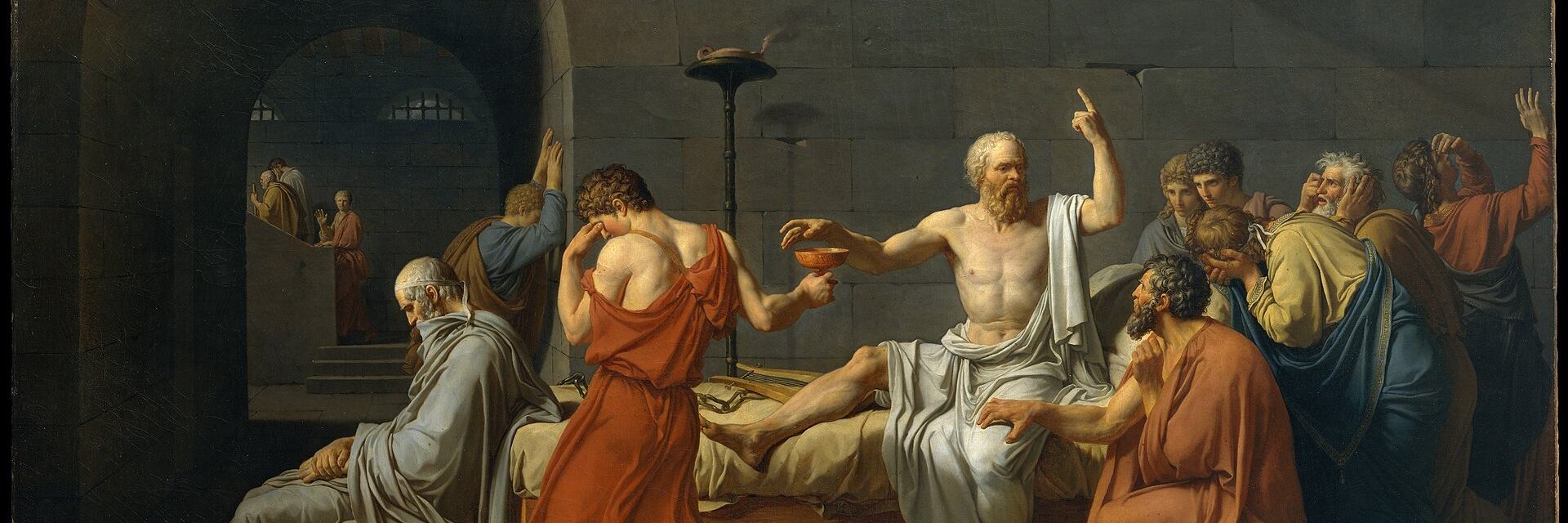
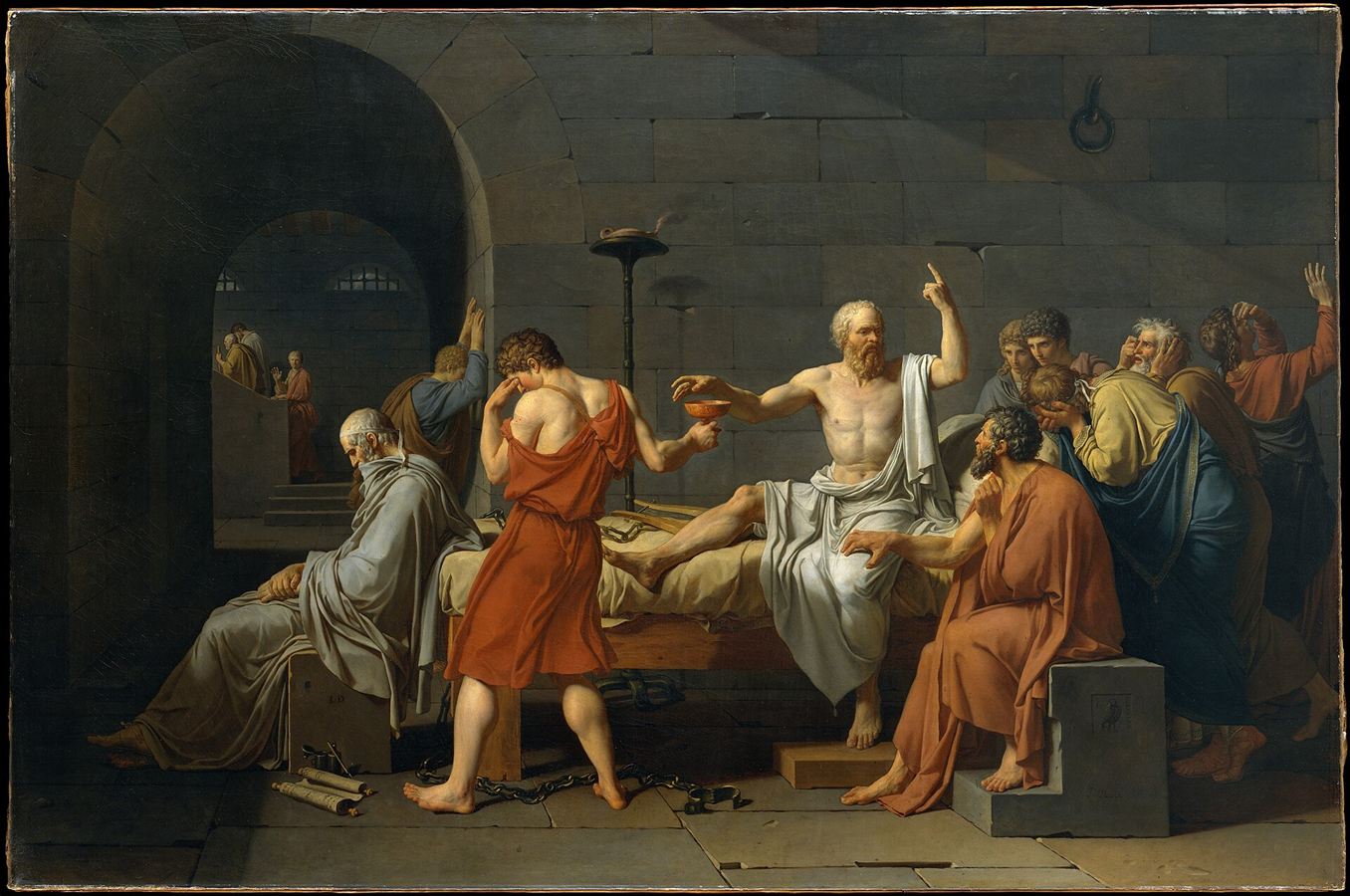
Jacques-Louis David, The Death of Socrates, 1787
The criterion he does set, the swimming pool, and the page that is quoted by half
R. M. Dancy holds that where Socrates is concerned with definitions “he is not concerned with metaphysics at all.” The review of Prior’s chapter treats that denial in two sections and moves on. It will not stay treated. Dancy is the only one of the five opponents who has written a three-hundred-page book on the question, and he is the only one whose denial rests on a device rather than a thesis — a two-page analogy about swimming strokes, given once, never defended, and never revisited.
The charge examined here is Charith’s, and it is prior to anything in the text. To say of a conversation that it is not metaphysics is to apply a criterion. Dancy nowhere states one. So either he has a criterion he does not state, in which case it should be extracted and examined; or he has none, in which case the denial is not a finding but a report of how the passage strikes him. This document shows that the first is true — the criterion is there, forty-seven pages before the pool — and that once it is stated, the denial cannot do the work it has been asked to do.
The result, in one line. Dancy’s threshold is possession of the Argument from Relativity; his three instruments all detect what a conversation is about; and what Allen asserts is a matter of what a conversation is committed to. Aboutness-detectors are blind to commitments by construction. That is why Dancy and Allen have never touched, in fifty years of citing each other.
Every page reference below was checked against the file it names during the reading that produced this document. Dancy 2004 is the primary text and was read in the passages cited; the Allen, Vlastos, Prior and Fine pages were re-read directly for the comparison at §14.
| Work | What it contributes here | Enters at |
|---|---|---|
| R. M. Dancy, Plato’s Introduction of Forms (Cambridge, 2004) — §1.2.2 at pp. 18–19; ch. 3 §3.1 at pp. 65–8; ch. 4 §4.1 at pp. 80–1 | The text under examination. The Argument from Relativity, the swimming pool, the procedure for deriving requirements, and the footnote that answers Allen. | throughout |
| R. M. Dancy, “Platonic Definitions and Forms,” in H. Benson (ed.), A Companion to Plato (Oxford, 2006), pp. 70–84 | The short statement of the same position, where Allen 1970 is named in a parenthesis as the view being denied. | §01 |
| R. E. Allen, Plato’s ‘Euthyphro’ and the Earlier Theory of Forms (London, 1970), pp. 68, 106 | The position denied — and the page Dancy cites, quotes half of, and answers the half he quoted. Also the Laches analogy, which is the dialogues’ own rival to the swimming pool. | §§05, 10, 13 |
| Gregory Vlastos, Socrates: Ironist and Moral Philosopher (Cambridge, 1991), pp. 47–8, 57–8 | The other stated threshold, and the one closest to Dancy’s: reflective investigation. Set beside Dancy’s at §14. | §§06, 14 |
| William J. Prior, “Socratic Metaphysics,” ch. 4 of The Bloomsbury Companion to Socrates (London, 2012), pp. 75, 78, 81, 92 | The Quinean threshold, the Zeyl complaint, and the refutation of Vlastos’s criterion that generalises to Dancy’s. | §§12, 14 |
| Gail Fine, On Ideas (Oxford, 1993), pp. 51, 60–1 | The modal threshold — separation as capacity for independent existence — and the verdict that the middle dialogues do not clearly meet it. | §14 |
Read §02 first. Everything in Part Two depends on the criterion recovered there.
Dancy’s denial has three moving parts, and they are in three different chapters. In ch. 1 he fixes what would count as metaphysics: the Argument from Relativity, an argument from the Phaedo. In ch. 3 he shows by analogy that the vocabulary of the early dialogues — existence, unity, the causal idiom — can occur with no metaphysics attached. In ch. 4 he answers Allen in a footnote, by pointing out that forms play no role in whether Socrates’ arguments are valid.
Each part is sound against a different opponent, and none of them is sound against Allen. The criterion is sound against anyone who thinks the word “form” settles the matter. The pool is sound against Burnet, who reads ontology straight off a dative. The validity test is sound against anyone claiming forms as premises. Allen claims none of these things: he claims the ontology is what makes the question askable. No test for what an argument states can find that.
Dancy’s case, reconstructed from the three chapters it is spread across, and stated as strongly as the text allows.
He has a criterion. It is the Argument from Relativity, and he states it in ch. 1 rather than where he uses it. The method is then the field’s standard one — establish the axiom, then test whether the dialogues satisfy it — and everything else follows from putting the threshold where he puts it.
The first job is to state the position without the objections, and to state it better than its summaries do. Dancy is usually reported as holding that the early dialogues contain a theory of definition rather than a theory of forms. That is true but thin. What makes his book an argument rather than an assertion is the pair of devices in ch. 1 and ch. 3 — a stated criterion for when a text has crossed into metaphysics, and a worked counterexample showing that the usual evidence does not cross it.
Both are easy to miss. The criterion is given forty-seven pages before it is used, in a section headed as a “forward glance” at dialogues the book has not reached. The counterexample is a joke about a swimming pool.
Four distinctions the secondary literature runs together, and which Dancy himself keeps carefully apart.
The denial is narrower than it is usually reported to be, and the narrowness is deliberate. Dancy sets it out in his own voice in ch. 3, immediately after the pool:
The question is not about what Plato believed when he wrote the Socratic dialogues. It is about what he does in those dialogues: what is involved in the arguments of those dialogues. In particular, I am not saying: the Socrates of these dialogues would not have conceded the existence of forms, of which things here below are merely pale reflections. If the Socrates of these dialogues is the historical Socrates, and Aristotle is right about the historical Socrates, he would have made no such concession. He might well have wondered what someone who asked for such a concession was on about … At any rate, there is no discussion of such questions in the Socratic dialogues. Dancy, Plato’s Introduction of Forms p. 67
Exactly one claim: the arguments of the Socratic dialogues do not require an ontology, and the dialogues do not discuss one. Everything Dancy is famous for denying is a consequence someone else drew from that.
It is worth noticing how much this concedes. On this statement Dancy is not an opponent of the claim that the Euthyphro’s idiom carried ontological weight for the Greeks who used it. He has declined to take a view. The review calls that Project B′ at its §19; here it is Dancy in his own words, standing outside it.
The 2006 short statement makes the target explicit, in a parenthesis Prior does not quote:
The latter two especially will feed into the Theory of Forms. They do not, however, entail that theory; where Socrates is concerned with definitions, he is not concerned with metaphysics at all (against this see, e.g., Allen 1970). We shall see the turn toward metaphysics when we get to the Phaedo. Dancy, “Platonic Definitions and Forms” 2006: 71
So the confrontation is not something the review has arranged. Dancy names Allen 1970 as the position he is denying, on the sentence where he denies it — and in the 2004 book he names the page: Allen 1970: 68, at p. 80 n. 3. That page is read in full at §13, and it does not say what the footnote takes it to say.
The criterion is in chapter 1, in a section about dialogues the book has not yet reached. This is the section on which everything here turns.
It is regularly said — by Zeyl in his review, by Prior quoting him, and by the review at its §04 — that Dancy never says what makes a theory metaphysical. That is true of any definition. It is not true of his practice. Forty-seven pages before the pool, he names the thing that has to be present:
“The pattern of argument we shall see emerging from the Socratic dialogues and made explicit in Phaedo 74a–c, whose upshot is to contrast forms and perceptible objects” p. 18.
And then, on the next page, the line that does the work of a definition:
Interlocutors in Socratic dialogues sometimes concede (ARE) as a preliminary to discussing the F … The concession by itself is not a piece of metaphysics, but simply a matter of fixing the topic for discussion. We shall consider cases of this kind below. But the rest of the argument is intended to bring out what … we committed ourselves to in conceding the truth of (ARE): the Theory of Forms. Dancy p. 19
The same criterion reappears in ch. 3, in the sentence that launches the survey the pool was staged to justify:
A text is doing metaphysics when the existence claim has been joined by the rest of AR — the premise about ordinary Fs and the premise about the F. Existence alone is topic-fixing. Existence plus the apparatus is metaphysics. The apparatus is a particular argument, first made explicit at Phaedo 74a–c.
Once the criterion is visible, the shape of the whole book is visible with it, and it is not the shape it is usually described as having. Dancy is not reading the Euthyphro and reporting that he finds no metaphysics in it. He is running a test he has already specified.
Criterion first, text second. It is not peculiar to Dancy: Prior fixes Quine’s criterion of ontological commitment and shows the sentences meet it; Gail Fine fixes separation, modally defined, and shows the early dialogues do not clearly reach it — nor, she adds, do the middle ones; Fronterotta fixes the content of the adequacy conditions and shows they are already met; Vlastos fixes reflective investigation and shows Socrates never performs any. Five positions, five criteria, one method. The comparative table is at the review’s §04 and again at §14 below.
Allen does not do this. He fixes no criterion and runs no satisfaction test. He argues from the working of the elenchus back to what the elenchus presupposes: Socrates refutes answers without ever establishing what the thing is, because what he demands is a real definition; and a real definition is a definition of something that exists. The forms are not what the argument concludes but what the question needs in order to be a question.
Which is exactly why Dancy’s step 2 cannot reach him. A satisfaction test asks whether the text contains something. Allen’s claim is about what the text must already have in place before it can contain anything. Running step 2 against Allen is not a weak refutation of his position; it is not a refutation of his position at all. The footnote at p. 80 n. 3 is step 2 in miniature, and §13 shows what it leaves out.
This is a real criterion, it is operable, and it is the one the book runs on. It also has two properties that the rest of this document is about, and the first of them is visible four sentences later.
Having said that the concession is not metaphysics, Dancy immediately tells us where the other two premises live:
Although the Argument from Relativity first appears in the Phaedo, the materials for its construction are to be found in the Socratic dialogues. Premise (ARF) figures as a criterion of adequacy for a correct definition, and instances of (ARO) are used in showing that various proposed definitions fail to meet that criterion. Dancy p. 19
All three premises are in the early dialogues on Dancy’s own account. (ARE) is conceded as topic-fixing; (ARF) operates as the adequacy condition on definitions; (ARO) is deployed in the refutations. What is absent is not the material but the assembly — the explicit statement of the conclusion.
This is exactly what the Euthyphro does at 7e–8a. The god-loved is both loved and hated by the gods, hence both pious and impious: that is an instance of (ARO), used to refute a candidate, against a standard that is (ARF). Dancy describes the procedure on p. 19 and declines to draw the consequence.
Two pages of chapter 3, reproduced closely enough that the reader can check the objections in Part Two against what is actually there.
Chapter 3 is called “Fixing the topic,” and its opening sentence states the thesis the pool is staged to illustrate: the existential admissions are “merely ways of isolating the subject to be discussed” p. 65. Then:
I: Well, there’s the Australian Crawl.
YOU: Oh, and what’s that?
I: It’s when you thrash about like this, and . . . {there follows an explanation, more or less, of this stroke}; like what that fellow over there is doing.
YOU: Talk about thrashing about! There’s also the Butterfly Stroke, you know.
I: No, how does that go?
What the analogy then does is assemble, one at a time, every piece of evidence his opponents rely on — and each time note that nothing metaphysical has happened.
And then the sentence the whole device exists to deliver:
In all of this, nothing has been said about the structure of the really real, and the only depth is in the water. But Him and Her are thinking: they have conceded the Existence, and then the Unity, of each of the Strokes; now they have gone on to admit their Priority: they have realized that the Strokes are a precondition for the intelligibility of the world of changing strokers, and that one can only become a stroker by swimming a Stroke. I am saying: nonsense. Dancy p. 66
The transfer to Socrates follows immediately, in a single sentence, and it is the sentence Part Two is about:
We are about to consider passages in which Socrates makes claims involving existence and unity, and says that people control themselves because they have temperance. Is he doing metaphysics, or something else? Something else, I think, mostly what we should call “ethics,” his approach to which centrally involves defining things like virtues. This of course requires that there be things like virtues to define, just as listing the swimming strokes requires that there be swimming strokes to list. It does not require consideration of the Ontological Status of things like virtues, any more than the other requires consideration of the Ontological Status of swimming strokes. Dancy p. 66
1 · It appears once. Two pages, ch. 3 §3.1. It is never returned to, never defended against an objection, and not indexed. The framing of a three-hundred-page book rests on a device used a single time.
2 · The capital letters are carrying the distinction. Existence, Unity, Priority, the Strokes, Ontological Status. Dancy’s way of marking the move from using a word to asserting a doctrine is typographic. Nothing in the paragraph states the condition the capitals stand for.
3 · The explanation is bracketed out. “{there follows an explanation, more or less, of this stroke}”. The one part of the exchange where definitional content would appear is the one part Dancy declines to write. §10 is about what that omission costs.
The constructive half of the book, and the sentence in which the conclusion is assumed.
Chapter 4 opens the positive project. Dancy does not find a theory of definition stated in the dialogues; he builds one from the refutations, by a stated procedure:
The theory is not supposed to be Socrates’ (or Plato’s) own. Rather, it is derived in the following way. When Socrates rejects definitions he uses certain arguments against them. We ask: what would an answer have to be like in order not to fall to that argument? We identify the assumption, and ask what general claim it might most naturally be taken to instantiate. The assumptions in question are not ones that require reference to any special entities that figure as the objects of these definitions. Dancy, §4.1 p. 80
Read the last sentence of the derivation rule again. The procedure is: find the argument, find the assumption, generalise the assumption. Then, without a step, an extra clause: “The assumptions in question are not ones that require reference to any special entities.”
That is not a further instruction to the reader. It is the book’s conclusion, announced as a property of the method before the method has been run once. The footnote attached to it is the reply to Allen, and it is treated at §05.
Note also what immediately follows in the text. Ten lines after stating the requirements, Dancy quotes Euthyphro 6d9 as “a preliminary reading” — “I did not direct you to teach me this, some one or two of the many pious things, but that form itself by which all the pious are pious” p. 81. That is the refusal of a list. Fifteen pages earlier the framing rested on a conversation that lists. §10.
Dancy answers Allen once, in a footnote, and the footnote is the second of his three instruments.
Note 3 to the derivation rule quotes Allen and replies:
Allen (1970) 68 (and passim, also in Allen [1971]): “Forms play a regulative role in the dialectic: . . . they determine the kinds of answer that are acceptable, and . . . unacceptable in Socrates’ search for definition.” But the hypothesis of a form to which Socrates has access is irrelevant to the logic of his argument. If his arguments work, they do so because his premises are true and his conclusions follow from them. These premises are either ones he states or ones close by what he states, and the question of validity has nothing to do with forms. Dancy p. 80 n. 3
Take Socrates’ argument. Ask whether it is valid, and whether its premises are true. If the answer does not require a form, forms are not doing any work. Premises are what the test detects.
Against a certain opponent this is exactly right, and it should be said plainly: if anyone claimed that a Form appears among the premises of the argument at 10a–11b, or that Socrates’ access to one is what makes his refutation go through, Dancy has answered them. Nobody in this literature claims that.
The pattern only appears when the three are laid side by side, because they are in three different chapters and addressed to three different opponents.
| Where | The instrument | What it detects | What it is blind to |
|---|---|---|---|
| p. 66 — the pool | Thematisation. “Nothing has been said about the structure of the really real.” | What a conversation is about. | Idiom. What speakers convey without discussing. |
| p. 67 — the survey | Discussion. “There is no discussion of such questions in the Socratic dialogues.” | Explicit second-order treatment. | Everything a text takes for granted. |
| p. 80 n. 3 — vs Allen | Validity. “The question of validity has nothing to do with forms.” | Premises, stated or “close by.” | Presuppositions, necessarily. |
All three are aboutness-detectors. Each asks, in its own register, what the text puts forward: as topic, as discussion, as premise. None of them asks what the text must already have in place for the putting-forward to make sense.
That is why the disagreement with Allen has never produced an exchange. It is not that one of them has misread the Euthyphro. It is that Dancy’s apparatus has no register in which Allen’s claim could be entered, either to be confirmed or to be refuted.
Five objections, in the order they were put. All five are Charith’s; the working-out under each is the evidence for or against it.
Two of the five turn out to be confirmed by Dancy’s own text against himself. One requires a correction. The last two are the ones that matter, and neither has an answer in the book.
These are stated as they were put, and answered as they deserve rather than as they would be flattered. Where an objection is wrong, the section says so and says why — §08 is a correction, not a defence. Where it is right, the section supplies the text that makes it right, since an objection with a page behind it is worth more than an objection with an argument behind it.
They are numbered as objections, not as a single argument, because they are independent: any one of them can fail without touching the others.
“To Dancy, to say that is not metaphysics, he must know what metaphysics is. Why is existence, unity, priority not metaphysics?”
The question is correct in form, and its answer is not the one the literature gives.
The standing answer in the literature is that Dancy has no criterion. Zeyl says so in his review; Prior quotes him approvingly and adds it in his own voice — “he does not offer an account of what makes a theory metaphysically innocent” Prior p. 75; and the review repeats it at its §04. That answer is too quick, and this section withdraws it.
Dancy has no definition. He has an operational criterion, stated at §02 above: the Argument from Relativity. Existence, unity and priority are not metaphysics because they are not yet AR. The concession of (ARE) is “simply a matter of fixing the topic for discussion” p. 19; metaphysics is what you get when the affirmation acquires “the subsequent apparatus” p. 68.
The threshold complaint gets stronger, not weaker. It was: nobody in this literature states a criterion. It becomes: one of them does, and it is the thing to be measured, used as the measure. That is a sharper charge and an easier one to check, and it is the reason this document exists.
“Does this mean that for Dancy the category of swimming strokes cannot be considered in an ontological sense, because they only exist in the depth of the water — when the swimmers leave the pool it ceases to exist, therefore it is not real? So for Dancy, if it continues to exist, is it real?”
And, after the first reply: “Does he mean that within the context of the analogy, ontological matters never come up, never arise?”
The first reading is wrong; the second is right, and the second is what makes §11 work.
The sentence is about the conversation, not about the strokes. The verb is said: “nothing has been said about the structure of the really real.” “The really real” is the stock English for Ἕντως ὄν, used derisively; and “the only depth is in the water” is a pun on deep — the exchange has no profundity, only a pool. Dancy is reporting that a question did not arise. He is not answering it.
1 · He says the opposite on the next page. “But if it means that there is an entity called a ‘norm,’ ‘over and above’ the actions and people to be judged or doing the judging — well, that is another question, and we need not go into it yet. Socrates does not go into it yet. He will, in the doctrinal dialogues” p. 67. The ontological status of virtues is expressly left open, to be settled later. Nothing is being declared unreal.
2 · The strokes would pass a persistence test anyway. The Australian Crawl does not cease when the pool empties; it is a stroke-type, and it survives the swimmers. If Dancy’s point turned on transience the example would refute him. It does not turn on transience, and he offers no criterion of the real at all — not persistence, not anything.
So the answer to the second form of the question is yes, and it should be stated exactly: within the analogy the ontological question never arises. It is not raised, and therefore not answered either way.
Dancy needs two claims here and the paragraph supplies one.
Aboutness: the conversation is not about the ontological status of strokes. True by inspection, and nobody disputes it.
Commitment: the conversation does not commit its speakers to any ontological status. Asserted, not shown.
“Nothing has been said about the structure of the really real” is the first. “It is one thing to list the swimming strokes, another to do metaphysics” is the second. The slide between them happens inside one paragraph, and the missing step is the whole question.
“Even if his analogy is internally logically coherent, and would show that the swimming-strokes category cannot be ontological or metaphysical, and even if his analogy can be smoothly mapped onto the Socratic dialogues — still what he would do is show that Socratic conversation does not carry any metaphysical theory for Dancy, or for modern readers. It would not show that Socratic conversations did not carry any metaphysical theory for fifth-century BC Greeks, nor for Socrates.”
The objection is right, and Dancy concedes it in advance — which is a more interesting result than his resisting it would have been.
The question is not about what Plato believed when he wrote the Socratic dialogues. It is about what he does in those dialogues: what is involved in the arguments of those dialogues. In particular, I am not saying: the Socrates of these dialogues would not have conceded the existence of forms … He might well have wondered what someone who asked for such a concession was on about: he might have supposed that such questions were merely irrelevant to what he himself was after, namely how he ought to live. Dancy p. 67
“Here Dancy is mapping the ontological status of swimming strokes onto virtues. But how did he map it? Take what he says about swimming strokes as coherent, for the benefit of the argument. How would it then be mapped onto Socratic conversations and concepts like virtue? What if, while the swimming strokes’ status might be compromised exactly as Dancy wants, Socratic virtue’s is not?”
The load-bearing question of the whole document. The answer is that he does not decide it; he asserts it, and the assertion is two connectives long.
Just as and any more than carry the transfer, and nothing in the book defends either. Four ways the transfer fails, in order of increasing force.
This is the part of the objection that can be settled from the texts rather than by argument. Socrates, asked what kind of thing a virtue is, reaches for a comparison himself — at Laches 189e–190b, which Allen quotes at length on the page where he says “the aim of dialectic is real definition”:
If we know that sight added to the eyes makes that to which it is added better, and further, if we are able to add it to the eyes, then clearly we must know the essential nature of sight … if one did not know the thing itself, the essential nature of sight or hearing, one could hardly qualify as a consultant or physician in the matter of eyes and ears … So the first requirement is to know the essential nature of virtue. Laches 189e–190b, as translated and quoted at Allen 1970 p. 106
Allen draws the consequence in one line: “As sight is to the eyes, and hearing to the ears, so virtue is to the soul. As sight and hearing are things which are, so is virtue a thing which is” p. 106.
Two analogies, two results. Dancy picks a practice whose identity is fixed by its practitioners, and gets no ontology. Socrates picks a capacity whose nature is fixed independently of anyone’s practice, and gets one. Neither analogy proves anything by itself. But one of them is in the dialogues, and it is not Dancy’s.
“Even if Dancy added that to his example and a hundred per cent mapping could be shown, the best he could do is show that the analogue displays no metaphysical theme, no metaphysically thematised discussion — and therefore none in the Socratic discussion. Unless Dancy shows why that is the case with his swimming-pool analogue, it would not succeed.”
This is the general form of which §§08–10 are instances, and it is correct.
Grant the analogy at a hundred per cent. What is then established is: the pool conversation contains no thematised metaphysics, and neither does the Euthyphro. True, and not in dispute — nobody claims Socrates announces an ontology. What is needed is: and therefore neither is committed to one. That step is never taken, in ch. 3 or anywhere else.
The natural repair is to enrich the swimming case: put a ti esti question into it, have “YOU” refuse the ostension and demand the stroke itself. That would not help. It would only make the swimming case controversial in exactly the way the Euthyphro is controversial, and the analogy would stop being an analogy to something obvious.
What he would need instead is a demonstration that the pool conversation and the Euthyphro exchange stand in the same relation to their own presuppositions — not merely that neither of them discusses ontology. That requires an account of what the ti esti question presupposes: the existential presupposition, the condition on admissible answers, and a theory of the category to which admissible answers belong. The review sets that out at its §27.
Dancy has no such account. What he has is a validity test, and a validity test is the one instrument guaranteed not to find one.
What is left standing, what the footnote leaves out, and how Dancy’s threshold compares with the six others in the dispute.
Against Burnet the pool wins outright. Against Allen it never engaged — and the page it cites says so.
A case made only against a position is worth less than a case that says what its target gets right. This part begins with what Dancy establishes, because it is substantial and because the rest is only credible if it is said first.
The pool is decisive against the reading it was built to defeat. That reading is Burnet’s, and it is still the commonest one in the commentary tradition.
Burnet’s note on Euthyphro 6d9 reads the ontology straight off the grammar: the dative is instrumental and productive, so “the universal makes the particulars” Burnet 1924: 116. If that inference were good, then any construction of the same shape would carry the same freight.
Burnet’s claim is an entailment from an idiom. A single counterexample defeats an entailment, and analogies are the right tool for producing one. Allen’s claim is not an entailment from an idiom at all. It is that the form is what the question is a question about — the antecedent of the pronoun — and that real definition and the existence of forms are two descriptions of one commitment.
A counterexample to an entailment is not an answer to a presupposition claim. Dancy’s device does one job well and has been asked to do a second job it cannot do.
Dancy’s single engagement with Allen cites a page. The page was read in full for this document, and two things in it are not in the footnote.
Here is the note again, with its ellipses as Dancy prints them:
Allen (1970) 68 (and passim, also in Allen [1971]): “Forms play a regulative role in the dialectic: . . . they determine the kinds of answer that are acceptable, and . . . unacceptable in Socrates’ search for definition.” But the hypothesis of a form to which Socrates has access is irrelevant to the logic of his argument … the question of validity has nothing to do with forms. Dancy p. 80 n. 3
And here is the passage on the page, at length:
These assumptions constitute a theory of Forms. That theory is both logical and metaphysical. Logically, Forms play a regulative role in dialectic: as antecedents of ‘it’ in the question ‘What is it?’ they determine the kinds of answer which are acceptable, and more importantly, unacceptable, in Socrates’ search for definition. They define the conditions for deciding when dialectic has succeeded, and when it has failed. Metaphysically, Forms affect the career of the world: they are the real natures of things, and the world is what it is because they are what they are. These two sides of Plato’s theory meet in the notion of real definition … To say that Forms exist is to say that real definition should be pursued; to say that real definition should be pursued is to say that Forms exist. The theory of Forms in the Euthyphro is not a superstructure gracelessly added on to dialectic: it is the foundation of dialectic. Allen, Plato’s ‘Euthyphro’ and the Earlier Theory of Forms p. 68
Allen’s threshold is the biconditional: to say that Forms exist is to say that real definition should be pursued, and conversely. Dancy’s book is three hundred pages of deriving what a correct definition must do. On Allen’s threshold, that derivation is itself the commitment — which is why Allen 1970 gets named in the parenthesis at 2006: 71 and in the footnote at 2004: 80.
Dancy’s reply is the clause appended to the derivation rule: “the assumptions in question are not ones that require reference to any special entities” p. 80. That denies the biconditional. Denying it is what needed the argument, and what it gets is a subordinate clause and a footnote.
A note in Allen’s favour, and a limit on it. The identification Allen relies on — that a real definition is a definition of something that exists, so that demanding one is a metaphysical demand — is now a defended position in analytic metaphysics, opened by Kit Fine’s “Essence and Modality” (1994) and pursued by Lowe, Rosen, Koslicki and Oderberg. Allen’s book is of 1970 and could not have had it. So the premise Dancy’s footnote brushes aside is defensible — but Allen did not defend it, and the vindication is retrospective. The review’s abstract states this, and that literature is reported from knowledge, not held for this project.
Seven positions, seven answers to “how much must a text contain before it is doing metaphysics?” — and the answers are not even the same kind of answer.
The review’s §04 arranges the five opponents along one axis, from a high threshold to a low one. That arrangement is useful and it is incomplete, because it treats the disagreement as one about where the line falls. Once each criterion is stated in the words its author gives it, a second and deeper division appears: they are not measuring the same thing.
| Scholar | The threshold, as stated | What it tests | Verdict on the Euthyphro | Where |
|---|---|---|---|---|
| Prior | Quine’s criterion of ontological commitment. “Socrates is committed to the existence of justice, piety and the like: he treats them as values of bound variables.” | Commitment — what the sentences quantify over | Yes — and “whether or not it counts as a theory” | Bloomsbury p. 81; 2004: 7–8 |
| Fine | Separation, modally: forms are separate iff “they can exist whether or not any corresponding sensible particulars exist.” | Commitment — a modal fact about the entities | Forms yes, separation no — and “Plato never argues, or even says, that forms are separate” | On Ideas pp. 51, 60–1 |
| Allen | Real definition, biconditionally. “To say that Forms exist is to say that real definition should be pursued; to say that real definition should be pursued is to say that Forms exist.” Forms are “antecedents of ‘it’ in the question ‘What is it?’” | Presupposition — what the question must range over | Yes — “the foundation of dialectic,” not a superstructure on it | Allen 1970: 68 |
| Burnet | The construction itself. The instrumental dative, read productively: “the universal makes the particulars.” | Grammar — the shape of the sentence | Yes — delivered in a philological note, without argument | Burnet 1924: 116–17 |
| Fronterotta | The content of the requirement on the definiendum. If what is defined must be universal, unchangeable and stable, “it obviously cannot belong to the physical world.” | Commitment — entailment from the adequacy conditions | Yes, and already separate — development becomes “a narrative change at most” | OSAP 32 (2007), pp. 50–1, 57 |
| Vlastos | Reflective investigation. “One qualifies as a linguist when one makes language an object of reflective investigation. One would qualify as an ontologist if one made ontology an object of reflective investigation. And this is what SE never does. … What is form? he never asks.” | Aboutness — second-order thematisation | Has an ontology; is not an ontologist | Vlastos 1991: 58; cf. 47–8 |
| Dancy | Possession of the Argument from Relativity. Existence alone is “simply a matter of fixing the topic”; metaphysics is the affirmation plus “the subsequent apparatus that turns the affirmation into metaphysics.” | Aboutness — and, in the footnote, validity | Not yet — the conclusion is not stated, though p. 19 grants that the premises are present | Dancy 2004: 18–19, 67–8, 80 n. 3 |
1 · Three kinds of test, not one scale. Prior, Fine and Fronterotta ask what the claims commit their user to. Allen asks what the question presupposes. Vlastos and Dancy ask what the text takes as its topic. A commitment test and an aboutness test can both be correctly applied to the same passage and return opposite answers without either being wrong — which is exactly what has happened for fifty years.
2 · The two “no” verdicts share an instrument. Vlastos’s reflective-investigation test and Dancy’s thematisation test are the same test in different words. Both ask whether the text turns and looks at its own furniture. Neither asks what the furniture is doing while nobody looks.
3 · Prior has already refuted that instrument once. Against Vlastos: “it is too restrictive. True, Socrates does not ask ‘What is Form?’ in the early or Socratic dialogues, but neither does he ask it in later dialogues, such as the Phaedo and Republic, which Vlastos admits are metaphysical. Not until the Parmenides does Socrates ask, ‘What is Form’” Bloomsbury p. 81. Applied evenly, an aboutness test either promotes the Euthyphro or demotes the Phaedo. The same objection reaches Dancy and has never been made against him.
Three amendments to the review, and four things this document does not settle.
Dancy does have a threshold, it is the Argument from Relativity, and the Argument from Relativity is the thing whose presence in the early dialogues is under dispute — so the test cannot be run without assuming the answer, and the three instruments that were supposed to be doing the work instead are all blind, by construction, to the kind of claim Allen makes.
Charith’s. The five objections at §§07–11 are his, put in the order they were put and labelled at the head of each section: that a denial of metaphysics presupposes a criterion of metaphysics (§07); the question of what the “really real” sentence is a claim about (§08); the scope objection, that a result about what a conversation carries for us is not a result about what it carried for its speakers (§09); the mapping objection, that the transfer from strokes to virtues is asserted rather than argued and may fail precisely where it matters (§10); and the general form, that the most a perfected analogy could establish is absence of thematisation, which is not absence of commitment (§11). The upgrade of the review’s threshold complaint at §07 follows from his first question and is his result.
Mine, as the reader of the texts. The recovery of the Argument from Relativity as Dancy’s operational criterion (§02); the observation that all three premises of AR are granted to the Socratic dialogues at p. 19 (§§02, 07); the four disanalogies at §10 and the Laches counter-analogy from Allen p. 106; the reading of the three denials as one instrument (§06); the three things the footnote leaves out of Allen p. 68, including what the first ellipsis removes (§13); the classification of the seven thresholds into commitment, presupposition and aboutness tests (§14); and the extension of Prior’s refutation of Vlastos’s criterion to Dancy’s (§14).
Not claimed. That the Euthyphro is committed to an ontology — that is argued elsewhere and on other grounds. That Dancy is careless: the pool is a good instrument aimed at a real target, and §12 says which. That the Laches analogy settles what kind of thing a virtue is; it is evidence that the dialogues do not reach for Dancy’s kind of example, and no more.