 τί ἐστι;
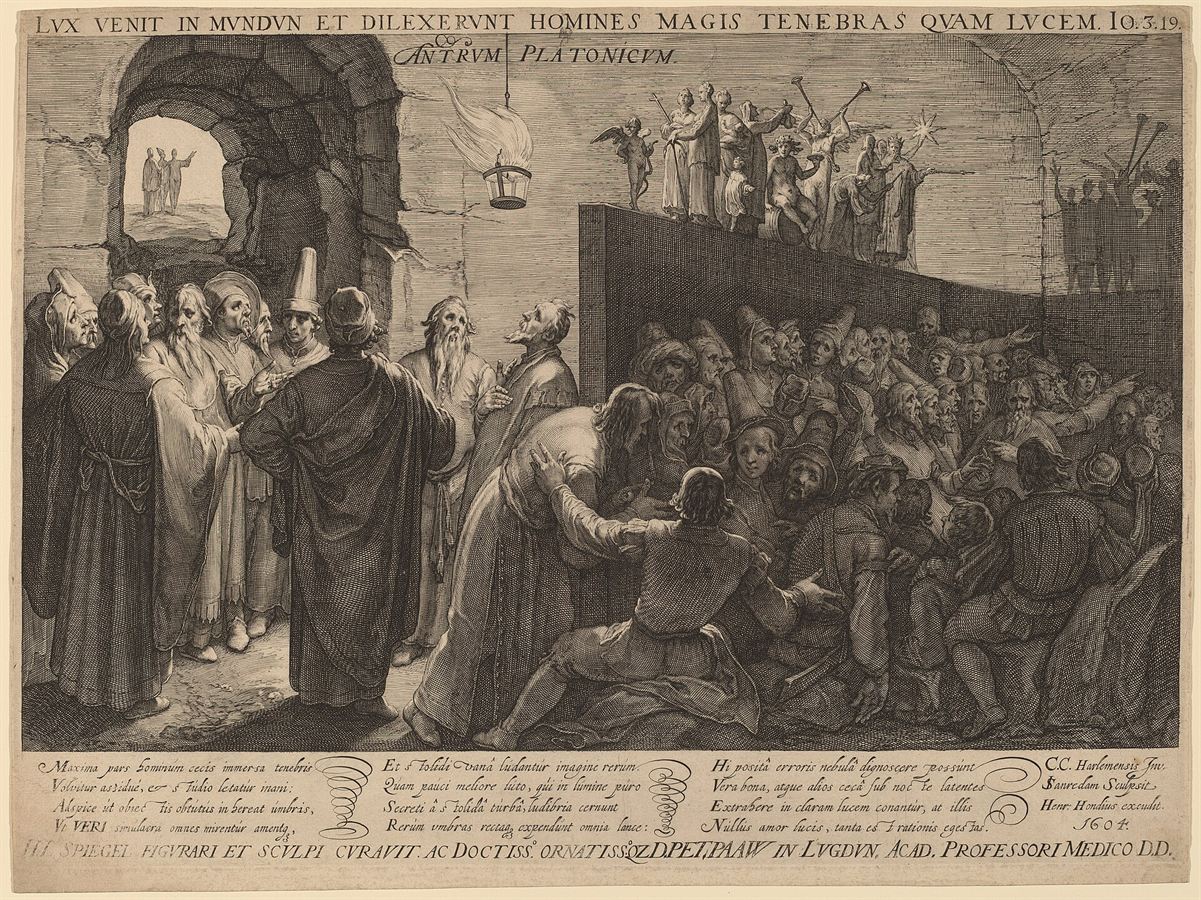
Jan Saenredam after Cornelis van Haarlem, Plato's Cave, 1604
The argument of the Introduction, stage by stage
The two worlds survive as a distinction between two kinds of entity, and collapse entirely as a distinction between two sealed compartments of the mind.
Forms really are a different kind of thing from sensibles — non-sensible, mind-independent universals that, Fine thinks, can exist uninstantiated. But there is no wall between them on the cognitive side: you can know sensibles, you can have mere beliefs about forms, and knowledge is not the opposite of belief but a kind of belief. On Fine's reading the Republic is not merely innocent of the Two Worlds Theory — it is inconsistent with it.
Nine stages, from the definition of the theory to the verdict on the Republic.
She states the target precisely before touching it — and note that on the strong version the claim is not merely that knowledge and belief have different objects, but that they exclude one another.
It is often thought that in the middle dialogues Plato favours the Two Worlds Theory… On one familiar version, knowledge and belief have disjoint objects — forms and sensibles, respectively… Otherwise put, the contents of knowledge and belief — the propositions one can know or believe — are disjoint… On this view, knowledge, so far from implying belief, excludes it.Introduction §II, p. 8
Her first move is not to attack the Republic but to establish that the theory cannot be Plato's general view, because another dialogue plainly denies it.
The Two Worlds Theory is at odds with the epistemology of the Meno. For there, as we saw, Plato says that knowledge is true belief bound by an aitias logismos; on this view, knowledge, so far from excluding belief, implies it… He says, for example, that although the slave has a mere true belief about the answer to the geometrical question Socrates poses, he can acquire knowledge of it. Plato also says that one may know, or have a mere true belief about, the way to Larissa (97 a ff.). The Meno also seems to allow knowledge of sensible particulars as well as beliefs about forms.§II, p. 8
So the question narrows to a single one: is Republic V–VII — "Plato's lengthiest and most systematic discussion of knowledge and belief in the middle dialogues" — committed to the theory?
The interpretive key, and the constraint that does most of the work in what follows. The argument at the end of Republic V is addressed to a specific audience.
At the end of Republic V Plato seeks to persuade those he calls sightlovers, on grounds acceptable to them, that they lack knowledge. The argument is therefore governed by what I call the requirement of noncontroversiality, or the dialectical requirement (cf. Meno 75 d): it should use premisses that are acceptable to the sightlovers.§II, p. 9
The two central premisses are that knowledge is set over what is and belief over what is and is not. But esti — "is" — can be used in several ways, and which one Plato means decides the whole dispute.
If esti is used veridically here, then the point is that knowledge but not belief implies truth. I call this a contents analysis, since it distinguishes knowledge and belief by their propositional contents. If esti is used existentially or predicatively, then knowledge and belief are distinguished by their nonpropositional objects; hence I call this an objects analysis.§II, pp. 9–10
On the predicative reading — "probably the most popular one" — the objects of knowledge are restricted to what is F and not also not-F, the objects of belief to what is both F and not F. That reading gives you the Two Worlds Theory. Her whole case is that it is the wrong reading.
I argue, however, that for most of the argument (from the beginning through 478 b 12), esti is used veridically, to make the point that knowledge but not belief implies truth. One advantage of this reading is that it, unlike its rivals, satisfies the dialectical requirement.§II, p. 10
And in the footnote, a second and colder advantage:
A further advantage of my reading of the argument is that on it, the argument is valid. On at least some versions of the existential and predicative readings, by contrast, the argument is invalid.§II, n. 24
At 479 a ff. Plato does turn to the predicative use — to establish that the many Fs are both F and not F. Her illustration is characteristically concrete:
Bright colour, for example, is beautiful in this Matisse painting; but it is merely garish, and so ugly, in that other painting.§II, p. 10
And this too respects the dialectical requirement, because it is the sightlovers' own reason for saying the beautiful is many rather than one. Plato is not smuggling; he is using their premise against them.
I argue… that he shifts from the veridical to the predicative use, without confusion, in order to persuade the sightlovers that if they define beauty in terms of the many beautifuls, which are beautiful and ugly, they will inevitably have both true and false beliefs about beauty: in which case they lack knowledge of beauty.§II, p. 10
This is the moment the Introduction earns its place. In the two Republic essays reprinted later in the same volume, she had said Plato assumes that beauty is one. She now withdraws it, on her own dialectical-requirement grounds.
In Chapters 3 and 4 I say he assumes that beauty is one. This, however, can't (or, at any rate, had better not) be right: for that assumption is the central bone of contention between Plato and the sightlovers. If Plato simply assumes that beauty is one, there is an especially egregious violation of the dialectical requirement. But in fact, contrary to Chapters 3 and 4, we need not accuse Plato of reasoning in this way.§II, p. 11
The replacement premise is weaker and uncontroversial — which is exactly why it works:
He seems to rely, not on the assumption that beauty is one, but on the assumption that reliance on a satisfactory definition shouldn't inevitably issue in false beliefs about what things do, or don't, fall under the definition: this explains his emphasis on the truth condition for knowledge.§II, p. 11
Plato therefore in effect eventually argues that beauty is one; but he doesn't assume that it is in arguing against the sightlovers. Nor, in any case, is this last stage of the argument governed by the dialectical requirement. That requirement governs only the argument for the claim that the sightlovers lack knowledge.§II, p. 12
Two stages, two standards of proof. The negative stage must be fought on the opponent's ground; the positive stage need not be.
The standard charge against Plato is that he slides between knowing that and knowing a thing. She denies the slide by showing the two are connected, not conflated.
For in his view, to know a form requires knowing what it is; and that, in turn, is to know its definition, which is a matter of propositional knowledge.§II, p. 12
Later she puts the same point as a compliment: Plato "has the deep insight that knowing things requires knowing truths about them."
As I interpret the argument, it doesn't imply the Two Worlds Theory. Rather, Plato defends only the weaker view that to have any knowledge at all, one must know forms. This leaves open the possibility that once one has such knowledge, one can know more than forms; it also leaves open the possibility that one can have mere belief (whether true or false) about forms.§II, pp. 12–13
And then the stronger claim, which is the sentence to remember from the whole Introduction:
"In Republic VI–VII, in the famous images of the Sun, Line, and Cave, Plato goes further, and says that there is (or can be) knowledge of sensibles, and that there is mere belief about forms. The Republic, then, so far from endorsing the Two Worlds Theory, is incompatible with it."
Introduction §II, p. 13Having removed the two-worlds picture, she owes a positive account. It arrives at the end of the epistemology sections, and it is where the whole first half of the Introduction lands.
On the general account of Plato's epistemology that I've suggested, he favours a version of a justified-true-belief account of knowledge… On Plato's view, moreover, knowledge is a type of belief. Plato couldn't consistently take knowledge to be a type of belief if, as is often thought, he were committed to the Two Worlds Theory, according to which knowledge excludes belief. But I argued that even in the Republic, he rejects the Two Worlds Theory; he allows knowledge of sensibles and belief about forms.Introduction §VI, p. 28
The justification condition is where Plato becomes strange again — but strange in a way she thinks is a merit rather than a defect:
Though Plato takes knowledge to be justified true belief, he has an unusually rich conception of justification… one is justified in believing p… only if one can explain why p is so, where this involves being able to explain how p is connected to other propositions in the same domain or field; for the best sort of knowledge, one must be able to explain the teleological structure of reality as a whole. On this view, Plato is a holist about knowledge: knowledge of a given object or proposition requires knowledge of related objects or propositions.§VI, p. 28
She closes the epistemological half with an unusually direct compliment, and it tells you what she thinks is at stake:
Some of those who agree with Plato that knowledge of an objective world is possible think we can have such knowledge only if we have direct, nonpropositional access to such a world. It is to Plato's credit that he sees that we can have knowledge of an objective world even if knowledge is propositional, and even if it is conceived of holistically.§VI, p. 28
The epistemology has removed the cognitive wall. But "two worlds" also names an ontological claim, and here her answer is more concessive — with one striking exception.
On the view I defend, forms are just universals, conceived as real, mind-independent, objective explanatory properties; they are not also or instead particulars. As in his epistemology, so in his metaphysics: Plato's views, this time about forms, have much to recommend them still.§VII, pp. 30–31
She grants that Plato calls forms everlasting, unchanging, unperceivable, paradigms — and that he accepts self-predication. Her claim is that none of that stops them being universals, or being immanent in particulars, and that his resulting account of property possession "is no more implausible than Aristotle's allegedly superior account."
On why there are forms she sides with Aristotle: knowledge requires definition, and definition requires real universals (Metaph. A 6, M 4, M 9). What she rejects is his inference from separation to particularity.
From this point of view, the puzzling question isn't why Plato takes forms to be separate, if he does, but why Aristotle thinks that separation makes forms particulars. I suggest that Aristotle has the deep-seated view that only particulars can be separate… universals, in his view, are not the sorts of things that can exist uninstantiated.§VIII, pp. 32–33
Separation is a relational notion: to be separate is to be separate from something… Separation is also a modal notion: to say that forms are separate is to say that the form of F can exist whether or not any sensible F things exist… to say that they are separate is to say they can exist uninstantiated by sensible particulars.§VIII, pp. 32–33
Note what this definition does not say. Nothing about location, nothing about another realm, nothing about copies. "Separate" means: can exist uninstantiated. The whole ontological content of "two worlds," on her account, reduces to that modal claim.
For one thing, it's a striking fact that none of Plato's arguments for the existence of forms implies that they are separate.… This shows that forms must be different from sensible particulars (and from sensible properties). But to say that forms are different from sensibles falls short of saying that they are separate from them: A can be different from B, without being able to exist without it.§VIII, p. 33
She applies this to the flux argument specifically — the argument most people take to establish two worlds:
He certainly argues that the flux of sensibles requires the existence of stable, nonsensible forms that escape flux. But this again shows only that forms are different from sensibles; it doesn't show that forms are separate from sensibles.§VIII, p. 33
And she declines the easy conclusion that Plato therefore blundered:
Nor does Plato invalidly infer separation from the 'flux argument'… He takes such arguments to establish no more than that forms are different from sensibles. Nor does Aristotle accuse Plato of arguing invalidly for separation; he thinks separation rests on other grounds, which give Plato a valid (but, in Aristotle's view, unsound) argument for separation.§VIII, p. 33
Nor, in the middle dialogues, does he even explicitly say that forms exist separately (chōris). None the less, I think Plato accepts separation. Just as Aristotle seems to assume without argument that universals cannot be uninstantiated, so Plato seems to assume without argument that forms are separate, that is, can exist uninstantiated.§VIII, p. 34
Her evidence is oblique and, for that reason, persuasive — artefact forms. In the Cratylus and Republic X Plato countenances a form of shuttle; and a form of shuttle can exist whether or not any shuttle does. The commitment "emerges in unexpected ways and in unexpected cases."
| The claim | Fine's verdict | Where |
|---|---|---|
| Knowledge and belief have disjoint objects | Rejected. Knowledge of sensibles and belief about forms are both allowed | §II, pp. 12–13 |
| Knowledge excludes belief | Rejected. Knowledge is a type of belief — justified true belief | §VI, p. 28 |
| Republic V proves two worlds | Rejected. It proves only that any knowledge requires knowing forms | §II, p. 12 |
| Republic is neutral on the question | Rejected too — VI–VII make it incompatible with the theory | §II, p. 13 |
| Forms are a different kind of entity from sensibles | Accepted. Real, mind-independent, non-sensible universals | §VII, p. 31 |
| Forms are separate — can exist uninstantiated | Accepted, but as an unargued assumption, not a proved conclusion | §VIII, p. 34 |
| The flux argument establishes separation | Rejected. It establishes difference only | §VIII, p. 33 |
| Forms are also particulars (Aristotle) | Rejected. Rests on Aristotle's own unargued premise | §VIII, pp. 32–33 |
One world of entities with two kinds of member; one continuous field of cognition with two grades of achievement.
Forms and sensibles differ in kind — that much of the traditional picture stands, and Fine defends it. Forms are universals; sensibles are not. Forms can exist uninstantiated; sensibles cannot exist unexemplified in that way. To that extent Plato is a "two-item" metaphysician.
But the epistemological wall is gone, and with it the picture most readers arrive holding. There is no realm you may only believe about and another you may only know. The difference between epistēmē and doxa is how well you can explain — whether you can locate the thing in a field of related truths — not where the thing lives. Which is why, on her account, the philosopher who goes back down into the cave can genuinely know what is there.
And notice how she reached it. Not by finding a text that says "two worlds is false," but by insisting that an argument aimed at an opponent may only use premises the opponent grants — and then following that constraint until the popular reading became untenable and one of her own earlier papers had to be withdrawn.
The Introduction is a map of the essays. If a stage above interested you, the full argument is in:
| Stage | Chapter |
|---|---|
| 1–2 | Ch. 2, 'Inquiry in the Meno' — knowledge as true belief plus an aitias logismos |
| 3–9 | Ch. 3, 'Knowledge and Belief in Republic V' — fuller on Book V, and she now thinks it right where Ch. 4 went wrong |
| 3–9 | Ch. 4, 'Knowledge and Belief in Republic V–VII' — extends to the Sun, Line and Cave, but mistakenly treats both claims as opening premisses |
| Holism | Ch. 10, 'Knowledge and Logos in the Theaetetus' — the interrelation model |
| 10–14 | Ch. 11, 'Separation' (1984) — the central metaphysical essay |
| 10 | Ch. 12, 'Immanence' — why separation doesn't preclude being in things |
| 11 | Ch. 14, 'Plato and Aristotle on Form and Substance'; and On Ideas (1993) for the full treatment of Aristotle's criticisms |