 τί ἐστι;
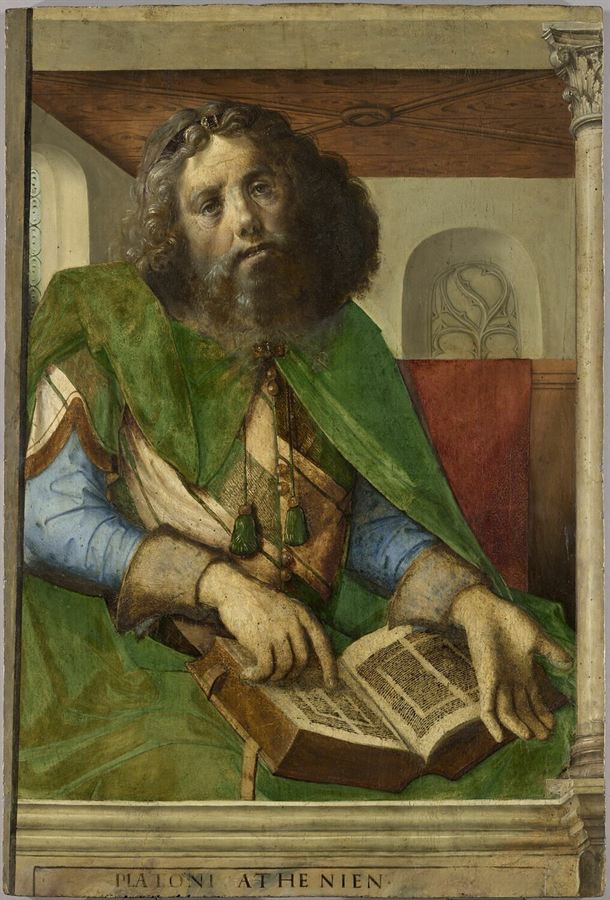
Justus van Gent and Pedro Berruguete, Plato, c. 1476
How the Forms become necessary — traced through three chapters
Not was there a historical Socrates, but: how does the conceptual pressure that produces the Forms become visible in the dialogues?
The answer both scholars converge on: the elenchus creates a debt it cannot pay. It refutes without establishing; it presupposes a distinction between knowledge and opinion it cannot ground; it relies on the interlocutor already possessing true beliefs it cannot explain. The theory of Forms — and the recollection doctrine arriving with it — settles that debt.
Vlastos says this himself, in a footnote. See §07 below: the crucial assumption is "unsupported and unsupportable within the elenctic dialogues" and "must await the metaphysical grounding it will be given by Plato in the Meno."
Chapter 1, "Introduction: The Interpretation of Plato," pp. 1–6. Not about Plato's philosophy — it is the rulebook.
| Error | What it is | Page |
|---|---|---|
| Mosaic interpretation | Loading weight on an isolated sentence without asking if it is a passing remark or settled doctrine | p. 1 |
| By abstraction | Author mentions X; X looks like a case of Y; so you say he "was well aware of Y." Example: Plato "discovered the copula" in the Sophist | p. 2 |
| By inference | "Plato says p, p implies q, therefore Plato meant q." Example: Adam reading "mathematicals" into the Republic | pp. 2–3 |
| Insinuating the future | Reading back what only became explicit later. "The oak is in the acorn, no doubt; but we must not leave it at that" | p. 3 |
| Beyond the last word | Ascribing not just every step the author took but the next one, actually taken by a later generation | pp. 3–4 |
He opens by catching two named scholars: Cornford, who said the second part of the Parmenides is "avowedly" an exercise in ambiguities — though the dialogue contains no word for "ambiguity"; and Shorey, who found "express recognition" of extension/intension in a passage that neither names nor describes the distinction p. 1.
Robinson's declared rules p. 5: attribute to Plato no inference he does not make in so many words, and no abstraction he has no name for, without special reason. Behind them an assumption: possessing a single name for an idea is a later stage than being able to express it only in a sentence.
He names the risk himself — "an ungenerous narrowness or blindness to the range of an author's ideas" p. 6 — and credits Julius Stenzel for the ideal.
This is the rule Vlastos opens with. When Vlastos observes that Socrates has no name for his method and never asks "What is elenchus?", he is running Robinson's canon. The two men share the method and disagree about its application.
Chapter 2, "Elenchus," pp. 7–20.
Two senses p. 7: the wider — examining a person about a statement; the narrower — cross-examination or refutation. The pattern: a primary ethical question, a primary answer, then secondary questions whose answers seem inescapable — until Socrates in effect says let us add our admissions together (Prot. 332d), and the sum is the contradictory of the primary answer. So pervasive that "we may almost say that Socrates never talks to anyone without refuting him" p. 7.
| Justifying text | Justification | Page |
|---|---|---|
| Meno 84 | Arouses curiosity. The one who knows he is ignorant is better off — he now has the drive that may lead to knowledge | pp. 11–12 |
| Sophist 229e–230e | Purification. The medical-purging analogy: it removes the conceit of knowing. Explicitly preferred to "admonition" | pp. 12–13 |
| Apology | Moral improvement. The oracle, the gadfly (30e), elenchus as examination of men's lives (39c) | pp. 13–14 |
The chain that makes logic-chopping fit for moral reform: you cannot be virtuous without knowing the definition of virtue; so remove the false conceit of knowing; so apply the elenchus pp. 14–15.
Three conditions: the answerer must believe his own statement, accept the argument's validity, and genuinely accept the premisses (Grg. 471d) p. 15.
The Gorgias contains the root elench- over fifty times in its eighty pages, and opposes Socratic procedure to the lawcourts: there you convince the judges; here you must convince your opponent himself. "The result depends not on a majority of votes, but on the single vote of the answerer" — Grg. 471e–472c, 474a, 475e p. 16.
The objection: the elenchus tells you that you are wrong, not why p. 17. Robinson's reconstructed reply is that the aim was never to swap a false opinion for a true one but to wake men into curiosity. And then:
The conviction of one's own ignorance involves and includes some dim realization of the difference between knowledge and all opinions whether false or true. In other words, the notion of the elenchus contains a germ of the Platonic conception of knowledge as absolutely distinct from opinion. Robinson, p. 18
Your developmental hinge, stated in 1941. To realise you do not know is already to sense that knowledge differs from opinion as such — not merely from false opinion. Made explicit and given objects, that is the middle-period epistemology.
Three things happen in the middle and later dialogues pp. 19–20: it loses its irony (Letter VII 344b requires friendly conduct); it is absorbed into dialectic, "harnessed to the car of construction"; and it gradually ceases to be depicted.
Thus elenchus changes into dialectic, negative into positive, pedagogy into discovery, morality into science. Robinson, p. 20
A visible curve in the text, independent of any historical claim: the method recedes exactly as the metaphysics advances.
Chapter 3, "Direct and Indirect," pp. 21–34.
Indirect refutation: deduce a falsehood from the thesis itself. Direct: reach the contradictory "without at any time or in any way assuming the refutand" p. 24. Every indirect argument is in outline If A then B; but not B; therefore not A p. 25.
The count Vlastos uses: in nine named dialogues, "roughly 39 arguments of which 31 seem to be indirect" p. 25.
Did Plato make these distinctions? No — that would be "a gross case of misinterpretation by abstraction," his own ch. 1 term. The evidence is lexical: Plato has no word for "premise" and no word for "indirect argument" p. 28. So Plato habitually wrote as if the falsehood followed "without the aid of any extra premise," and as if all elenchus consisted in reducing the thesis to a self-contradiction p. 29.
He anticipates Vlastos's objection — that this attributes to Plato "an actual logical error too gross for him to commit" p. 29 — and answers by granting many refutations are direct while insisting Plato regarded them as reductions to contradiction pp. 30–31. Diagnosis: Plato confused the answerer contradicting his former opinion with the theory contradicting itself p. 31.
| Element | Robinson | Vlastos |
|---|---|---|
| The canon | No abstraction the author has no name for p. 5 | Socrates has no name for the method; never asks "What is elenchus?" |
| The witness seam | Lawcourt contrast; Grg. 471e–472c, 474a p. 16 | The same passages become SE T18, T21, T22 — re-read as Socrates claiming to prove |
| "Say what you believe" | The answerer must genuinely accept the premisses p. 15 | A formal constraint documented across four dialogues (SE T8–T11) |
| The count | Roughly 39, of which 31 indirect p. 25 | 39 arguments, not one fits the self-contradiction pattern |
| Definition of the art | "The art of elenchus is to find premises believed by the answerer and yet entailing the contrary of his thesis" | Quoted approvingly in ch. II n. 20 — Vlastos adds only: to "believed" add "and admitted" |
Robinson rules that Socrates' denial that he is conducting an elenchus "is insincere"; from the very first secondary question he "saw and intended" the refutation pp. 8–9. Chapter II is Vlastos's answer — and it is where the developmental chain gets completed.
The companion piece, and the half that completes the chain. Vlastos states his own plan: review the evidence (§I), develop the hypothesis (§II), exhibit its explanatory power (§III), meet objections (§IV).
Two standing answers, and Vlastos argues both are false — possible only because Socrates is "making appropriately variable use of his words for knowing."
| Reading | Advocate | Source |
|---|---|---|
| Insincere. The disclaimer is "an expedient to encourage his interlocutor to seek out the truth" | Norman Gulley | The Philosophy of Socrates (London, 1968), p. 69 |
| Sincere, and total. He renounces knowledge and claims no more than true belief | Terence Irwin | Plato's Moral Theory (Oxford, 1977) — "PMT" — pp. 39–40. Still his view in 1995 — see §10 |
He is scrupulous about Irwin: "My debt to this book is very great. Nothing I have ever read on Socrates' philosophy has done more to sharpen up my own understanding of it" — adding that only those "strangers to the ethos of scholarly controversy" will read his critique as anything but esteem.
Webster's: "A pretence of ignorance… called also 'Socratic irony'." OED: "Dissimulation, pretence; especially [of] ignorance feigned by Socrates…"
The dictionaries — showing how deep the reading runs
"Pretence" is the key word. On this reading Socrates knows, and pretends not to.
Vlastos's counter-evidence is a survey of who actually says Socrates feigns:
| Text | Source | What it shows |
|---|---|---|
| T3 | Aristotle, Soph. El. 183b6–8 | Reports the disclaimer — but the wording (past imperfect: "he used to confess") suggests he did not think it a pretence; Aristotle has a verb for "feigned" and does not use it |
| T4 | Aeschines Socraticus, Alcibiades, frag. 10C Dittmar | A contemporary writer of Socratic dialogues has Socrates disclaim teaching-knowledge in earnest |
| T5 | Rep. 1, 337a3–7 | Thrasymachus is the only character in Plato who says Socrates feigns — and he says it while giving a sardonic horselaugh |
1 · The rule. How could Socrates dissemble when his own first rule of elenctic dialogue is "say what you believe"? Vlastos cites Cri. 40c–d; Prt. 331c; Rep. 337c, 346a, 350a; Grg. 495a, 500b. And why keep up a pretence at moments when it cannot serve to put the interlocutor in the answerer's role — as at T6 (Grg. 509a4–6), where he disclaims knowledge after declaring his theses "bound and clamped down by arguments of iron and adamant"?
2 · The soliloquy. The strongest evidence is the Apology. In T7 (21b2–5) Socrates reports thinking to himself, on hearing the oracle, that he is "aware of being wise in nothing." In T8 (21d2–6) he narrates reasoning to himself that he is wiser only because he does not think he knows.
If fiction, Socrates is lying to the judges, to whom he had promised, just a moment earlier (20d): 'Now I shall tell you the whole truth.' If fact… then Socrates would have had to believe that he had performed an unperformable speech-act, namely, that he had knowingly dissembled to himself. Vlastos, ch. II §I
First the framing: if Socrates only ever wanted true belief, why does he spend his life searching for knowledge? T9 (Grg. 505e4–5) and T10 (Grg. 472c6–d1) — "to know or not to know who is happy and who is not."
And a life-shaped argument: he holds that virtue is knowledge. If after decades he still had none, "his life is a disaster… he has missed out on virtue and, therewith, on happiness." Yet he is serenely confident of both. Vlastos notes the asymmetry: Socrates' epistemic self-doubt is never paralleled by any admission of moral failure.
| Text | Passage | How the claim is made |
|---|---|---|
| T11 | Ap. 29b6–7 | Openly. "this I know to be evil and base." The one flat avowal — which Irwin dismisses only on the ground that it is exceptional PMT 58 |
| T12 | Grg. 486e5–6 | Programmatically. "I know well that if you will agree with me on those things which my soul believes, those things will be the very truth" |
| T13 | Prt. 357d7–e1 | By implication. Telling the multitude "you yourselves know" implies he knows — else he'd have no reason to say it |
| T14 · T15 | Rep. 350c10–11; 351a5–6 | By implication. A Stephanus page after the conclusion, with no new argument: "no one could still not know this" |
| T16 | Grg. 512b1–2 | By proxy. The sea-captain parable — the captain "knows" that for a wicked man it is better not to live. But the captain "is Socrates' creature" |
| T17 | Cri. 48a5–7 | By proxy. "the man who knows" — a construct of the argument. Imputing knowledge to him would be "a fraud" unless Socrates had it |
The methodological charge: Irwin's conclusion is reasonable from the texts he cites, but "that textual base is incomplete." Vlastos notes that none of T11–T17 appear in PMT's index locorum, which he calls otherwise commendably full.
Vlastos motivates it with a modern analogy. Ordinarily he would say he knows heavy smoking causes cancer. Challenged — "but do you know it?" — he would defer to a research physiologist and say he doesn't. No contradiction, and no retraction: his reasons were imperfect but good enough to act on.
| knowledgeC | knowledgeE | |
|---|---|---|
| What it is | Certainty. Infallible — the standard philosophers used before and long after | Elenctic knowledge. Fallibly justified true belief, reached and tested by the elenchus |
| Socrates' stance | Disclaims it — habitually, sincerely | Claims it — rarely, but unmistakably |
The philology that secures knowledgeC. T18 (Rep. 477e) has Glaucon say no sensible man would identify the infallible with the fallible. But the Greek word could mean "inerrant" (not in error) or "inerrable" (cannot err). Vlastos shows Plato uses it both ways — and argues it must be the strong sense here, because Plato is distinguishing knowledge from belief as such, and a true belief is no less inerrant than knowledge.
He then shows this was the consensus of the age, not an eccentricity: Aristotle at T21 (APo. 71b), T22 (APo. 72b — knowledge is "immovable by persuasion"), T24 (EN 1139b19–21 — "We all believe that what we know could not be otherwise"), and Plato at T23 (Ti. 51e4). He adds the tell: Plato has Glaucon state the criterion and Socrates accept it unquestioned — the mode of presentation of something taken as agreed.
What can Socrates offer for any thesis P? Only that it is elenctically viable:
Q(a) — P is entailed by beliefs held by anyone who denies it.
Q(b) — not-P is not entailed by beliefs held by Socrates who affirms it.
Three failures of security, stated by Vlastos himself: (i) even if Q(a) held, it would show only that his opponents happen to have such beliefs — "it could not begin to show that those beliefs are true"; (ii) the evidence for Q(a) is his own experience, and a thousand successes might be followed by a failure; (iii) "Elenchus is not a computer… It is a human process, a contest" — so winning may only show he is the better debater, not that his own beliefs are consistent.
In this footnote he does three things at once.
1 · He scales down assumption (A). Q(a) is the weakened version; the full-strength version is Q(A) = assumption (A) from 'SE'. He also restates (B): "The set of moral beliefs held by Socrates at any given time is consistent."
2 · He credits the critics who forced the change: Thomas Brickhouse and Nicholas Smith, whose paper he heard in his Berkeley seminar in summer 1983, published as 'Vlastos on the Elenchus,' Oxford Studies in Ancient Philosophy 2 (1984), 185–95.
3 · And then the sentence your whole question turns on:
Q(A), thus unsupported and unsupportable within the elenctic dialogues, must await the metaphysical grounding it will be given by Plato in the Meno: transmigration and the theory of recollection ensure that true beliefs entailing the negation of every false belief are innate in the soul. Vlastos, ch. II, n. 44
That is the elenchus handing its unpayable debt to metaphysics, in Vlastos's own words.
T28 (Grg. 508e6–509a5) is one passage in two parts: (a) his doctrines are "clamped down and bound by arguments of iron and adamant"; (b) "I do not know how these things are." With T29 (Grg. 479e8) — "Has it not been proved… true?" — the tension looks fatal.
On the hypothesis it vanishes: he implies knowledgeE and denies knowledgeC. And T30 (Grg. 505e4–506a4) puts both uses inside a single paragraph — we should be eager to knowE what is true; but "I do not assert what I assert as one who knowsC."
Why say it precisely when he has won? Because spectators of his victories "think him wiseC" (Ap. 23a3–4). Disclaiming certainty at the moment of triumph is how he keeps the invitation to refute him sincere.
Peter Geach, in 'Plato's Euthyphro: An Analysis and Commentary', Monist 50 (1966), 369–82 — a paper Vlastos calls "powerfully and fruitfully provocative" — extracted:
(A) If one does not know what the F is, one cannot know anything whatever about F. (B) It is therefore useless to seek the F by investigating examples.
Irwin's escape is what Vlastos labels STB — "sufficiency of true belief" — also accepted independently by Burnyeat, Santas (Socrates, London 1979) and Woodruff (Plato: Hippias Major, Indianapolis 1982, p. 140).
Vlastos's two-part answer. First, disambiguate: read with knowledgeC throughout, (A) is vacuous; read with knowledgeE, it is false. Second — and this is the textual bombshell — (A) is never asserted in the elenctic dialogues at all. It appears only in the transitional Lysis and Hippias Major. The passages usually cited for it (Chrm. 176a, La. 189e–190b) lack the required generality; and Euthphr. 6e states a different proposition — which, following Santas (Socrates, 116–17), makes definitional knowledge a sufficient condition, not a necessary one.
T31 (Hp.Ma. 304d5–e3) is the text STB cannot absorb: part (a) instantiates (A), but part (b) asks whether in that condition one is "better off alive than dead" — despair no mere lack of definitions could explain if true belief really sufficed.
The answer comes from the oracle story itself. T32 (Ap. 20d6–e1): he has "human wisdom," while others are wise "in a wisdom that is more than human." T33 (Ap. 23a–b4): "human wisdom is worth little or nothing."
So the two-senses hypothesis is stated by Socrates in so many words. And the resolution: measured against the god's standards his insight ranks low, yet it earns praise because it is humble. He knowsE that he has no knowledgeC.
Vlastos answers with Greek linguistic practice: in Heraclitus, Sophocles and Euripides, ambiguous utterance is a favoured form of pregnant speech. His example is a Euripidean line meaning literally "Wisdom is not wisdom" — a flat self-contradiction at which translators balk and quietly repair (he names Gilbert Murray and Dodds). The poet throws the burden of disambiguation on the audience, and the paradox is the point.
Then the definition that has become standard:
In Socrates' most powerful uses of it the irony is more complex: in these Socratic sayings what is said both is and isn't what is meant. Vlastos, ch. II §IV
The same holds of Socratic teaching: "He teaches saying he is not teaching" — true if teaching is imparting truth already known, false if it is triggering an autonomous learning process.
And he rejects Kierkegaard by name. The purpose is not to "deceive [the learner] into the truth" but "to tease, mock, perplex him into seeking the truth." That is the difference between irony and dissembling — and the exact point where he parts from Robinson.
With sources, so you can follow any thread out.
| Name | Source | Vlastos's treatment |
|---|---|---|
| Norman Gulley | The Philosophy of Socrates (London, 1968), pp. 62, 69 | Refuted — the insincerity reading. Also credited for a correct observation about Aristotle |
| Terence Irwin | Plato's Moral Theory (Oxford, 1977) — pp. 37–41, 58, 294, 401; also Plato: Gorgias (Oxford, 1979) | Refuted, with unusual warmth — incomplete textual base, T11–T17 absent from the index locorum, and a conflation of knowledge with certainty. Irwin replies in 1995 and does not concede: §10 |
| Richard Robinson | Plato's Earlier Dialectic (Oxford, 1953), p. 15 | Quoted approvingly on the art of elenchus — Vlastos adds only "and admitted" to "believed" |
| Peter Geach | 'Plato's Euthyphro', Monist 50 (1966), 369–82; repr. Logic Matters | Source of the problem — (A) and (B), "powerfully and fruitfully provocative" |
| Gerasimos Santas | Socrates (London, 1979), 116–17, 119 ff., 311 n. 26 | Both — criticised for conceding Irwin's view in passing, but followed on the necessary/sufficient distinction at Euthphr. 6e |
| M. F. Burnyeat | 'Examples in Epistemology', Philosophy 52 (1977), 384 ff.; 'Aristotle on Understanding Knowledge' (1981), 111 | Both — his concession to Irwin is noted as unargued, but he is quoted with approval on Aristotle |
| Paul Woodruff | Plato: The Hippias Major (Indianapolis, 1982), p. 140 | Listed among those accepting STB |
| E. R. Dodds | Plato's Gorgias (Oxford, 1959), p. 541 | Criticised — the "complicated exegetical manoeuvre" Gulley borrows; Vlastos's retort in 'Afterthoughts on the Socratic Elenchus', OSAP 1 (1983), 71 |
| Eduard Zeller | Sokrates und die Sokratiker, Eng. trans., p. 124 | Sharply criticised — glossing "Socrates really knew nothing" as "had no developed theory" blunts the texts "past all recognition" |
| W. K. C. Guthrie | A History of Greek Philosophy, iii (Cambridge, 1969), 422 ff. | Cited as a sample of the same "emasculations" of the avowal of ignorance |
| Brickhouse & Smith | 'Vlastos on the Elenchus', OSAP 2 (1984), 185–95 | Credited — their criticism made him scale (A) down to Q(a) |
| Robert Nozick | 'Knowledge', Philosophical Explanations (Oxford, 1982) | Offered as an alternative he would welcome if a case could be made |
| Kierkegaard | quoted via Walter Lowrie, Kierkegaard (Princeton, 1938), 248 | Rejected — irony's purpose is not to "deceive into the truth" |
| Translators | Cornford, Lindsay, Robin vs. Bloom, Grube, Shorey | The first three render eirōneia correctly as dissembling; the others mistranslate it "irony," missing that deception is built into one and not the other. Robin also over-translates Grg. 509a5 |
| Vlastos himself | Introduction to Plato's Protagoras (New York, 1956), p. xxxi | Refuted — he had conflated renouncing certainty (true) with renouncing knowledge (false); "Gulley fell into the same trap" |
All three chapters together. This is the answer to your question.
You can claim: a documented conceptual pressure running from the elenchus to the Forms, converging from two independent directions, with the Gorgias as the dialogue where the strain surfaces — Vlastos notes it is the one early dialogue where Socrates utters the remarks revealing his assumptions. And you can now cite Vlastos's own footnote 44 for the handover to the Meno.
You cannot claim: that Plato says any of this. Robinson: we must not say Plato "was aware of these variations in the abstract way in which we have described them" p. 28. Vlastos: ours "can only be a hypothesis — a guess. And we may guess wrongly" — proved by his reversing a position he had held since 1956, and again by scaling down (A) after Brickhouse and Smith.
Vlastos gives Socrates two concepts of knowledge and has the Meno supply metaphysical grounding for the weaker one. Fine rejects this whole architecture. She lists the two-senses move as solution (4) in her Introduction, attributes it to Vlastos, raises three questions about it, and adopts solution (5) instead — justified true belief with no certainty tier at all. So the chain above is Vlastos's developmental story, not the field's consensus. Reading Fine's Introduction §I against this document is the natural next step.
Vlastos's ch. II was published in 1985. Irwin's next full statement came ten years later. Did he move?
The position did not change. The defence did — completely. In 1995 Irwin still holds that Socrates' disavowal of knowledge is sincere and unrestricted, that Socrates has true belief and not knowledge, and that the elenchus is nevertheless constructive. What is new is that he now gives the disavowal a reason — the priority of definition — instead of leaving it as a bare "strict condition"; and he now defends the position at exactly the three points where Vlastos attacked it, without ever naming the attack in the text.
| Point at issue | PMT 1977 | Plato's Ethics 1995 | Moved? |
|---|---|---|---|
| Is the disavowal sincere and total? | "a disclaimer of knowledge does not require a disclaimer of all positive convictions" PMT 40 | "he cannot consistently mean to disavow all reasonable positive convictions about morality" PE 28; and "This global disavowal of knowledge is quite reasonable in the light of Socrates' view that knowledge requires Socratic definition" PE 29 | No — hardened. The word "global" is new, and n. 35 says his conclusion here agrees with Vlastos [1991] 238 PE 359 n. 35 |
| Does Socrates distinguish knowledge from true belief? | "Socrates does not explicitly distinguish knowledge from true belief; but his test for knowledge would make it reasonable for him to recognize true belief without knowledge" PMT 40 | "Aristotle, following Plato, distinguishes knowledge from mere belief; it is reasonable to attribute a similar distinction to Socrates, since he does not say that a definition is necessary for any true belief about the virtues, but does imply that it is necessary for knowledge about them" PE 29 | Same claim, stronger footing. 1977 conceded Socrates never draws it; 1995 argues it can be attributed to him on Aristotelian grounds |
| What about Ap. 29b6–7 — Vlastos's T11, the flat avowal of knowledge? | Conceded as an anomaly: "quite exceptionally, he claims to know this (Ap. 29b6–7)" PMT 58 | A whole new section, §17 "Difficulties about Socratic Ignorance," is built around it. Three options are listed — "Either he does not accept the priority of definition, or he is inconsistent, or this remark does not really state a claim to knowledge" — and Irwin takes the third: it expresses "human wisdom" (Ap. 20d5–9, 23a5–b7), i.e. "a moral conviction accompanied by his further rationally warranted conviction that the moral conviction does not really count as moral knowledge" PE 29 | Changed — this is the real move. The 1977 "exception" that Vlastos pounced on is withdrawn and replaced by a deflationary reading |
| Is elenctically-held true belief too insecure to act on? (Vlastos's "trebly insecure") | "Socrates, then, has some reason for confidence in his beliefs, even though he cannot find the account of justice or the good which would justify them" PMT 40 | "his disavowal of knowledge does not imply that his convictions are subjectively uncertain or practically unreliable… they are stable and based on some rational defence (Cri. 46b4–c6). He therefore has some basis for confidence in his beliefs, even though he does not know that they are true" PE 30 | No — the same sentence, rewritten. Compare the two cells: this is the clearest proof that the 1995 book is PMT's position restated, not revised |
1977 said only that "Socrates observes strict conditions for knowledge" PMT 40. 1995 makes the condition do argumentative work. Irwin extracts two assumptions from the practice of the elenchus: "(1) that knowledge of what bravery (for example) is requires a definition of bravery, and (2) that knowledge that something is brave requires knowledge of what bravery is" PE 28, supporting them from Eu. 5c4–d5, 6d9–e6; La. 189e3–190c6; Lys. 211e8–212a7, 223b4–8, and from Aristotle at Met. 1078b23–30. The disavowal is then a consequence: Socrates has no definitions, so by his own rule he has no knowledge. That is why the disavowal can be global without being sceptical.
Irwin argues Socrates seeks real, not nominal, definitions — "not the 'nominal essence' grasped by the competent speaker and hearer, but the 'real essence' they are referring to" PE 27, on the model of gold vs. fool's gold, with Locke, Essay III 3.13–17 in the note PE 358 n. 30. The textual anchors are Eu. 6d10 ("that very form by which all the piouses are pious"), Eu. 5d1, La. 191e9–192b8. This is the load-bearing move for your question: if Socrates is already after real essences in the early dialogues, the middle-period Forms are the completion of a project already under way, not a new one.
Vlastos charged that Socrates' confidence needs an unargued assumption about what interlocutors already believe. Irwin's answer is to enumerate it — five "guiding principles of the elenchos, not simply Socrates' own beliefs" PE 49–50: (1) there is a single informative answer to "What is F?"; (2) the interlocutor has fairly reliable views about examples; (3) a virtue is a state of the agent, not a behaviour pattern; (4) virtuous action is always fine, good and beneficial; (5) when (2) and (4) conflict, (4) overrides (2) — citing La. 197a1–c9 and Ch. 175e5–176a1. He also states the residual problem honestly, in five open questions PE 30–31, the first of which is the 1977 "consistently crazy" worry restated: "the result of adjusting false beliefs to the guiding principles may simply be a more consistent set of false beliefs."
Almost every decisive text in Vlastos's case comes from the Gorgias. In 1995 Irwin brackets it deliberately — "I will try to present the Socratic view without reference to the Protagoras or the Gorgias… it is sometimes believed that the Gorgias advances positive claims about the elenchos that mark an essential difference from the shorter dialogues. I do not believe there is any essential difference" PE 19 — and then returns to it 90 pages later. On G. 508e6–509b1 (Vlastos's key text) he writes: "In this deliberate juxtaposition of his confident conclusion with his disavowal of knowledge, Socrates implies that his frequent disavowal of knowledge is not a disavowal of positive convictions" PE 123. And on G. 474a5–6 — Vlastos's T22 — he denies it claims any special skill: "He must mean that his moral position will convince any rational interlocutor who examines it on its merits" PE 124.
"Vlastos [1985] suggests that Socrates uses know in two senses. Against this suggestion, see Irwin [1992a]."
Plato's Ethics, ch. 2 n. 36 PE 359. Irwin [1992a] = 'Socratic puzzles', OSAP 10 (1992), 241–66 PE 399.
This is the whole answer, in one sentence. Vlastos's entire solution — knowledgeC vs. knowledgeE, the architecture that §09 of this document is built on — is rejected in a footnote with a pointer elsewhere. Irwin does not need two senses of "know" because on his account there is only one sense and only one thing Socrates lacks: a definition.
"This point about the scope of Socrates' disavowal of knowledge is emphasized by Vlastos [1991], 238, against the solutions offered by Lesher [1987] and Woodruff [1990]. It also raises difficulties for the view defended by Reeve [1989], 32–53."
Plato's Ethics, ch. 2 n. 35 PE 359, attached to the sentence about the "global disavowal."
Note what this means: on the scope of the disavowal Irwin now cites Vlastos in his own support. The two agree that Socrates disclaims knowledge across the board. They disagree only about what he keeps.
"An 'external' account of Plato's criticisms of Socrates is presented by Vlastos [1991], chap. 4. He claims that Plato's interest in mathematics swept him 'away from his Socratic moorings' towards 'the "Socrates" of his middle period, pursuing unSocratic projects to antiSocratic conclusions' (131)… Vlastos' view is criticized well by Gentzler [1991a], chap. 4."
Plato's Ethics, ch. 9 n. 44 PE 374–375.
The sharpest disagreement, and the one that matters most for this document. Vlastos's ch. II n. 65 — quoted in link 10 of §09 above — makes Plato's mathematics the cause of the elenchus's abandonment. Irwin calls that an external account and rejects it. On his view nothing swept Plato anywhere; the demands were internal to Socratic practice from the start.
Vlastos (ch. II n. 44): assumption (A) is "unsupported and unsupportable within the elenctic dialogues" and "must await the metaphysical grounding it will be given by Plato in the Meno." The Meno supplies something the early dialogues lacked and could not have had.
Irwin (PE §100): "Since the Meno presents an explicit account of knowledge that is absent from the early dialogues, it gives a clear formulation and defence of claims that are implicit and undefended in the early dialogues; it does not introduce a new epistemological demand that was absent from earlier dialogues" PE 143. He adds that the explicit distinction "explains what is said and done in earlier dialogues," and that "when Socrates claims that he and other people are ignorant about the virtues, he claims that they lack the 'why', the explanation that would transform their beliefs into knowledge" PE 142–143.
Same passage, same direction of travel, opposite verdict on whether anything new happens. On Vlastos the Meno is a rescue; on Irwin it is a write-up. Both agree the Meno is where the elenchus hands over.
Your aim is to see the conceptual development of the Forms as it is visible in the dialogues. §09 above gives you the discontinuity version — a debt the elenchus cannot pay, settled by recollection and the Forms. Irwin gives you the continuity version: real definitions are what Socrates was after all along PE 27, 50, explanation is what he found himself unable to give PE 142–143, and the Meno merely names the gap. Notice that both stories run through the same three places — the demand for a definition, the instability of belief, and the Meno's aitias logismos. That convergence is itself evidence: whatever you decide about who is right, the textual pressure point is not in dispute.
"I began this book intending it to be a second edition of Plato's Moral Theory. The Press agreed to a moderate increase in the length of the earlier book, in the hope that a new edition would (1) offer a less one-sided presentation of some controversial issues than I gave in the earlier book; (2) expound the main issues less cryptically…; (3) include some discussion of the later dialogues; and (4) take account of what has been written on this topic since the publication of the earlier book." Irwin, Plato's Ethics, Preface PE viii
"Since the book is meant to be accessible to people who are beginning to think seriously about Plato's ethics, I have not emphasized the differences between it and PMT. After writing an appendix describing the main objections raised against PMT, and the ways I now want to accept or answer these objections, I decided not to include the appendix in this book, since it would probably be more interesting to me than to most of my readers… I am sure that the present book has been improved by the criticisms of PMT, whether or not I have accepted them." Irwin, Plato's Ethics, Preface PE x
He also names Vlastos among those he has learnt most from PE x, and records that Vlastos supervised his dissertation on Plato's ethics in 1971–72 PE xi. So the reply is real but deliberately unmarked: the appendix answering Vlastos was written and then withheld. What survives of it is the four notes above and the restructured argument of ch. 2.
The reply is not symmetrical. Vlastos's charge against PMT had two parts: (i) the textual base is incomplete — T11–T17 never appear in PMT's index locorum; and (ii) the STB escape conflates knowledge with certainty. 1995 answers (i) directly and well — Ap. 29b6–7 gets a full section PE 29, Cri. 48a and the Gorgias texts are treated PE 30, 123–124. It answers (ii) only by referring you to a separate paper (Irwin [1992a]). If you want Irwin's full reply to Vlastos on the sense of "know," Plato's Ethics is not where it is; 'Socratic puzzles' is.