 τί ἐστι;
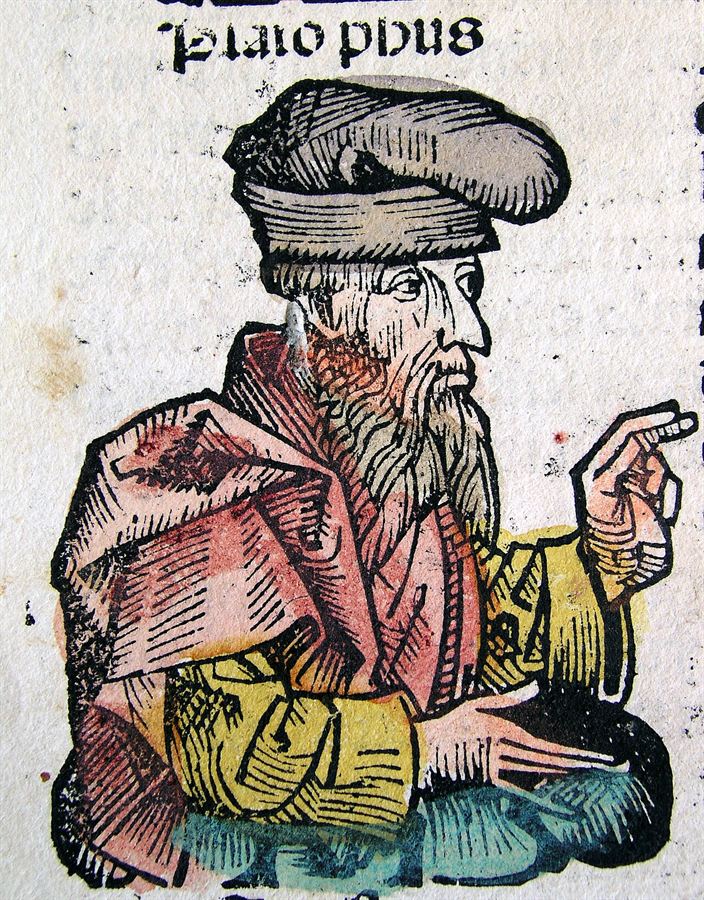
Plato, from the Nuremberg Chronicle, 1493
Plato's metaphysics and epistemology — what the field actually argues with
I could not obtain real citation counts. Google Scholar blocks automated access outright; the Semantic Scholar API rate-limited every request. And even if they had answered, their numbers would have misled you here: coverage of pre-1990 humanities journals is patchy, so Vlastos 1954 — the single most-replied-to article in modern Plato studies — typically shows a count an order of magnitude below its real standing, because forty years of citations sit in JSTOR back-content nobody indexed.
So I substituted two measures that are harder to fake and, for this particular field, better. Both are computed from books already in your folder.
Mentions across Fine's 1999 anthology and On Ideas — roughly 2.8 million characters of the most careful recent scholarship. Not a popularity contest: a map of whose positions still have to be answered.
| Scholar | Plato 1 (1999) | On Ideas | Total | Weight |
|---|---|---|---|---|
| G. E. L. Owen | 143 | 386 | 532 | |
| Gregory Vlastos | 183 | 93 | 280 | |
| Harold Cherniss | 37 | 85 | 122 | |
| T. H. Irwin | 58 | 47 | 108 | |
| F. M. Cornford | 81 | 23 | 104 | |
| M. F. Burnyeat | 45 | 10 | 64 | |
| J. L. Ackrill | 34 | 22 | 57 | |
| W. D. Ross | 24 | 33 | 57 | |
| Michael Frede | 41 | 13 | 56 | |
| Gilbert Ryle | 46 | 6 | 54 | |
| Alexander Nehamas | 29 | 9 | 51 | |
| Julia Annas | 18 | 29 | 49 | |
| R. E. Allen | 24 | 20 | 44 | |
| David Bostock | 30 | 7 | 42 | |
| S. Marc Cohen | 8 | 31 | 39 | |
| John McDowell | 27 | 6 | 37 |
Owen outranks Vlastos almost two to one, and in On Ideas by four to one. Outside the field Vlastos is the famous name — the Socrates books, the Third Man. Inside it, Owen is the one whose arguments everyone is still trying to get past. He published no monograph on Plato; his influence runs entirely through articles, which is exactly why an article-level survey shows what a book-level one hides.
Two caveats on reading these numbers. They are surname counts, so "Owen" absorbs any other Owen and "Frede" merges Michael and Dorothea; and On Ideas is a book about a text Owen wrote the founding modern paper on, which inflates him there specifically. The Plato 1 column is the cleaner signal, and Owen still leads it on articles alone.
Selected independently by three different editors across thirty-four years. This is as close to an objective canon as this field has.
A single exchange running twenty years, reprinted across all three anthologies. If you read one controversy end to end, read this one.
| Article | Author, year, journal | Where you have it |
|---|---|---|
| The Third Man Argument in the Parmenides | Vlastos, 1954, Phil. Review | Allen ch. XII |
| The Third Man Again | Geach, 1956, Phil. Review | Allen ch. XIII |
| Postscript to the Third Man: A Reply to Mr. Geach | Vlastos, 1956, Phil. Review | Allen ch. XIV |
| Plato and the Third Man | Strang, 1963 | Vlastos ch. 9 |
| The Logic of the Third Man | S. M. Cohen, 1971 | Fine ch. X, p. 275 |
| Is Plato Vulnerable to the Third Man Argument? | Fine, 1993 (On Ideas ch. 16) | On Ideas, p. 225 |
The debate you have been tracking. Note that the orthodox statement and its demolition are both in your folder.
| Article | Author, year | Position | Where |
|---|---|---|---|
| Knowledge, Belief and the Forms | Cross & Woozley, 1971 | The classic two-worlds reading of Rep. V — knowledge and belief have disjoint objects | Vlastos ch. 5 |
| Logos and Forms in Plato | R. C. Cross, 1954, Mind | Forms as the objects of logos; Bluck's reply follows it | Allen chs. II–III |
| Hypothesis in the Republic | R. Robinson, 1971 | The method of hypothesis and the Divided Line | Vlastos ch. 6 |
| Mathematics and Dialectic in the Republic VI–VII | Cornford, 1932, Mind | The Line and the ascent to the Good; the source of the acquaintance reading Fine rejects | Allen ch. V |
| Plato on the Imperfection of the Sensible World | Nehamas, 1975, APQ | Sensibles are not defective copies — the paper that unpicks the "imperfection" cliché | Fine ch. VI, p. 171 |
| The Theory of Forms | T. H. Irwin | The best modern statement of the standard middle-period picture | Fine ch. V, p. 143 |
| Knowledge and Belief in Republic V–VII | Fine | Against two worlds; knowledge of sensibles is possible | Fine ch. VIII, p. 215 |
| The Form of the Good in Plato's Republic | Santas, 1980 | What the Good is supposed to do that other Forms cannot | Fine ch. IX, p. 247 |
| Reasons and Causes in the Phaedo | Vlastos, 1969, Phil. Review | The aitia passage — Forms as reasons, not pushes. Fine's ch. 14 argues with it | Vlastos ch. 7 |
| Learning as Recollection | Moravcsik, 1971 | The standard modern treatment of anamnēsis | Vlastos ch. 4 |
| Platonic Recollection | Dominic Scott | The later revisionist account of recollection | Fine ch. III, p. 93 |
Where twentieth-century epistemology met Plato and both changed. Fine's five Theaetetus chapters are all responses to these.
| Article | Author, year | Why it matters | Where |
|---|---|---|---|
| Knowledge is Perception: Theaetetus 151d–184a | M. F. Burnyeat | The standard treatment of the dialogue's first definition and the Protagoras/Heraclitus material | Fine ch. XII, p. 320 |
| Plato on Sense-Perception and Knowledge (Tht. 184–186) | J. M. Cooper, 1970, Phronesis | Demolishes the Cornford–Cherniss reading; argues the passage locates knowledge in judgement, not in acquaintance with Forms | Fine ch. XIII, p. 355 |
| Observations on Perception in Plato's Later Dialogues | Michael Frede | What perception can and cannot deliver, after the Theaetetus | Fine ch. XIV, p. 377 |
| Identity Mistakes: Plato and the Logical Atomists | John McDowell | The false-belief puzzles read through Russell — a landmark in analytic history of philosophy | Fine ch. XV, p. 384 |
| Knowledge and Forms in Plato's Theaetetus | W. F. Hicken, 1957, JHS | The older question of whether Forms are silently present in the dialogue | Allen ch. VIII |
| Language and Reality in Plato's Cratylus | J. L. Ackrill | The naming/atomism debate that Fine's ch. 5 enters | Fine ch. IV, p. 125 |
| Article | Author, year | Where |
|---|---|---|
| Plato on Not-Being | Owen, 1971 | Vlastos ch. 12 · Fine ch. XVII, p. 416 |
| Plato and the Copula: Sophist 251–259 | Ackrill, 1957, JHS | Allen ch. X · Vlastos ch. 11 |
| Being in the Sophist: A Syntactical Enquiry | Lesley Brown, 1986 | Fine ch. XVIII, p. 455 |
| Sentence Meaning, Negation, and Plato's Problem of Non-Being | David Wiggins, 1971 | Vlastos ch. 13 |
| Plato's Description of Division | A. C. Lloyd, 1954, Classical Quarterly | Allen ch. XI |
A self-contained fight worth knowing about, because how you date the Timaeus decides whether Plato ever gave up the Forms.
| Article | Author, year, journal | Where |
|---|---|---|
| The Place of the Timaeus in Plato's Dialogues | Owen, 1953, Classical Quarterly | Allen ch. XVI |
| The Relation of the Timaeus to Plato's Later Dialogues | Cherniss, 1957, American Journal of Philology | Allen ch. XVII |
| The Disorderly Motion in the Timaeus | Vlastos, 1939, Classical Quarterly | Allen ch. XVIII |
| Necessity and Persuasion in Plato's Timaeus | Morrow, 1950, Philosophical Review | Allen ch. XIX |
| The Double Explanation in the Timaeus | Steven Strange | Fine ch. XVI, p. 397 |
The good news: essentially this entire canon is already sitting in your folder, inside three books.
| Volume | Articles | Covers | File |
|---|---|---|---|
| Allen, Studies in Plato's Metaphysics (1965) | 20 | 1932–1960. Third Man, Timaeus, Sophist, Parmenides. The mid-century canon | Studies in Plato's Metaphysics … Allen |
| Vlastos (ed.), Plato I: Metaphysics and Epistemology (1971) | 13 | Overlaps Allen on the essentials, adds the Republic epistemology and not-being | Modern Studies in Philosophy … Vlastos |
| Fine (ed.), Plato 1: Metaphysics and Epistemology (1999) | 18 | 1970–1999. Nothing earlier than 1970 — deliberately the modern canon | [Gail_Fine]_Plato_1_… |
Fine states in her Preface that for the Oxford Readings volume "all the selections are relatively recent: the earliest appeared in 1970." Allen's runs 1932–1960. So Allen and Fine are almost disjoint by design, and Vlastos (1971) sits between them, sharing four articles with Allen. Together they give you three consecutive generations with very little duplication — about 47 distinct articles, which is close to the whole working canon of the field.
Individually important articles that none of your three anthologies reprints.
| Article | Author, year | Why you would want it |
|---|---|---|
| Separation | Fine, OSAP 2 (1984) | The paper the whole separation debate now runs through. You have it — Plato on Knowledge and Forms ch. 11, p. 252 |
| The One over Many | Fine, Philosophical Review (1980) | Her argument that Plato's One-over-Many is realist, not semantic. Not in the 2003 collection — revised into On Ideas ch. 8 instead |
| Plato on the Grammar of Perceiving | Burnyeat, Classical Quarterly (1976) | Companion to his Theaetetus chapter; frequently cited alongside it. [year/journal not independently re-verified] |
| Idealism and Greek Philosophy: What Descartes Saw and Berkeley Missed | Burnyeat, Philosophical Review (1982) | Cited in Fine's own bibliography; the standard reference on why the Greeks had no idealism |
| Self-Predication and Plato's Theory of Forms | Nehamas, APQ (1979) | The other half of the Nehamas position you have in Fine ch. VI. [year/journal not independently re-verified] |
| Separation and Immanence in Plato's Theory of Forms | Devereux, OSAP (1994) | You have it — Fine ch. VII, p. 192. The standing objection to Fine on separation |
Verified from the books themselves: every article title, author and chapter position in all three anthologies, read from their tables of contents; and the year and journal for all twenty Allen articles, which his Preface lists by article number. The corpus counts are reproducible — plain surname frequency over the full text of two books.
Not verified: real citation counts, for the reasons given at the top. Where I have given a year or journal for an article outside Allen's volume and could not confirm it against a source in this session, I have marked it in grey rather than presenting it as checked. Vlastos's and Fine's tables of contents give titles and authors but not original publication data, so those years come from my own knowledge and should be confirmed before you cite them.