 τί ἐστι;
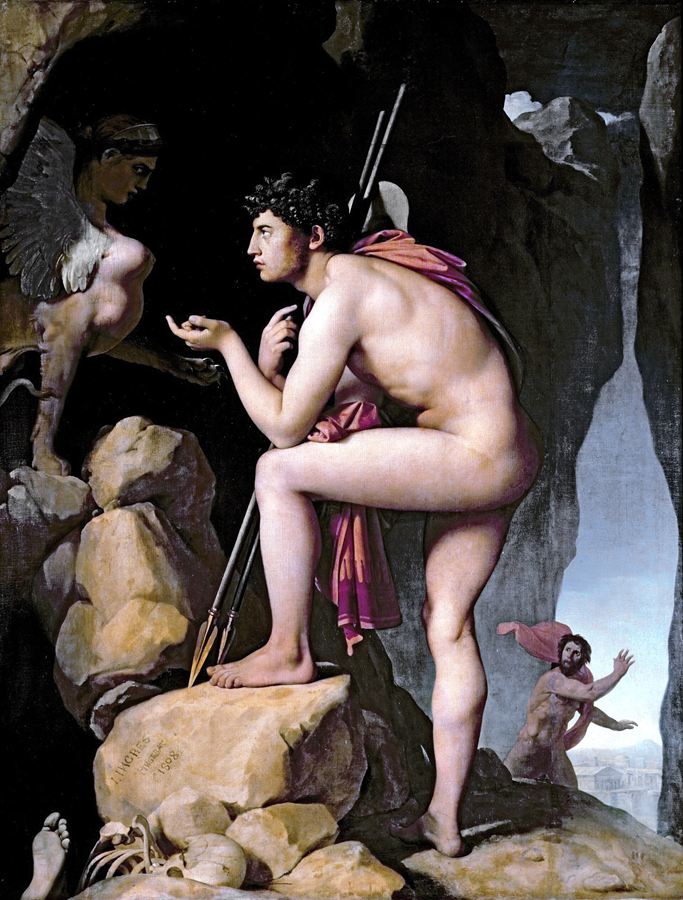
Jean-Auguste-Dominique Ingres, Oedipus and the Sphinx, 1808
Brill’s Companion to the Reception of Socrates, ed. Christopher Moore (Brill, 2019), ch. 1, pp. 41–74 · argument map in the form if a,b,c,d… then P
Greek tragedy is admissible evidence for the reception of Socrates — once we stop asking what did the historical Socrates think? and ask what did the name “Socrates” already mean, and by when? Because he left no writings, the man himself is the work that gets received. His tradition therefore behaves like Homer’s, so Nagy’s diachronic-evolutionary method transfers: an “idea of Socrates” was assembled and circulating by the 420s BCE, before Plato, who received rather than created it. Tragedy, though it names no contemporaries, engages that idea.
supported by six premises
Reception studies is a discipline of works; Socrates wrote none. Converted into the engine: the man becomes the work.
Tragedy avoids naming contemporaries. Every reading must be inferential — downgraded from refutation to a limit on confidence.
Socratic vs Sophistic vs generic “intellectual climate”; and Socrates vs Plato. Never fully answered.
z→a · y→b · x→c · u→d · v→e · w→f ⟹ z,y,x,u,v,w ∴ P
Load-bearing: premise d. Everything downstream needs a portable “idea of Socrates” by the 420s. Strip d and f collapses into coincidence — parallel intellectual climate, which is exactly what O3 warned about. Bromberg knows it: poverty and shoelessness get four pages, the tragedy is compressed.
The poverty move is the cleverest thing in the chapter. A trait that is probably untrue but universally circulated is better evidence than a true one — it can only be explained as a construction, which is what a and b predict.
Weakest joint: premise e. Licensing reception “in the minds of audiences” makes resonance count as data even without influence. Defensible inside reception studies, question-begging outside it. A reader who rejects e sees Section 2 as a list of commonplaces — which is precisely Barrett’s objection, quoted at p. 65 and never really answered.
The unclosed gap Bromberg names himself: on Medea / Protagoras — “whether Euripides is here responding to a Socratic thesis, or whether Plato has his ‘Socrates’ argue against a popular tragic theme.” If the second, the arrow runs backwards and f inverts.
Modality check: P is offered as a methodology, not a finding — “The goal of this chapter is to propose a methodology” (41); “this essay hopes only to move this project a small step forward” (71).