 τί ἐστι;
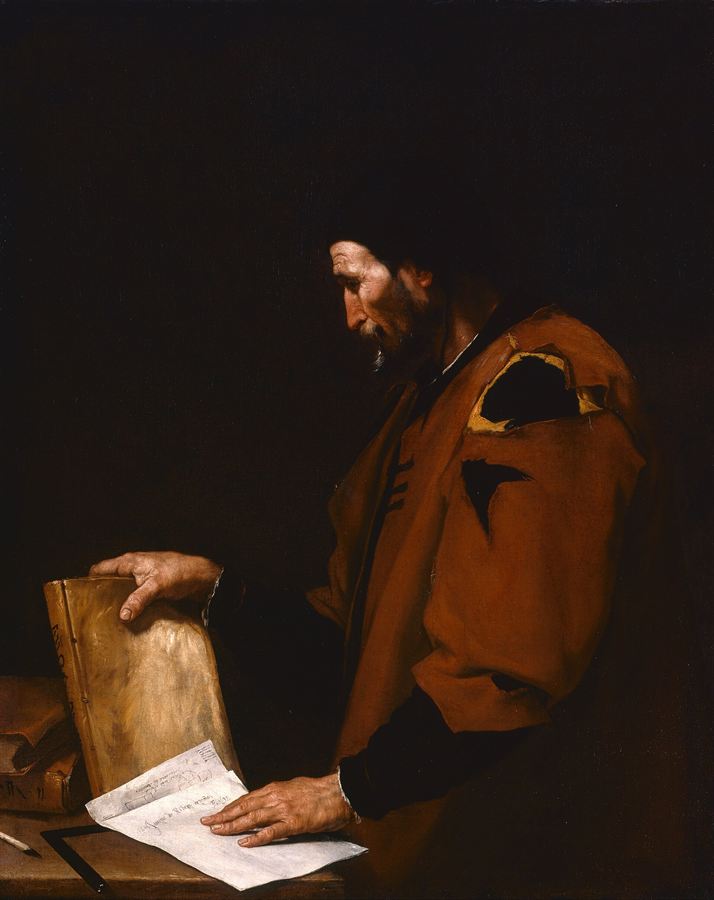
Jusepe de Ribera, Aristotle, 1637
Vlastos's case, move by move — and the texts that carry it
Gregory Vlastos, “The Socratic Elenchus,” in Gail Fine (ed.), Plato 1: Metaphysics and Epistemology
(Oxford Readings in Philosophy, OUP, 1999), ch. I, pp. 29–50. First published OSAP 1 (1983).
Socrates does not merely expose contradictions. He believes the elenchus proves moral theses true — and he can believe this only because he is relying on an unstated, unargued assumption about the human mind.
Vlastos's route there is unusual: he begins by refuting his own earlier published view, and the evidence that forces him to change his mind is a single sentence that he, and everyone before him, had read many times and dismissed.
Before building, Vlastos demolishes. Three demolitions, each with textual or statistical backing.
He never says why his way of searching finds truth, or even what that way is. The words elenchos and elenchein appear in Plato in great profusion — dozens of times, mostly in the early dialogues — but always to describe what is happening, never to name a method.
Vlastos's sharpest proof: the “What is F?” question that Socrates presses about everything else, he never poses about the elenchus. So there is no Socratic definition of it. Ours can only be a hypothesis — and, Vlastos warns, we may guess wrongly.
Supporting evidence: the word methodos is itself Plato's own coinage — its first occurrence in surviving Greek is in the Phaedo. Interest in “method” belongs to the middle period, not to Socrates.
“I guessed wrongly twenty-five years ago” — in his own 1956 introduction to the Protagoras. This is not modesty for its own sake. It licenses the later, larger reversal, and it establishes that the target is a mistake everyone made, including the author.
He then names who turned “elenchus” into a proper name: George Grote (Plato and the Other Companions of Socrates, 1865) and Lewis Campbell, followed by Henry Sidgwick (1872). The technical term is roughly 2,300 years younger than the practice.
He takes the Encyclopedia of Philosophy entry by Roland Hall as the representative statement of the received view, and finds three faults:
That third point is the hinge of the whole paper. What Socrates actually does is convict p not of falsehood but of membership in an inconsistent premiss-set — which shows only that something in the set is false, not that p is.
Having cleared the field, Vlastos proposes his own replacement.
A search for moral truth by adversary argument, in which a thesis is debated only if asserted as the answerer's own belief, and the answerer counts as refuted if and only if the negation of his thesis is deduced from his own beliefs.
Every clause is load-bearing, and the rest of the paper unpacks them.
The Greek word suggests an adversarial procedure but does not entail that adversarial procedure is the point. If it were, Socratic dialectic would be eristic — verbal jousting, argument aimed at winning. It is not, because its object is always the positive reach for truth.
“you shall no longer engage in this search nor philosophize”
Apology 29c — Socrates imagining the authorities silencing him
What it proves: “search” and “philosophize” are used as equivalents — the nor is epexegetic (explanatory, not additive). For Socrates, philosophizing simply is searching.
“examining and searching there as I have been doing with people here”
Apology 41b — what he would do in Hades
What it proves: the same equation again, now linking examining (the elenctic verb) to searching. The method is the search.
Elenctic argument is not how Socrates would settle the price of olive oil, the right diet for a fever, a geometrical construction, or the logical conditions a definition must satisfy. Two consequences Vlastos draws are important and often missed:
| Case | What Socrates does | Why it matters |
|---|---|---|
| The slave boy in the Meno | The method there is not elenctic but maieutic (midwifery). Plato has already taken “a giant step” — recollection — turning the moralist of the early dialogues into the metaphysician of the middle ones. | The Meno's epistemology is already past the elenchus. It is Plato's, not Socrates'. |
| Conditions on a good definition | He produces them on his own initiative, tells the interlocutor what they are, and asks not “Do you agree?” but “Do you understand?” | Logical truths are never treated as elenctic theses. Only moral truths are. |
Clause 3 of the definition — “asserted as the answerer's own belief” — turns out to be a formal rule Socrates enforces. Vlastos documents it with four texts.
“Don't think that you can play games with me and answer whatever comes to your head, contrary to your real opinion” (Grg. 500b)
“don't answer contrary to your real opinion, so we may get somewhere” (Rep. 1, 346a)
“watch out that you are not doing so contrary to your real opinion” (Crito 49c–d)
“it isn't this ‘if you wish’ and ‘if you think so’ that I want to be refuted, but you and me” (Prt. 331c)
What they prove: four separate dialogues, one rule. This is not a stylistic habit — it is a constraint Socrates enforces, and it is what separates elenchus from every other Greek argumentative practice.
Hypothetical premisses were perfectly legitimate in Greek argument. Greek geometry uses them constantly in indirect proofs; Zeno — whom Aristotle called the inventor of dialectic — built his whole method on unasserted counterfactuals. So why does Socrates forbid what mathematics permits? He never says. Vlastos proposes three reasons:
1 · To test honesty. In eristic, where winning is the object, you may say anything advantageous. In elenchus you must say what you think true even if it loses you the debate.
2 · To test seriousness. Seriousness can be faked with a solemn face. But saying what you believe puts your opinion “on record” — you give it the weight of your life. People treat opinions as more expendable than lives; Socrates makes them tie the two together.
3 · The existential dimension. The elenchus examines not just propositions but lives.
“he who comes closest to Socrates in discussion, even if he should start discussing something else, will find himself unavoidably carried round and round in argument until he falls into giving an account of himself — of the way he is living now and the way he has lived in the past.”
Laches 187e6–188a3 — Nicias warning Lysimachus
What it proves: this is a third-party testimonial inside the dialogues — someone who knows Socrates describing the effect from outside. Vlastos uses it to establish the double objective: the elenchus must discover how everyone ought to live and test whether this person is living so. Not two methods — “a two-in-one operation.”
Now the formal analysis. Vlastos abstracts the recurring pattern, then shows it cannot do what Socrates claims for it.
Showing that p conflicts with q and r shows only that at least one member of the set is false — not that p is. And Socrates has not undertaken to establish q and r; they entered as propositions the two men happened to agree on.
Vlastos distinguishes this sharply from indirect elenchus, where the refutand may be used as a premiss in its own refutation. There Socrates isn't committed to the premisses, and all he claims is internal contradiction in the interlocutor's beliefs. The problem arises for standard elenchus only.
The most striking section. Vlastos sets out his own former position, explains why it collapsed, and identifies the exact sentence that destroyed it.
His 1956–57 position: the elenchus only reveals muddles and inconsistencies to the interlocutor. It had a “mighty precedent” — Grote, who held that Socrates' negative cross-examination and his positive convictions were “two unconnected operations of thought”.
If exposing inconsistency were all the elenchus did — where did Socrates' strong moral doctrines, the ones he based his life on, get their rational support? The elenchus was his only line of argument. If it grounded nothing, what did?
Grote wasn't troubled, because he accepted the two-track picture. Vlastos couldn't: it left him with “Grote's missionary of the examined life, who was a dogmatist himself.” But, he notes, being dissatisfied with a picture is one thing; finding the evidence that destroys it is another. His critics did not have that evidence. He had to find it himself.
“Has it not been proved that what was asserted [by myself] is true?”
Gorgias 479e — Socrates to Polus, at the close of the argument
What it proves: Socrates says in so many words that he has done the thing Grote and Vlastos both said he never does — proved his own thesis true by elenctic argument.
Vlastos's account of why it was missed is the methodological heart of the paper. He had “scaled them down, even while reading them, discounting them as a careless overstatement.” Grote had gone over the sentence many times, and so had scores of others. It “had not hit anyone between the eyes.”
An obvious defence: T20 is a slip made “in the last gasps of the debate.” Vlastos closes it with two further texts.
“But I, a single man, do not agree; for you do not compel me, but produce a multitude of false witnesses against me, trying to drive me from my property, the truth.”
Gorgias 472b — seven Stephanus pages before T20
What it proves: in an argument the only means of compulsion are logical. So Socrates is announcing in advance that he intends to give a logically compelling proof that p is false. T20 is therefore not a slip — it is the fulfilment of a promise.
“But I know how to produce one witness to my assertions: the man against whom I am arguing.”
Gorgias 474a5–6
What it proves: the claim is perfectly general. Not “I proved this one thesis” but: whenever arguing elenctically with anyone against any moral thesis, Socrates knows how to make the adversary witness to its contradictory. The confidence is systematic, not local.
Vlastos presses the courtroom image running through the Gorgias passage, and uses it to state the objection in its strongest form.
Imagine a witness who testifies p, then concedes q and r under prodding, and is shown that q and r entail not-p. Has he been compelled to testify that p is false? He has not. Faced with the conflict, it is still up to him which statement to retract.
Vlastos writes Polus's missing speech for him: “I see the inconsistency… But I don't have to do it your way. I could decide that p is true and q is false. Nothing you have proved denies me this alternative.”
And Polus had every motive to do exactly that. He believes p strongly — he thinks it absurd of Socrates to deny what almost all the world affirms. For q he has no enthusiasm; Callicles later says Polus conceded it only “because he had been ashamed to say what was in his mind” (Grg. 482e2). He should have thrown q to the lions and kept p — leaving the elenchus in a worse state than he entered it.
So why isn't Socrates worried by this ever-present possibility? Vlastos's answer: because Socrates believes that if the wrong choice were made, he could start again and find other premisses inside that person's belief system to make the same trouble. The question is whether this confidence can be shown from the text.
“(b) So you must either refute her… or, if you leave this unrefuted, then, by the dog, god of Egypt, Callicles will disagree with you, Callicles, and will dissent from you your whole life long.”
Gorgias 482a–b — Socrates to Callicles
What it proves — and this is the decisive inference of the paper: how can a thesis Callicles scornfully rejects remain in him as a source of lifelong internal dissension? Only if he goes on believing other things that entail it, unbeknown to him. And “your whole life long” means: always. He can never escape by retracting, because there will always be further beliefs in his system that entail the Socratic thesis.
Anyone who ever has a false moral belief will always have at the same time true beliefs entailing the negation of that false belief.
Vlastos calls this “a tremendous assumption.” Socrates never states it and never argues for it.
Because (A) is a meta-elenctic statement — a claim about the elenchus rather than within it. To support it Socrates would have to conduct meta-elenctic inquiry, and in every dialogue before the Meno he maintains “epistemological innocence, methodological naïvety.” This closes the circle back to the paper's opening sentence: he never says why his way of searching finds truth.
But it is not arbitrary. Socrates has purely inductive evidence: (A) proves true in his own experience, and never fails. Every time he looks for true premisses inside an opponent's beliefs, they are there.
From (A) it follows that any set of moral beliefs that is internally consistent must consist exclusively of true beliefs — because a single false belief would drag in beliefs entailing its negation, destroying consistency.
Socrates prizes the consistency of his own beliefs above everything. So he may infer that his own beliefs are true; hence q and r, to which he has agreed, are true; hence deducing not-p from true premisses does prove not-p true. Step (4) is licensed after all.
“I would rather that my lyre were out of tune, or a choir I was training, and that the greater part of mankind should dissent from me and contradict me, than that I should be out of tune with my own single self and contradict [myself]”
Gorgias 482b–c
What it proves: consistency is elevated to the supreme desideratum — exactly the premiss the reconstruction needs. Vlastos is not importing a modern criterion; Socrates states it himself.
He concedes the inference is “a very chancy” one. Socrates infers the consistency of his belief-set from its undefeated track record. But results in elenctic argument depend heavily on argumentative skill — and Socrates' vastly exceeds his interlocutors'. So his unbeaten record may show only that his inconsistencies have defied his adversaries' power to find them, not that there are none.
And Vlastos turns this into a positive result: this sense of the method's fallibility is, he believes, “the right clue to his profession of ignorance.” Socrates disclaims knowledge because he knows his instrument can fail.
The paper ends by using the result to explain something outside itself.
Reconstruct Plato's situation. Through Cratylus he had become convinced there is no knowledge of the sensible world because it is in flux — Aristotle's testimony at Metaph. 987a32ff. — leaving him wondering how there could be knowledge of anything. Meanwhile the Socrates he keeps writing disclaims knowledge yet searches confidently for moral truth, and finds it in the most unlikely place: in the minds of confused, wrongheaded people.
The question “How could this be true?” never disturbs Socrates. It never stops disturbing Plato.
Then Plato becomes convinced of something Socrates would have thought fantastic: that every soul existed before birth, passed through many incarnations, and so acquired knowledge of everything — knowledge now present in every soul as true covert beliefs.
That is exactly what assumption (A) requires. Recollection explains how every interlocutor comes to possess the true beliefs Socrates needs. Vlastos: that “wildest of Plato's metaphysical flights” is understandable as, among other things, an answer to a problem in Socratic elenchus — which may be why Plato put it in Socrates' mouth.
Vlastos pinpoints when the question became urgent for Plato: the Gorgias, on the widely held view one of the latest of the early dialogues. The elenchus is practised throughout the earlier dialogues — but only in the Gorgias is Socrates made to utter the cluster of remarks that reveal the assumptions behind his confidence. That is not a coincidence; it is the record of Plato beginning to worry.
Vlastos adds an observation he says has not been noticed in the literature: Euthydemus, Lysis and Hippias Major — all often placed late among the early dialogues on independent grounds — share a feature that separates them from every other dialogue in the group. Adversary argument is abandoned. The theses seriously debated are not contested by any interlocutor; Socrates is both their author and their critic. The elenchus is dying before Plato replaces it.
Vlastos numbers his quoted texts T1–T25. This is what each is doing in the argument.
| Text | Source | Job in the argument |
|---|---|---|
| T1, T2 | Ap. 29c, 41b | Philosophizing = searching = examining. Establishes the elenchus as search, not combat |
| T3, T4, T5 | Grg. 500c; Grg.; Rep. | The stakes are “how we ought to live” — the moral restriction, in Socrates' own words |
| T6, T7 | Ap. 29d, 30a | “Anyone… young or old, citizen or foreigner” — the indiscriminate address, the street-evangelist reach |
| T8–T11 | Grg. 500b; Rep. 346a; Cri. 49c–d; Prt. 331c | The “say what you believe” rule, documented across four dialogues. Separates elenchus from geometry, from Zeno, from eristic |
| T12 | Ap. 29e | “question and examine and refute him… I shall reproach him” — the existential dimension |
| T13 | La. 187e–188a | Nicias's outside testimony: you end up giving an account of your life. Proves the double objective |
| T14 | — | Specimen of elenctic exchange |
| T15, T16 | Grg. | Socrates wants universally valid results, not merely personal ones — rules out the deflationary reading of the elenchus |
| T17 | Grg. | Polus thinks it absurd to deny what almost all mankind affirms — establishes how strongly Polus holds p, which sets up the objection |
| T18 | Grg. 472 | “If I cannot produce one man — yourself — to witness to my assertions…” — the witness metaphor introduced |
| T19 | Xen. Mem. 4.6.15 | Xenophon's Socrates argues from generally accepted opinions. Used to show Xenophon is at loggerheads with Plato's Socrates and Aristotle's |
| T20 | Grg. 479e | The crucial text. “Has it not been proved… true?” — Socrates claims to prove, not merely refute |
| T21 | Grg. 472b | “you do not compel me” — seven pages earlier. Proves T20 is not a slip but a fulfilled promise |
| T22 | Grg. 474a5–6 | “I know how to produce one witness: the man against whom I am arguing” — the claim is fully general |
| T23 | Grg. | Polus and the rest of mankind believe what they repudiate — the mechanism of (A), stated for one case |
| T24 | Grg. 482a–b | The decisive text. “Callicles will disagree with Callicles… your whole life long.” Yields the word always — and therefore assumption (A) |
| T25 | Grg. 482b–c | “out of tune with my own single self” — consistency as supreme value, the premiss that licenses step (4) |
Almost every load-bearing text — T18, T20, T21, T22, T23, T24, T25 — comes from one dialogue, the Gorgias. Vlastos makes this a feature rather than a weakness: the Gorgias is late among the early dialogues, and it is precisely there that Plato lets Socrates reveal the assumptions behind his confidence. The concentration of the evidence is itself part of the developmental argument.
Worth extracting, because it is transferable to your own reading. Vlastos's procedure is: (1) refuse to accept a technical term at face value — ask whether the author ever used it that way; (2) test received interpretations against a count of the actual cases (39 arguments, not one fits); (3) when a text embarrasses your reading, do not scale it down — let it destroy the reading; (4) block the “it's a slip” escape by finding the same claim elsewhere in the same work; (5) state the assumption your reconstruction needs in full generality, then admit openly that the author never argued for it.