 τί ἐστι;
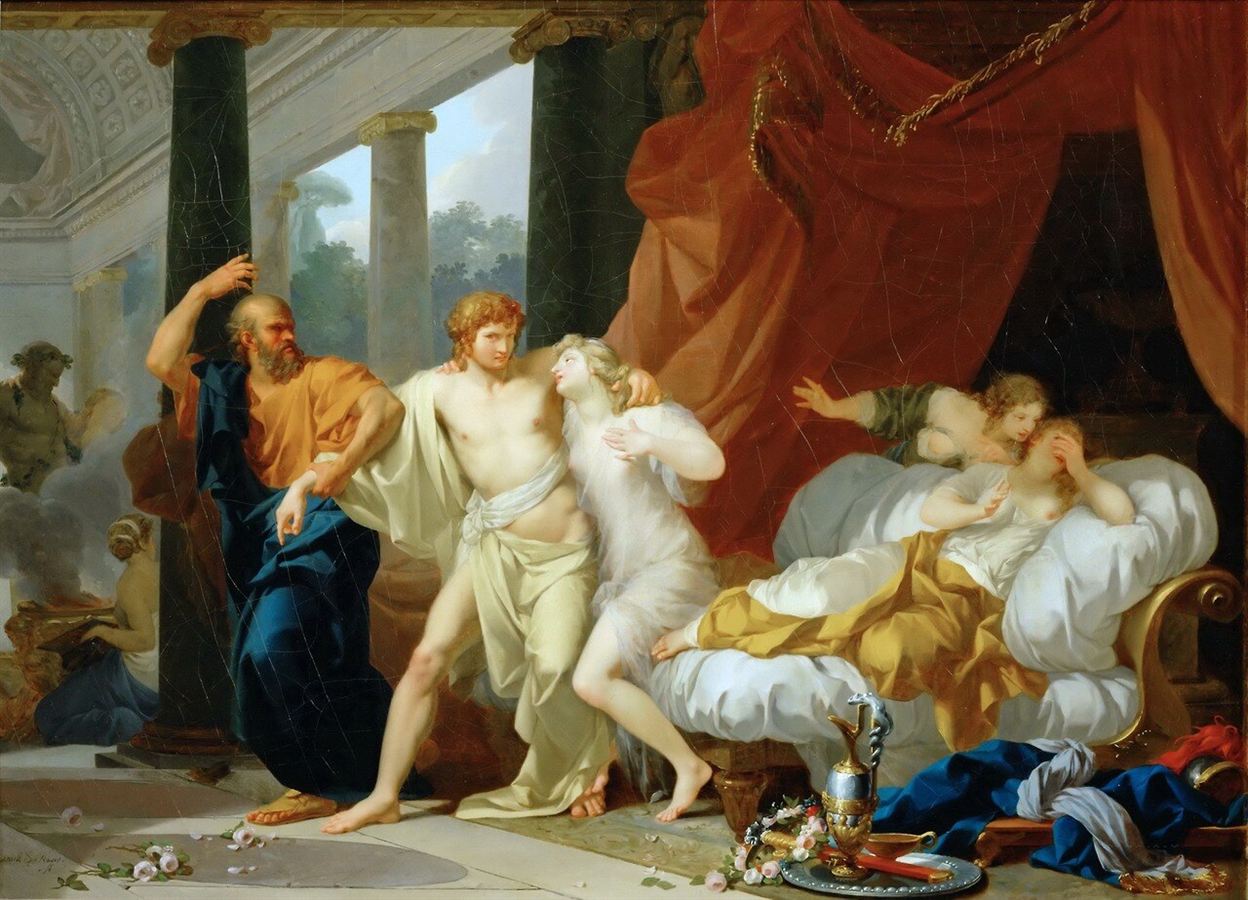
Jean-Baptiste Regnault, Socrates Tears Alcibiades from the Embrace of Sensual Pleasure, 1791
τί ἐστι;
Jean-Baptiste Regnault, Socrates Tears Alcibiades from the Embrace of Sensual Pleasure, 1791
The problem of the elenchus, 1983–2009, in the order and under the headings of
David Wolfsdorf’s survey — with each scholar’s own words set beside it.
Chapter 3 of the Bloomsbury Companion to Socrates is a chronological survey of twenty‑one contributions to one question. This page reproduces its structure section by section, and under each section puts the primary text.
David Wolfsdorf, “Socratic Philosophizing,” in J. Bussanich and N. D. Smith (eds.), The Bloomsbury Companion to Socrates (London, 2012), ch. 3, pp. 34–67. Wolfsdorf declares his own principle of arrangement at p. 36: the survey “will proceed chronologically, from Vlastos (1983a) to Santana (2009),” because “this approach preserves the integrity of the contributions as well as illustrates their dialectical engagement.” That ordering is kept here.
Every section carries two registers, colour‑coded and never mixed: what Wolfsdorf says about that contribution, and what the contributor wrote, quoted from the article itself with its own page numbers. Where the second register is empty, the section header says so.
Before the survey begins, Wolfsdorf sets his terms, states what the elenchus is supposed to be, names the problem the whole literature circles, and — unusually for a companion chapter — explains and defends the order he is going to use. Those four moves are the frame everything below hangs on.
He restricts the subject twice over — to a character, and to a list:
“By ‘Socratic philosophizing’ I understand ‘the manner in which the character Socrates in Plato’s early dialogues engages in philosophia’. (Hereafter, I will refer to the character Socrates in Plato’s Socratic dialogues simply as ‘Socrates’. I will refer to the historical Socrates as ‘the historical Socrates’. By ‘Plato’s early dialogues’ I mean to include: Apology, Charmides, Crito, Euthydemus, Euthyphro, Gorgias, Hippias Major, Hippias Minor, Ion, Laches, Lysis, Republic 1, Protagoras.)”
Wolfsdorf, “Socratic Philosophizing,” p. 34.
The bracket is doing real work. Everything the chapter surveys is a claim about a character in a list of texts, not about a man. Wolfsdorf returns to this at p. 67, where he asks why we should speak of “Socrates’ method” rather than “Plato’s” at all — see §22.
Then the word itself, and the adversarial reading he attributes to Vlastos:
“‘Elenchus’ is a Latinization of the Greek elenchos, which often in its original context and usually in the recent literature on Socrates’ method means ‘refutation’. … Accordingly, the elenchus is conceived as an adversarial approach to claims or to people. Thus Vlastos understood the Socratic elenchus; the word ‘adversarial’ is his.”
p. 34. Wolfsdorf notes in the same parenthesis that he uses the Latin form throughout “despite the fact that a number of the most recent contributions prefer the Greek form” — which is why quotations below from Scott’s 2002 volume read elenchos where his own prose reads elenchus.
The problem, in his own compressed form:
“Indeed, Vlastos himself centrally raises this problem: how can the elenchus refute a thesis? Vlastos calls this ‘the problem of the elenchus’. Most scholarship of the last quarter century has been devoted to solving, dissolving or criticizing attempts to solve or dissolve the problem of the elenchus.”
p. 35.
And the defence of chronological order — the sentence that makes this chapter usable as an anthology spine rather than a topic list:
“My discussion of the interpretations of Socrates’ method of philosophizing will proceed chronologically, from Vlastos (1983a) to Santana (2009). In this respect, the organization of the discussion in this chapter differs from the topical organizations of the other chapters in this companion. My justification for proceeding in chronological order is that this approach preserves the integrity of the contributions as well as illustrates their dialectical engagement within this vein of scholarship.”
p. 36.
Having committed to chronology, he offers a cross‑cut “for those who would appreciate some topical mapping of the terrain.” It sorts the same twenty‑one contributions under three questions. This is the most efficient single page in the chapter, and it is worth having before the sections begin.
| Question | Position | Who |
|---|---|---|
| Does Socrates have a single, uniform approach? | Yes — and it is the elenchus | Vlastos (1983a) |
| No — the elenchus is one form among several | Benson 1995, 2002; Carpenter and Polansky 2002 | |
| No — the elenchus is itself a broad kind with various forms or purposes | Adams 1998; Brickhouse and Smith 1991; Forster 2006; McPherran 2002b, 2007 | |
| No — there is no such thing at all | Brickhouse and Smith (2002b) | |
| Granted refutation, how can Socrates refute? | Premises he thinks true, or likelier than the refutand | Adams 1998; Brickhouse and Smith 1991; Forster 2006; Kraut 1983; McPherran 2002b, 2007; Polansky 1985; Santana 2009 |
| By endoxic premises | Polansky | |
| Because the premises have survived repeated elenctic testing | Brickhouse and Smith | |
| Because the thesis is shown self‑contradictory | Forster | |
| Because Q carries more evidential weight — both agree to it, only one asserts p | Santana | |
| Is refutation of the thesis even the aim? | No — the aim is inconsistency, undermining the conceit of knowledge | Benson 1987, 1990b |
| No — inconsistency, but with beneficent intent | Tarrant 2002 | |
| No — the engagement is cooperative, not adversarial | Wolfsdorf 2003 |
“Indeed, in the wake of Kraut’s criticisms, Vlastos (1983b) himself concedes that his conception of the Socratic elenchus is only true of one dialogue Gorgias. Consequently, Vlastos (1983b) rejects the view that Socrates has a single, uniform approach to philosophizing.” (p. 36) — The founding thesis is withdrawn within the same volume in which it appeared, and everything after §03 is a fight over what survives the withdrawal.
1983–1985
Oxford Studies in Ancient Philosophy, volumes I, II and III — three consecutive years, one argument.
A thesis, a reply printed beside it, a concession printed beside that, and two critiques in the next two volumes. The whole shape of the subsequent literature is set in thirty‑six months.
Vlastos states the five‑step schema, names the problem, and proposes assumptions (A) and (B) yielding (C). Kraut, in the same volume, denies there is a problem. Vlastos, four pages later in the same volume, concedes the point for every dialogue but the Gorgias. Brickhouse and Smith then show that (A) and (B) do not in fact yield (C); Polansky shows that (C) would not cover the premises Socrates actually uses.
Read §01 with its provenance warning in view: the essay that starts all this is the one text in this anthology that cannot be quoted from itself.
The copy of OSAP vol. I in the library is a library scan in which pp. 26–58 and 122–144 have been physically cut out; the corresponding contents‑page entries are struck through in ink. The text runs from Owen’s p. 25 straight to Kraut’s p. 59. So no sentence below is quoted from Vlastos 1983a directly. Each is quoted either (i) from a scholar reproducing it verbatim, with their citation, or (ii) from Socratic Studies (1994), which is a revision, not a reprint — and at one point demonstrably says something different. Both routes are labelled on every quotation.
Wolfsdorf gives Vlastos’s definition and then the five‑step schema:
“Vlastos himself defines Socratic elenchus as ‘a search for moral truth by adversary argument in which a thesis is debated only if asserted as the answerer’s own belief and is regarded as refuted only if the negation of his thesis is deduced from his own beliefs’ (1983a: 30).”
Wolfsdorf p. 37, quoting Vlastos 1983a p. 30.
On step (1) Wolfsdorf stresses the “existential dimension”: “elenchus has a double objective: to discover how every human being ought to live and to test the single human being that is doing the answering – to find out if he is living as one ought to live” (Vlastos 1983a: 37, quoted at Wolfsdorf p. 37). On step (5) he identifies the crucial text: Gorgias 479e, “Has it not been proved (apodédeiktai) that what was asserted [by myself] is true?” — adding, “More generally, as we will see, the main evidence for Vlastos’s thesis derives from Gorgias” (p. 37).
He then works the Charmides case — sound‑mindedness is restraint (p); sound‑mindedness is always fine (q); restraint is not always fine (r); therefore not‑p — and puts the objection: the discussants could reject q or r instead. “Thus, what the exchange reveals is simply that Q and p are inconsistent, not that p is false rather than Q or some component of Q” (p. 37).
And then the problem, in Vlastos’s own words as Wolfsdorf prints them:
“The problem of the Socratic elenchus: how is it that Socrates claims to have proved a thesis false when, in point of logic, all he has proved in any given argument is that the thesis is inconsistent with the conjunction of agreed upon premises for which no reason has been given in that argument?”
Vlastos 1983a p. 49, quoted at Wolfsdorf p. 38.
The solution, in three steps, with Wolfsdorf’s page references to the 1983a text:
Wolfsdorf adds two things about (A) that matter later. Socrates never argues for it — his reason for holding it is that it “proves true in his own experience” (1983a: 53); the evidence is inductive. And (C) is what licenses step (5): “Since Socrates assents to the premise set Q from which not‑p is deduced, Q must consist of true premises” (p. 38).
Finally, the appendix: in Euthydemus, Lysis and Hippias Major — late among the early dialogues — “Socrates abandons adversarial argumentation and thus the elenchus. Instead, Socrates both proposes and criticizes his own theses. Vlastos conjectures that at this point in his career Plato had lost faith in the elenchus” (p. 38).
“What Socrates … does in any given elenchus is convict p not of falsehood but of being a member of an inconsistent premiss‑set; and to do this is not to show that p is false, but only that either p is false or that some or all of the premisses are false. The question then becomes how Socrates can claim … to have proved that the refutand is false, when all he has established is the inconsistency of p with premisses whose truth he has not undertaken to establish in that argument: they have entered that argument simply as propositions on which he and the interlocutor are agreed. This is the problem of the Socratic elenchus …”
Vlastos 1983a, 30 — quoted in full as the opening block of Hugh H. Benson, “The Problem of the Elenchus Reconsidered,” Ancient Philosophy 7 (1987), 67.
This is the single most‑quoted paragraph in the literature and it is recoverable exactly, because Benson reproduces it as an epigraph before beginning his own argument. It is also the version Benson quotes back at the end of his 1995 paper (p. 112), there with the concordance “1983a: 30 ~ Socratic Studies, 3.”
“A — Everyone’s moral beliefs always include a subset of true beliefs which entail the negation of each of his false moral beliefs.”
Vlastos’s assumption (A) as Richard Kraut prints it, “Comments on Gregory Vlastos, ‘The Socratic Elenchus’,” OSAP 1 (1983), 67–68.
Kraut’s formulation and Wolfsdorf’s (“Anyone who ever has a false moral belief …”) are the same proposition in different words — both are reports of the same 1983a text.
“(A) Anyone who ever has a false moral belief will always have at the same time true beliefs entailing the negation of that false belief, and
(B) The set of moral beliefs held by Socrates at any given time is consistent,
which according to Vlastos entail
(C) The set of moral beliefs held by Socrates at any given time is true.”
Vlastos’s three assumptions as Benson prints them, with the note “‘The Socratic Elenchus’, 52–5 … and ‘Elenchus and Mathematics’, 369” — Benson, “The Dissolution of the Problem of the Elenchus,” OSAP 13 (1995), 48.
Benson adds the adjectives Vlastos used of his own assumptions: “two ‘tremendous’ and ‘exceedingly bold’ assumptions.” Note the wording of (B) here — the set of moral beliefs — and compare Route 2 below, where the 1994 revision narrows it.
“regardless of which conceded premisses they [his interlocutors] choose to retract, there will always be others in their belief system which entail the Socratic thesis”
Vlastos 1983a, 52 (Vlastos’s own emphasis) — quoted twice by Kraut, at pp. 65 and 67, and made the target of his central objection.
“Without some contra‑endoxic premisses how could he [Socrates] hope to get contra‑endoxic conclusions?”
Vlastos, “in the longer version of his paper,” 43 n. 41 — quoted by Kraut, p. 63.
This is the claim Polansky attacks in 1985 (§05): that Socrates could not have reached contra‑endoxic conclusions from endoxic premises.
“The [premise set Q] from which Socrates deduces the negation of the opponent’s thesis are logically unsecured within the argument: no reason has been given to compel agreement to them”
Vlastos 1983a, 40 — quoted at Wolfsdorf p. 37.
“[Socrates] never troubles to say why his way of searching is the way to discover truth or even to say what this way of searching is. He has no name for it. Elenchos and the cognate verb elenchein (to refute, to examine critically, to censure) he uses to describe, not to baptize, what he does; only in modern times has ‘elenchus’ become a proper name.”
Vlastos 1983a, 28 — quoted by Gary Alan Scott, Introduction to Does Socrates Have a Method? (2002), 5 n. 5. Full context at §11.
The concession that gives the deflationists their opening: on Vlastos’s own account the term is a modern proper name for something Socrates never named. Brickhouse and Smith build their 2002 chapter on exactly this (§16).
“if that were all Socrates had expected of the elenchus — exposure of inconsistencies in his interlocutors — where did he find positive support for those strong doctrines of his on whose truth he based his life? If the elenchus, his only line of argument, gave those doctrines no rational grounding, what did? … I could not reconcile myself to Grote’s missionary of the examined life, who was a dogmatist himself.”
Vlastos 1983a, 46 — quoted by Benson 1995, 109 (Benson’s emphasis). Full context at §09.
The motive for the problem, as distinct from its statement. Vlastos wants the elenchus to be constructive because otherwise Socrates is a dogmatist. Benson quotes it in order to attack the motive.
Vlastos revised the 1983 essay and its Afterthoughts together as ch. 1 of Socratic Studies (Cambridge, 1994), where his own headnote reads: “Duly revised, it appeared under the title ‘The Socratic Elenchus’, in Oxford Studies in Ancient Philosophy 1 (1983), 27–58 and 71–4.” Every quotation in this block is from the 1994 text with 1994 pagination, and none of it should be cited as 1983a.
“Socratic elenchus is a search for moral truth by question‑and‑answer adversary argument in which a thesis is debated only if asserted as the answerer’s own belief and is regarded as refuted only if its negation is deduced from his own beliefs.”
Socratic Studies, 4.
Compare the 1983a wording at Wolfsdorf p. 37: “a search for moral truth by adversary argument …”. The revision inserts “question‑and‑answer” and replaces “the negation of his thesis” with “its negation.”
“This brings us smack up against what I had called earlier on ‘the problem of the elenchus’: how is it that Socrates claims to have proved a thesis false when, in point of logic, all he has proved is that the thesis is inconsistent with the conjunction of agreed‑upon premises for which no reason has been given in that argument? Could he be blind to the fact that logic does not warrant that claim?”
Socratic Studies, 21.
“I see the inconsistency in what I have conceded, and I must do something to clean up the mess. But I don’t have to do it your way. I don’t have to concede that p is false. I have other options. For example, I could decide that p is true and q false. Nothing you have proved denies me this alternative.”
Socratic Studies, 21 — the speech Vlastos writes for Polus, “if he had had his wits about him.”
This is the objection in its most vivid form, put by Vlastos into the mouth of the interlocutor. Everything from §02 onward is an answer to it.
“Surely Socrates would be aware of this ever present possibility. Why then is he not worried by it? Because, I submit, he believes that if that wrong choice were made he would have the resources to recoup that loss in a further elenchus.”
Socratic Studies, 22 (Vlastos’s italics).
“Socrates then is making a tremendous assumption. Stated in fullest generality, it comes to this: [A] Whoever has a false moral belief will always have at the same time true beliefs entailing the negation of that false belief.”
Socratic Studies, 25.
“If this is what Socrates assumes, why does he not argue for it? Because it is a meta‑elenctic statement. To support it Socrates would have to engage in meta‑elenctic inquiry. And this … Socrates never does in Plato’s earlier dialogues. In every one of them prior to the Meno Socrates maintains epistemological innocence, methodological naivety.”
Socratic Studies, 25.
The footnote to this sentence (n. 65) is the sharpest thing Vlastos ever wrote against his own reconstruction: “[A] is not a premise in any elenctic argument, nor does Socrates suggest that it is. The remarks from which I have teased it out are obiter dicta. The interlocutor would be perfectly justified if he ignored them as pure Socratic bluster: he has been given no reason why he should think them true.”
“So he has this purely inductive evidence for a part of [A] — for all of it except the claim in [A] that the beliefs from which he deduces the negation of his interlocutors’ theses are true. For this he would have to fall back on nothing better than the pragmatic value of those beliefs: they articulate intuitions which prove practically viable in his own experience; they tell him who is happy and who isn’t; he does what they tell him and he is happy.”
Socratic Studies, 26.
“[B] The set of elenctically tested moral beliefs held by Socrates at any given time is consistent. Socrates would not wish to say, and never does say, that he knows that all of his moral beliefs are mutually consistent.”
Socratic Studies, 28.
This is a substantive revision, not a rewording. Wolfsdorf’s (B) — and Benson’s, quoting 1983a: 55 — is “the set of moral beliefs held by Socrates”. The 1994 (B) is restricted to the elenctically tested ones and is explicitly downgraded from something known to something believed and open to challenge. If you are assessing the strength of (B), it matters a great deal which text you are assessing.
“The answer is in assumptions [A] and [B] whose conjunction … entails that Socrates’ belief‑set consists entirely of true beliefs, from which it follows that q and r are true: to show that not‑p follows from premises which are true, is to prove not‑p true.”
Socratic Studies, 28.
“At this point I am much indebted to helpful criticism from Brickhouse and Smith (1984: 187–92). They convinced me that the contrary view I had expressed in the earlier version of this paper was wrong, and I withdrew it in my next publication.”
Socratic Studies, 26 n. 66.
The concession recorded in the revision itself. What was withdrawn is the claim that the inductive evidence supports the whole of (A), including the truth of the premises — see §04. It is not a withdrawal of (A).
“That wildest of Plato’s metaphysical flights, that ultra‑speculative theory that all learning is ‘recollection’, is understandable as, among other things, an answer to a problem in Socratic elenchus.”
Socratic Studies, 29 — the closing sentence of ch. 1 before the appendix on the demise of the elenchus.
“The first response to Vlastos (1983a), by Richard Kraut, was published in the same volume…. Kraut begins by praising Vlastos’s contribution as surpassing ‘every other discussion this topic has received’ (1983: 59). After this, Kraut criticizes Vlastos’s account of the problem of the elenchus and his proposed solution to it.” Wolfsdorf sets out the three points as Kraut himself numbers them at p. 59:
On (1): “Kraut emphasizes that any argument must contain premises for which no argument is given. In that case, the reason Socrates thinks his arguments are proofs is simply that he thinks his premises are true.” On (2): it would be “astonishing and arrogant” for Socrates to believe he could always find new resources; and “(A) presupposes that Socrates has sorted out true from false moral beliefs.” On (3): Socrates’ professions of perplexity are “not, as many have claimed, ironic, but sincere.”
Wolfsdorf’s summary verdict, p. 40: “In short, as Kraut sees it, there is no problem of the elenchus; thus, there is no need to think – and indeed no compelling evidence for thinking – that Socrates has a commitment to (A) and (B) and so (C) that resolves the problem.”
“I think that Professor Vlastos’s paper on the Socratic elenchus surpasses every other discussion this topic has received, and in many cases I believe that his observations are correct and his arguments decisive. But I want to raise some questions about what he calls ‘the problem of the elenchus’, and about his attempt to solve it. … I am not convinced of one major thesis that Professor Vlastos propounds: that the elenchus is too weak an instrument to provide proof, unless it is supplemented by the two methodological assumptions, labelled A and B, which can allegedly be found in the Gorgias.”
Kraut 1983, 59 — the opening paragraph.
“I suggest that this attempt to raise a problem about the elenchus rests on a mistake. Granted, whenever someone claims to have a proof, then the statements that constitute his argument must be true. But it is not necessary that he give or even have reasons for the premisses used in his argument. As Aristotle realized, if arguments contain a finite number of steps and if circularity is to be avoided, then every demonstration will contain statements for which no argument is given.”
Kraut 1983, 62.
This is the sentence Brickhouse and Smith go back to in 2002 (§16) when they announce that Kraut was right all along. It is also the sentence Santana in 2009 (§21) treats as generating the infinite regress that only a properly interpreted (EA) can avoid.
“So, if we want to know why Socrates thinks he has proofs, the answer is simple: he thinks that his premisses are true, and he thinks that those premisses force us to a certain conclusion. If we want to know why Socrates thinks those premisses true, he may have no answer to our question, but that is no fault of his. One can’t always give a reason for everything one believes, and this fact does not deprive one of proof.”
Kraut 1983, 62.
“I think the weak point in this interpretation lies in its a priori assertion that a surprising and unorthodox conclusion cannot be derived from a premiss‑set that consists of nothing but humdrum, orthodox truths. Such derivations are what philosophers often search for, and sometimes they succeed. Think of Arrow’s paradox, for example … Why couldn’t Socrates’ arguments have this same feature? Surely, the only way to tell whether they do is to look — we can’t decide the matter a priori.”
Kraut 1983, 63.
Kraut’s answer to “without some contra‑endoxic premisses how could he hope to get contra‑endoxic conclusions?” Polansky presses the same point two years later from the other direction — “Quite unusual conclusions, surely, may derive from most ordinary premises” (§05).
“He makes no appeal to self‑evidence or the common consensus, but he does begin his arguments with propositions so eminently reasonable that they are as yet in no need of justification. They will come to need justification only if Socrates or one of his interlocutors discovers a good reason for challenging their status as starting points.”
Kraut 1983, 65 (Kraut’s italics on as yet).
This is the formula Wolfsdorf later adopts as his own position in 2003 (§17). Note that the words are Kraut’s here, but the phrase “picks premisses which he considers so eminently reasonable” that Wolfsdorf quotes in 2003 is Vlastos’s, from the Afterthoughts (§03) — written four pages later, in reply to this paragraph.
“I find that an astonishing claim for Socrates to make, and I think that the text does not support this interpretation. It is astonishing because however arrogant Socrates was he must have realized that he had only a finite number of arguments for his conclusions. At some point, he is going to run out of arguments, and therefore he cannot seriously believe that no matter how often his interlocutor demands that he start all over again from new premisses, he will be able to find a new argument.”
Kraut 1983, 65 — on Vlastos 1983a p. 52.
Vlastos answers this precise objection in Socratic Studies n. 64: “Both Socrates and his opponent are finite creatures and sooner or later each of them will run out of steam. What Socrates is claiming is that his resources will always match those of his interlocutor. Anything impossible about that?”
“Socrates is assuming a certain amount of psychological and moral fixity in all of his interlocutors: they are all compelled to live with the premisses he uses in his arguments against them. … I prefer to interpret him to be making the less arrogant claim that, given a certain fixity in human beliefs, he can always find contradictions in his opponents.”
Kraut 1983, 67.
Kraut’s replacement for (A): an empirical claim about how rigid people’s moral outlooks are, in place of a universal claim about the structure of belief.
“So assumption A itself presupposes that Socrates has sorted out the true from the false: whatever confidence he has in his ability to recognize which beliefs are true is therefore independent of and prior to his belief in A.”
Kraut 1983, 68.
The circularity charge: (A) cannot be the ground of Socrates’ confidence in his moral beliefs, because the inductive evidence for (A) already requires that confidence.
“My conclusion, then, is that consistency is not quite so important for Socrates as Professor Vlastos thinks it is. He strives for it, of course, but he does not think he has achieved it, and he claims to have proofs in spite of this failure. If my interpretation is correct, then Socrates neither has nor needs an answer to the absurdly general question, ‘What makes you think that your ethical views are correct?’ … By its nature, all argument and all proof rests on assumptions open to challenge, and no argument loses its force merely because the speaker has, somewhere or other, inconsistent beliefs.”
Kraut 1983, 70 — the closing paragraph.
Kraut’s third piece of evidence against (B) is Gorgias 527d, where Socrates tells Callicles that both of them “never think the same about the same matters.” Kraut, p. 69: “This is as clear a confession of inconsistency as we could want, and I see no reason to ignore or belittle it.”
Vlastos’s 1994 reply, n. 68, is blunt: “The irony at G. 527D should be transparent: Callicles had been convicted of numerous inconsistencies, Socrates of not even one. Kraut, 1983: 69, missing its irony, takes this text to be ‘as clear a confession of inconsistency as we could want’.” Wolfsdorf does not report this exchange; it is one of the places where the primary texts say more than the survey.
“In the same volume of Oxford Studies in Ancient Philosophy, Vlastos briefly replies to Kraut and makes a major concession: outside of Gorgias there is no evidence from the Socratic dialogues for (A). Thus Vlastos maintains, consistently with Kraut, that in all the Socratic dialogues composed before Gorgias Socrates argues” in the ordinary way — and Wolfsdorf then quotes the long “eminently reasonable” sentence from p. 73.
He continues: “In pre‑Gorgias dialogues, then, Socrates does not question, as an epistemologist would, the justification of his elenchus. But in Gorgias, Plato’s own epistemological concerns lead him to question the justification of Socrates’ elenctic method. Plato’s answer, (A), is his ‘gift’ to Socrates…. In short, (A) and (B) and so (C) are one‑off aberrations in Plato’s philosophical career – albeit aberrations motivated by a legitimate epistemological concern.”
And then the sentence that a reader of this anthology should check against the page: “Vlastos concludes his reply with the suggestion that after abandoning the elenchus in Euthydemus, Lysis and Hippias Major, Plato’s introduction of the theory of recollection in Meno provides a new means of justifying the elenchus. Thus, in Meno, a dialogue transitional between the early and middle periods, the elenchus returns.”
“Even so, there are residual differences of which I did not take sufficient account in the foregoing essay. These I must now acknowledge, even though I cannot, at this last moment, altogether repair the fault.”
Vlastos 1983b, 71 — the opening concession.
“Only in the Gorgias does Socrates maintain that his theses have been ‘proved true’ … or, equivalently, by a powerful metaphor, have been ‘clamped down and bound by arguments of iron and adamant’ (508c–509a). In previous dialogues he contents himself with weaker language.”
Vlastos 1983b, 71–72.
This is the passage Benson quotes back at 1995 n. 12 in order to say that his own argument goes further: Socrates fails to claim falsity “even in this weaker way” in the three paradigmatic dialogues.
“Only in the Gorgias do we encounter those texts from which we can tell that Socrates is now committed to that extraordinary idea which, transposed into more abstract language, has been formalized as assumption A. Not one of those texts is paralleled in any earlier dialogue. … At this point the chasm between the Gorgias and its predecessors is unbridgeable.”
Vlastos 1983b, 72.
“In section III of the foregoing essay I had tacitly opted for (i). For reasons which I shall not undertake to detail, it has now become clear to me that this is untenable exegesis: why impute to Socrates that ‘tremendous’ assumption in all those earlier dialogues in which he gives no positive evidence of his adherence to it — indeed no evidence of its having even occurred to him? I must, therefore, declare for option (ii)…”
Vlastos 1983b, 72–73. Option (i) was “Socrates has been making assumption A right along, but only in the Gorgias does he say the things which reveal that fact”; option (ii), “Assumption A is first made in the Gorgias; in all of the earlier dialogues Socrates is free of it.”
The retraction, stated as a choice between two exegeses. Note what is retracted: the scope of (A), not (A) itself. In the Gorgias it stands.
“Throughout the dialogues which precede the Gorgias Plato depicts Socrates arguing for his views in much the same way as other philosophers have done before or since when trying to bring others around to their own view: he picks premisses which he considers so eminently reasonable in themselves and so well‑entrenched in his interlocutors’ system of belief, that when he faces them with the fact that these premisses entail the negation of their thesis he feels no serious risk that they will renege on the premisses to save their thesis — as in fact, they never do: not once does a personage in a Socratic dialogue do what I said in section III above an interlocutor could ‘always’ do, if he so chose…”
Vlastos 1983b, 73.
The sentence the rest of the literature lives off. Kraut’s position, granted. Wolfsdorf in 2003 will quote a compressed form of it and attribute it to Kraut (§17, and §25 no. 5). And the clause “as in fact, they never do” is an empirical claim about the whole corpus that, so far as this survey records, no one has tested by counting.
“This being the case, the ‘problem of the elenchus’ never bothers Socrates in those earlier dialogues. Why should it? He has a method that works well enough for his own purposes.”
Vlastos 1983b, 73.
“If he were an epistemologist, he might well have asked, ‘What reason is there to believe that those who disagree with me must have those entrenched beliefs which I can use to make them “see” the falsehood of their misguided theses?’ But since he is no epistemologist, he doesn’t raise that question. And if he doesn’t, why should he be worried? That is Plato’s distress, not his. It is Plato, his mind ‘full of epistemological worries’, who feels the force of that question.”
Vlastos 1983b, 74.
The problem of the elenchus is relocated. It is not a difficulty Socrates has; it is a difficulty Plato notices about Socrates. This single move is what turns a question in Socratic epistemology into a question in Platonic chronology.
“So A is Plato’s present to his teacher, bestowed in the Gorgias where he is made to say those very strong things … of which there is no hint earlier on.”
Vlastos 1983b, 74.
Wolfsdorf’s account writes “gift” here, in scare quotes, as though quoting. The word on the page is present, and it is repeated ten lines later in “a further, more lavish, present to Socrates.” The sense is the same; the quotation marks are not accurate. See §25 no. 1.
“To continue the scenario: when Plato sees how strong is that assumption, how hopeless it would be to justify it by the inductive evidence, which is all Socrates could have offered for it — extrapolation from his own experience in elenctic argument — Plato loses faith in the elenchus and proceeds to extricate Socrates from it: so he does in the Euthydemus, Lysis, and Hippias Major…”
Vlastos 1983b, 74.
“After its euthanasia in these three dialogues, the elenchus is resurrected in the Meno on the strength of a further, more lavish, present to Socrates: the transmigration of the soul and the theory of recollection. By the time this has happened the moralist of the earlier dialogues has become the metaphysician of the middle ones. The metamorphosis of Plato’s teacher into Plato’s mouthpiece is complete.”
Vlastos 1983b, 74 — the last sentence of the paper.
Read this against Wolfsdorf’s summary. Wolfsdorf writes that recollection “provides a new means of justifying the elenchus.” What the page says is that the elenchus is “resurrected … on the strength of” recollection. The justificatory reading is defensible — it is spelled out in the 1994 revision, p. 29, as an answer to “how could it have happened that each and every one of Socrates’ interlocutors did have those true beliefs he needs” — but it is not in the 1983 text. See §25 no. 2.
“I now see that a more appropriate title for section III of the foregoing paper would have been ‘The Socratic Elenchus in the Gorgias’.”
Vlastos 1983b, 74 n. 8 — the whole retraction in one footnote.
Benson quotes this note at 1995 n. 11 and then observes that in Vlastos’s later work “this restriction does not appear to be religiously adhered to” — and that in the 1994 revision “there is no indication that he takes ‘the problem of the elenchus’ to arise only in the Gorgias. Rather, it is only in the Gorgias that Plato has become sufficiently troubled by the problem to propose a solution.”
OSAP I runs: Owen, “Philosophical Invective” (1); Vlastos, “The Socratic Elenchus” (27); Kraut, “Comments” (59); Vlastos, “Afterthoughts” (71); Kahn, “Drama and Dialectic in Plato’s Gorgias” (75). Kahn’s paper — dedicated to Vlastos and written “under the direct stimulus of Gregory’s article on the elenchus” — is printed immediately after the exchange and is not surveyed in Wolfsdorf’s chapter. Benson cites it at 1995 n. 174 for the claim that after 499b Callicles “is no longer a real adversary but a passive, often silent interlocutor.”
“Brickhouse and Smith’s argument is brief, but taut and subtle.” Wolfsdorf gives the strategy first: Vlastos needs (C) to guarantee that the moral propositions of Q are true; but “Socrates has no means of assuring and no good reason to believe that his moral belief‑set is wholly true.” Worse, “it is not merely moral propositions that serve in Q to entail not‑p” — so the solution would require the consistency and truth of all Socrates’ relevant beliefs, moral and non‑moral.
The argument then runs in two movements.
Against the justification of (A). “(A) concerns true beliefs, but the elenchus can only reveal inconsistency. Thus, Socrates would have no means by which to infer whether any particular one of his interlocutor’s beliefs was true.” Wolfsdorf notes that Kraut makes the same point at 1983 n. 4, and adds a correction of his own: their discussion at 188–90 “is slightly confusing insofar as it also incorporates the claim that Socrates could have no justification for (B) as well as (A). Nothing in their argument to this point tells against (B).”
Against the entailment of (C). This is the technical heart. “(A) merely states that if one has a false moral belief, then one will also have true beliefs – not necessarily moral ones – that entail the negation of that false moral belief.” And a belief‑set can be consistent while containing both true and false beliefs. Their example, as Wolfsdorf reports it: {‘Socrates is married to Xanthippe’, ‘Socrates can fly’}. So Socrates could have a consistent moral belief‑set one of whose members is false, while his moral‑plus‑non‑moral set is inconsistent. (A) and (B) do not yield (C).
Two repairs are tried and both fail:
The same for (B): (B1) “All of Socrates’ beliefs – not merely his moral beliefs – are consistent” is rejected because “there is no reason to suppose that Socrates, even on Vlastos’s view, subjects all of his non‑moral beliefs to the sort of rigorous scrutiny” he gives his moral ones (192). (B2), restricted to beliefs he might use elenctically, lacks textual support: Gorgias 482a5–b1 shows Socrates “always maintains the same beliefs” (193) but it would be an “extremely unrealistic overestimation” of the method to think it had produced a fully consistent set (193).
And the constructive residue, which Brickhouse and Smith themselves pick up seven years later: an adequate account must “allow us to make sense of [the elenchus] as a method [of moral inquiry that] Plato or Socrates would prescribe” (194). Wolfsdorf’s comment: “On Vlastos’s view, which requires (C), the elenchus is in fact not a method that even Socrates can use.”
The paper itself is missing, but its effect is on record in two places held here.
“At this point I am much indebted to helpful criticism from Brickhouse and Smith (1984: 187–92). They convinced me that the contrary view I had expressed in the earlier version of this paper was wrong, and I withdrew it in my next publication (1985: 18–19 = ch. 2, pp. 56–7).”
Vlastos, Socratic Studies, 26 n. 66.
“Indeed, as Brickhouse and Smith, ‘Vlastos on the Elenchus’, were quick to point out, (A) and (B) are not ‘tremendous’ and ‘bold’ enough, since they fail to entail (C).”
Benson 1995, 48 n. 10.
Benson’s one‑sentence version of the 1984 result, and the neatest statement of it anywhere: the assumptions are not too strong, they are too weak.
Two related criticisms. The first defends the endoxic reading of Q that Vlastos had ruled out; the second attacks (A), (B) and (C) directly.
“Polansky suggests that ‘none of Vlastos’s [three] arguments aiming to prove that Socrates cannot rely exclusively upon endoxic premises is effective’ (1985: 249).” Wolfsdorf takes the three in order.
Beyond the three, Polansky charges Vlastos with an “impoverished” conception: “Endoxic views are not equivalent to conventional views. Endoxic views are the views of the wise and such views may be resisted by the ‘mass of men’ (252).” And he re‑reads the Republic I argument (335b–c) that Vlastos had taken as non‑endoxic. Wolfsdorf adds the Xenophontic corroboration Polansky invokes: Mem. 4.6.15, “Whenever Socrates himself argued something out he proceeded from the most generally accepted opinions, believing that security in argument lies therein.”
Two of Polansky’s sentences survive in works held here, which is enough to fix his position on two contested points.
“Socrates might hold that his experience in elenctic encounters gives this modified version of (B) strong inductive support, for where he does use non‑moral premises they prove consistent with the moral beliefs he utilizes as the other premises and those moral beliefs that are his conclusions.”
Polansky 1985 n. 13 — quoted at Wolfsdorf p. 42, dissenting from Brickhouse and Smith’s rejection of (B2).
“Ronald Polansky, for example (‘Vlastos’ Analysis’), attributes to Socrates the doctrine that endoxa are epistemologically more secure than non‑endoxa.”
Benson 1995, 101 n. 148 — listing Polansky among those who save the constructivist reading by attributing further, “textually unsubstantiated” doctrines to Socrates.
Polansky returns in 2002 as co‑author with Michele Carpenter (§13) — and the position has hardened: by then the target is not Vlastos’s particular solution but the project of a general account.
1987–1998
From asking how the problem is solved to asking whether it arises.
Everyone in Part One accepted Vlastos’s second premise — that Socrates claims to have refuted the thesis — and argued about the first. Benson accepts the first and attacks the second.
The 1987 paper argues conditionally: if Vlastos is right that there is a problem, it cannot be solved, because two constraints Socrates places on the elenchus — availability and doxastic — block every constructive supplement. The 1990 paper shows the non‑constructivist reading handles the Socratic Fallacy better. The 1995 paper does the philology the others skipped: it walks through every individual elenchus in the Euthyphro, Charmides and Laches and finds the claim of falsity is never made.
Brickhouse and Smith’s 1991 paper cuts across all three, and Adams’s 1998 paper answers the question Benson leaves standing: if not (A) and (B), what makes Socrates’ premises good enough?
Wolfsdorf’s verdict on this Part, delivered at p. 66: “Benson’s dissolution has not won much support.”
Wolfsdorf frames the paper by the distinction it introduces. “On the constructivist view, endorsed by Vlastos, the elenchus demonstrates as well as persuades the interlocutor that p is false. … On the non‑constructivist view, which Benson endorses, the elenchus demonstrates and persuades the interlocutor merely that Q and p are inconsistent.”
He notes the demonstration/persuasion split Benson uses: “Benson characterizes the aim of demonstrating not‑p as ‘impersonal’ and persuading an interlocutor that not‑p as ‘personal’.” And he simplifies Benson’s formal structure — “more complex than Vlastos’s (1987: 69)” — by writing K for the conjunction of p and Q, so that both sides agree K is false and disagree over whether all but one conjunct is “true or … has some other property that can plausibly be seen to be associated with truth” (69).
The two constraints, in Wolfsdorf’s summary:
And the conclusion Wolfsdorf draws from their conjunction: “since the doxastic constraint requires that the interlocutor believe all the elements of K – which implies that the interlocutor believes the truth of p – and the availability constraint requires that the interlocutor understand and endorse the soundness of the argument from Q to not‑p, the elenchus cannot persuade the interlocutor that p is false. Instead, the elenchus can only persuade the interlocutor that he holds contradictory beliefs, p and not‑p. Thus, the elenchus can only be non‑constructive.”
“It is clear from this that ‘the problem of the elenchus’ rests upon two independent premises: first, the premise that, given the formal structure of the elenchus, the elenchus can only establish the inconsistency of a particular set of propositions, i.e., the elenchus cannot have constructive results, and second, the premise that Socrates takes himself to have established by means of the elenchus the falsehood of one particular member of that set…. In this essay I will argue that if this is ‘the problem of the elenchus’, then ‘the problem of the elenchus’ cannot be solved.”
Benson 1987, 67 — immediately after quoting Vlastos 1983a p. 30 in full.
The two‑premise analysis is the pivot of the whole subsequent debate. Almost everyone in Part One argued about the first premise. Benson grants it and goes after the second.
“First, it should be noticed that it is a conditional thesis. The position is only that if Vlastos is right concerning ‘the problem of the elenchus’, then it cannot be solved. I point this out because while the first premise upon which ‘the problem’ rests may be uncontroversial, the second is not. Vlastos himself has only recently begun to accept it and it is my view that it should not be accepted.”
Benson 1987, 67–68.
1987 announces the dissolution but does not yet argue for it. The argument against the second premise is the work of 1995 (§09).
“I want to suggest that the evidence on behalf of the theoretical constraints is sufficiently strong that in such a case we will simply have to face the fact that Socrates takes the results of his elenchi to be stronger than his own constraints will allow.”
Benson 1987, 68.
“Kraut does not deny that Socrates can take the elenchus to have constructive results. Rather, Kraut denies that, given the formal structure of the elenchus, in order for Socrates to justifiably take it to have constructive results it needs to be supplemented in the way in which Vlastos supplements it. … Thus, as I have structured the debate, Kraut is much closer to Vlastos’ position than to mine. … Let us call the Kraut‑Vlastos position the constructivist position and my position the non‑constructivist position.”
Benson 1987, 68–69.
Worth marking. On Benson’s taxonomy Kraut and Vlastos are on the same side — both hold the elenchus can prove falsity. Their quarrel is only over what licenses it. Wolfsdorf’s topical map (§00) sorts them the same way.
“The constructivist holds that all but one of the conjuncts at (5), usually t and u, either are true or have some other property which can plausibly be seen to be associated with truth and so Socrates can conclude that the remaining proposition, usually p, is false. The non‑constructivist, on the other hand, holds that all that Socrates can justifiably conclude from (5) is that either p or t or u is false.”
Benson 1987, 69.
“Both these passages suggest, then, that the goal of the elenchus is to persuade the interlocutor of his ignorance as a necessary first step in the attainment of knowledge.”
Benson 1987, 75, on Meno 84a and Sophist 230c–d.
“Thus, Socrates will be justified in believing that a particular elenchus has succeeded in establishing the falsehood of a particular conjunct insofar as Socrates is justified in believing that the argument is sound and the interlocutor has access to its soundness.”
Benson 1987, 77 — the availability constraint in its final form.
“There are numerous passages in the early dialogues in which Socrates calls the interlocutor’s attention to the fact that the only property t and u need to have for the elenchus to succeed is the property of being believed by the interlocutor. At Crito 49d, for example, Socrates … reminds Crito to be careful never to agree to anything contrary to his opinion (parà dóxan).”
Benson 1987, 79 — the doxastic constraint, with Laches 193c, Meno 83d and Gorgias following in the same paragraph.
Brickhouse and Smith make this constraint the target of their 2002 paper (§16): it is precisely because Benson makes belief‑by‑the‑interlocutor the sole condition that they conclude no elenctic argument could prove anything — and therefore that no such thing as “the elenchus” is being described.
Benson 1990a, “Misunderstanding the ‘What Is F‑ness?’ Question,” Archiv für Geschichte der Philosophie 72 (1990), 125–42 — a separate paper, also in the library (filed as benson1990.pdf), and not the one Wolfsdorf surveys here.
The paper develops the non‑constructivist reading against the Socratic Fallacy — Geach’s 1966 charge. Wolfsdorf gives the two principles and their conjunction:
“A number of scholars respond to Geach’s charge by attempting to show that Socrates is not committed to (PD), mainly because he is not committed to (D). But Benson here argues that Socrates is committed to (PD).” That makes the constructivist’s position worse: not only can the elenchus not prove the interlocutor’s definition false, the pursuit of definitional knowledge becomes impossible.
Benson’s own reading survives it. If the immediate aim is to test the interlocutor’s knowledge, and if a necessary condition of knowing F is consistency of one’s beliefs about F, then Socrates need know nothing about F’s instances or properties in order to detect the failure. Wolfsdorf quotes the crucial two sentences (58–59) and then notes the residue: the ultimate aim, acquiring knowledge, remains hard to understand — and Benson “digs in his heels.”
“Rather, Socrates will only need to determine that some necessary condition for knowledge other than truth is unsatisfied, and I submit that this necessary condition is that one’s beliefs concerning the relevant F‑ness are consistent. In this case, Socrates and the interlocutor can come to know that the interlocutor fails to have the knowledge that he thinks he has merely by determining that the interlocutor’s beliefs concerning the relevant F‑ness are inconsistent. To do this neither Socrates nor his interlocutor needs to know that the examples which the interlocutor believes to be F are in fact F.”
Benson 1990b, 58.
The whole dissolution in miniature. Inconsistency is enough for the immediate aim, and inconsistency is all the elenchus can deliver — so the elenchus is exactly adequate to what Socrates uses it for, and Vlastos’s problem never has to arise.
“Thus, Socrates can hold (PD) and think that his elenchus can succeed in testing the knowledge of his interlocutors without being confused.”
Benson 1990b, 59.
“I recognize that it is difficult to understand how Socrates hopes to acquire knowledge of the nature of F‑ness by this method, especially since he has long ago come to the realization that he is not likely to come across anyone who does know what they think they know (Ap. 22), but it is, nevertheless, the method that Socrates employs. Further, it is not as if Socrates testifies very enthusiastically to the success of his method.”
Benson 1990b, 63.
Wolfsdorf’s phrase for this is that Benson “digs in his heels.” The paragraph is the most candid statement in the literature of the cost of the non‑constructivist reading: it makes Socrates’ positive project unintelligible, and Benson accepts that rather than give up the constraints.
“It may be worth noting that the Platonic theory of recollection is introduced in the Meno at just the point at which the earlier dialogues had come to an end. The theory is Plato’s answer to how to go on once conceit has been eliminated short of seeking someone who knows. … If Socrates had an answer to this question, we have no compelling evidence for what it is.”
Benson 1990b, 63 n. 85.
Set this beside Vlastos 1983b p. 74 (§03). Two scholars who agree on nothing else agree that recollection enters exactly where the early method runs out — and disagree about what it is answering. For Vlastos it answers the epistemological question about the premises; for Benson it answers the practical question about how inquiry continues after the conceit of knowledge is gone.
This is the constructive answer to their own 1984 demand for “a method … Plato or Socrates would prescribe.” The central move: “the elenchus tests not merely propositions but human lives.”
Socrates sees himself “as doing something more than just attempting to display the falsehood of his interlocutors’ propositions … Through the elenchus Socrates examines the manner in which his interlocutors live” (1991: 135).
Quoted at Wolfsdorf pp. 46–47.
Two things connect propositions to lives. First, the say‑what‑you‑believe rule: “Only if the interlocutors answer his questions with their sincerely held beliefs can Socrates be confident that he is really testing at least some aspect of how they think they should live” (137). Second, intellectualism: agents never act against what they believe is best, so “one will always act in such a way as to follow one’s beliefs about how it is best for one to live” (140–1).
Wolfsdorf notes the divine supplement: the Delphic oracle and the divine sign both support the truth of Socrates’ moral beliefs and mark the limits of his wisdom — “Socrates has, as they put it, good moral judgement, but not wisdom” (151). And that they do not accept Benson’s strict (PD) (n. 25).
Their conclusion, quoted at Wolfsdorf pp. 48–49:
“… On our account of the elenchus, moral philosophy for Socrates is not a matter of demonstrating which propositions in the moral sphere are true and which false. Rather, it is a rich and complex enterprise in which one must purge others of their pretence of wisdom, undertake to determine what kinds of things people must believe about how to live if their lives are to be happy, test and refine definitions of the virtues, deliberate about right action, and when the nature of right and wrong action is clear enough, exhort others to pursue what is right and shun what is wrong.” (159)
Quoted at Wolfsdorf p. 48; compare Brickhouse and Smith 1994a: 3–29.
“repeated [as opposed to single] elenctic examinations [of a variety of interlocutors] can confirm the untenability of an opposed view, and thus give Socrates grounds for claiming that leading the examined life [i.e. pursuing the elenctic method] provides substantive and constructive doctrinal consequences”
Brickhouse and Smith 1991, 146 — quoted by Benson 1995, 111, with Benson’s italics, and endorsed by him as one of three answers to where Socrates’ moral commitments come from.
This is the crossing point of the two lines of Part Two. Benson, who denies that any single elenchus establishes anything, accepts that repeated elenchi can. McPherran builds the same idea into his 2002 account of the oracle (§15), and Santana in 2009 builds a different mechanism — corroborative agreement — to do a similar job (§21).
“They call attention to the phrase ‘but no one I’ve ever met, just as now, is able to speak otherwise without being ridiculous’ at Gorg. 509 a 5–7 … and maintain that it suggests that Socrates’ commitment to the doctrine that to commit injustice is worse than suffering it ‘derives at least in part from the fact that he has previously examined others who were initially inclined to deny what he has come to believe’.”
Benson 1995, 110–11, quoting Brickhouse and Smith 1991, 145.
Wolfsdorf identifies the paper’s methodological complaint and then deliberately passes over its bulk. Prior treatments, Benson observes, “have taken place at the level of generalities or by focusing on one or two examples, supposed (with little argument) to be paradigmatic” (1995: 48). Benson examines every individual elenchus in the Euthyphro, Charmides and Laches, taking them as paradigmatic of the method described in the Apology, “the dialogue which can be most confidently relied upon to represent the Socrates with whom he is concerned” (49). Wolfsdorf: “I will not discuss further this aspect of Benson’s paper, which is by far the bulk of his discussion (50–100).”
What he does discuss are the two potential defeaters Benson takes up at 100–12: the Gorgias passages, and the source of Socrates’ own moral views.
On the Gorgias: “Benson holds that Gorgias is ‘not a paradigmatic elenctic dialogue’ (101). ‘The Gorgias reads much less like an examination of the knowledge‑claims of Gorgias, Polus, and Callicles, than like a defense of a Socratic thesis against the views of Polus and Callicles’ (101).”
On the source of the doctrines, three responses (109–11):
“The assumption that lies behind the argument of this paper is that if Vlastos’s ‘problem of the Socratic elenchus’ does arise it will be very difficult, if not impossible, to solve. … We should have compelling evidence indeed that such a problem arises which requires attributing to Socrates ‘tremendous’ and ‘exceedingly bold’ assumptions like these to solve it satisfactorily. Such compelling evidence, I argue, is not to be found.”
Benson 1995, 48.
“These four dialogues form the central core against which all interpretations of Socrates’ method should be measured. … If these two arguments prove persuasive, then ‘the problem of the Socratic elenchus’ fails to arise in the three dialogues most representative of the method Socrates describes himself as practising in the Apology.”
Benson 1995, 49.
The methodological claim on which everything else rests: the paradigm set is Apology + Euthyphro + Charmides + Laches. The Gorgias is outside it. Compare Tarrant, who rejects the Gorgias for a different reason (§12), and Santana, who deliberately ignores it in order to build his case elsewhere (§20).
“In his ‘Afterthoughts’ … he was quick to restrict many of the most important claims he made in the earlier piece concerning the elenchus in general to the elenchi in the Gorgias. … Nevertheless, in his most recent contributions to this discussion this restriction does not appear to be religiously adhered to. … Indeed, in the 1994 revision (Socratic Studies) of ‘The Socratic Elenchus’ and ‘Afterthoughts’ there is no indication that he takes ‘the problem of the elenchus’ to arise only in the Gorgias. Rather, it is only in the Gorgias that Plato has become sufficiently troubled by the problem to propose a solution.”
Benson 1995, 48–49 n. 11.
The most useful footnote in the literature for anyone tracking what Vlastos actually conceded in 1983b and what he took back afterwards. Wolfsdorf’s chapter does not report the walk‑back.
“Here, then, we have the compelling evidence required for attributing to Socrates the belief that his individual elenchi establish positive moral doctrines. Indeed, the evidence has appeared so unequivocal that Vlastos and others have argued that we should attribute to Socrates other doctrines — some ‘tremendous’ and ‘exceedingly bold’, others textually unsubstantiated — to save him from the charge of being ‘blind to the fact that logic does not warrant the claim [made in these passages]’.”
Benson 1995, 101, quoting Vlastos 1983a, 49 (~ Socratic Studies, 21).
“The evidence of these passages, however, is not as compelling as might appear. In the first place, the Gorgias is not a paradigmatic elenctic dialogue. This is not so much because some or all of the features which were discernible in Socrates’ description of his method in the Apology are absent in the Gorgias: it is rather the case that these features are much less conspicuous.”
Benson 1995, 101.
“… the Gorgias reads much less like an examination of the knowledge‑claims of Gorgias, Polus, and Callicles, than like a defence of a Socratic thesis against the views of Polus and Callicles. No other early dialogue contrasts Socrates’ view and his interlocutor’s view as forcefully and explicitly” as Gorgias 472e1–7.
Benson 1995, 102.
Note the spelling: the printed page reads defence. Note also that Benson does not quarantine the dialogue. The next page: “The point here is not that the Gorgias is not an early dialogue or that it fails to provide evidence for the views … Rather the point is simply that the Gorgias is an unusual early dialogue.” And he then argues at 103–9 that even in the Gorgias the elenchi do not establish falsity — “‘The problem of the elenchus’ need not arise even in the Gorgias” (109).
“A number of difficulties, however, undermine this motivation for ‘the problem of the elenchus’. First, it depends on the dogma that the elenchus is Socrates’ only method of argument. But Socrates may have arrived at his strong moral commitments as a result of non‑elenctic arguments of the sort that we find the Laws providing in the Crito, or Socrates providing in most of the Apology or following the refutation of Callicles in the Gorgias.”
Benson 1995, 109–10.
Compare Wolfsdorf’s wording. Wolfsdorf writes: “he suggests that it is simply a dogma of Platonic or Socratic studies that ‘the elenchus is Socrates’ only method of argument’ (109).” The printed sentence has no quoted clause and no “of Platonic or Socratic studies”; it says the motivation depends on the dogma. The substance is the same, the quotation marks are not. See §25 no. 3.
“In describing his earlier non‑constructivist picture of the elenchus, Vlastos writes: ‘if that were all Socrates had expected of the elenchus — exposure of inconsistencies in his interlocutors — where did he find positive support for those strong doctrines of his on whose truth he based his life? If the elenchus, his only line of argument, gave those doctrines no rational grounding, what did? … I could not reconcile myself to Grote’s missionary of the examined life, who was a dogmatist himself.’”
Benson 1995, 109, quoting Vlastos 1983a, 46 (~ Socratic Studies, 18–19), Benson’s emphasis.
The philosophical motive behind the problem, in Vlastos’s own words, recovered here from a paper that is arguing against it. This is one of the more valuable pieces of the razored‑out essay that survives in quotation.
“Socrates’ moral commitments — though strongly held — are always open to examination and investigation. The fact that such a commitment survives an elenctic attack (is found to be consistent with Socrates’ other moral commitments), or that the rejection of such a commitment falls prey to an elenctic attack … does not lead Socrates to proclaim that it has been established. It may provide Socrates with some reason to believe it. But it does not lead Socrates to avow knowledge.”
Benson 1995, 111.
“Consequently, given that ‘all [Socrates] has established is the inconsistency of p with premisses whose truth he has not undertaken to establish in that argument’ (Vlastos, ‘The Socratic Elenchus’, 30 ~ Socratic Studies, 3), there is no reason to suppose that he claims or believes that he has established anything else.”
Benson 1995, 112 — the last sentence of the paper.
The paper ends where the debate began, with Vlastos’s own sentence turned around: the description of what the elenchus does is accepted in full, and the claim that Socrates wanted more than that is what gets denied.
Adams opens with two distinctions.
| Distinction | First term | Second term |
|---|---|---|
| Conclusion | Hypothetical — Socrates concludes only if Q then not‑p. “Perhaps Socrates is pointing out to Charmides not that his definition is false, but only that his admissions are inconsistent with his definition” (288). | Categorical — Socrates concludes not‑p. |
| Justification | Internal — justification comes primarily from within the elenchus. | External — from outside it. Vlastos’s (A) and (B) are external to any particular elenchus (290). |
Wolfsdorf adds the mapping: hypothetical/categorical “clearly correlate with non‑constructivist and constructivist interpretations à la Benson.”
Adams defends the internal reading, and grounds it in what he calls Socratic evidentialism — never explicitly defined, but whose spirit is Hume’s: “A wise man … proportions his belief to the evidence” (292). He distinguishes belief‑evidentialism from action‑evidentialism and argues Socrates is both. The text: Crito 46b, “I have always been the sort [of person] who is persuaded by nothing other than the argument which appears best upon reflection” (293).
The evidence for elenctic conclusions is internal: the refutation of Charmides’ first definition rests on “numerous examples of calmness not being finer than vigour” (294). Socrates draws his conclusions because they “have more evidence [drawn from the elenchus itself] in their support” (295).
But he is not close‑minded — he “accepts that all the evidence does not infallibly prove that his [conclusion] is right” (294), and the Crito ends: “Know well that if you have anything to say against these arguments, you will speak in vain. Nevertheless, if you think you have something more, speak” (Cri. 54d, cited at 293).
“Socrates is not naïve about evidence; Socrates realizes that it is always possible for an interlocutor to re‑think the evidence upon which a particular refutation is based, and if he can make the case that the evidence is spurious, then Socrates is willing to reconsider the claim he tried to refute” (296).
Quoted at Wolfsdorf p. 51.
Hence the payoff: “evidentialism explains why the Socratic elenchus gives the dual appearance of reaching conclusions which can appear simultaneously categorical and hypothetical” (296). The same solvent is then applied to the avowals and disavowals of knowledge, the priority of definitions, and the tension between disavowal and “unquestioning confidence in his own moral rectitude” (297).
Wolfsdorf ends with a limiting footnote of Adams’s own: “I am not arguing that the elenchus has only one purpose. I agree … that Socrates uses the elenchus for many purposes. I am trying to identify what we would call one of its epistemological uses” (n. 13, agreeing with Woodruff 1987: 83–8 and Brickhouse and Smith 1991). So the argument’s scope is “limited to some, unclearly specified range of Socratic elenchi.”
McPherran 2002b builds on him: Wolfsdorf notes that McPherran’s central point “can be conceived as combining Adams’s view of Socrates’ belief evidentialism and Brickhouse and Smith’s view that Socrates’ beliefs are secured through induction” (Wolfsdorf p. 56; McPherran cites Adams at n. 73). McPherran’s own note, on the printed page of the Scott volume, reads: “For a good exposition of the contention that on Socrates’ view the elenchos reveals falsehoods and secures truths because of the evidential strength of the agreed‑upon premises, see now Adams, ‘Elenchos and Evidence’” (Scott 2002, 144 n. 73).
2002
Gary Alan Scott (ed.), Does Socrates Have a Method? Rethinking the Elenchus in Plato’s Dialogues and Beyond (Pennsylvania State University Press).
Five of the twenty‑one contributions Wolfsdorf surveys come from a single book, and four of them appear in one section of it. The book is held in full — so this is the part of the anthology where every quotation is first‑hand.
Scott’s volume is built in four sections of four chapters, each section closing with a commentary by someone from a different school. Wolfsdorf takes one chapter from Part One (Tarrant, which he thinks is misfiled — “in fact an interpretation of the Socratic method and precisely an interpretation critical of Vlastos’s view. So, in my view, it belongs in the second section”) and all four of Part Two.
The volume’s spelling is elenchos, not elenchus. Wolfsdorf converts to the Latin form throughout by declared policy (p. 34); quotations below keep the printed page.
“Scott’s book is the first and to date sole assemblage of papers devoted to the subject of Socrates’ method. The book divides into four sections: Historical Origins of the Socratic Method, Re‑Examining Vlastos’s Analysis of the ‘Elenchus’, Socratic Argumentation and Interrogation in Specific Dialogues and Four Interpretations of the Elenchus in the Charmides. Each section consists of four chapters. The fourth chapter in each section is a commentary on the preceding three papers.”
And the editorial complaint that determines what he covers: the third paper in Part One “is in fact an interpretation of the Socratic method and precisely an interpretation critical of Vlastos’s view. So, in my view, it belongs in the second section. I will discuss this piece and the four papers in the section entitled ‘Re‑Examining Vlastos’s Analysis of the “Elenchus”’.”
| Ch. | Title | Author | p. |
|---|---|---|---|
| Part One · Historical Origins of Socratic Method | |||
| 1 | Parmenidean Elenchos | James H. Lesher | 19 |
| 2 | Forensic Characteristics of Socratic Argumentation | Hayden W. Ausland | 36 |
| 3 | Elenchos and Exetasis: Capturing the Purpose of Socratic Interrogation | Harold Tarrant | 61 |
| 4 | Comments on Lesher, Ausland, and Tarrant | Charles M. Young | 78 |
| Part Two · Reexamining Vlastos’s Analysis of “the Elenchus” | |||
| 5 | Variety of Socratic Elenchi | Michelle Carpenter and Ronald M. Polansky | 89 |
| 6 | Problems with Socratic Method | Hugh H. Benson | 101 |
| 7 | Elenctic Interpretation and the Delphic Oracle | Mark McPherran | 114 |
| 8 | The Socratic Elenchos? | Thomas C. Brickhouse and Nicholas D. Smith | 145 |
| Part Three · Specific dialogues — not surveyed by Wolfsdorf | |||
| 9–12 | Gonzalez; Renaud; P. C. Smith; Gerson — Clitophon, Euthydemus, Lysis, Philebus | 161–234 | |
| 13–16 | Schmid; Press; Carvalho; Waugh — four readings of the Charmides | 235–298 | |
Wolfsdorf’s reason for skipping Parts Three and Four is not stated; the chapter’s remit is theories of method, and those sections are readings of particular dialogues. Note that the volume is designed so that the commentator gets the last word: “the authors of the first three chapters in each section are not afforded the opportunity to respond to their commentators, and this permits the critics to have the last word” (Scott, Introduction, 7). That is why Brickhouse and Smith’s chapter (§16) reads as it does — it is a commentary, not a free‑standing paper.
“Vlastos’s focus on a logical form of argument, which he called ‘the elenchus’ and which he used to characterize something greater and more general about what Socrates does, has had the effect of ushering commentators and general readers alike into a ‘fallacy of misplaced concreteness’, to borrow a phrase from Alfred North Whitehead. For the focus upon the logic of Socratic argumentation has occluded, or diverted scholarly attention away from, many other interesting and important features of what Socrates does in Plato’s dialogues.”
Scott, Introduction, 5 n. 5.
The editorial thesis of the whole book in one footnote, and the sharpest single formulation of the anti‑Vlastos case anywhere in this anthology. Wolfsdorf does not quote it.
Vlastos admits: “[Socrates] never troubles to say why his way of searching is the way to discover truth or even to say what this way of searching is. He has no name for it. Elenchos and the cognate verb elenchein (to refute, to examine critically, to censure) he uses to describe, not to baptize, what he does; only in modern times has ‘elenchus’ become a proper name” (28).
Vlastos 1983a, 28 — quoted by Scott, Introduction, 5 n. 5.
A further recovered fragment of the missing essay, and one that cuts against its own author: the term everyone is arguing about is, on Vlastos’s own admission, a modern coinage. Compare Socratic Studies, 2: “elenchos and the parent verb elenchein … he uses to describe, not to baptize, what he does. Only in modern times has elenchus become a proper name.”
“Perhaps this focus on the logic of an argument is simply too narrow to encapsulate or characterize all of Socrates’ tactics in Plato’s dialogues. Perhaps the more one pays attention to Socrates’ larger objectives with the characters he encounters, the less uniform and generic his method appears to be in the various ‘case studies’ Plato has dramatized for posterity.”
Scott, Introduction, 6.
The argument is lexical before it is philosophical. “Tarrant reviews all instances of the word ‘elenchus’ and its cognates in pre‑Republic dialogues. On the basis of this, he concludes that ‘elenchus’ refers to a competition among rivals and that Socrates rarely describes himself or is described as engaging in elenctic activity.”
He rejects Vlastos’s focus on the Gorgias “on the grounds that it is a late early dialogue and that the concept of elenchus is specifically suited to the sphere of rhetoric, a central topic of this dialogue,” and turns to the Apology instead, where exetasis is the better word for two reasons: Socrates presents himself as friend rather than opponent, and the term is tied to examining the extent of knowledge.
Wolfsdorf’s placement of Tarrant: “Apparently, then – although he does not explicitly say so – Tarrant views Socrates’ characteristic activity as non‑constructive à la Benson, yet, as Tarrant emphasizes, with a beneficent intent.”
He also records a puzzle. Tarrant’s closing claim about the Callicles arguments speaks of “a binding process for propositions that can apparently be valid [sic] without an interlocutor’s nod” (61). Wolfsdorf: “It is not clear to me what Tarrant intends by ‘valid’ here. Arguments may be valid regardless of one’s attitude toward them.”
And he adds the volume’s own commentary. Young (2002) “is dubious of ‘conclusions drawn from word counts or other stylistic features’ (85),” and suggests that if the only difference is that elenchos targets rivals, Socrates may simply use exetasis “out of politeness” with non‑rivals — in which case “there is little substantive distinction between elenchus and exetasis.”
“Among the problems with our habit of using the term elenchos for a distinctively Socratic dialectical process is that interlocutors are just as likely to use the term as Socrates is; another is the fact that Socrates is usually not the subject of the verb. In fact, only twenty‑seven cases out of ninety involve Socrates as subject, with a large majority of cases involving oblique moods, a command, or a negative. Seven cases only imply that Socrates actually exposes somebody. Clearly, if elenchos had been the term for Socrates’ activity, then both Socrates and Plato seem to have been curiously unaware of it.”
Tarrant 2002, 68.
The counts, which Young distrusts and which Wolfsdorf reports without endorsing. Twenty‑seven of ninety; seven that actually describe Socrates refuting someone.
“It was never a friendly process. Consequently, Xenophon well understood that elenchos was Socrates’ aim in tackling rivals, while instruction was his aim when correcting his friends.”
Tarrant 2002, 67–68, on the forensic background.
“Exetasis is the preferred term for the examination process in the Apology for two principal reasons. First, Socrates represents himself as the friend and benefactor of those being examined, not as their opponent. This makes elenchos terminology less appropriate, even though the exposure of culpable ignorance is still very much part of the process. Second, exetasis is specially associated with the examination of the extent of somebody’s knowledge.”
Tarrant 2002, 72.
“Socratic exetasis does not appear to lead to the discovery of truth and falsehood; at best it gives us an indication of those whose leadership might ultimately help us to distinguish the one from the other.”
Tarrant 2002, 74.
This is the sentence on which Wolfsdorf’s alignment of Tarrant with Benson rests. It is non‑constructivism reached by a lexical route rather than a logical one.
“… insofar as the arguments with Callicles [in the Gorgias] imply something different and speak of a binding process for propositions that can apparently be valid without an interlocutor’s nod, Plato has already moved away from his Socratic heritage into a dialectical world that brings us logically to Aristotle.”
Tarrant 2002, 61 (the paper’s abstract).
Wolfsdorf’s sic is on “valid.” His guess — “perhaps Tarrant simply means that Socrates is less concerned with his interlocutor’s attitude toward propositions and arguments in the Gorgias” — is charitable and probably right. Note also what this claim does: it makes the Gorgias a departure from Socrates rather than the place where Socrates is clearest, which is the reverse of Vlastos’s use of it, and agrees in effect with Benson’s “not a paradigmatic elenctic dialogue.”
“Carpenter and Polansky argue that Socrates ‘has no single method of refutation or cross‑examination. He uses a variety of approaches based on the needs of the particular interlocutor and conversational setting’ (2002: 90). Moreover, Socrates does to some extent reflect on his method, yet his reflection is not of a general nature; it ‘tends to be restricted to the immediate context of the argument’ (90). Thus, they argue that the aim of determining a general theory of Socratic elenchus is misguided.”
He notes the opening move — Socrates “must not be credited with originating refutative argumentation, and … he is not even the only one to practice elenchus in the dialogues” (91) — and observes that it “is actually not directly relevant to their thesis. But it is part of their general strategy of exploding a narrow view of the scope, form and function of elenctic argumentation.”
Then the two lines of evidence. Variety of contexts: Socrates sometimes refutes not definitions but formally inadequate answers, and sometimes proposed deliberative procedures — “Such argumentation about decision procedures seems rather unlike what is often supposed the usual practice of Socrates, to refute proposals of substantive beliefs” (95). Variety of approaches, from four texts: Alcibiades I, where Socrates refutes “not by showing it is false but only by showing that it has bad results” (97); the Apology, where the refutation of Meletus exemplifies to the jury the “sorts of elenctic encounters for which he is brought to trial” (97); Republic I, where Socrates explicitly dispenses with conventional belief; and the Gorgias, where the refutation of Polus is (they hold) deliberately fallacious and thereby “illustrate[s] the very case he is making. Socrates does injustice through arguing unfairly, and Polus is made to suffer injustice” (99).
“An embracing reflection upon all elenctic discussion does not appear, because Socrates has no single method of refutation or cross‑examination. He uses a variety of approaches based upon the needs of the particular interlocutor and conversational setting. We also suggest that far more of Socratic conversation is refutative than is generally appreciated. Recognition of how widespread this refutation is enhances appreciation of the unlikelihood of a general method of elenchus.”
Carpenter and Polansky 2002, 90.
Two claims, and the second is the surprising one: more of the conversation is refutative than people think, and that is an argument against a general method, not for one. Breadth defeats system.
“With such variety as this, should we not perhaps sensibly despair about any general account of the logic of the elenchus?”
Carpenter and Polansky 2002, 99–100.
The rhetorical question that Brickhouse and Smith answer affirmatively three chapters later — and then go further than.
“This investigation suggests the unlikelihood of developing any straightforward general account of Socratic elenchus. This hardly denies, however, that the elenchus that constitutes nearly all of Socratic conversation is his principal procedure for philosophical investigation. It suggests the value of expanding reflection upon Socrates’ methods beyond too narrow a view of the logic of elenctic refutation.”
Carpenter and Polansky 2002, 100 — the last paragraph.
Important qualification, and Wolfsdorf omits it. Carpenter and Polansky do not deny that there is such a thing as the elenchus, or that it is central. They deny only that a general logic can be given for it. Brickhouse and Smith, who cite them approvingly, go a great deal further — and Wolfsdorf marks the difference at p. 56 by calling their move “in the spirit of Carpenter and Polansky, although in a much more deflationary way.”
“We have shown that refutations may confront well‑formed definitions and possibly faultily formulated definitions as well. Refutations deal with proposed procedures and behaviors as well as substantive doctrines. Refutations are sometimes deemed conclusive by the interlocutor and often thought to be quite suspect (see, for example, Rep. 350d–e, La. 200a–c, Grg. 505c and 513c). Socrates sometimes suggests, as we have seen, that he only establishes likelihood or what is simply more profitable to believe.”
Carpenter and Polansky 2002, 99.
“Benson’s paper begins with an elegant review of Vlastos’s conception of the problem of the elenchus. Benson also briefly reiterates his dissolution of the problem.” The stated objective, though, is to leave it: “to turn our attention away from [the problem of the elenchus] once and for all” and instead “to focus our attention on two other problems with the Socratic method that Socrates explicitly discusses in the early dialogues and that [Benson thinks] are more fundamental to Socrates’ philosophical enterprise” (101).
Wolfsdorf’s inference from the paper’s structure, drawn carefully: “insofar as Benson regards both problems as more general and fundamental to Socrates’ philosophical enterprise than Vlastos’s problem of the elenchus, it follows – although Benson does not explicitly say this – that Benson thinks that the Socratic elenchus plays a relatively limited role in Socrates’ philosophical mission.”
“Ever since Vlastos’s seminal paper ‘The Socratic Elenchus,’ some of the very best work devoted to the Socratic method has been focused on what Vlastos labeled there ‘the problem with the Socratic elenchus.’ Most scholars have devoted their energies to attempting to solve the problem (or refuting others’ attempts to solve it), while others (primarily myself) have attempted to dissolve it. In this essay I endeavor to turn our attention away from this problem once and for all.”
Benson 2002, 101 — the first paragraph.
“I do not deny that these passages indicate that Socrates aims to uncover truths and acquire knowledge and to encourage his interlocutors to do the same as well. (How could one?) I do deny, however, that Socrates (directly) employs his elenchos in an attempt to achieve these goals. We should not suppose that whenever Socrates behaves philosophically — whenever he engages in philosophical discourse — he must be behaving elenctically.”
Benson 2002, 107.
The 1995 “dogma” point restated as a principle. Note that in this printing Benson uses elenchos, following the volume’s convention; Wolfsdorf’s quotation converts to elenchus.
“Remember that the problem of the elenchos requires that we understand the elenchos as a unique form of argument with unique features. In particular, I maintain that it has a very unique constraint on premise acceptability. It can only employ premises believed by the interlocutor, but it can employ any such premise. But if this feature is required for elenctic discourse, then Socrates does not always employ his elenchos when engaging in philosophical discourse. Consider the speech of the laws in the Crito, most of the argument of the Apology, or the prologue of the Laches.”
Benson 2002, 107.
This paragraph is the direct target of Brickhouse and Smith’s reply in the same volume (§16). They accept the doxastic constraint as Benson’s definition, observe that on it nothing can be proved, and conclude that what has been defined is not a real object.
“Benson concludes that the real challenge to Socrates, as Plato portrays him, has nothing to do with the employment of any particular method but rather concerns the fundamental question: How does one search for the knowledge one lacks?”
Scott’s summary, Introduction, 11.
Included because it puts the point more sharply than Benson does himself, and because it shows the editor reading the chapter the way Wolfsdorf does.
The chapter is about the oracle, and about the elenchus only by way of it. “McPherran claims that Socrates’ reaction to the oracle, including his interpretation of it, is ‘the most explicit instance in Plato’s dialogues of what has been termed “elenctic interpretation”’ (2002b: 126). Consequently, McPherran proposes that a close examination of Socrates’ reaction to the oracle will ‘clarify more general aspects of the elenchus’ (127).”
Wolfsdorf reconstructs the sequence: Socrates had been practising elenctic inquiry before the pronouncement — it was his intellectual capacities that sent Chaerephon to Delphi (120–2) — but “Socrates had yet to hit upon the idea that recognition of ignorance could count as a form of wisdom” (127). His piety obliged him to affirm the oracle; so “for his method of discovery, of interpretation, Socrates turns to his customary elenctic method, attempting to refute, to show false, the apparent meaning of the oracular pronouncement taken at face value, not … the oracle or god” (129), seeking “a counterexample” (130).
The interrogations resolve the puzzle by splitting two senses of wisdom — and yet they do not stop. McPherran’s explanation: Socrates remains “driven by a concern for piety and justice to confirm to the highest degree of truth possible his account of what the oracle [means] … piling up as much evidence as he [can] so as inductively to warrant” it (134). And a second distinction — knowing that versus understanding how — keeps him ahead even of others who admit their ignorance (135).
The last three and a half pages generalize. “McPherran’s conception of the elenchus follows Vlastos. … The central point McPherran here makes can be conceived as combining Adams’s view of Socrates’ belief evidentialism and Brickhouse and Smith’s view that Socrates’ beliefs are secured through induction.” Q has more evidential weight than p, and its grounds are that its premises have survived repeated elenctic testing.
“… Socrates (O) continues to philosophize even after nailing down the probable truth that he is wisest, because — as a result of the rigorous testing initiated by the oracle — his success is best explained on the view that he is probably being used by the god as a paradigm to deliver the message that any person is wisest who, like Socrates, has become cognizant that he is in truth worth nothing in respect of wisdom (23a–b).”
McPherran 2002b, 136.
“… the oracle story emphasizes that while Socrates proceeds on assumptions, he does so not unreasonably. Those propositions that he does assume, we are assured, are those every prior attempt to overturn which has resulted in self‑contradiction, while every argument where they serve as leading premises has either furthered inferences to similarly resistant apparent truths or contributed to the unmasking of a self‑professed expert who, like Euthyphro, cannot make his words ‘stand still.’ That this is warrant enough for Socrates is only worrisome, then, when we forget just how many such arguments there must have been in thirty years of playing the relentless gadfly and street preacher.”
McPherran 2002b, 144.
The answer to Vlastos’s problem in one paragraph: the premises are secured not by (A) and (B) but by a thirty‑year track record. Wolfsdorf quotes this passage at p. 56 with the wording slightly rearranged — “those that every prior attempt to overturn has resulted in self‑contradiction” — where the printed page reads “those every prior attempt to overturn which has resulted in self‑contradiction.” See §25 no. 6.
“One function of the oracle story, then, is to remind us that by being always on the move, Socrates was best able to stand still.”
McPherran 2002b, 144 — the closing sentence.
“For a good exposition of the contention that on Socrates’ view the elenchos reveals falsehoods and secures truths because of the evidential strength of the agreed‑upon premises, see now Adams, ‘Elenchos and Evidence.’”
McPherran 2002b, 144 n. 73.
The footnote Wolfsdorf points to when he says McPherran combines Adams with Brickhouse and Smith. It is also the only first‑hand trace of Adams’s 1998 paper available in this library.
“In McPherran’s view, Socrates is obliged repeatedly to attempt to disconfirm his wisdom, and he uses elenchos to remind himself constantly of his ignorance, while coming increasingly both to know what he does not know and to gather inductive evidence for certain core beliefs he already holds.”
Scott’s summary, Introduction, 11.
“Here I restrict myself to their central conclusion. They begin with the claim that ‘despite the intense and extensive attention the subject has received … [they] find no general agreement about precisely what the elenchus is’ (2002b: 145). But Brickhouse and Smith do not try to rectify this problem by clarifying what the elenchus is. Instead, rather in the spirit of Carpenter and Polansky, although in a much more deflationary way, they maintain that ‘there can be no solution to “the problem of the elenchus” and no single analysis of elenctic arguments, for the simple reason that there is no such thing as “the Socratic elenchus”’ (147).”
He then reports the return to Kraut, and the transformation of the problem into an ordinary one: “the so‑called problem of the elenchus is not a problem unique or distinctive to the way Socrates refutes his interlocutors’ theses; it is just the basic epistemological problem of what secures the premises that entail a given conclusion. What distinguished Socrates from his contemporaries was his awareness of his ignorance. This did not yield a ‘tool or craft by which to advance one’s cognitive condition’ (157), but, they emphasize, it did make Socrates outstandingly courageous.”
“Briefly, our view is that there can be no solution to ‘the problem of the elenchus’ and no single analysis of elenctic arguments, for the simple reason that there is no such thing as ‘the Socratic elenchos.’ Socrates argues with people in several different ways. Although it is tempting to group all or some of these ways under a single heading, ‘the elenchos,’ it is a temptation that should be resisted, for nothing in Plato’s texts compels such a grouping, and gathering all of Socrates’ various arguments under a single heading only gives rise to interpretive problems now so familiar in the literature. In brief, then, our view is that the very idea of ‘the Socratic elenchos’ — and thus the notion that there is some very special ‘problem of the elenchus’ — is an artifact of modern scholarship.”
Brickhouse and Smith 2002b, 147.
Note the spelling on the printed page: elenchos for the thing they deny exists, elenchus for Vlastos’s problem — a distinction Wolfsdorf’s conversion to the Latin form erases. See §25 no. 4.
“According to Benson, the sole condition that must be met for a proposition to qualify as a premise in an elenctic argument is that it be believed by the interlocutor. Given only this condition, as Benson shows quite vividly, it cannot be that elenctic arguments prove any proposition true or false…”
Brickhouse and Smith 2002b, 147.
Their route to the conclusion. They do not dispute Benson’s constraint; they accept it and treat it as a reductio of the object it defines.
“As Benson notes in his paper, the very first reply to Vlastos’s famous article on the Socratic elenchos — by Richard Kraut — provided essentially the same response as the one we are now offering. … Kraut replied, in effect, that, on the contrary, there was nothing unusual going on in Socratic arguments or what he claimed to get from them — it was just what we all do when we try to argue well. Accordingly, there is no ‘problem of the elenchus.’ What Kraut did not specifically say in his early reply, but might have said to anticipate our argument completely, is that neither must there be anything unique or distinctive about the elenchos for there to be the sort of problem Vlastos tried far too imaginatively to solve.”
Brickhouse and Smith 2002b, 155–56.
Wolfsdorf renders this as: Socrates “has no special method or means of arguing; he just does ‘what we all do when we try to argue well’ (156).” The printed sentence is “it was just what we all do …” and the subject of “it” is what Kraut said, not what Socrates does. Substantively the same; the quotation marks fall in a different place. See §25 no. 4.
“What was unique about Socrates was that he was a man absolutely — even religiously, as McPherran’s work has so powerfully shown — devoted to the life of reasoned argument. He put every other concern that occupies ordinary people behind his concern to lead ‘the examined life.’ … This sort of life, Plato’s works try to show us, is a model for us all — a model we can emulate without first mastering some special method of reasoning. The very project pursued most elegantly by Vlastos and then debated by all of those who have nonetheless followed the path he proposed for us — to identify such a special method — has distracted us from the Socratic mission, which is what made Socrates what he was.”
Brickhouse and Smith 2002b, 156.
This is the ethical motive behind the deflation, and it is worth noticing that it is an ethical motive. Their objection to “the elenchus” is not only that no such object is in the text; it is that positing one makes the examined life a technique available to specialists.
“Like the prisoners in Plato’s cave, Socrates was and is only ‘like us’ (see Rep. vii.515a) in what he could bring to the task of overcoming ignorance. The only advantage Socrates ever claimed over any of his contemporaries was that he was aware of his own ignorance, whereas others were not. This provides no tool or craft by which to advance one’s cognitive condition. It provides only motive for those who regard ignorance as a bad thing.”
Brickhouse and Smith 2002b, 157 — the last words of the chapter.
Wolfsdorf adds that this “did make Socrates outstandingly courageous.” The word courageous is not on this page; the sentence just above it reads “To imagine that there is such a thing turns Socrates into a more clever man than he was, but also a less heroic man than he was.”
Four positions in one book, and they do not line up on a single axis. Tarrant says the word is wrong. Carpenter and Polansky say the logic is not general. Benson says the problem is not the interesting one. Brickhouse and Smith say the object does not exist. Only the last is a denial that anything is there; and Wolfsdorf marks that by saying they “go even further” than Benson (p. 37) and are “much more deflationary” than Carpenter and Polansky (p. 56).
2003–2009
Three attempts to move past the impasse, and two to reinstate it.
Wolfsdorf’s own contribution sits inside his own survey, and he writes about it in the third person. Forster revives a reading Vlastos had dismissed in a footnote. McPherran opens a topic nobody had treated. Santana closes the chapter by putting the problem back.
Wolfsdorf 2003 argues that the pursuit of definitions is cooperative rather than adversarial, and so “not elenctic” in the only sense that makes the word do work. Forster 2006 defends Robinson’s pre‑Vlastos view that Socrates refutes by exposing self‑contradiction. McPherran 2007 turns to epagōgē — the other feature Aristotle attributes to Socrates — which no article before it had treated. Santana’s two papers argue first that constructivism has textual support outside the Gorgias, and then that the assumption generating the problem, properly interpreted, can be met.
Wolfsdorf’s verdict at p. 66: “Vlastos’s problem remains alive and invites further reflection.”
The chapter writes about its own author in the third person, and does not spare him. The exposition: Socrates pursues true definitions by introducing F‑conditions — “an essential property of F that Socrates believes a satisfactory definition of F must satisfy”; proposed definitions are rejected for failing them. Contra Brickhouse and Smith 1991, Socrates is “principally concerned with investigating definitions or propositions rather than lives” (305–8). And “contra Vlastos, there is no demise of the elenchus … no demise of Socrates’ manner of pursuing definitions in Lysis and Hippias Major in particular.”
On the epistemology: Socrates is committed to the truth of F‑conditions “on various grounds: self‑evidence, their endoxic status, experience, deduction from premises to which he is committed on the basis of any of the previous three. As such, Wolfsdorf’s position vis‑à‑vis the problem of the elenchus is equivalent to Kraut’s.”
Then the criticism, which is unusually direct for an author summarizing himself:
“Wolfsdorf’s response to the problem here is general and to some extent vague. He maintains that Socrates’ pursuit of definitions is ‘theoretically and methodologically naïve’ and that Socrates is in some sense sensitive to these limitations. … Wolfsdorf appears to be claiming that Socrates needs some sort of meta‑ethical, specifically meta‑definitional theory.”
Wolfsdorf, ch. 3, pp. 57–58.
And then, in a parenthesis, a nine‑year‑later revision: “(I still agree with this view, particularly since I maintain, as most do, that Socrates pursues real definitions. However, I would add and stress that such a theory must be semantic and epistemological as well as metaphysical.)”
The conclusion he draws for the word itself: “Insofar as Socrates’ cooperatively pursues true definitions with his interlocutors, Wolfsdorf maintains that Socrates’ manner of pursuing definitions is not elenctic, where ‘elenctic’ saliently has the sense of ‘adversarial’ or ‘refutative’. In short, Wolfsdorf thinks it is misguided to speak of Socrates’ ‘elenctic method’.” And on the Socratic Fallacy: no fallacy is committed, “because he never claims to know the instances of F or, in particular, properties of F that he employs in his pursuit. But, granted this, it seems that Socrates’ pursuit of definitions can only reasonably aspire to some sort of justified putatively true belief.”
“Socrates’ manner of pursuing definitions is not elenctic just insofar as the word ‘elenchus’ is interpreted to have adversarial connotations; that is inconsistent with Socrates’ motives and interests.”
Wolfsdorf 2003b, 271 (abstract).
Read the qualification carefully. The claim is conditional on a reading of a word, not on a fact about Socrates. It is a proposal about terminology backed by a claim about motive — which is exactly the structure of Tarrant’s argument a year earlier, reached from a different direction.
“Socrates’ belief in the truth of a given F‑condition to which he is committed may be based on self‑evidence, its endoxic status, experience, or deduction from premises to which he is committed on the basis of any of the previous three. However, Socrates does not consider the epistemological grounds of his commitments to his F‑conditions. This is part of a broad avoidance of meta‑ethical and ethical epistemological issues. Due to his avoidance of these, Socrates’ pursuit of true definitions is theoretically naive. However, Socrates recognizes a certain limitation to his manner of pursuing definitions.”
Wolfsdorf 2003b, 273–74.
Note the first item on the list: self‑evidence. Vlastos had ruled it out flatly — “To self‑evidence there is no appeal at all by anyone in Plato’s earlier dialogues” (Socratic Studies, 13). And the second, endoxic status, is Polansky’s 1985 claim reinstated.
“In other words, we must agree with Kraut and Vlastos that when he develops his arguments Socrates ‘picks premises … he considers … eminently reasonable’.”
Wolfsdorf 2003b, 293.
The chapter drops two words. Wolfsdorf’s survey renders this as “we must agree with Kraut . . . that…”, the ellipsis swallowing “and Vlastos.” The difference matters: the quoted formula is not Kraut’s at all. It is Vlastos’s, from Afterthoughts p. 73 (§03) — conceding Kraut’s point. So the position Wolfsdorf assigns to Kraut is the position Vlastos adopted in reply to him, and Wolfsdorf 2003 says so. See §25 no. 5.
“The problem that this conclusion does not address and which I regard as the deeper problem motivating Vlastos’ conception of the problem of the elenchus is this. If Socrates develops arguments using premises he considers eminently reasonable, then why then does he so frequently disavow ethical knowledge? In other words, why is Socrates so infrequently willing to claim that he knows a given ethical proposition?”
Wolfsdorf 2003b, 293.
This is the paper’s real contribution to the debate. Kraut’s answer dissolves the problem of the premises but reopens the problem of the disavowal — if the premises are that good, why the persistent profession of ignorance?
“Nowhere in the early dialogues does Socrates broach epistemological questions about the grounds for believing or determining the truth‑value of ethical propositions. In this respect, his pursuit of true definitions is theoretically and methodologically naïve. Yet Socrates is in some sense aware of his epistemological and methodological limitations of his investigations. It is this sensitivity to these limitations that compels Socrates to disavow knowledge. It is precisely such an understanding of ethical matters that he believes an expert (or the possessor of a craft of excellence) would have and which he does not.”
Wolfsdorf 2003b, 293.
Compare Vlastos, Socratic Studies, 25: “In every one of them prior to the Meno Socrates maintains epistemological innocence, methodological naivety.” The two men agree on the diagnosis and differ on what follows from it. For Vlastos the naivety is why Socrates never argues for (A); for Wolfsdorf it is why he disavows knowledge.
“In sum, among the definitional dialogues there is no demise of the elenchus because Socrates’ manner of pursuing definitions in these texts is not ‘elenctic’. Moreover, Socrates’ examination of his own definitions in Lysis and Hippias Major is consistent with the non‑elenctic manner of pursuing definitions that I attribute to Socrates throughout the early definitional dialogues.”
Wolfsdorf 2003b, 304.
Directly against Vlastos’s appendix (§01) and against the Afterthoughts narrative of euthanasia and resurrection (§03). Note the structure of the denial: Lysis and Hippias Major are not an abandonment of the elenchus, because what precedes them was not the elenchus either. The demise is denied by denying the thing that is supposed to have died.
“Historically, the WF question arises prior to the conceptualization of metaphysics. But methodologically the pursuit of the WF question requires such conceptualization. So, in the absence of a general theoretical ontology … What Socrates lacks is a theoretical ontology to provide a general framework for real definitions.”
Wolfsdorf 2003b, 304–5.
Wolfsdorf’s chapter quotes this as “the [‘What is F?’] question arises prior to the conceptualization of metaphysics. But methodologically the pursuit of the [‘What is F?’] question requires such conceptualization” (305), expanding his own abbreviation WF in brackets.
Wolfsdorf’s chapter cites “Forster (2006)” without a letter, and the Bloomsbury Companion’s own bibliography distinguishes 2006a, “Socratic Refutation,” Rhizai 3, 7–57, from 2006b, “Socrates’ Demand for Definitions,” OSAP 31. Wolfsdorf’s page citations in ch. 3 — 9, 10–13, 15, 16, 23, 29, 32–7, 38–47, 48, 52, 54 — and the content he reports (Zeno, the Daedalus statues, sense‑internality) belong to 2006a. The volume held here is OSAP 31, which contains 2006b — a companion piece on the demand for definitions, cited in the notes of other chapters of the Companion, not in this one. So this section has Wolfsdorf’s account only. Two paragraphs of the companion article are given at the end for orientation, clearly labelled as such.
The paper is a revival. “In his 1941 Plato’s Earlier Dialectic, Richard Robinson proposes that Socrates refutes his interlocutor by showing that his thesis p is self‑contradictory (1953: 28…). In his 1983a article Vlastos mentions Robinson’s position only to reject it as an earlier misguided attempt to explain the Socratic elenchus (1983a: 29…). In this 2006 piece, Forster resurrects and defends Robinson’s view.”
Three theses, in Forster’s numbering: that “at least sometimes [Socrates understands] his refutations as attempts to reduce a thesis to a self‑contradiction without the aid of independent premises” (9); that this conception is “reasonable [in a] significant number” of cases (9); and that “it is not implausible of [Socrates] to suppose that theses of the sort those refutations attack are in fact self‑contradictory” (9).
The prima facie case. Phaedo 101d–e, where Socrates examines a hypothesis to see whether the propositions that “rushed forth from it” agree (10); Euthyphro 11b, where the theses will not stand still and Socrates compares them to the self‑moving statues of Daedalus — the analogy of moving “by themselves” suggesting self‑contradiction (10–11); and Zeno of Elea’s influence on the young historical Socrates (11–13).
Three problems, and the solution. (i) None of the early elenchi actually works by exposing self‑contradiction (15). (ii) Socrates uses “a multiplicity of premises in order to generate a logical difficulty” (15) and knows it — Grg. 498e–499b, Prt. 332d, Chrm. 164c–d, 165a–b. (iii) The conception is implausible anyway. Forster’s answer to (i) and (ii) turns on “certain implicit assumptions about meaning” that are “alien to us” (14): the premises are “internal to the sense of the thesis” (16).
“the sense of any given belief statement that someone utters is in part constituted by, and hence only determinable by investigation, a network of related beliefs which he has … [And] cross‑examinations of the sort Socrates performs have the function of uncovering this network” (23). And: “this network of sense‑internal beliefs … is quite broad (somewhat broader than the semantic intuitions of most modern philosophers would be likely to allow)” (23).
Quoted at Wolfsdorf p. 59.
Sense‑internality is not analytic implication: it concerns the “speaker‑meaning” of the interlocutor’s claims, not the “meaning‑in‑the‑language” (52) — which is why Socrates sometimes asks what the speaker means by p (Euthphr. 7a, Hp. Mi. 369d, at 16–17).
The payoff for this debate, in Wolfsdorf’s words: “An additional virtue of Forster’s interpretation is that it provides a solution to Vlastos’s problem of the elenchus. Socrates is able to refute his interlocutor’s theses precisely because he exposes them as self‑contradictory (29).” Forster’s rejection of Benson’s dissolution is at 25–9.
The third problem is answered from Wittgenstein and from empirical work on ordinary language: analyticity/syntheticity, meaningfulness/meaninglessness, synonymy/non‑synonymy are “more vague and mutable than modern philosophers of language typically admit” (32); Socrates draws the analytic/synthetic distinction “in a different place from us” (33), and there is no “good reason to assume in advance that” ours is better (34). Add the “highly unstable state of ethical thought in fifth‑century Athens” (35) and Socrates had reason to expect his interlocutors’ beliefs to be contradictory.
And the unresolved tension Forster himself concedes. The principle of univocity — “whenever a single general term is involved there is just a single meaning involved as well” (48) — is at odds with the focus on speaker‑meaning, since univocity “entails uniformity in the meaning attached to [a general term] by different individuals” (54). Forster: “it is not altogether clear whether Plato’s Socrates perceives this tension between or has a way of reconciling these two opposing sides of his position” (54).
“In this article I would like to offer an interpretation of a central aspect of the philosophy of the historical Socrates: his demand for definitions of ethical terms. (A companion article to follow, ‘Socrates’ Profession of Ignorance’, will offer a closely interconnected interpretation of the historical Socrates’ profession of ignorance.)”
Forster 2006b, 1.
Note what the project is: an interpretation of the historical Socrates. This is a different enterprise from the one Wolfsdorf’s chapter defines at p. 34 — the character in a list of dialogues — and it is worth knowing when reading his summary of 2006a.
“There is no royal road to a knowledge of Socrates, any more than there is justification for throwing up our hands and treating him as a myth. The early Plato is rightly regarded as our main source, but no source can be trusted or ignored entirely, and no source can be assumed to be equally reliable throughout. We simply have to go about it the hard way and examine the available evidence ad hoc for the particular problem that we happen to be concerned with.”
A. R. Lacey, quoted approvingly by Forster 2006b, 1–2, as a statement of his own position — with the addition that the Apology deserves “an especially authoritative position as historical evidence,” and that confidence “should be proportionate to the generally rather modest quality of the evidence available.”
“Like Lacey, I assume a fairly conventional (albeit hardly uncontroversial) chronological ordering of the Platonic dialogues, such as that advocated by R. Robinson or G. Vlastos. However, I follow E. R. Dodds and T. H. Irwin in regarding the Gorgias as late among the early dialogues, and as bordering on the dialogues of the middle period.”
Forster 2006b, 2 n. 2.
Relevant here because Tarrant rejects Vlastos’s use of the Gorgias on exactly this ground — “it is a late early dialogue” (§12) — and because it is where nearly everyone in this anthology quietly agrees.
Wolfsdorf calls it “McPherran’s important paper” and notes the gap it fills: Aristotle at Metaphysics 1078b7–32 names epagogic argument as one of two distinguishing features of Socratic philosophizing; Plato and Xenophon “target epagōgē as an innovative, distinguishing mark of Socratic methodology” (348); earlier accounts — Robinson, Gulley, Santas, Vlastos — conflict; and “no article prior to McPherran’s is devoted to the subject.”
The paper begins from Robinson’s classification of three types of epagōgē, which Wolfsdorf sets out, with a warning about symbols:
| Type | Movement | Example |
|---|---|---|
| 1 | Premise set → a proposition superordinate to it | Every opposite has only one opposite (Prt. 332c–d) |
| 2 | Premise set → another coordinate proposition | Expert builders have the best success at building (Ap. 27b; Hp. Ma. 284a–b) |
| 3 | Premise set → superordinate proposition → back down to a subordinate one | Men are mortal; humans are mortal; women are mortal (Euthphr. 10a–d) |
And three conceptions of the movement to a universal: (i) intuition of the universal from a sample, yielding certainty; (d) complete enumeration then trivial deduction; (g) probable inductive generalization, defeasible by a disconfirming instance. Wolfsdorf flags his own relabelling: “McPherran uses the symbols ‘(A)’, ‘(B)’ and ‘(C)’. I have avoided these to avoid confusion with the symbols Vlastos uses.”
Robinson said (d) is the most conspicuous form and that there is no clear case of (g). McPherran reverses him: “Robinson provides no convincing evidence that Socrates ever – let alone frequently – conducted his elenchi” by (d) (351); rather (g), modified by (i), “gives us the correct account of one sort of Socratic epagōgē” (350).
Against Vlastos’s “explicative epagōgē” — where epagōgē communicates a meaning rather than supporting a claim — Wolfsdorf notes the stake for the elenchus: “Vlastos’s position here is significant for his view of Socratic elenchus, specifically for his view that argument is from Q not to it [= (3)]. In other words, Vlastos’s view that Socrates employs intuitive induction … is consistent with the view that Socrates never tries to persuade an interlocutor of the truth of a premise.”
McPherran grants Vlastos the Ion case but denies it is representative: there is a “considerable presence of probabilistic, inductive, persuasive epagōgē” in Plato and Xenophon (359), and the Charmides argument at 159b–160d is his main evidence.
“Hence, there is clearly a need for a fresh, critical account of Socratic epagōgē — one tied to its occurrences in several key Socratic elenchoi. This paper is an introductory sketch of just such an account. Among other things, it shows not only that Socrates sometimes uses a non‑inferential epagogic form to communicate the meaning of some general claim in order to obtain or cement an interlocutors’ consent to that claim (‘explicative epagōgē’ — what Gregory Vlastos called ‘intuitive induction’), but also that, pace some commentators, Socrates uses another, legitimately inductive form of epagōgē to persuade interlocutors to adopt various beliefs.”
McPherran 2007, 349.
The second half is what bears on this debate. If Socrates sometimes argues to a premise rather than only from it, then Vlastos’s step (3) — “argument is from Q, not to it” — is not universally true, and the picture of the interlocutor as merely conceding what he already believed is incomplete.
“Finally, it seems to me that anyone attempting to maintain that there are few or no epagogic cases of type (a) — that Socrates rarely or never attempts to persuade his interlocutors to accept beliefs that they did not harbor prior to their encounter with him … — must address what we may term the ‘Number of Instances Problem.’ That is, if Socrates always or generally uses epagōgē to explain, but not to persuade, why does he frequently use more cases — more than just one or two sample cases — than are needed for mere explanation?”
McPherran 2007, 358–59.
A genuinely new argument, and a countable one. The number of examples Socrates adduces is a fact about the text, and it tells against the explicative reading. Wolfsdorf does not report it. Compare §22, where he recommends exactly this kind of survey work as the way forward.
“In any event, it does seem that Vlastos is correct to take Ion 540b–d as providing an example of one sort of epagōgē — explicative epagōgē — that we can find in Plato and Xenophon. … Here, it seems clear, there is, in fact, no logical opening for the presentation of a counter‑example, for given the very concept of what it is to be an opposite, as Socrates would define ‘opposite’, it is inconceivable that some property x might have two opposites.”
McPherran 2007, 359–60.
“Secondly, I have indicated how advocates of anti‑constructivist interpretations of the elenchos need to provide a better account of the place of Socratic epagōgē in what they allege to be Socrates’ single‑minded use of the elenchos to pursue knowledge‑testing of knowledge‑professing interlocutors.”
McPherran 2007, 364 — the closing sentence.
A challenge to Benson, laid down as the paper’s second result and left standing. Wolfsdorf quotes it at p. 62 and calls the relation of epagogic argumentation to anti‑constructivism “a secondary concern of McPherran’s in this paper.”
“My thanks to Hugh Benson, Daniel Cohen, Jan Kaufman, and Scott LaBarge for their comments on an earlier version of this paper.”
McPherran 2007, 364 n. 46.
A small thing, but it is the texture of this literature: the person whose position the paper challenges read the draft.
“The aim of Santana’s paper is rather modest: to vindicate a constructivist conception of the elenchus just to the extent of defending the constructivist assumption that:”
Wolfsdorf underlines the modesty: “I emphasize that Santana does not endeavour to solve Vlastos’s problem of the elenchus, merely to confirm, say, against Benson, that it is a genuine problem. Relatedly, Santana is not concerned with whether Socrates is justified….”
Two preliminaries matter. Santana “deliberately ignores Gorgias” (253) — the dialogue whose evidence Vlastos leaned on and Benson set aside. And he concedes heterogeneity to Carpenter and Polansky: “we can recognize a [constructivist] pattern in a sub‑set of elenchi without conceiving it to be the definitive account of the elenchus” (254).
The method is a three‑property test for whether Socrates takes an elenchus to establish falsity:
Three elenchi are examined: Crito 44c–48b (all three properties), Republic I 335b–336a and Euthyphro 8b–e (properties 2 and 3) — “thus vindicating (CA)” (summarized at 263).
Four objections are then taken (264–6). Against the hypothetical reading: property (3) undermines it. Against the disavowal of knowledge: “one can be a fallibilist yet still give proofs of which one is confident” (265). Against Benson’s doxastic constraint: given (3), “Socrates must himself affirm the truth of [Q] and therefore believe [Q]” (265). And the fourth — that Q’s premises must have an epistemic property more plausibly related to truth than the thesis — Santana “simply acknowledges … as a problem that a defender of (CA) must answer. He defers his own answer to another paper.”
The Bloomsbury Companion’s bibliography gives “Santana, A. 2007. ‘Constructivism and the Problem of the Socratic Elenchus’, Ancient Philosophy 31, 241–60” and “— 2009. ‘Reasons and the Problem of the Elenchus’, Philosophical Inquiry 27, 251–67.” Neither range fits the chapter’s citations: ch. 3 cites the 2007 paper at pp. 252–66 (beyond 260) and the 2009 paper at pp. 41–52 (nowhere near 251–67). The two page ranges look to have been crossed. Verify against the journals before citing either; the page numbers reproduced in this section are the ones the chapter gives.
The 2009 paper pays the debt left at the end of 2007. Its stated purpose: “to address the … controversy [about whether there is a genuine problem of the elenchus], part of which centers around an important but ambiguous assumption which seems to require that Socrates give or have particular epistemic reasons for the truth of the premises he uses to refute the interlocutor” (2009: 41).
Which yields what Santana calls the central question: “How does Socrates think he and the interlocutor are justified in thinking that [the premises constitutive of Q] in his elenctic arguments are true?” (44) — and the assumption that generates it:
| Reading | Content | Consequence |
|---|---|---|
| (EA1) | Reasons for the truth of every premise of Q | Kraut’s infinite regress follows; (EA1) is unjustifiable; and with it the problem is resolved. Wolfsdorf: Santana discusses this at 44–5. |
| (EA2) | Reasons for some premises — those that need them | Santas’s route: there are “at least piecemeal solutions,” since an argument for q unsecured in one elenchus may be found elsewhere in the early dialogues (45–6). |
| (EA3) | General epistemic reasons for the truth of the premises of Q | Santana’s reading, and the one that preserves the problem: Vlastos’s was “a general methodological problem that seeks to reveal Socrates’ background methodological assumptions regarding the epistemic status of [the premises of Q], whatever these may be” (47). |
“Socrates’ general epistemic rationale for the truth of the premises of Q, which lends them more evidential weight than his interlocutor’s thesis p, is that Socrates and his interlocutor agree to Q, whereas only the interlocutor agrees to p. In short, the mutual agreement of Socrates and his interlocutor to Q corroborates the truth of Q” (50).
The everyday analogy Wolfsdorf reports: two people identifying someone at a distance; each asserting it is Jones gives the other more reason to think it is (52).
And the distinction that has to hold for this to work: corroborative agreement inside an elenchus versus mere agreement in rhetorical contexts not aimed at truth (51). It has to hold because “Socrates himself dismisses the mere agreement of others as a reason for thinking a claim is true” — he “dismisses the popularity of a claim as a reason for thinking that claim is true” (50–2). “Thus, corroborative agreement in elenctic contexts has a special weight that tips the evidence in favour of Q and so not‑p.”
Santana’s solution and Vlastos’s are the same shape and different in one respect that matters. Both look for something general that raises Q above p. Vlastos found it in a claim about the structure of everyone’s beliefs, backed by induction from Socrates’ own experience. Santana finds it in the bare fact that two people assented and one did not — no claim about belief structure, no induction, nothing that needs a thirty‑year track record. The obvious objection is the one Wolfsdorf makes at p. 66: it “is open to debate.” Two people agreeing that Q is not obviously better evidence than one person’s conviction that p, particularly when one of the two chose the question.
Wolfsdorf’s own conclusion, then the apparatus this anthology adds.
The chapter ends with a verdict, four research recommendations, and a warning about the evidence base that quietly threatens the whole enterprise.
§22 gives that ending in full. §23 lays the twenty‑one contributions out as one movement. §24 is the honest ledger of what this anthology could and could not put under each heading. §25 records every place where the survey’s wording and the printed page came apart — not as fault‑finding, but because an anthology that reproduces a survey has to say where the survey is a paraphrase.
“A theory of Socrates’ method depends upon the interpretation of arguments and as such to some extent falls within the domain of logic. But as we have seen, the interpretation of Socratic arguments is not limited to their logical form; it also requires interpretation of the psychological attitudes of the participants, in other words, the pragmatics of argumentation. … In that case, it is necessary to survey and clarify the evidence that informs our knowledge of the relevant psychological states of the characters. Some of this work has indeed been done. But it has not been done so carefully or systematically as it should be. In particular, one should be wary of generalizing within and across dialogues. It is possible, for various reasons, that Plato employs Socrates and his interlocutors variously in different argumentative contexts.”
Wolfsdorf p. 66.
“As far as the elenchus is concerned, Benson’s dissolution has not won much support. Indeed, the most recent contributions to the debate, Santana’s, reaffirm that there is a problem of the elenchus. Santana’s proposed solution, that corroborative agreement carries greater evidential weight than the interlocutor’s sole assertion, is open to debate. In short, Vlastos’s problem remains alive and invites further reflection.”
Wolfsdorf p. 66 — the verdict of the chapter.
Note what the verdict is and is not. It is not that Vlastos was right; the survey has recorded that the founding thesis was withdrawn in 1983, that (A) and (B) do not entail (C), and that (C) would not cover the premises anyway. It is that the problem survived all of that. Twenty‑six years, twenty‑one papers, and the question — how can showing an inconsistency show which member of the set is false? — is still open.
“At the same time, as other scholars have suggested, we should broaden examination of Socrates’ arguments beyond the elenchus and the problem of the elenchus. Not all of Socrates’ arguments aim at or achieve refutation. But even among those that do, not all pursue or accomplish this objective in the same way. For example, some arguments operate through some form of reductio; some by analogy; some are epagogic; some use certain premises as dialectical expedients; some are deliberately fallacious and variously so. It may be useful to consider to what extent Socratic arguments, both critical and constructive, can be classified.”
Wolfsdorf pp. 66–67.
A research programme, and a countable one: a form‑by‑form census of Socratic argument. Nobody in the survey has done it. Carpenter and Polansky opened the question, Forster added self‑contradiction, McPherran added epagōgē.
“In short, between Vlastos’s monolithic conception of the elenchus as Socratic method and Kraut’s general claim that Socrates argues by picking premises he considers eminently reasonable, a good deal of middle ground lies open for investigation of details and specifics.”
Wolfsdorf p. 67.
The two poles named, twenty‑six years after they were set out in consecutive papers in the same volume. Everything in between is what the chapter has surveyed. (And see §25 no. 5: “Kraut’s general claim” is stated in Vlastos’s words.)
“The primary data or domain of evidence on the basis of which a theory of Socrates’ method is to be constructed is Plato’s early dialogues. But there are controversies surrounding which Platonic dialogues are early and which were composed by Plato. For example, many scholars simply reject developmentalism. … Insofar as we are serious about studying Socrates’ method in the early dialogues of Plato, we must be prepared to defend the view that a certain set of dialogues is early and Platonic.”
Wolfsdorf p. 67.
The chapter’s last move is to put its own evidence base in question. Every section above depends on a list of dialogues given in a parenthesis on p. 34 — and that list is a chronological claim, not a datum.
“To this it may be objected that it suffices to focus on a set of dialogues uncontroversially identifiable as Platonic and perhaps early. But this would only be acceptable if there were a uniform Socratic method. Why should we presume that? Since questions of chronology and authorship are extremely difficult to settle, it may be prudent simply to examine Socrates’ method in a set of dialogues and allow our results to encourage or discourage the view that the method is consistent or continuous among these texts. Finally, insofar as we are concerned with the method of the favoured character, if not the authorial mouthpiece, in a group of Platonic texts, why should we speak of ‘Socrates’ method’ rather than ‘Plato’s’?”
Wolfsdorf p. 67 — the last substantive paragraph of the chapter.
The proposal in the middle is the important one, and it inverts the usual order: do not fix the chronology and then read the method, but read the method across a set of texts and let the results bear on whether the set is continuous. The closing question is the one the chapter opened with in a parenthesis on p. 34, now asked without an answer.
“Scholarship of the last quarter century on the philosophical method or methods portrayed in a set of Platonic dialogues has been an unprecedentedly vibrant period in the history of the subject. The foregoing survey of central contributions should help to advance the discussion still further.”
Wolfsdorf p. 67 — the closing sentence, signed “David Wolfsdorf.”
Twenty‑one contributions, in Wolfsdorf’s order, with what each one moved. Read the last two columns together: the second is the position, the third is what it costs.
| Contribution | The move | What it leaves standing |
|---|---|---|
| Vlastos 1983a | Names the problem; solves it with (A) and (B) yielding (C) | An assumption Socrates never argues for and, on Vlastos’s own later note, would be “perfectly justified” in ignoring |
| Kraut 1983 | There is no problem: all proof rests on undemonstrated premises | Then why does Socrates so often disavow knowledge? (Wolfsdorf 2003 presses this) |
| Vlastos 1983b | Concedes (A) is confined to the Gorgias — Plato’s “present” to Socrates | The problem is relocated from Socrates to Plato; the elenchus dies and is resurrected in the Meno |
| Brickhouse & Smith 1984a | (A) and (B) do not entail (C); no amendment repairs it | Vlastos’s solution is gone, but the problem is untouched |
| Polansky 1985 | Q may be endoxic after all; and (C) covers only moral beliefs | Vlastos cannot widen (C) without giving up “solely a moral philosopher” |
| Benson 1987 | The availability and doxastic constraints make the problem insoluble | Conditional: it still assumes Socrates claims falsity |
| Benson 1990b | Non‑constructivism survives (PD); inconsistency suffices for the immediate aim | The ultimate aim — acquiring knowledge — becomes unintelligible; Benson accepts this |
| Brickhouse & Smith 1991 | Five functions; the elenchus tests lives, and repeated testing gives grounds | Requires that people’s deepest moral beliefs are in fact the right ones |
| Benson 1995 | Dialogue‑by‑dialogue: the claim of falsity is never made in the paradigm texts | Rests on the Gorgias being “an unusual early dialogue” |
| Adams 1998 | Socratic evidentialism: justification is internal to the elenchus | Scope limited by his own n. 13 to “one of its epistemological uses” |
| Tarrant 2002 | The word is wrong: exetasis, not elenchos | Young: the distinction may be mere politeness |
| Carpenter & Polansky 2002 | No general logic; refutation takes many forms in many contexts | They still hold the elenchus is Socrates’ “principal procedure” |
| Benson 2002 | Turn away: the Charmides and Meno problems are deeper | Both are conceded to be independent of the elenchus |
| McPherran 2002b | The premises are secured by thirty years of survived testing | Follows Vlastos’s conception of the elenchus while replacing his solution |
| Brickhouse & Smith 2002b | There is no such thing; the problem is an artifact of modern scholarship | Kraut’s 1983 answer, arrived at by conceding Benson’s constraint |
| Wolfsdorf 2003 | The pursuit of definitions is cooperative, so not “elenctic”; no demise | The disavowal of knowledge still needs explaining — and the answer is “theoretical naivety” |
| Forster 2006 | Robinson revived: refutation exposes self‑contradiction, via sense‑internality | A conceded tension with the principle of univocity, unresolved |
| McPherran 2007 | Socratic epagōgē is sometimes genuinely inductive and persuasive | If so, argument sometimes runs to Q, against Vlastos’s step (3) |
| Santana 2007 | Constructivism has textual support outside the Gorgias | Explicitly does not address what makes Q epistemically better |
| Santana 2009 | (EA3): corroborative agreement gives Q more evidential weight | Wolfsdorf: “open to debate” |
| Wolfsdorf’s verdict | “In short, Vlastos’s problem remains alive and invites further reflection” (p. 66). | |
Vlastos’s answer did not survive its first three years. Vlastos’s question has survived everything thrown at it — including a sustained attempt to show that the object it is a question about does not exist.
Every solution offered after 1985 replaces (A) and (B) with something weaker: endoxa (Polansky), survived testing (Brickhouse and Smith, McPherran), internal evidence (Adams), self‑contradiction (Forster), corroborative agreement (Santana). Every dissolution offered denies a different premise: that Socrates claims falsity (Benson), that the word is right (Tarrant), that a general logic exists (Carpenter and Polansky), that the object exists (Brickhouse and Smith), that the pursuit is adversarial (Wolfsdorf).
What sits behind each section, item by item. Twelve of the twenty‑one contributions can be quoted from the article itself; five cannot be quoted at all; one is reconstructed from other people’s quotation; and one is represented by the wrong paper. Nothing in this document is quoted from a source it does not name.
| § | Contribution | Status | What is actually in the library |
|---|---|---|---|
| 01 | Vlastos 1983a | Reconstructed | OSAP I is held, but pp. 26–58 are physically removed from the scan. Recovered verbatim through Benson 1987 (p. 30), Benson 1995 (pp. 30, 46, 49, and the A/B/C statements), Kraut 1983 (pp. 43 n. 41, 52, and (A)), Scott 2002 Introduction n. 5 (p. 28), plus Socratic Studies (1994) for the revised text. |
| 02 | Kraut 1983 | Held | OSAP I, pp. 59–70 — complete. |
| 03 | Vlastos 1983b | Held | OSAP I, pp. 71–74 — complete. |
| 04 | Brickhouse & Smith 1984a | Not held | OSAP II absent. Traced through Vlastos, Socratic Studies 26 n. 66, and Benson 1995, 48 n. 10. |
| 05 | Polansky 1985 | Not held | OSAP III absent. Two sentences survive via Wolfsdorf p. 42 (n. 13) and Benson 1995, 101 n. 148. |
| 06 | Benson 1987 | Held | Ancient Philosophy 7, 67–85 — complete, text layer. |
| 07 | Benson 1990b | Held | OSAP VIII — image scan, no text layer; pp. 45–66 read by OCR at 200 dpi. Pages 19–44 not read. |
| 08 | Brickhouse & Smith 1991 | Not held | OSAP IX absent. Two passages survive via Benson 1995, 110–11; the rest is Wolfsdorf pp. 46–49. |
| 09 | Benson 1995 | Held | OSAP XIII — image scan; pp. 45–52 and 98–113 read by OCR. The bulk (52–98, the dialogue‑by‑dialogue analysis) not read — and Wolfsdorf does not discuss it either. |
| 10 | Adams 1998 | Not held | Only trace is McPherran 2002b, 144 n. 73. |
| 11 | Scott 2002 (volume) | Held | Complete, text layer, including Scott’s Introduction and full contents. |
| 12 | Tarrant 2002 | Held | In Scott, 61–77 — complete. |
| 13 | Carpenter & Polansky 2002 | Held | In Scott, 89–100 — complete. |
| 14 | Benson 2002 | Held | In Scott, 101–13 — complete. |
| 15 | McPherran 2002b | Held | In Scott, 114–44 — complete. |
| 16 | Brickhouse & Smith 2002b | Held | In Scott, 145–57 — complete. |
| 17 | Wolfsdorf 2003b | Held | Phronesis 48, 271–312 — complete. Wolfsdorf 2003a (Apeiron 36, 175–88) also held but not surveyed in ch. 3. |
| 18 | Forster 2006a | Wrong paper | The library has OSAP XXXI = Forster 2006b, “Socrates’ Demand for Definitions,” 1–47. The paper surveyed is 2006a, “Socratic Refutation,” Rhizai 3, 7–57 — absent. |
| 19 | McPherran 2007 | Held | JHP 45.3, 347–64 — complete, text layer. |
| 20 | Santana 2007 | Not held | No trace anywhere in the library beyond Wolfsdorf’s account. Citation itself uncertain — see §20. |
| 21 | Santana 2009 | Not held | As above. |
Benson 1990a, “Misunderstanding the ‘What Is F‑ness?’ Question,” AGPh 72, 125–42 — a different paper from the one surveyed at §07. Wolfsdorf 2003a, “Understanding the ‘What Is F?’ Question,” Apeiron 36, 175–88. Klagge and Smith (eds.), Methods of Interpreting Plato and His Dialogues (1992) — which contains no paper by any of the twenty‑one, but does contain Michael Frede, “Plato’s Arguments and the Dialogue Form,” 201–19, whose didactic/elenctic distinction bears directly on §14 and §16. Forster 2006b as above.
Five sections — §04, §05, §08, §10, §20, §21 — carry no primary text. Everything in them is Wolfsdorf’s report, and every page number in them is a page number he gives. They are perfectly usable for orientation and completely unusable as a citation source: if you need to quote Brickhouse and Smith 1991 or Santana 2009, you must get the article. The same holds, with a different flavour, for §01: it has abundant verbatim material, but every line of it is at one remove, and the Socratic Studies lines are from a text that differs from the one everybody is citing.
A survey paraphrases; that is its job. These are recorded not as errors of substance — in nine of the ten the substance is right — but because an anthology built on a survey has to mark where a quotation mark is doing more work than the page will bear. Each entry gives the survey’s wording, the printed wording, and what turns on it.
On every substantive point checked against a held text, the chapter is accurate. The five‑step schema, the statement of the problem, the (A)/(B)/(C) apparatus, Kraut’s three objections, the Brickhouse and Smith entailment failure, Benson’s two constraints, Tarrant’s counts, McPherran’s oracle reconstruction, the deflationary conclusion of 2002, Santana’s three readings of (EA) — all confirmed. Two omissions are worth noting as omissions rather than errors: Vlastos’s n. 68 answering Kraut on Gorgias 527d (§02), and Benson’s n. 11 observing that Vlastos did not hold to the 1983b restriction afterwards (§09).
The twenty‑one contributions arranged by what they do to Vlastos’s problem rather than by date. Click a node to collapse or expand its branch. Drag to pan; hold Ctrl or ⌘ and scroll to zoom, or open it full screen.
Every node carries a citation line in monospace, in the form source page · survey page · section. A bare author‑and‑year with a number — Kraut 1983: 62, Benson 1990b: 58–59 — is the page in that scholar’s own article. W 38 is the page in Wolfsdorf’s chapter where he discusses it. SS is Vlastos, Socratic Studies (1994). §09 is the section of this document where the passage is quoted in full.
So Vlastos 1983a: 52 · SS 25 · §01 on the (A) node means: assumption (A) is stated at p. 52 of the 1983 article, restated at p. 25 of the 1994 revision, and both are set out at §01 above. Where a node has only a § number, the claim is this document’s rather than a source’s.
The citation line is clickable. Every underlined segment jumps to the section where that passage is quoted in full — the § number to its own section, the page references to the first section named on the line. The section briefly highlights when you land on it, and a ↑ Back to the map button appears in the corner to bring you here again. Clicking a citation does not fold the node; click the node’s title to do that.
Editorial matter contributed by this document rather than by a source: the two‑register layout, the provenance ledger (§24), the ten collations (§25), the arc table (§23), and the map (§26). Everything inside a quotation block is the named author’s. Where a passage reaches this page through an intermediary, the intermediary is named on the line.