
 Anatomy
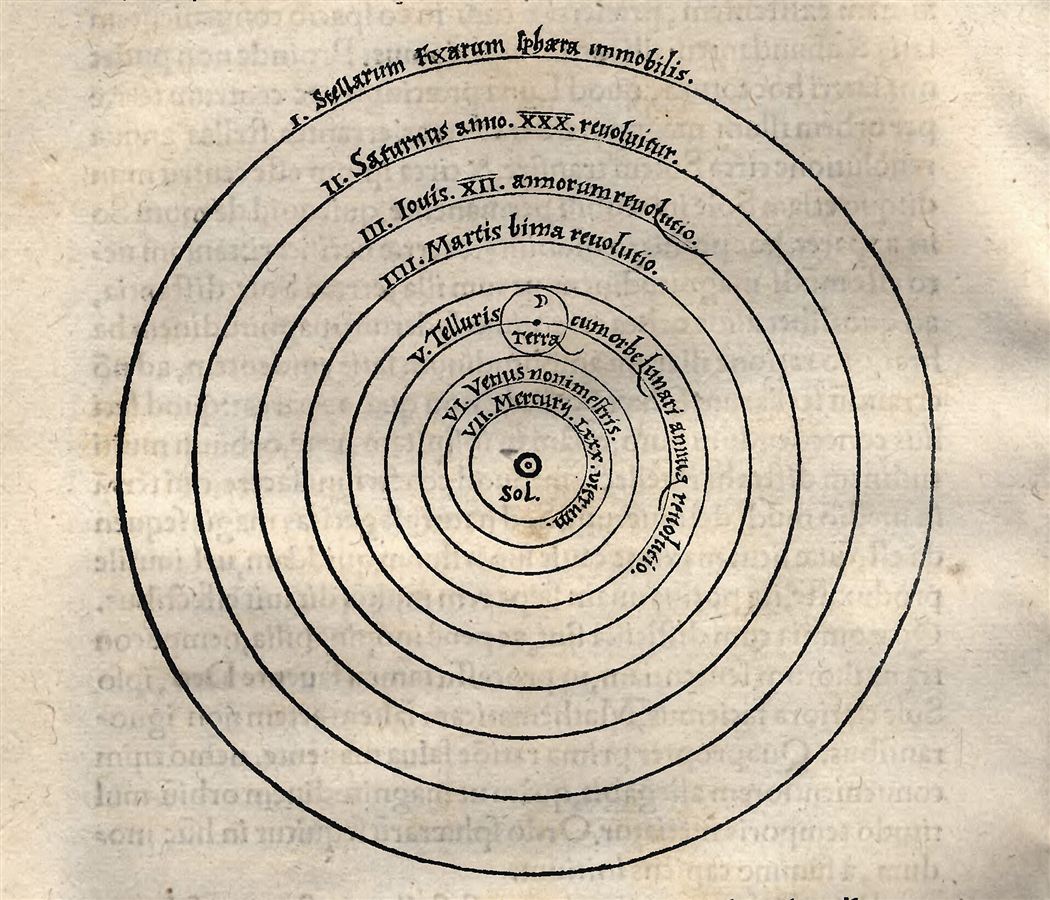
The Copernican heliocentric diagram, De revolutionibus, 1543
The research run that produced the essay on getting it right without a hidden world: the report in full, a plain summary of it, and Goodman’s riddle — three questions and their answers
Once a posit-free network matches a theory’s predictions, prediction can certify only the regularities both track. What remains is a deflated structural realism: realist about invariants that survive theory change, deflationary about any hidden ground, with rightness made of invariant capture and inferential fertility. It pays three costs: no correspondence-sense “really true”, an unsolved projectibility problem, and a hostage to how theory-like networks turn out to be.
This chat runs the research prompt written in the Opus 4.8 conversation. Claude sent a brief to its research tool and delivered the report reproduced in full below; Charith then asked for a plain list of its moves and for an explanation of Goodman’s riddle.
Charith’s questions are given as he wrote them, with grammar and spelling corrected. Claude’s answers are reproduced as given; the brief sent to the research tool is in a section you can open, and the report’s list of web sources is left out.
The report’s nine sections in order. The gold link is the demotion of prediction; the dashed link is the bill the position cannot pay.
One request, the brief Claude wrote for its research tool, and the report that came back.
The request, the brief, and the report that came back.
This is a beautifully constructed prompt — clear, sequenced, and demanding in exactly the right ways. No clarification needed. I’ll kick off deep research across the relevant literature right away.
Conduct deep multi-pass philosophical research to support the writing of an original synthetic philosophical essay titled “The Demotion of Prediction and the Deflation of the Noumenon — What Survives of ‘Getting It Right’”. This is NOT a literature survey — it is research to support constructing and defending an original argument through a specific dialectic. The deliverable must be a 4,000–6,000 word synthetic philosophical essay that takes a position and pays its costs.
The essay must address, in sequence:
1. Formalize the demotion of prediction, and test it against Hempel.
2. The “more” question.
3. The internal/external deflation, and Quine’s attack on it.
4. The split in “right” — the core original move.
5. Structural realism, stated correctly — three repairs:
6. The bill the deflation cannot dodge: projectibility.
7. The forced choice: OSR vs. Humean supervenience.
8. The arche-fossil, through the right door.
SYNTHESIS: Build toward and defend: structurally realist about invariants that survive theory change; deflationary about the noumenal ground; residual “rightness” = (i) capture of invariants + (ii) inferential and unifying fertility, certified by criteria other than bare prediction, neither requiring correspondence to hidden substance.
State costs:
FOILS required:
CONSTRAINTS:
The audience has strong philosophical literacy — comfortable with Kant, Sellars, analytic philosophy of science, structural realism, deflationary truth, Humean/anti-Humean laws debate, and Meillassoux’s correlationism. Do not reintroduce basics.
Please research the key literature, arguments, and positions needed to construct this essay: Craig’s theorem and Hempel’s theoretician’s dilemma, ML in science philosophy, Carnap’s ESO paper and Quine’s objections, deflationary vs. correspondence truth (Horwich, Wright), structural realism (Worrall, Ladyman, French, Votsis, Saatsi, Psillos), Humean and anti-Humean laws (Lewis, Maudlin, Armstrong), Goodman’s new riddle, van Fraassen’s constructive empiricism, and Meillassoux on correlationism and ancestral statements. Then produce the full 4,000–6,000 word essay.
Your philosophy of science report is ready. It argues that once predictive success is demoted as the sovereign criterion of theoretical success—a demotion made vivid by neural networks that match a theory’s predictions without representing any of its posits—the noumenal floor beneath scientific realism largely collapses, leaving a deflated structural realism in its place. The report works through Hempel and Craig’s theorem on theoretical terms, Carnap’s internal/external distinction after Quine, deflationary truth versus correspondence, the epistemic/ontic structural realism split, Goodman’s projectibility riddle, the forced choice between Humean supervenience and OSR, and Meillassoux’s arche-fossil. It engages Psillos, Boyd, van Fraassen, Horwich, Maudlin, Armstrong, and recent work by Pietsch, Sullivan, Boge, and Creel on machine learning, and is candid about three unpaid costs: the loss of “really true” in the correspondence sense, an unsolved projectibility problem, and an empirical hostage to how theory-like ML representations turn out to be.
A trained neural network can match the predictions of general relativity for a domain of test cases without representing a metric, a connection, or the Einstein field equations in any form a physicist could recognise. The conclusion this paper draws is not that theories are dispensable, nor that science is just induction at scale, nor that realism is an illusion. It is narrower and stranger. Prediction, treated as the sovereign criterion of theoretical success, cannot do the work scientific realists once asked of it; and once it is demoted, the noumenal floor under “getting it right” loses most of what gave it traction. What remains is a deflated, structurally realist position: realism about invariants that survive radical theory change, agnosticism to the point of dismissal about the categorical natures putatively behind them, and a residual notion of “rightness” with two components — capture of those invariants and inferential-unifying fertility — neither of which depends on correspondence to hidden substance. The bill this position cannot avoid is projectibility. The choice it cannot dodge is between ontic structural realism and Humean supervenience. The cost is that we stop saying our best theories are “really true” in the correspondence-realist’s sense, and we shoulder Goodman’s riddle without metaphysical relief.
The standard scientific-realist payoff from predictive success runs through inference to the best explanation: if a theory predicts novel phenomena, the best explanation of its predictive success is that its theoretical posits track something real. Demoting prediction means denying this conditional its desired strength. The cleanest case is constructed as a reductio. Take a mature theory T, with its full apparatus of theoretical terms and laws. Train a sufficiently expressive neural network N on T’s predictive outputs across the relevant domain. By construction, N approximates the same input-output regularities as T. By stipulation, N has no theoretical posits — only weights, biases, and an architecture. If predictive success certifies theoretical content, then N’s predictive success should certify its content. But N has no content of the relevant sort to certify. Therefore predictive success, by itself, does not certify posits. It certifies only the shared regularity-tracking substrate.
This is where the dialectic must engage Hempel rather than wave at him. Hempel’s “Theoretician’s Dilemma” (1958) anticipated and partly answered exactly this challenge through Craig’s theorem (1953). Craig showed that for any recursively axiomatised theory T partitioned into observational and theoretical vocabularies, the observational consequences are themselves recursively reaxiomatisable — call the resulting theory Craig(T). Craig(T) eliminates theoretical terms while preserving every deductive observational consequence. Hempel’s dilemma followed: if theoretical terms serve their purpose by establishing connections among observable phenomena, they are dispensable (by Craig); if they do not, they are obviously dispensable. Either way, dispensable.
Hempel’s escape was to deny the first horn for a specific kind of work. Craig’s theorem preserves deductive observational consequences but not inductive ones. Theoretical posits earn their keep, Hempel argued, by enabling inductive systematisation: from one observational regularity domain to another, via a theoretical intermediary that itself outruns either. A flat observational vocabulary cannot replicate this projection because it cannot preserve the inductive support relations the theoretical predicate licenses.
Now the question becomes whether the neural network is Hempel’s worst nightmare or his vindication. The candidate move — that the network’s weights are an inductive systematisation, just opaque and non-Craigian — turns out, I think, to be correct, but the reasoning matters. The network’s weights are not a recursive enumeration of observational conditionals. The whole point of training is that such an enumeration would be intractable and would forfeit projection to new inputs. Compression supports projection precisely because it carves the input space at joints that hold beyond the training distribution. Whatever those joints are, the network has them; without them, generalisation would fail.
So Hempel’s deeper claim survives: prediction-supporting projection across observational domains cannot be Craig-eliminated; whatever the system that licenses such projection is, it is more than a list of consequences. But Hempel’s gloss does not survive. He identified the locus of this projective work with recognisable theoretical posits — semantically interpreted predicates embedded in lawlike structure. The network shows that this identification was contingent. What the work requires is inductive structure sufficient for projection. Such structure can be realised by an interpreted theoretical vocabulary, by a Ramsey-sentence existentially quantifying over uninterpreted relations, or by trained weights that compress regularities without being articulated into discrete posits at all. Florian Boge’s distinction between how-opacity and what-opacity makes the second possibility precise: a network can possess inductive structure (it projects) without our knowing what features the structure encodes. Emily Sullivan’s notion of implementation irrelevance sharpens the same point — internal model details can be epistemically inert provided the external link to the phenomenon is well-evidenced. Sullivan’s “link uncertainty” then becomes the operative epistemic notion, not opacity per se.
The lesson is not that posits are dispensable. The lesson is that the theoretician’s dilemma is dissolved in a way that does not vindicate realism about posits. What earns its keep is inductive structure; referential commitment to recognisable theoretical entities is a separable question. Prediction is demoted not because it is unimportant but because it certifies less than was assumed: the shared regularity-tracking substrate, no more.
If prediction does not certify posits, what could? The candidates from the realist tradition are familiar. Explanatory unification in Michael Friedman’s and Philip Kitcher’s senses: a theory earns its content by reducing the number of independent phenomena we must accept. Cross-domain inferential transfer: a theoretical concept earns its keep when it licenses inferences in domains unrelated to its origin. Inferential-role fertility in something like Sellars’s and Brandom’s senses: a concept earns its keep by enabling moves in the space of reasons that no observational sentence can. The natural question is whether any of these survives the network challenge. Can a posit-free predictor unify, transfer, or license inferences in the space of reasons?
Honesty requires admitting that this is genuinely unsettled. The temptation is to deploy a clean dichotomy — networks live in the space of causes, theories in the space of reasons — and the temptation should be resisted. Networks can be probed; their internal representations can be aligned with human-recognisable features; saliency methods and mechanistic interpretability have already extracted intelligible structure from layers that initially looked alien. Kathleen Creel’s three-way taxonomy of transparency — functional, structural, run — clarifies that opacity is not a single bar but a graded condition with multiple remediations. The question whether networks will mostly remain shallow pattern-matchers or develop probeable, transferable, theory-like internal structure is an empirical question, and one I will treat as open below.
What can be said with some confidence is this. Unification, transfer, and inferential fertility are exactly the criteria that distinguish a recognisable theoretical achievement from a brute lookup table. AlphaFold is illuminating here. Insofar as its representations encode features that transfer to ligand binding, post-translational modification, and other domains not covered by the training task, it is doing something more than predicting folds. Insofar as the same network would have to be retrained from scratch to address each new domain, with no internal feature reusable across tasks, it is not. The contemporary literature on foundation models suggests the actual situation falls between these extremes. The empirical answer matters: it determines whether networks are doing the kind of work that traditionally certified theoretical content, or only the lesser work of predictive systematisation. Wolfgang Pietsch’s reading of machine learning as variational induction — a Millian Method of Difference made algorithmic — captures the lower bound: networks can identify difference-makers without that constituting unification or fertility.
The dialectical upshot for the essay: even after prediction is demoted, the realist has resources. Capture of invariants under domain transfer, inferential traction across nominally unrelated fields, unification of previously independent regularities — these criteria are not Hempel’s posits in disguise. They are criteria for structure. A theory that unifies and transfers has earned a claim on something more than its predictive substrate. That something more, I will argue, is not a noumenal substance behind the appearances; it is the invariant structure the theory captures. Whether networks can do this remains to be seen. The realist criteria themselves are intact, but they have been pulled away from referential commitment to entities and toward commitment to structural-inferential profile.
The essay’s official quarry is the question “does gravity exist over and above its effects?” Carnap’s 1950 paper “Empiricism, Semantics, and Ontology” gave it the canonical answer: internal questions about the existence of gravity (does the relevant theory predict measurable curvature here?) are settled by the framework’s rules and the empirical evidence. The external theoretical question — does gravity really exist, in a sense that outruns all such internal evidence? — is a pseudo-question. There is also a legitimate external practical question (whether to adopt the gravitational framework), but that is settled pragmatically, by fruitfulness and convenience.
The trouble is Quine. In “On Carnap’s Views on Ontology” (1951) and “Two Dogmas of Empiricism” (1951), Quine showed that the internal/external distinction presupposes an analytic/synthetic distinction Carnap could not sustain. If there are no purely framework-constitutive sentences, then “is there gravity?” cannot be insulated as a framework-internal question whose answer is settled by L-rules. The web of belief has center and periphery, but no joints between conventional and factual claims. A dialectic that accepts Quinean holism — as ours does — cannot then deploy Carnap’s distinction as if Quine had not happened.
This is a real obstacle, not a verbal one. But I think the Carnapian deflation can be reconstructed on grounds that are post-Quinean rather than pre-Quinean. Howard Stein, Michael Friedman, and Huw Price have each gestured at different routes. Friedman’s relativised a priori retains constitutive framework principles (the light postulate; the manifold structure of GR) as preconditions for empirical testing without claiming they are analytic in any strict sense; they are historically mutable but functionally constitutive. Price’s global expressivism dispenses with analyticity entirely, reconstructing pluralism about discourses functionally: different vocabularies (descriptive, modal, evaluative) serve different roles, and asking after the framework-transcendent reality of their objects asks a question the function of the vocabulary does not equip us to answer.
What survives Quine, on either route, is not Carnap’s particular formalism but the diagnostic. The external question “does gravity really exist over and above all its effects?” is malformed not because it violates an analytic/synthetic distinction but because the function of the gravitational vocabulary — to track curvature, to license inferences about geodesics and orbits — exhausts what its commitments are for. The metaphysical “over and above” demands a use the vocabulary has no function to support. This is closer to Wittgenstein than to logical positivism: certain questions have no work to do in the practice that gives the relevant terms their sense.
A constructive empiricist would reach roughly the same destination by a different route. Bas van Fraassen takes the explanatory virtues that motivate the external question — simplicity, scope, unification — to be pragmatic virtues irrelevant to truth. To accept a theory is to commit to its empirical adequacy and use it as a research program, not to believe its claims about unobservables. Van Fraassen’s “bad lot” objection to inference to the best explanation is congenial here: we select the best from the historically given hypotheses, not from the truth-containing set; absent a privilege premise, the conclusion is not warranted. I take a different line from van Fraassen — he stops at empirical adequacy where I assert invariants — but the dismissal of the metaphysician’s “over and above” is shared.
So Carnap survives Quine in deflated form: not as a formal theory of frameworks, but as a diagnostic resource for distinguishing legitimate uses of “exists” from metaphysical uses that the practice cannot support. The “over and above all its effects” reading of gravity’s existence is rejected on those grounds. What gravity is, on the position being defended, will turn out to be exhausted by its effects, the invariants its theory captures, and the inferential roles its concepts play. There is no remainder.
The realist intuition that science gets things right fuses two ideas that should be pried apart. Call them (a) invariant-tracking: theories capture regularities and structural relations that hold across changes of vocabulary and theoretical framework. And (b) noumenal correspondence: theories’ terms refer to mind-independent entities whose intrinsic natures the theories more or less accurately describe. When (a) and (b) are run together — as in Boyd’s and Psillos’s robust correspondence realism — the result is the familiar no-miracles argument: it would be a miracle if our theories were predictively successful, novelly predictive, and structurally preserved across change without their terms referring to natures that explain that success.
The position I am defending separates them and keeps only (a). Under (a) alone, what does “right” reduce to? The candidate analysis is: a theory is right insofar as (i) it captures invariants that are preserved across radical theory change, and (ii) it exhibits inferential and unifying fertility certified by criteria beyond bare prediction. Neither component requires correspondence to hidden substance.
The question is whether (a)-only rightness is stable. Two pressures threaten collapse: upward into full correspondence, or downward into bare instrumentalism. The way to stabilise the position is to settle on a theory of truth that fits it. Robust correspondence theories are too much: they import the noumenal substance the position rejects. Deflationary truth — Horwich’s minimalism — is the natural ally. On minimalism, the truth predicate is exhausted by the equivalence schema: “p is true” is just a logical device for generalising over claims one cannot list. There is no substantive nature of truth to which “p is true” answers; a fortiori no correspondence relation to noumenal entities.
The pointed challenge from Psillos and Boyd is that deflationary truth cannot sustain the no-miracles intuition. How does the deflationist explain why gravitation succeeded and phlogiston failed, if “true” carries no explanatory weight? The deflationist’s reply is that the first-order claims do all the work. Gravitation succeeded because gravitational fields exist and Newton’s, then Einstein’s, equations capture their behaviour. Phlogiston failed because there is no phlogiston. The disquotational predicate adds nothing to these explanations; subtracting it changes nothing. Horwich’s “Realism Minus Truth” makes the case directly: realism is a thesis about what exists, not about truth’s nature; the truth-talk is mere generalisation.
But this only addresses individual cases. The harder version of the realist’s question is generalisation: why do successful theories across the history of science exhibit structural continuity? The deflationist must answer: because successive theories pick up invariants their predecessors captured. The reply does work, but it requires that the deflationist combine minimal truth with a substantive commitment to invariants — exactly the structural-realist commitment of (a). Deflationary truth alone is not sufficient; it must be paired with realism about structure. The pairing is consistent because the realism is about what the world is like (it has these invariant relations), not about what truth is (a substantive correspondence relation between sentences and noumena).
Crispin Wright’s pluralism about truth offers a more elaborate route, with superassertibility doing the work in some discourses and a more robust local truth-predicate in others. I do not need Wright’s full apparatus. What I need is the structural point: realism about invariants is a first-order metaphysical commitment compatible with a minimal truth predicate. The “no-miracles” force is preserved because the explanation that science tracks structural invariants is itself a first-order claim, defended by inference to the best explanation of structural continuity across theory change — not by ascribing a substantive correspondence-property to theories.
The cost is now visible. We can still say a theory is true. We can no longer say it is really true in the correspondence-realist’s loaded sense. The deflationary “true” suffices for science but not for the philosopher who wanted truth to do explanatory work over and above the world’s being as the theory says. This is a discipline, not a defeat. It is the discipline the position pays.
The position so far is committed to invariants surviving theory change. This is structural realism. But structural realism comes in incompatible flavours, and the version being defended must be stated carefully.
Three repairs are required. First, the distinction between epistemic and ontic structural realism. The “structure-of-structure” regress objection — what makes a structure physical rather than merely mathematical, if structure is all there is? — bites hardest against ontic structural realism in its eliminative form, the Ladyman-Ross-French “relations without relata” view. If the world just is mathematical structure, there is no resource for distinguishing structures that obtain from structures that do not, and OSR threatens collapse into mathematical Platonism or trivialisation. ESR — Worrall’s original position — is a more limited claim: in mature physics, what we are epistemically entitled to is the relational/mathematical structure our theories capture; we remain agnostic about the intrinsic natures of the relata. This is a selective realism internal to mature physics, not a metaphysical thesis about the world’s basic furniture. The position I am defending is closer to ESR’s modesty than to OSR’s metaphysical ambition — though, as the next section will show, this modesty cannot remain indefinitely.
Second, the case selection must be honest. Fresnel-to-Maxwell is the friendly case: Fresnel’s amplitude equations for reflection and refraction at a dielectric interface reappear literally inside Maxwellian electromagnetism, with the variables reinterpreted (ether displacement becomes electric field amplitude) but the mathematical equations preserved. Newton-to-Einstein is the brutally hard case, and it is intellectually dishonest to treat it as preservation. Newtonian gravity has gravitational force, instantaneous action at a distance, Euclidean three-space and absolute time. General relativity has none of these. The pseudo-Riemannian manifold, the Levi-Civita connection, the Einstein field equations — these are not reformulations of Newtonian structure; they are replacements. There is no Newtonian “force” with a GR correlate; geodesic deviation is the closest analogue, but it is geometry, not force, and treating it as “force preservation” forces a category error.
What is preserved is not Newton’s structure but Newton’s predictions in a limit. Saatsi’s distinction is exactly the one needed: recovery of predictions in a weak-field, low-velocity limit is not preservation of theoretical structure. Votsis’s operative/idle distinction further refines the claim: only the structures playing an active role in the predictive and explanatory success of the predecessor need be preserved, and the gravitational-force structure was, in retrospect, idle — it was the inverse-square dependence and the local equation of motion that mattered, and those are recoverable as projections of GR’s geometry, not as preservations of Newton’s. The structural realist who claims Newton-to-Einstein as a structural-preservation case has miscounted; the structural realist who frames it as predictive-limit recovery of operative structural elements is closer to honest, but is also closer to selective realism than to structural realism qua general thesis. The position I defend takes the lesson: what is preserved is what plays the inferential and projective role in successful prediction; what is preserved across change is not entities, not laws-as-stated, but a thin layer of structural-mathematical relations whose identification is retrospective and theory-relative.
Third, Psillos’s objection — that structural preservation cannot underwrite reference, and therefore cannot underwrite realism — is genuine in the original Worrallian setting, where realism just was reference to mind-independent entities whose natures we agnostically gestured at. But in the deflated setting I have constructed, the objection loses its sting. The Newman objection — that any Ramsey-sentence formulation of structural realism is trivially satisfied on a domain of the right cardinality — depends on a substantive notion of reference and on treating Ramsey sentences as bearers of literal truth in a correspondence-loaded sense. Once truth is deflationary and reference is disquotational, the demand “show that the Ramsey sentence refers to the right relations” no longer has the metaphysical weight Psillos meant it to carry. The structuralist is not in the business of getting reference right to hidden relata; she is in the business of identifying invariants that survive theory change as the things her successful theories are about. “About” here is functional and disquotational, not robustly representational. If you have given up the project of reference to noumena, “you cannot get reference to noumena” is not an objection.
This is not a free escape. The price is exactly what is being paid throughout: the loss of any sense in which our theories “really” describe a mind-independent reality whose intrinsic features they capture. What they capture is structure. What we say about it is governed by a thin truth predicate. The position is consistent. Whether it is satisfying is the open question.
Here the position meets its hardest opponent. Suppose regularities are real and there is no hidden ground beneath them — no necessitation, no powers, no governing laws qua primitive entities. Then what makes the mosaic of past regularities a guide to the future? Why is one pattern projectible and another, equally well-supported by past evidence, not?
Goodman’s new riddle of induction is the operative problem. All emeralds observed before time t are green; they are also grue (green-if-examined-before-t, else blue). Past evidence supports both hypotheses equally on any purely formal criterion. Goodman’s own answer was that “green” is better entrenched than “grue” — projected more often in our practice. The worry has always been that this answer is sociological: it makes projectibility a matter of which predicates our linguistic community happened to embed in its inferential practices.
The Humean Best-System analyst — David Lewis — answers that laws are theorems of the simplest, strongest deductive systematisation of the total mosaic of local intrinsic matters of fact. Projectibility, on Lewis’s view, is parasitic on the system: regularities that figure as theorems of the best system are projectible. The reply is elegant but inherits Goodman’s worry, because the simplicity ordering presupposes a privileged language of natural predicates. In a language with “grue” as primitive, “all emeralds are grue” is the simpler hypothesis. Lewis invoked elite natural properties to anchor the language, but this is exactly the modal-metaphysical bedrock the Humean is supposed to do without.
The anti-Humean answers — Armstrong’s necessitation relations N(F,G), Maudlin’s primitivism about governing laws, dispositional essentialism, Lange’s counterfactual stability — each pay the projectibility bill with modal currency. Necessitation, primitive lawhood, essential powers, or subjunctive primitives are posited to underwrite why the mosaic of past regularities constrains future ones. The cost is the inference problem (how does a relation between universals entail anything about particulars?) and the bare positing of unanalysed modal primitives.
So what does the deflated structural-realist position say here? Three options present themselves: deflating the noumenon makes projectibility worse, better, or unchanged. The honest answer is that the position does not solve the projectibility problem and does not pretend to. Goodman’s worry was always a worry for anyone who took regularities to be the basic stuff. Deflating the noumenon does not introduce the problem — it was already there — but it does eliminate one route to dissolving it. The structural realist who reifies modal structure can say: the invariants just are modally robust; the projection is built in. The structural realist who deflates the noumenon cannot say that without inflating the structure itself into something doing more than tracking — without, that is, becoming an anti-Humean realist about modal structure.
This is where the temptation to rename rather than dissolve must be resisted. Calling the invariants “modally robust” without an account of what their modal robustness consists in repeats Armstrong’s larceny in structuralist dress. The honest stance is to acknowledge that projectibility is an open problem, that the deflated position has not solved it, and that one’s response to the problem will determine the next forced choice.
The “regularities are real, no hidden ground” formula cannot remain neutral between Humean supervenience and ontic structural realism. The two disagree fundamentally about whether relations and structure are themselves fundamental, or whether structure supervenes on a categorical mosaic of intrinsic local matters of fact. The structural realist who refuses to choose is equivocating.
Lewis’s Humean supervenience holds that the world is, at base, a mosaic of points each instantiating perfectly natural intrinsic properties, with spatiotemporal distances as the only fundamental external relations. Laws, chances, counterfactuals, modal facts — all supervene on the mosaic. This is the canonical “regularities are all there is” view, and it is in fact the more conservative inheritor of the deflationary spirit: there is no modal stuff over and above the actual distribution of categorical properties.
Ontic structural realism asserts the opposite. Relations and structure are fundamental; there are no intrinsic categorical natures over and above the structural-relational facts. The radical version eliminates intrinsic-natured objects altogether (“relations without relata”); the moderate version keeps objects but takes their natures to be exhausted by structural-relational features.
The position I have been defending — deflationary about noumenal categorical natures, realist about invariants — cannot be HS, because HS posits exactly the categorical mosaic the deflation rejects. Lewis’s “perfectly natural intrinsic properties at points” are noumenal: they are not the structural invariants captured by physics; they are the categorical bedrock on which those invariants supervene. To take HS seriously is to commit to a substrate behind the invariants that does not appear in any physical theory and could not. This is precisely the metaphysical “over and above” the position rejects.
So the position must lean toward OSR — but in a deflated key. Not Ladyman and Ross’s verificationism-cum-radical-ontology, with its eliminative “no objects at all” pronouncements. Something more modest: structures and relations are what physics is realist about; intrinsic categorical natures are not posited because there is no work for them to do, no role in the inferential and projective practice of mature science, and no semantic vocabulary that needs them. This is closer to Worrall’s epistemic structuralism reframed as a thin ontic claim: the world has the structural invariants captured by mature physics, and there is nothing further to say. The categorical mosaic disappears not because it has been refuted but because the practice gives it no role.
A defensible third option exists — dispositional essentialism, with properties having modal essences from which laws flow. This avoids HS’s categoricalism and OSR’s elimination of intrinsic natures by making natures themselves modal. I find this less attractive in the present setting because it imports as much metaphysics as it removes: powers are now the noumenal floor, and the deflation is undone. The choice I therefore take is structural realism in a deflated ontic key. The cost is the inference problem in a new dress: the structural invariants must be modally robust enough to underwrite projection, and the position owes an account of what that modal robustness consists in. The account I would offer is parasitic on physics: it is part of what we mean by saying the invariants are captured by mature theory that they are projectible across the domain in which the theory holds. This is admittedly thin. The Humean would call it Armstrong’s larceny again. I concede the worry. What I will not do is call the problem solved.
The final question is what the deflated position can say to correlationism. Meillassoux’s argument from ancestrality is that scientific statements about events anterior to any thinking being — the accretion of the earth at 4.56 Gyr, the cosmic background radiation at 13.5 Gyr — cannot be reconstrued as “for-us” statements without absurdity. The arche-fossil is not an unwitnessed corner of the present world; it is a content that was true before any correlation existed. The correlationist who retrojects the past from the present concedes existence to the ancestral event but ties its sense to the present scientific community, generating the absurdity that what came-before-givenness has its meaning constituted in the present.
There is a tempting and wrong move available to the structural realist here: to treat inter-theoretic convergence as the anti-correlationist resource. Several theoretical schemes (Newtonian gravity, GR, ΛCDM cosmology, geochronology, stellar nucleosynthesis) converge on the date 4.56 Gyr; surely that convergence is what defeats the correlationist? It is not. Convergence is the resolution of underdetermination — it tells us that multiple inferential routes pick out the same value — but it does not get behind the schemes. The correlationist’s complaint is precisely that even agreed-upon representations remain representations for-us. Two schemes that agree are still two schemes. Convergence is a synchronic epistemic virtue; correlationism is about diachronic constitution.
The genuine anti-correlationist resource in Meillassoux is temporal, not epistemic. The ancestral statement asserts a content true before any correlation existed; the asymmetry is between the time of the event and the time of thought. Brassier puts this with clarity: the time of science is anathema to any position for which objective reality is constituted through some originary condition of manifestation, because the natural sciences place the origin of thought inside a world whose deeper history does not require it.
Does the deflated regularity position have something to say to correlationism on these terms? It does, but the answer is more modest than Meillassoux’s. The position can assert that the regularities obtained before us. The mosaic of categorical occurrences includes patches anterior to the emergence of any thinker; the structural invariants captured by physics held in those patches; the date 4.56 Gyr refers to such a patch. This is not a derivation from a speculative absolute. It is a first-order claim, defended by the same considerations that justify any claim of physics: the theory works, its invariants project, its predictions match the rock and the radiation, and there is no Cartesian theatre in which we are watching the inference happen.
This is not the same move as Meillassoux’s mathematised primary qualities. Meillassoux retains a Cartesian primary/secondary distinction and stakes everything on intellectual intuition of factiality — the absoluteness of contingency. The position I am defending dispenses with primary qualities as a category (the structural invariants are not “qualities of objects” in the Cartesian sense), and offers no rationalist deduction. What it offers is the diagnosis that the correlationist circle gives a misleading picture of the practice: science is the discourse in which we situate thought as a late and local episode in a world whose structure does not require it. To accept that picture is not to refute correlationism by transcendental argument; it is to refuse correlationism’s framing of what science is doing.
The cost is that Meillassoux’s lurid theses — the contingency of laws as a metaphysical absolute, hyper-chaos, the virtual God — fall away. They were never part of what I needed. What I needed was the ancestral statement, taken literally; and the deflated structural realist takes it literally, by being realist about invariants whose date is ancestral and refusing the metaphysical inflation that would make either the invariants or the ancestral content something more than the practice supports.
The position is now visible. Be a structural realist about the invariants that survive radical theory change — not in the eliminative Ladyman-Ross mode, but in a deflated mode that takes mature physics’ relational and mathematical content as the operative ontology, and assigns no role to noumenal categorical natures putatively behind it. Be deflationary about truth, so that “true” generalises but does not name a substantive correspondence relation; combine this with realism about invariants as a first-order metaphysical claim, not as an upgrade of truth’s nature. Treat “rightness” as having two components — capture of invariants and inferential-unifying fertility — neither of which requires correspondence to hidden substance. The criteria are stricter than bare prediction; they are exactly the criteria that distinguish theories from networks insofar as networks are merely predictive, and exactly the criteria that will qualify networks as theory-like to the extent that networks develop probeable, transferable structure.
Three costs are real and cannot be paid down. The first is discipline: we stop saying our best theories are really true in the correspondence sense. The position requires accepting that “really” is a word the practice does not give us. The second is projectibility: Goodman’s riddle remains, and the position has not solved it. The deflation rules out one set of responses (it cannot reify modal structure into a noumenal underlayer) and the practice gives only thin resources for the rest. This is the bill the position cannot dodge. The third is empirical: whether machine learning in science stays shallow — pure regularity-tracking, opaque, non-transferable — or develops probeable internal structure that earns the structural realist’s criteria is not a question philosophy can settle from the armchair. The verdict on AlphaFold and its successors will be empirical, and it will partly determine whether the demotion of prediction is the demotion of a sovereign criterion or the demotion of an obsolete one.
The foils were Psillos and Boyd on correspondence, van Fraassen on constructive empiricism, Horwich on deflation, Maudlin and Armstrong on anti-Humean laws, and Pietsch, Sullivan, Boge, Creel on machine learning. Each has been engaged at the point where the position meets resistance. I have not pretended the resistance is illusory. The position pays: in discipline, in an unsolved problem, and in an empirical hostage. What it gains is a coherent way of saying what science is doing without saying more than the practice supports — a structural realism that has stopped pretending it has access to a noumenal floor it never had, and has not therefore stopped meaning anything by “right.”
The report reduced to its eight moves and three costs, and the riddle at the centre of its unpaid bill.
A plain summary of the report’s moves.
The essay defends a deflated structural realism — being realist about the invariants theories capture across radical theory change, deflationary about any noumenal ground beneath those invariants, and treating a theory’s “rightness” as having two components: capture of those invariants and inferential-unifying fertility, neither requiring correspondence to hidden substance.
The eight key moves are:
Prediction demoted. A posit-free neural network can match a theory’s predictions without representing any of its posits. Therefore predictive success certifies only the shared regularity-tracking substrate, not the posits themselves. Hempel’s point survives — inductive systematisation cannot be Craig-eliminated — but stops being a point about posits specifically; it becomes a point about compressive-projective structure, achievable by theory or by trained weights.
What else could certify? Explanatory unification, cross-domain transfer, and inferential fertility are the remaining realist criteria. Whether neural networks can meet them is genuinely open, not settled. The dichotomy “networks in the space of causes, theories in the space of reasons” is interrogated rather than assumed.
Carnap survives Quine, deflated. The internal/external distinction cannot be sustained in its original analytic/synthetic form after Quine. It survives as a diagnostic: “does gravity exist over and above all its effects?” is malformed not because of framework rules but because no function in scientific practice supports that use of “over and above.”
“Right” split in two. The success-intuition fuses invariant-tracking (a) with noumenal correspondence (b). The essay retains (a) and deflates (b). A Horwichian minimal truth predicate handles generalisation; realism about invariants is a first-order metaphysical claim, not a substantive property of truth. Deflationary truth plus invariant realism is enough to distinguish phlogiston from gravity and sustain the no-miracles intuition at the first-order level.
Structural realism stated correctly. Three repairs: the structure-of-structure regress bites OSR, not ESR. Newton→Einstein is not structural preservation but predictive-limit recovery of operative elements. Psillos’s reference objection is defanged: if you have given up reference to noumena, “you cannot get reference to noumena” is not an objection.
Projectibility unpaid. The deflation does not solve Goodman’s riddle and does not pretend to. Deflating the noumenon removes one possible solution route (reifying modal structure into a ground) without introducing the problem. This is an acknowledged open cost.
OSR over Humean supervenience. Lewis’s categorical mosaic is itself a noumenal floor the position rejects. The essay comes down on the side of deflated ontic structural realism: structure and relations are what physics is realist about; intrinsic categorical natures get no role.
Meillassoux via ancestrality, not convergence. Inter-theoretic convergence is underdetermination, not an anti-correlationist argument. The genuine resource is temporal: the regularities obtained before us, and the ancestral statement is taken literally as a first-order claim of the practice, without rationalist inflation.
Three unpaid costs itemised: the discipline of dropping “really true” in the correspondence sense; an unsolved projectibility problem; and an empirical hostage to whether ML representations turn out shallow or theory-like.
The new riddle of induction, and why it matters here.
Goodman’s riddleQuoted from the report“What is it?”
Goodman introduced the riddle in Fact, Fiction, and Forecast (1955) as the “new riddle of induction.” Here it is:
Define the predicate “grue”: an object is grue if it is examined before time t and is green, or is not examined before t and is blue.
Now consider all the emeralds observed so far — they are all green. But they are also all grue, because they have all been examined before t and are green. Both hypotheses are equally supported by the same evidence:
Yet they make contradictory predictions about emeralds examined after t — green says they’ll be green, grue says they’ll be blue.
The riddle is: what makes “green” a projectible predicate and “grue” not? Pure logical or probabilistic criteria cannot distinguish them, since the evidence confirms both equally.
Goodman’s own answer was entrenchment — “green” has been used and projected far more often in our inferential practice, so it is better entrenched. But critics note this makes projectibility a sociological or historical fact about us, not a fact about the world.
Why it matters for the essay: the deflated structural-realist position asserts that regularities are real and there is no noumenal ground beneath them. Goodman’s riddle then bites hard — if there is no modal bedrock (no powers, no necessitation relations, no governing laws as primitives), what makes any regularity projectible rather than just grue-like? The position inherits this problem and the essay honestly acknowledges it cannot pay that bill.
The questions are Charith’s, corrected for grammar and spelling only. The brief, the report and the answers are Claude’s, as given in the conversation.