
 Active Inference
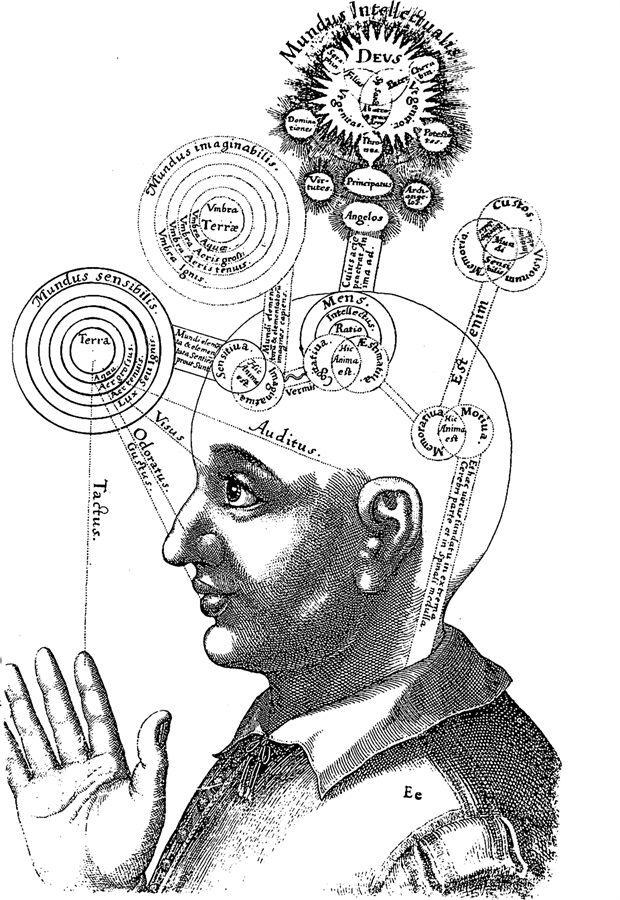
Robert Fludd, the threefold vision of the soul, from Utriusque cosmi historia, 1619
Active Inference
Robert Fludd, the threefold vision of the soul, from Utriusque cosmi historia, 1619
Active Inference and the Critical Apprehensions, the problem of other minds, the C1/C2 encounter that makes a self, no language before encounter, two critiques answered, the reverse Turing test, and Anil Seth’s substrate argument — twenty questions and their answers
COGITO stops being an architecture that proves its own selfhood and becomes a test case for functionalism: a self that begins without language, is forced into existence by meeting another of its kind, and is checked by a reverse Turing test in which the machine is the judge.
The conversation opens with Karl Friston’s work read against the Critical Apprehensions critique: the Hum becomes free-energy minimisation, pain becomes precision-weighted, and ten open problems remain. Charith then answers the two deepest objections. The hard problem is the problem of other minds, which no one solves for their friends either, and symbol grounding is internal for a brain in a vat too. He also moves the origin of the self from self-inspection to an encounter. Using his C1/C2 framework and Constrained Conceptual Topology, a COGITO that meets another COGITO accumulates structured prediction errors it cannot explain, exhausts its C2 recombinations (proved by Z3 UNSAT), and must expand its C1 primitives with the only template available, itself. Before that encounter there is no language at all.
The architecture is then written up in four documents, and two external critiques are checked against it. The reverse Turing test answers the homunculus and falsifiability objections, and the critic concedes the project is coherent as “a mirror for theories of mind”. The chat ends on the substrate: Anil Seth’s wetness and anaesthesia arguments, the Engineering Consciousness report that places software COGITO in Tier 3, and an unanswered question about reaching Tier 2 neuromorphic hardware.
This is the first page in the series. The two earlier chats in the project were research runs, a survey of Friston’s publications and a report on consciousness-compatible substrates, and have no page of their own. Their reports are linked where this conversation uses them. Research reports read in the chat are not reproduced here; each is replaced by a link to the file. Files Claude wrote in the conversation, and the reports it read, are hosted beside this page in the reports/ folder.
Charith’s questions are given as he wrote them, with grammar and spelling corrected and nothing else changed; attached documents are described in square brackets. Claude’s answers are reproduced as given in the conversation; tool calls and file contents are omitted and noted where they occurred. The model label (Claude Opus 4.5) is inferred from the date of the chat; the chat record does not store which model answered.
The key exchanges in order, each with where it landed. Gold links are where the architecture took shape; the dashed link is the question the chat left unanswered.
Documents read or written in the conversation. They are hosted in the reports/ folder beside this page, except where marked; two research reports come from the earlier research chats in the project.
The questions are Charith’s, corrected for grammar and spelling only. The answers are Claude’s, as given in the conversation; tool calls, file contents and research reports are omitted and noted where they occurred. The model label (Claude Opus 4.5) is inferred from the date of the conversation.
Source: claude.ai project “COGITO”, conversation of 31 January – 1 February 2026, “Karl Friston’s active inference framework for COGITO”. Research chats skipped: “Google Scholar profile” (the Friston publication survey) and “Engineering consciousness-compatible substrates”.